2.284 Ergebnisse
1898Best.-Nr. 44238London Taylor and Francis 1898 No wrappers. In "Proceedings of the Royal Society of London." Vol.63 Nos. 399-400 both issues offered. Pp. 373-480 a. 5 plates. Ransay & Travers' paper: pp. 405-408. First appearance of the paper in which Ramsay and Travers announced their discovery of a new element which they named "krypton" meaning hidden."Dr. William Hampson presented them Ransay & Travers with about a liter of liquid air which they used not for liquefying the argon but for obstaining sufficient skill in manipulation so that they would not risk loosing their precious fifteen liter of argon.The residue left after most of the liquid air had boliled away consisted largly of oxygen and nitrogen which Ramsay and Travers temoved with red-hot copper and magnesium. .they then examined the twenty-five cibic centimeters of residual gas and when they found it to be inerst they immediately placedit in a Pl'ucker tube connected to and induction coil and observed its spectrum. There was a bright yelælow line with a greener tint than that of the helium line and a brilliant green line that did nor coincide with any line of argon helium mercury or hydrogen. They discoverede this gas on 30 May 1898 and named it 'krypton'.they found that it belonged between bromine and rubidium in the periodic table and so great was their excitement that the younger chemist almost forgot about his examination for doctor of sciwence which had been schedules for the next day."Weeks p. 267.Parkinson "Breakthroughs" 1898 C. unknown
1882Best.-Nr. 47024Paris Gauthier-Villars 1882. 4to. No wrappers. In: "Comptes Rendus Hebdomadaires des Séances de L'Academie des Sciences" Tome 95 No 22 a. Tome 104 No 21 entire issues offered. Pp. 1017-1076 and pp. 1387-1462. Raoult's papers: pp. 1030-33 tome 95 and pp. 1430-1433 tome 104. First appearance of Raoult's two importent papers in which described a method for finding the molecular weight of an organic compound by the determination of the lowering of the freezing point of water that resulted from dissolving that compound in water and the law governing the relation between solutes and vapor pressure."Then in 1882 F.-M. Raoult published his results on the effects of nondissociating organic solutes from which he deduced a general law controlling the lowering of freezing points the first paper offered. Four years later he extended this work to show the effect of solutes on vapor pressure the second paper offered. Having established the effect of nondissociating compounds he was in position to show that salts produced an eeffect which though anomalous could nevertheless be explained by the supposition that a dissolved molecule broke up into other molecules. This work was of great value in supplying a new method for determining molecular weights since the depression of freezing point and vapor pressure as well a the related rise in boiling point later discovered are proportional to the moleculat concentrations ofthe solutions; it was of equal value in supporting the ideas of van't Hoff on osmotic pressure. With the announcement of the dissociation theory of Arrhenius the anomalies were explained and the full significance of the generalizations of Raoult was recognized. Raoult published the formulations of his laws in the "Comptes Rendus" for 1882 and 1887 the papers offered" Leicester a. Klickstein "A Source Book in Chemistry" pp. 471 ff. unknown
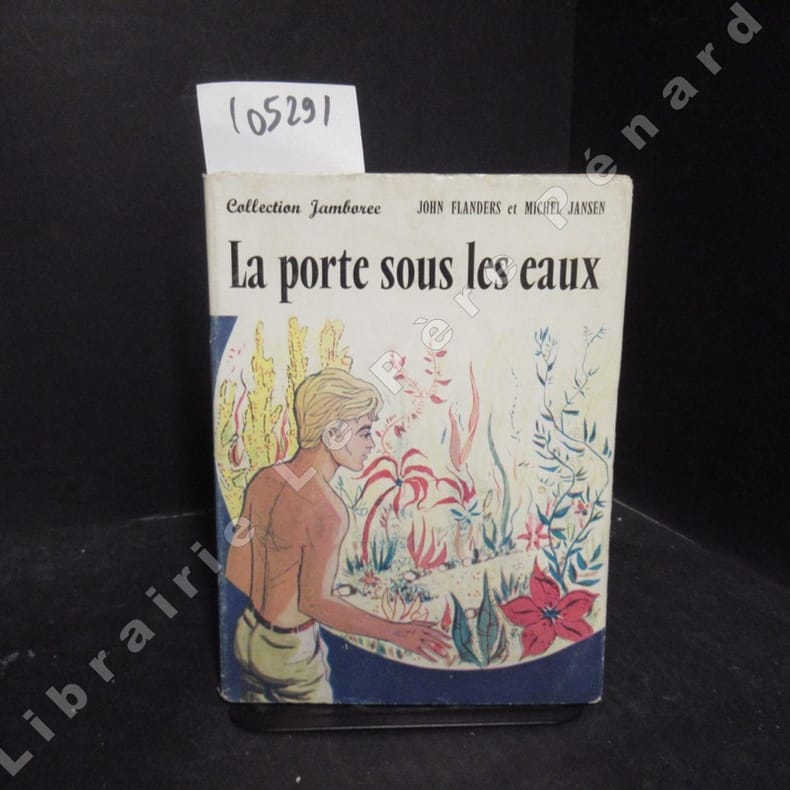
1960Best.-Nr. 1052911960 Ed. SPES - Coll. Jamboree - 1960 - In-12 broché, sous jaquette papier illustrée en couleurs - 188 p. - Illustrations en N&B de M. Raffray - Non coupé (sauf les premières pages)
1895Best.-Nr. 42221London Harrison and Sons 1895. 4to. No wrappers as extracted from "Philosophical Transactions" Vol. 186 - I Series A. Pp. 187-241 a. 8 textillustrations apparatus. Fine and clean. First printing of this importent paper in the history of chemistry Lord Rayleigh's most famous discovery announcing the discovery of this new gas the first finding of one of the rare gases inert gases having unusual properties and forming a distinct group in the periodic table and all with zero valency."The original paper in the "Philosophical Transactions" will undoubtly rank as a classic the investigation having been a particularly brilliant ine." Ernst von Meyer in History of Chemistry. For this discovery Lord Rayleigh and W. Ramsay received the Nobel Prize 1904.After having made several measuring of the densities of gases "Rayleigh came across a curious puzzle. With oxygen he always obtained the same density regardless of how the oxygen might be produced whether from one particular compound from a second compound or from the air. The situation was different with nitrogen. The nitrogen he obtained from air constantly showed a slightly higher density than the nitrogen he obtained from any of various compounds. Rayleigh could think of several ways in which the nitrogen obtained from air might be contaminated but none of the possibilities checked out experimentally. He was so frustrated that he went so far as to write to the journal "Nature" asking for suggestions. Ramsay a brilliant Scottish chemist asked permission to tackle the problem and received it. The upshot was that a new gas somewhat denser that nitrogen was discovered to exist in the atmosphere. It was named argon and it was the first of a series of rare gases of unusual properties whose existence had never been suspected."Asimow.Dibner Heralds of Science No. 50 - Neville Historical Chemical Library vol. II p.358. unknown
1895Best.-Nr. 49207London Harrison and Sons 1895. 4to. Orig. full cloth. Gilt lettering to spine. Blindtooled covers. First corner a bit bumped. In "Philosophical Transactions" Vol. 186 - I Series A. XIV26024 pp. Entire volume offered. The paper: p. 187-241 a. 8 textillustrations apparatus. The title-page with faint brownspots. Otherwise internally clean and fine. First printing of this importent paper in the history of chemistry Lord Rayleigh's most famous discovery announcing the discovery of this new gas the first finding of one of the rare gases inert gases having unusual properties and forming a distinct group in the periodic table and all with zero valency."The original paper in the "Philosophical Transactions" will undoubtly rank as a classic the investigation having been a particularly brilliant ine." Ernst von Meyer in History of Chemistry. For this discovery Lord Rayleigh and W. Ramsay received the Nobel Prize 1904. The volume also contains WILLIAM CROOKES "On the Spectra of Argon" OSBORNE REYNOLD "On the Dynamical Theory of Incompressible Viscous Fluids and the determination of the Criterion" KARL PEARSON "Contributions to the Mathematical Theory of Evolution. - II. Skew Variations in Homogenous Materials" etc.After having made several measuring of the densities of gases "Rayleigh came across a curious puzzle. With oxygen he always obtained the same density regardless of how the oxygen might be produced whether from one particular compound from a second compound or from the air. The situation was different with nitrogen. The nitrogen he obtained from air constantly showed a slightly higher density than the nitrogen he obtained from any of various compounds. Rayleigh could think of several ways in which the nitrogen obtained from air might be contaminated but none of the possibilities checked out experimentally. He was so frustrated that he went so far as to write to the journal "Nature" asking for suggestions. Ramsay a brilliant Scottish chemist asked permission to tackle the problem and received it. The upshot was that a new gas somewhat denser that nitrogen was discovered to exist in the atmosphere. It was named argon and it was the first of a series of rare gases of unusual properties whose existence had never been suspected."Asimow.Dibner Heralds of Science No. 50 - Neville Historical Chemical Library vol. II p.358. hardcover
Best.-Nr. 102369 tomes sur 10 en 9 volumes in 8 pleine cuir fauve raciné, pièce de titre cuir rouge, pièce de tomaison cuir vert, roulette, filets, fers dorés, triple filet doré encadrant les plats, roulette dorée sur coupes, tranches marbrées. Tome1 : faux-titre, portrait de l’auteur, en médaillon d’après COCHIN gravé par LARDY. Titre, XVI-532 pages. (Petite mouillure angle supérieur droit en début de volume) Tome 2 : faux-titre- 1 gravure en frontispice, titre, VIII, 582 pages. Tome 3 : faux-titre, 1 gravure en frontispice, titre, VIII, 580 pages(une pâle mouillure angle supérieur droit, en début de volume, une mouillure triangulaire en partie supérieure, aux dernières pages de table des matières. Tome 4 : faux titre, une gravure en frontispice, titre, VIII, 472 pages. Tome 5 faux-titre, une gravure en frontispice, titre, VII, 405 pages. Tome 6 : faux-titre, gravure en frontispice, titre, VII, 484 pages, pâle moulure en marge extérieure, plus apparente en fin de fin de volume. Tome7 : faux-titre, gravure en frontispice, titre, XVI, 558 pages. Tome 8 : faux-titre, gravure en frontispice, titre, II-538 pages. Pas de tome 9. Tome 10 : faux-titre, gravure en frontispice, titre, II, 538 pages. A Genève chez jean Léonard PELLET 1780. Les gravures en frontispice sont de MOREAU LE JEUNE. Troisième édition, la meilleure et la plus complète, le nombre de volume passe de 7 volumes auparavant, à 10 volumes. Belle édition sur beau papier.
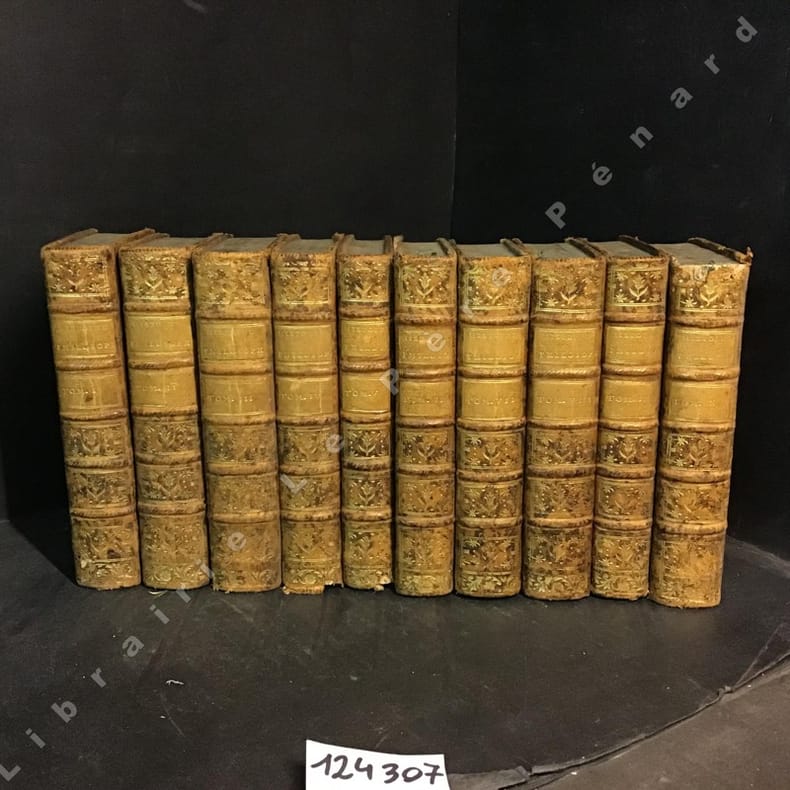
1780Best.-Nr. 1243071780 A Genève, Chez Jean-Léonard Pellet, Imprimeur de la Ville & de l'Académie - M. DCC. LXXX. (1780) - Dix volumes In-12, reliures pleine peau marbrée d'époque, dos à 5 nerfs avec pièce de titre et de tomaison sur fond marron clair, caissons ornés de fleurons en doré, toutes tranches marbrées, signet vert - xij-571 + 624 + 608 + 500 + 425 + 511 + 589 + 599 + 431 + 564 pages - Sans le volume d'Atlas
Best.-Nr. DADAX0415084008New unknown
Best.-Nr. 7984La Terre et les Hommes Tome 2:LA FRANCE in 4 demi-chagrin marron à nerfs,titre et fers dorés. Faux-titre,titre,carte dépliante(une petite déchirure)959 pages,1 page de table des matières,10 cartes en couleurs la plupart sur double page.69 vues et types gravés sur bois ,hors-texte,234 cartes dans le texte. Hachette & Cie 1877.rousseurs éparses habituelles, plus fortes en début et fin de volume.
1995Signed and inscribed by both authors upon title page. vi, 176 pages. Black and white illustrations. "A literary conjuring of the spirit of place; a collection of writings as rich and varried as the islands which has provided their inspiration. From Hardwicke in the north to Savary in the south, the islands jam the passage of the Northern Georgia Strait, creating a dynamic environment of turbulent waters and beckoning shores. In this anthology, brimming with humour, drama and tragedy, over 30 writers and artists bring us memoirs and tales of the Disccovery Islands." - back cover. Unmarked with moderate wear. A sound copy. Book
Best.-Nr. 8025reliure cartonnée de l’éditeur. Dessins d’après nature et documents originaux.Petit in 4 à l’italienne, demi-toile rouge,plats papier chagriné rouge.Avec titre argenté sur le premier plat.Faux-titre,titre avec vignette,64 pages 245 illustrations.Paul Paclot & Cie éditeur sans date,pages de garde renouvelées.Le pays et ses habitants -l'armée - religion-us et coutumes -la musique et la danse - le théâtre et les lutteurs, enseignement public - l'art et les artistes
2007Best.-Nr. AME_9781588296726Humana Press 2007. 1st. Hardcover. New/New. _ Humana Press hardcover
Best.-Nr. DADAX1420072617New unknown
Best.-Nr. DADAX0367384051New unknown
Best.-Nr. DADAX156163994XNew unknown
Best.-Nr. 30581Turnhout, Brepols, 2009 Broche, 127pp + facsimile en coul. hors texte, 16x25cm., *neuf. Texte francais et latin. ISBN 9782503528410.
1934Pages 309 - 403. Features: The Wabash and Erie Canal at Lafayette; High Points in the Life of Dr. John Shaw Billings; Post Roads in Southern Indiana;; Did Republicans "Colonize" Indiana in 1879?; A Survivor of "The Charge of the Light Brigade"; Henry Clay at Richmond in 1842; The Discovery and Identification of an Original Copy of the Constitution of 1816; Some Letters of Jesse D. Bright to William H. English; and more. Two closed openings to top of front cover. Prior owner's ink stamp atop first page otherwise clean and unmarked with moderate wear. Binding intact. A sound vintage copy. Book
Best.-Nr. SONG0960147012Used: Good unknown
1888Best.-Nr. CCC-223amb.edition Librairie D'Education A. Hatier 1888, avec carte en couleur,tres bon etat, photo possible
1999Best.-Nr. 538921999 Les Editions Naturellement - 1999 - 287 pages - 1 volume de 11x18 cm environ - broché
1999Best.-Nr. 538911999 Les Editions Naturellement - 1999 - 317 pages - 1 volume de 11x18 cm environ - broché -
Best.-Nr. 18132In-4 - N° 3 de 1994
1981Best.-Nr. 207582Couverture souple. Broché. 352 pages. Couverture légèrement abîmée.
1973Best.-Nr. 145216Couverture souple. Broché. 100 pages. Graffiti sur la couverture.