2 151 résultats
1992219 pages including bibliography and black and white illustrations. "Rich in information about our past, from European discovery to settlement, the creation of the townsite, incorporation, and the development of the modern town, while preserving its village character." - Jack Collins, Mayor, Qualicum Beach. Clean and unmarked. Very light wear. Excellent copy. Book
réf. 42355Tournai (Belgique)/Paris, Castertman, 1954. "15 x 21, 303 pp., quelques illustrations, 1 carte, broché + jaquette, état moyen (jaquette déchirée; cachets du Collège jésuite Saint Stanislas à Mons)."
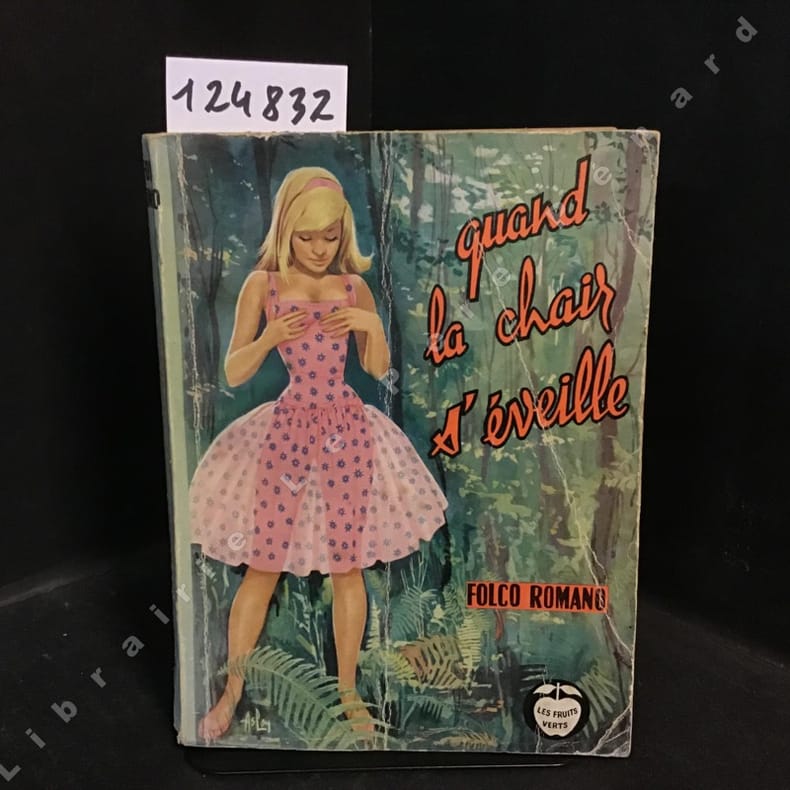
1958réf. 1248321958 Editions Les Presses de la Nuit / Le Styx - Collection "Les Fruits Verts" - 1958 - In-12 broché, couverture signée Aslan - 187 pages
1944réf. 1194311944 A Lyon, Audin et Cie - 1944 - In-12, broché - 331 p. - Quelques illustrations hors texte
1984réf. 47169London Royal Society 1984. Royal8vo. Full buckram gilt lettering to spine.In: "Proceedings of the Royal Society of London" Series A vol. 392. IV478 pp. Entire volume offered. Berry's paper: pp. 45-57. Clean and fine. First printing of the paper in which Berry describes his discovery of the "Berry phase" a unifying concept in quantum mechanics."In 1983 Berry made the surprising discovery that a quantum system adiabatically transported round a closed circuit in the space of external parameters acquires besides the familiar dynamical phase a non-integrable phase depending only on the geometry of the circuit. This Berry phase which had been overlooked for more than half a century provides us a very deep insight on the geometric structure of quantum mechanics and gives rise to various observable effects. The concept of the Berry phase has now become a central unifying concept in quantum mechanics with applications in fields ranging from chemistry to condensed matter physics. In particular the Berry phase plays an important role in modern magnetism an allows to reach a deeper understanding of a broad range of phenomena such as the spin-orbit coupling the Aharonov-Bohm effect the quantum Hall effect the anomalous Hall effect the magnon dynamics the tunneling of magnetization in molecular magnets etc. Further in the light of the Berry phase a number of new phenomena can be predicted in ferromagnets with a textured magnetization or in semiconductors with spin-orbit coupling." Patrick Bruno. hardcover
1984réf. 47169London, Royal Society, 1984. Royal8vo. Full buckram, gilt lettering to spine.In: ""Proceedings of the Royal Society of London"", Series A, vol. 392. IV,478 pp. (Entire volume offered). Berry's paper: pp. 45-57. Clean and fine.
réf. 6226Paris, La Table Ronde, 1964 14 x 20, 374 pp., cartes N/B, broché, bon état
réf. 13554aafSpezed (Bretagne), Keltia graphic, 1990, in-8°, 450 p. + 48 p. (Index), envoi manuscr. de l’auteur sur faux-titre, brochure originale illustrée.
1966réf. 13209Presses Universitaires de France 1966 125 pages in12. 1966. broché. 125 pages. Cet ouvrage de la collection 'Que sais-je ?' présente une synthèse des connaissances sur les groupes sanguins. Il retrace leur découverte explique leur nature biochimique et sérologique et aborde leur mécanisme d'hérédité ainsi que les techniques usuelles d'immuno-hématologie
1972347 pages. Originally published in 1872. "One of the most readable and colourful early accounts of life on the Northwest Coast." - from dust jacket. Average wear. Unmarked. Dust jacket now preserved in Brodart cover. Binding tight. A sound copy. Book
1967réf. 21341967 Paris Université de Paris Palais de la découverte 1966 Un volume in°12 broché 22 pages LR30
1929réf. CCC000f1Mb. Edition Ancienne librairie Roger RIOU-QUERNE, 1929. Couverture souple. État : Assez bon. Broché, in-8 (18.5 X 12.5 cm), 354 pages. Scènes vécues, illustrées d'après photos saisies par l'auteur, ces dernieres sont en noir/blanc hors texte. Ancienne librairie Roger Riou-Querné. Quelques rousseurs, couverture légèrement tachée, coins cornés, ouvrage a faire relié. Photos possibles.
1958réf. 12390BUCHET/CHASTEL 1958 295 pages in8. 1958. broché. 295 pages. L'ouvrage de Walter Brant explore la vie et la pensée des Esséniens à la lumière de la découverte des manuscrits de la Mer Morte en 1947. L'auteur pose la question des rapports entre Jésus-Christ et cette secte en tentant de répondre à des questions nouvelles et essentielles suggérées par cette découverte
réf. 12493In 12 pleine toile rouge, titre, caissons à froid. Faux-titre, frontispice sous serpente, titre 333 pages. Pris Librairie LECOFFRE ancienne Maison PERISSE Frères LECOFFRE & Cie successeur 1869.
1964réf. Reg5713,9 cm X 21,9 cm, 96 pp, couverture souple illustrée. 59 illustrations photographiques N&B hors le texte.
1967réf. 21391967 Paris Université de Paris Palais de la découverte 1961 Un volume in°12 broché 45 pages LR30
1983réf. 5935Éditions La Découverte/Maspero 1983 63 pages in8. 1983. broché. 63 pages.
réf. 8082Promenades aux Etats-Unis et aux Antilles.In 12 demi-cuir fauve, dos lisse,longs filets à froid, filets, roulette, titre dorés ;préface de M H.H.VILLEMASSANS,titre,VIII,304 pages,Alexandre Cadot 1856,édition originale,rousseurs habituelles,principalement concentrées en marges, mouillure angle supérieur droit page 243,marge extérieure plus courte, pages 131 à 134.Relation de la tournée en Amérique de la comédienne RACHEL
réf. 2090502113702419Not Available N.A. Soft Cover. Fine. The book is in fine condition. Not Available paperback
1923réf. 1188821923 Editions Calmann-Lévy - 1923 - In-12, broché - 370 p.
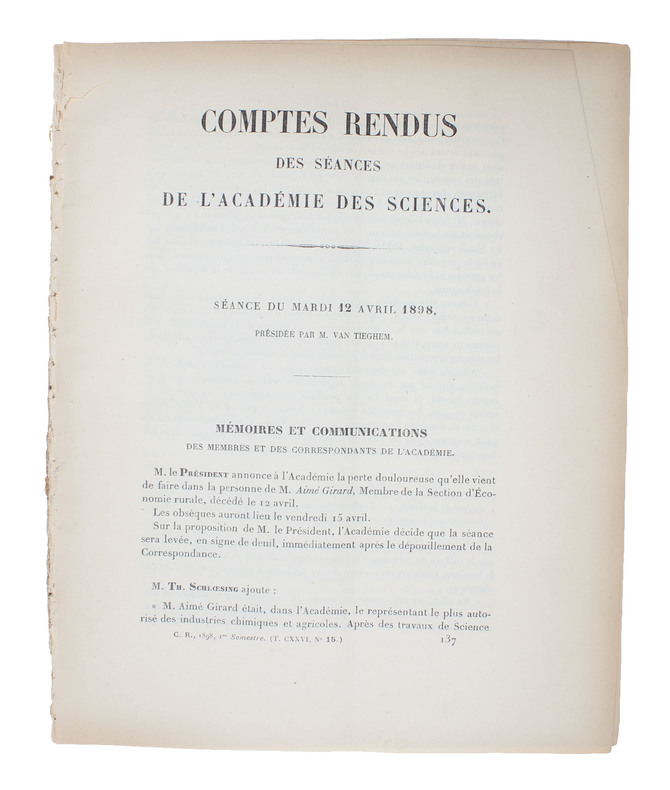
1898réf. 46852Paris Gauthier-Villars 1898. 4to. No wrappers. In: "Comptes Rendus Hebdomadaires des Séances de L'Academie des Sciences" Tome 126 No 15. Entire issue offered. With htitle and titlepage to vol. 126. Pp. 1059-1110. Curie's paper: pp. 1101-1103. First printing of this milestone paper being the first "Note" from Marie Curie about "radioactivity". This same "Note" contains a the fundamental observation: "Two uranium ores. are much more active than uranium itself. This fact. leads one to believe that these ores may contain an element much more active than uranium." This paper gives the first proof of the fact that radiation is an atomic property."Henri Becquerel discovered 1896 that uranium salts shielded from light for several months spontaneously emit rays related in their effects to Roentgen rays. Mme. Curie became enthusiastic about this subject filled with the unknown and as she later acknowledged involving no bibliographic research.The first step in the research was to determine whether there existed other elements capable like uranium of emitting radiation. Abandoning the idea of hyperfluorescence couldn’t one calculate by electrical measurement the effects on the conductivity of air that were revealed by the gold-leaf electroscope Pierre Curie and his brother Jacques had constructed an extremely sensitive apparatus to measure weak currents; Mme. Curie employed it in testing both pure substances and various ores. In her first "Note" in the Comptes rendus"de l Académie des sciences 12 April 1898 she described the method that she followed throughout her life the method that enabled her to make comparisons through time and crosschecks with other techniques:"I employed. a plate condenser one of the plates being covered with a uniform layer of uranium or of another finely pulverized substance diameter of the plates eight centimeters; distance between them three centimeters. A potential difference of 100 volts was established between the plates. The current that traversed the condenser was measured in absolute value by means of an electrometer and a piezoelectric quartz. In general she preferred the zero method in which the operator compensates for the current created by the active material by manipulating the quartz. All of her students followed this procedure."DSB.The first results came in 1898: the measurements varied between 83 × 10-12 amperes for pitch blende to less than 0.3 × 10⁻¹² for almost inactive salts passing through 53 × 10-12 for thorium oxide and for chalcolite double phosphate of uranium and copper. Thorium would thus be "radioactive" the term is Mme. Curie’s; its radioactive properties were discovered at the same time independently by Schmidt in Germany. unknown
1898réf. 46852Paris, Gauthier-Villars, 1898. 4to. No wrappers. In: ""Comptes Rendus Hebdomadaires des Séances de L'Academie des Sciences"", Tome 126, No 15). Entire issue offered. With htitle and titlepage to vol. 126. Pp. 1059-1110. Curie's paper: pp. 1101-1103.
196498 pages. Text in French. Features: Le miracle est devant nous; Chine - un document exceptionnel; Ma decouverte de l'oreopitheque; Ou en est le niveau de vie des Francais; Le combat desespere des Kurdes; L'existence d'une famille roumaine en 1964; Les enfants martyrs du divorce; L'objet-cathedrale par le nouveau Roman; Que se passe-t-il au chateau d'Oublaisse?; L'homme qui reconcilie l'Art et la Science; Les 10 meilleurs restaurants exotiques; Les secrets de Roger Vailland. Printed on glossy stock. Profusely illustrated in colour and black and white. Average wear. Unmarked. A sound vintage copy. Book
1949réf. 3133033Manchester: Manchester University 1949. 38 Seiten. Gr. 8° (22,5-25 cm). Orig.-Broschur. [Softcover / Paperback].
1809réf. 50198Paris Mad. Ve Barnard 1809. Contemp. hcalf. Spine gilt. Wear to top of spine. A few scratches to binding. Small stamps on verso of titlepage.In: "Annales de Chimie ou Recueil de Mémoires concernant la Chemie" Tome 70. 336 pp. Entire volume offered. Davy's paper: pp. 189-254. First edition in French the first English 1808 of this importent historical paper in chemistry in which Davy shows that electricity is capable of decomposing some alkalies isolating two new substances and discovering potassium and sodium. Neville in his Historical Chemical Library vol. I p.340 writes about this paper "ONE OF THE GREAT CLASSIC RESEARCHES IN CHEMISTRY in which Davy announced in this his second Bakterian lecture the isloation of metallic potassium and sodium by the electrolytic decomposition of their fused oxides.""He Davy began his own electrical experiments.The results were spectacular. On October 6 1807 the current passing through molten potash liberated a metal which Davy called potassium. The little globules of shining metal tore the water molecule apart as it eagerly recombined with oxygen and the liberated hydrogen burst into lavender flame. Davy danced about in a delirium of joy. A week later he isolated sodium from soda."Asimow. The paper offered here describes these discoveries."Humphry Davy was one of the most brilliant chemists of the early nineteenth century. His early study of nitrous oxide brought him his first reputation but his later and most importent investigations were devoted to electrochemistry. Following Galvani's experiments and the discovery of the voltaic pile interest in galvanic electricity had become widespread. The first electrolysis by means of the pile was carried out in 1800 by Nicholson and Carisle who obtained oxygen and hydrogen from water. Davy began to examine the chemical effects of electricity in 1800 and his numerous discoveries were presented in his Bakerian lecture to the Royal Society on November 20 1806. A Source Book in Chemistry p. 243. unknown