LECOUTURIER, M. - Dessins astronomiques par M. Ch. BulardLivre Rare Book
2178 risultati
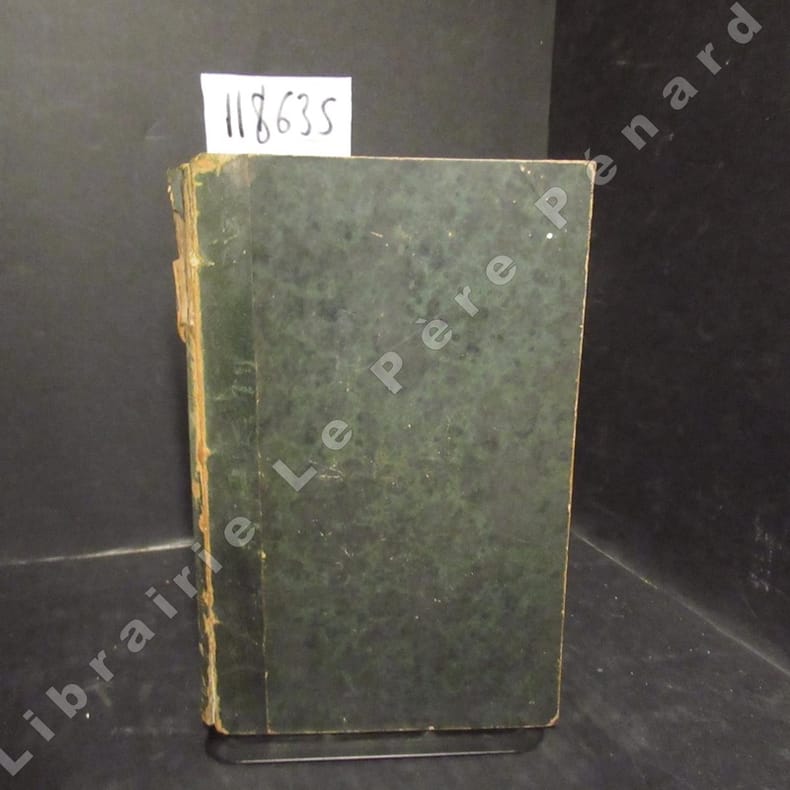
1858rif. 1186351858 A Paris, aux Bureaux du Musée des Sciences - 1858 - In-8, demi-basane verte - 461 pp. - 24 hors texte en N&B
rif. EEzz4761n(Paris), Palais de la Découverte o. J. 49 (von 50) lithogr. Karten nach Kupferst. (ornamentale Kurven nach mathematischen Formeln), in roter, berieb. Kartonschuber, Karten mit geringf. Gebrauchsspuren. Design von El-Milick, M. R. E. Moritz, M. K. Kurokawa, M. G. Gyllström.
Paris, Editions G. L. M., 1935. In-8, broché, couverture imprimée et rempliée, n.p. Tirage limité à 212 exemplaires numérotés. Un des 200 ex n° sur Hélio, n° 99. Bel exemplaire. Gregorio PRIETO : Images. Fernand POUEY : Chanson de Marguerite. Pierre COURTHION : L'époux - Le Parachutiste. Pierre-Jean LAUNAY : Dans la nuit. R. de SABLON-FAVIER : Poèmes. KLEIN : Images du cirque. Jacques BARON : Changement de saison. Lucien JUBLOU : Signaux. Jean FOLLAIN : Poèmes. Guy LEVIS-MANO : Il y a aussi des carrefours... Pierre ALBERT-BIROT: Mon ami Kyonos. Y. VINEUIL : Retour.
1997cartonnage, jaquette illustrée 1997, 1997, in-8, , cartonnage, jaquette illustrée, PREMIERE EDITION. Nombreuses illustrations en noir et en couleur
1882479 p. : illus., maps Hardcover Very good condition, in full sheep, front hinge cracked
rif. 9350561735.Gpaperback. Good. Access codes and supplements are not guaranteed with used items. May be an ex-library book. paperback
rif. ANAIS-1572933895Discovery House Publishers. other. Good. 0x0x0. Buy with confidence. Excellent Customer Service & Return policy. Discovery House Publishers unknown
1997rif. Q-1572930195Discovery House Publishers 1997-01-01. Paperback. New. In shrink wrap. Looks like an interesting title! Discovery House Publishers paperback
2009rif. Q-9781572933507Discovery House Publishers 2009-09-01. Paperback. New. New. In shrink wrap. Looks like an interesting title! Discovery House Publishers paperback
1988rif. Q-0929239016Discovery House Publishers 1988-01-01. Hardcover. New. In shrink wrap. Looks like an interesting title! Discovery House Publishers hardcover
rif. 1572933895.Gspiral_bound. Good. Access codes and supplements are not guaranteed with used items. May be an ex-library book. unknown
1989rif. Q-0929239032Discovery House Pub 1989-04-01. Paperback. New. In shrink wrap. Looks like an interesting title! Discovery House Pub paperback
2010rif. Q-1572933933Discovery House Publishers 2010-09-01. Leather Bound. New. In shrink wrap. Looks like an interesting title! Discovery House Publishers hardcover
2010rif. DADAX1572933925Our Daily Bread 2010-10-01. Translated. paperback. New. 5.50x1.25x8.00. Buy with confidence. Excellent Customer Service & Return policy. Our Daily Bread paperback
2005rif. 1186382005 Edité par Orchid Society of South East Asia - 2005 - In-4, cartonnage illustré en couleurs sous jaquette illustrée en couleurs de l'éditeur - 301 p. - Très riche iconographie in, hors texte et pleine page en couleurs et en N&B - Ouvrage en anglais
1992rif. 791501992 Edition La Découverte - collection Enquêtes - grand in-8 broché - 1992 - 201 pages
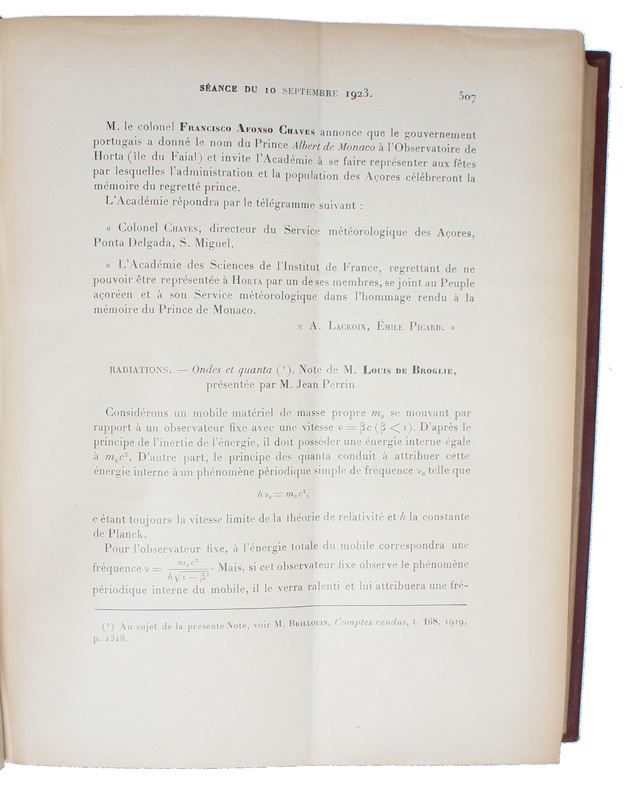
1923rif. 49718Paris Gauthier-Villars et Cie 1923. 4to. Bound in one contemp. full buckram. Spines gilt and with gilt lettering. In: "Comptes Rendus Hebdomadaires des Séances de L'Academie des Sciences" Tome 177. Bound with orig. printed front-wrapper to No. 1 half-title and title-page to vol. 177. 1513 pp. Entire volume offered. De Broglie's papers: pp. 507-510 pp. 548-551 a. pp. 630-32. Clean and fine. A punched stamp on foot of title-page. First edition of these papers which ESTABLISHED A NEW ERA IN PHYSICS by introducing the epochal new principle that particle-wave duality should apply not only to radiation but also to matter and thus CREATING QUANTUM MECHANICS. These 3 papers were extended to form his doctoral thesis of 1924 "Recherches sur la Théorie des Quanta."De Broglie relates "After long reflection in solitude and meditation I suddenly had the idea during the year 1923 that the discovery made by Einstein in 1905 should be generalized by extending it to all material particles and notably to electrons" Preface to his PhD thesis 1924."He made the leap in his September 10 1923 paper: E=hv should hold not only for photons but also for electrons to which he assigns a 'fictitious associated wave'. In his September 24 paper he indicated the direction in which one 'should seek experimental confirmations of our ideas': a stream of electrons traversing an aperture whose dimensions are small compared with the wavelenght of the electron waves 'should show diffraction phenomena' ."Pais "Subtle is the Lord" pp. 425-436.In the third paper October 8 he discusses "The interplay between the propagation of the particle and of the waves could be expressed in more formal terms as an identity between the fundamental variational principles of Pierre de Fermat rays and Pierre Louis Maupertuis particles as de Broglie discussed it further in his last communication . Therein he also considered some thermodynamic consequences of his generalized wave-particle duality. He showed in particular how one could using Lord Rayleigh’s 1900 formula for the number of stationary modes for phase waves obtain Planck’s division of the mechanical phase space into quantum cells.Louis de Broglie achieved a worldwide reputation for his discovery of the wave theory of matter for which he received the Nobel Prize for physics in 1929. His work was extended into a full-fledged wave mechanics by Erwin Schrödinger and thus contributed to the creation of quantum mechanics. After an early attempt to propose a deterministic interpretation of his theory de Broglie joined the Copenhagen school’s mainstream noncausal interpretation of the quantum theory."DSB."This idea i.e. de Broglie's that matter might behave as waves was tested and confirmed by Davisson and Germer in 1927. Thus the duality of both light and matter had been established and physicists had to come to terms with fundamental particles which defied simple theories and demanded two sets of 'complementary' descriptions each applicable under certain circumstances but incompatible with one another." Printing and the Mind of Man 417. hardcover
1923rif. 46949Paris Gauthier-Villars et Cie 1923. 4to. Bound in 2 contemp. full cloth. Spines gilt and with gilt lettering. In: "Comptes Rendus Hebdomadaires des Séances de L'Academie des Sciences" Tome 177. With htitle a. titlepage. 1513 pp. Entire volume offered. De Broglie's papers: pp. 507-510 pp. 548-551 a. pp. 630-32. Clean and fine. A stamp to verso of titlepage. First edition of these papers which ESTABLISHED A NEW ERA IN PHYSICS by introducing the epochal new principle that particle-wave duality should apply not only to radiation but also to matter and thus CREATING QUANTUM MECHANICS. These 3 papers were extended to form his doctoral thesis of 1924 "Recherches sur la Théorie des Quanta."De Broglie relates "After long reflection in solitude and meditation I suddenly had the idea during the year 1923 that the discovery made by Einstein in 1905 should be generalized by extending it to all material particles and notably to electrons" Preface to his PhD thesis 1924."He made the leap in his September 10 1923 paper: E=hv should hold not only for photons but also for electrons to which he assigns a 'fictitious associated wave'. In his September 24 paper he indicated the direction in which one 'should seek experimental confirmations of our ideas': a stream of electrons traversing an aperture whose dimensions are small compared with the wavelenght of the electron waves 'should show diffraction phenomena' ."Pais "Subtle is the Lord" pp. 425-436.In the third paper October 8 he discusses "The interplay between the propagation of the particle and of the waves could be expressed in more formal terms as an identity between the fundamental variational principles of Pierre de Fermat rays and Pierre Louis Maupertuis particles as de Broglie discussed it further in his last communication . Therein he also considered some thermodynamic consequences of his generalized wave-particle duality. He showed in particular how one could using Lord Rayleigh’s 1900 formula for the number of stationary modes for phase waves obtain Planck’s division of the mechanical phase space into quantum cells.Louis de Broglie achieved a worldwide reputation for his discovery of the wave theory of matter for which he received the Nobel Prize for physics in 1929. His work was extended into a full-fledged wave mechanics by Erwin Schrödinger and thus contributed to the creation of quantum mechanics. After an early attempt to propose a deterministic interpretation of his theory de Broglie joined the Copenhagen school’s mainstream noncausal interpretation of the quantum theory."DSB."This idea i.e. de Broglie's that matter might behave as waves was tested and confirmed by Davisson and Germer in 1927. Thus the duality of both light and matter had been established and physicists had to come to terms with fundamental particles which defied simple theories and demanded two sets of 'complementary' descriptions each applicable under certain circumstances but incompatible with one another." Printing and the Mind of Man 417. hardcover
1923rif. 46949Paris, Gauthier-Villars et Cie, 1923. 4to. Bound in 2 contemp. full cloth. Spines gilt and with gilt lettering. In: ""Comptes Rendus Hebdomadaires des Séances de L'Academie des Sciences"", Tome 177. With htitle a. titlepage. 1513 pp. (Entire volume offered). De Broglie's papers: pp. 507-510, pp. 548-551 a. pp. 630-32. Clean and fine. A stamp to verso of titlepage.
1923rif. 49718Paris, Gauthier-Villars et Cie, 1923. 4to. Bound in one contemp. full buckram. Spines gilt and with gilt lettering. In: ""Comptes Rendus Hebdomadaires des Séances de L'Academie des Sciences"", Tome 177. Bound with orig. printed front-wrapper to No. 1, half-title and title-page to vol. 177. 1513 pp. (Entire volume offered). De Broglie's papers: pp. 507-510, pp. 548-551 a. pp. 630-32. Clean and fine. A punched stamp on foot of title-page.
1837rif. 47418London Richard and John E. Taylor 1837. No wrappers. Extracted fron "Scientific Memoirs selected from The Transactions of Foreign Academies of Science and Learned Societies. Edited by Richard Taylor." Vol. I. Pp. 540-547. Henry's milestone paper announcing his discovery of electrical self-induction. "Henry independently discovered electro-magnetic induction and in this paper announced his discovery of electric self-induction one of the prime properies of an electro-magnetic circuit. Henry was an eminent experimenter but was casual in publishing his findings with resulting lack of recognition of his contributions."Bern Dibner.Dibner "Heralds of Sciece" No.63.It was also printed the same year in "Transactions of the American Philosophical Society New Series Vol. 5". The paper was later printed in "Philosophical Magazine" 1840."The direction of Henry’s thought became somewhat apparent in his 1835 paper refers to the papers reading before the American Phil. Soc. febr. 6th 1835 on the action of a spiral conductor in increasing the intensity of galvanic currents. The paper started out as an affirmation of Henry’s priority in the discovery of self-induction. He then combined induction proper using Faraday’s findings and his own with selfinduction to show how these produce a pattern of repulsions yielding an increased effect in spirals. He specifically linked these “magneto-electrical” results to the principles of static induction developed by Cavendish and Poisson. This explanation was then applied to Savary’s report of changes of polarity when magnetic needles were placed at varying distances from a wire in which a current was being transmitted "Mémoire sur l’aimantation" in Annales de chimie et de physique 34 1827. That is currents appeared periodically in the air surrounding a current-bearing straight wire as a result of the actions of induction and self-induction." DSB.Wheeler Gift: 2724-2725a. unknown
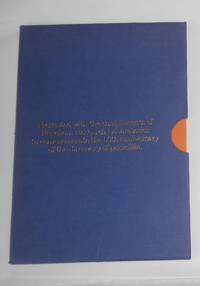
1979rif. TN254373British Journal of Experimental Pathology / Beecham Research Laboratories London 1979. 1st Edition Thus. SOFTCOVER. Mde to commemorate the 50th anniversary of the discovery of penicillin and published by Beecham Research Laboratories in 1979. 4to in black printed orange card covers pages numbered 191 to 236 - a very nicely produced facsimile using well matched paper of the exact size of the complete issue for June 1929 which contains Flemings famous paper. Housed in a cloth backed thin card slip-case with single leaf insert on thick glossy paper with a brief history and time-line for penicillin. Fleming made his own limited edition reprint of the offprint in 1944 but this is the first reprint of the whole issue. __CONDITION : The journal and insert are AS NEW the slipcase is a little shelf rubbed and faintly sunned. Overall an excellent copy of this facsimile which has become almost as hard to find as the original. __NOTE. Depending on destination this item may require an extra payment for shipping insurance. If so orders made by card will be completed only after you have approved the extra cost. . __We always ship in PROTECTIVE CARD PARCELS British Journal of Experimental Pathology / Beecham Research Laboratories, London paperback
1842rif. 42843London Richard and John E. Taylor 1842. 4to. No wrappers as extracted from "Philosophical Transactions" 1842 - Part II. Pp. 181-214 and one double-page folded engraved plate. First appearance of a pioneer-paper in the history of early photography in which Herschel announced some of his importent discoveries of the photographic printing processes the process of photographic contact-printing in Prussian blue brought to light just three years after Louis Daguerre and Henry Talbot had announced their independent inventions of photography in silver using metal and paper substrates respectively. and the photographic properties of red ferro sesquicyanuret of potassium."This is the first recorded observation of Prussian blue being formed for a photographic purpose by the action of light on potassium ferricyanide so it represents the moment of discovery of the first cyanotype process although this name still lay in the future. The significance of this observation impressed Herschel sufficiently to mention it also in his general diary entry for 23 April 1842."Mike Ware in "John Herschel's Cyanotype. Invention or discovery ". unknown
1825rif. 43119London W. Nicol 1825. 4to. No wrappers as extracted from "Philosophical Transactions" 1825 - Part II. Pp. 440-466. Clean and fine. First appearance of this remarkable paper in which Faraday announces his discovery of Benzene. Berzelius described this research as "without doubt one of the most importent which has enriched chemistry during 1825.""The first public announcement of the discovery of benzene the greatest chemical discovery made by Faraday. Originally named by him "bicaburet of hydrogen" benzene is the parent substance of all aromatic compounds. It constitutes the basis of thousands of organic compounds dyes perfumes and medicinal products as well as many polymers and structural materials. The discovery of benzene led to the creation of numerous chemical companies and the manufacture of materials previously unknown. This paper is a thourough study of the physical and chemical properties of benzene."Neville I p. 443. - Parkinson "Breakthrough" 1825 C. unknown
1843rif. 42662London Richard and John E. Taylor 1843. 4to. No wrappers as extracted from "Philosophical Transactions" 1843 - Part I. Pp. 1-6. First appearance of a pioneer-paper in the history of early photography as Herschel here for the first time describes his discovery of the iron printing process with ammonio-citrate of iron by both methods namely with blue lines on a white background and white lines on a blue ground. unknown