2,178 results
1830Very Good Arabic Original manuscript without binding. 12mo. (16 x 11 cm). In Arabic. [40] p., drawings, and tables. Marginal texts additionally. A linear wormhole on the bottom from beginning to the end, the thread in the spine is broken hence two separate parts. Otherwise a good copy. Rare manuscript compiled from works related to astronomical instruments written by probably Sibtu'l-Mardînî, copied anonymously in the early 19th century on the paper with 'ahar' with four marginal drawings and tables. The copier of this manuscript is not described. An 'Ebced' notes on the last blank page. The manuscript starts with a calendar in the Islamic system which is prepared with red and black inks and annotated info around the table. The first part includes how to use an almucantar, directions on the sphere, location of the stars in the sky. On the last two pages, the author describes the preparation of an almucantar. The second part is titled "Hadhâ risâle-i cenûb tarafi" [i.e. Tractate on the South direction], and the third and last part titled " Hadhâ risâle-i cenûb taraf, Hadha mukharrar latashich al-shaat fî taraf al-cayb min al-rub'u' mu'âl-ihtizâr", includes some 'sinus mathematics' with two impressive tables on the opposite page. Sibt al-Maridini, the full name Muhammad ibn Muhammad ibn Ahmad ibn Muhammad ibn al-Ghazal (1423-1493), was an Egyptian-born astronomer and mathematician. His father came from Damascus. The word "Sibt al-Maridini" means "the son of Al-Mardini's daughter". His maternal grandfather, Abdullah al-Mardini, was a reputed astronomer of the eighth century AH. He was a disciple of the astronomer Ibn al-Majdi (d. 850/1506). Sibt al-Mardini taught mathematics and astronomy in the Great Mosque of al-Azhar, Cairo. He was also a timekeeper (muwaqqit) of the mosque. He wrote no fewer than fifty treatises in astronomy (sine quadrants, sundials, astronomical tables, and prayer times) and wrote at least twenty-three mathematics textbooks. Al-Sakhawy counted two hundred books that were written by Sibt al-Mardini, on Islamic law, astronomy, and mathematics. Libraries that specialize in ancient manuscripts, all over the world, have transcripts of his works. Sibt al-Mardini's declared that "the opinion of the muezzins (those who call people to prayer) is less correct than that of the legal scholars and it is the latter that should be used as the basis for the determination of prayer time". (Wikipedia). Sib? al-Maridini was a prolific author of astronomical texts, which were still being used and studied into the 19th century. Little is known with certainty about his life. It is thought that he grew up in Damascus, where his maternal grandfather, Abd Allâh ibn Khalîl ibn Yûsuf Jamâl al-Dîn al-Mâridînî (died: 1406), was the muwaqqit (timekeeper) in charge of regulating the daily rituals of the Islamic community) of the Umayyad Mosque. Later he traveled to Cairo, where tradition places him as a student of Ibn al-Majdî. Sib? al-Mâridînî wrote extensively on mathematics and mathematical astronomy. Like his grandfather, he was especially interested in astronomical instruments. The bio-bibliographical sources list some 25 treatises, many of which exist today in multiple copies. According to the historian al-Jabarti (died: 1822), Sib? al-Mâridînî's works on mîqât (ritual timekeeping) and astronomical instruments were still being studied in the curriculum of Cairo's al-Azhar, one of the preeminent educational institutions in the Islamic world, at about the beginning of the 19th century. (Biographical encyclopedia of astronomers, 2007).
1835Volume I only. xxxiv, 740 pages. 25 plates - some in colour, 5 maps including 1 fold-out. Library binding. Nine-inch opening to fold-out map now bound opposite page 1. Minimal library markings. Gift greetings - dated 1866. Faint signature atop title page. Above-average external wear. Contents and binding sound. Arctic Bibliography 14866. Book
ref. 115668London Royal Society 1908. . First edition; 4to; 2 coloured maps 1 folding 21 plates including 8 lithographs photographic plates including a folding panorama; original red buckram-backed boards spine faded a very good copy; v 192 pp. From the library of Professor Otto Nordenskjöld 1869-1928 the distinguished Swedish Antarctic explorer and scientist. Nordenskjöld was on the Swedish scientific expedition to the Antarctic 1901-1903 and would have had a particular interest in the results of the Discovery expedition. Physical Observations is notable for the series of eight lithographs of aurora observations including seven of aurora effects on thick brown paper. Rosove 288-8.A1; Spence 839; Taurus 47. London, Royal Society, 1908. hardcover
1723ref. P2-5A-4WHELER G. Voyage de Dalmatie, de Grèce et du levant. La Haye, Rutgert Albers, 1723. 2 volumes in-12 (170x100mm), reliés plein veau époque, dos à 5 nerfs ornés de caissons dorés, pièce de titre en maroquin rouge, tranches rouges, titre imprimé en rouge et noir, de la bibliothèque de J.C. Dezauche. XII + 358 pp. + 332pp. Illustré de 82 gravures hors-texte. Bel exemplaire. In-12, 358 & 332 pp. Illustrated with 82 engraved plates of which 8 are double page. 2 frontispieces, 5 plates of inscription and 12 pages of numismatics. Title printed in red and black, contemporary calf, red label, nice copy. From the library of J.V. Dezauche the geographer.
1893Very Good Turkish, Ottoman (1500-1928) A fine half leather bdg. with marbled boards. Two volumes in one. Cr. 8vo. (20 x 14 cm). The text in Ottoman script (Old Turkish with Arabic letters) with bilingual titles in Ottoman Turkish and French on frontispieces and title pages. 2 volumes set: (248 p.; 270, [1] p., the first volume has Columbus' engraved portrait frontispiece, the second has Amerigo Vespucci's portrait). Hegira: 1310 = Gregorian: 1893. First and only edition of this very rare book, which is the first Turkish original work on the history of the discovery of America printed for the Quadricentennial of the Discovery. With this book, Christopher Columbus and Amerigo Vespucci quickly became popular among Ottoman readers (soon after Iranian readers with a translation of the first volume only), and immediately among other Middle Eastern readers, and thus the first comprehensive and original text describing Colombus and the discovery of America appeared in the Middle East and Islamic world. It's been published in Istanbul under the title "The history of the discovery and conquest of America". The first volume is on Christopher Columbus, and the second volume is on Amerigo Vespucci, their lives and travels. Andreas Kopassis Efendy (1856-1912) was one of the few Ottoman Greeks proficient in the Ottoman literary language. Cretan Kopassis is an intriguing figure who made a remarkable career serving the Ottoman state. At the time of the publication, he was a member of the State Council (Sura-yi Devlet). He displayed quite an extraordinary interest in scholarly research and he seems to have been one of the first to have studied Ottoman "tahrir defterleri" [i.e. Ottoman tax registers]. This could be called a translation in a sense. Kopassis makes no reference to preceding translations, nor does he refer to Robertson's history of America. His main source was a more recent equally "classic" work on Christopher Columbus, Washington Irving's "History of the life and voyages of Christopher Columbus" (first published in 1828). Another source referred to by Kopassis is J. H. Campe's "Entdeckung von Amerika" (first published in 1781). His educational background is evident particularly in the introductory chapter where ample references are made to Pliny, Ptolemy, and Plato's Timaios which contain allusions to Atlantis. In his takri (Introduction) to this work, Kemalpasazade Said Bey (1848-1921) praised the author for his elegant prose. Sultan Abdülhamid awarded the order of merit (liyâkât) in gold to the author. In the same year (1315=1895), an aide-de-camp at the Iranian Ministry of War, Muhibb-i 'Âli Khan, translated the first volume into Persian. At the turn of the century, Christopher Columbus had become a very popular figure for Ottoman readers of all ages...". (Source: STRAUS, JOHANN: Nineteenth-century Ottoman Americana.; "Frontiers of the Ottoman Imagination: Studies in Honour of Rhoads Murphey."). Only one copy in OCLC 777274675 (Leiden University Library). Not in American libraries.; Özege 19857.
1842ref. 45440Kjöbenhavn, Bianco Luno, 1842 a. 1845. 4to. Bound in one contemp. halfcalf, spine gilt. A small tear to backhinge at lower compartment of spine. IV,76 pp. and 3 double-page, folded lithographed plates with many figs. + XIV,88 pp. and 2 double-apge lithographed plates with many figs. Light browning to the last leaves of the second work.
1842ref. 45440Kjöbenhavn Bianco Luno 1842 a. 1845. 4to. Bound in one contemp. halfcalf spine gilt. A small tear to backhinge at lower compartment of spine. IV76 pp. and 3 double-page folded lithographed plates with many figs. XIV88 pp. and 2 double-apge lithographed plates with many figs. Light browning to the last leaves of the second work. The scarce first edition of the work in which Steenstrup describes his discovery of the principle of 'ALTERNATION OF GENERATIONS'' sexual and asexual in plants and animals. "Steenstrup showed that certain animals produce offspring which never resemble them but which on the other hand bring forth progeny which return in form and nature to their grandparents or more distant ancestors." Garrison & Morton No 217. A German translation was published the same year and an English in 1845. Norman 2009 German translation. "The second major publication - the first dealing with geology - of 1842 was "Om Forplantning og Udvikling gjennem vexlende Generationsrækker." the work offered Steenstrup's comprehensive presentation of the form of reproduction that he called 'alternation of generations' that is the alternation of asexual and sexual reproduction or metagenesis. This phenomenon had previously been described by Chamisso but Steenstrup included a greater number of observations based on a significantly wider range of subjects and provided an importent chapter on its meaning. Steenstrup's growing reputation won him an appointment as professor of zoology at the University of Copenhagen where he tought from 1846 until 1885."DSB XII p. 9. unknown
ref. 46209Hetzel.1878.Cartonnage bleu cobalt à la sphère armillaire.Catalogue S.464 p. Belle fraicheur des plats.Dos légèrement fané.Coiffe basse un peu frottée.Qques rousseurs.Tranches dorées.
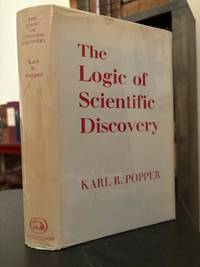
1959ref. 508Large Octavo. Publisher's cloth & dustwrapper. First edition first printing of one of the most significant works on the philosophy of science. The Logic of Scientific Discovery was originally published in Germany in 1934 and Popper rewrote and republished it in English in 1959 with the New York edition preceding this much rarer UK edition. A fine copy in an unclipped slightly worn and faded very good dust wrapper. Small inscription on the front pastedown of David Keyt 1930-2025 Professor Emeritus of Philosophy at Washington University Seattle. The book is mostly unopened and looks mostly unread. A very nice copy. Popper argues that science should adopt a methodology based on falsifiability because no number of experiments can ever prove a theory but a reproducible experiment or observation can refute one. According to Popper: "non-reproducible single occurrences are of no significance to science. Thus a few stray basic statements contradicting a theory will hardly induce us to reject it as falsified. We shall take it as falsified only if we discover a reproducible effect which refutes the theory". Popper argues that science should adopt a methodology based on "an asymmetry verifiability and falsifiability; an asymmetry which results from the logical form of universal statements. For these are never derivable from singular statements but can be contradicted by singular statements". Hutchinson hardcover
1796ref. AMO-3003By William Robertson, principal of the University of Edinburgh, historiographer to his Majesty for Scotland, and member of the Royal Academy of History at Madrid. In three volumes. The Seventh Edition. London, Printed for A. Strahan and T. Cadell, and E. Balfour, Edinburgh : and sold by T. Cadell Jun. W. Davies, Successors to Mr. Cadell, 1796 3 volumes in-8 (22,5 x 14 cm) de XLIV-343, (1)-475 et (1)-422-(34) pages. 4 grandes cartes dépliantes et 1 planche dépliante de glyphes de l'ancien Mexique. Reliure de l'époque (vers 1800) veau raciné, dos lisses richement ornés, pièces de titre de maroquin rouge, tomaison ovale de maroquin noir, tranches citron, roulette dorée sur les coupes. Reliure de très belle facture, probablement anglaise. Infimes frottements, un coin légèrement usé, sinon très fraîches reliures, intérieur également très frais imprimé sur beau papier, sans rousseurs notables. A noter une petite brûlure sur le bord des plats du deuxième tome (coulure acide), tranche et marge des derniers feuillets tachées sans gravité. Texte en anglais. Nouvelle édition anglaise. Robertson (1721-1793) contributed to the history of Spain and Spanish America in his History of America (1777), "the first sustained attempt to describe the discovery, conquest and settlement of Spanish America since Herrera's Décadas". Cette histoire de l’Amérique depuis l'arrivée de Christophe Colomb jusqu'à la fin de la conquête espagnole est basée sur l'étude de documents historiques solides. On y trouve le récit des conquêtes par Christopher Columbus, Hernando Cortez, Vasco Nunez de Balboa, Vasco de Gama, Ferdinand Magellan, Amerigo Vespucci. Les nombreuses notes historiques en fin de chaque volume sont très intéressantes. Les cartes géographiques sont très belles et parfaitement conservées. Provenance : Ex libris gravé monogramme non identifié. Très bel exemplaire conservé dans ses premières reliures en veau raciné.
ref. 3589Paris, Fuchs, 1794.edition originale en version française , 532 pages. Reliure de l'époque en plein basane . Dos lisse orné de bandes dorées. Titre sur pièce de couleur orangée. superbe. Photos sur demande
1934ref. 47071Paris, Gauthier-Villars, 1934. 4to. No wrappers. In: ""Comptes Rendus Hebdomadaires des Séances de L'Academie des Sciences"", Tome 198 No 3. Titlepage to vol. 198. Pp. (213-) 292. (Entire issue offered). The joint paper: pp. 254-256 a. 1 photographic illustration in the text. Titlepage with a stamp on verso, 2 small tears and a tiny bit of upper right corner gone. Titlepage a bit browned.
1878ref. 44231Paris, G. Masson, 1878. 8vo. Contemp. hcalf, raised bands, gilt spine. Light wear along edges. Small stamps on verso of titlepage. In: ""Annales de Chimie et de Physique"", 4e Series - Tome 15. 512 pp. a. 3 folded engraved plates. (The entire volume offered). Janssen's memoir: pp. 414-426.
1934ref. 47071Paris Gauthier-Villars 1934. 4to. No wrappers. In: "Comptes Rendus Hebdomadaires des Séances de L'Academie des Sciences" Tome 198 No 3. Titlepage to vol. 198. Pp. 213- 292. Entire issue offered. The joint paper: pp. 254-256 a. 1 photographic illustration in the text. Titlepage with a stamp on verso 2 small tears and a tiny bit of upper right corner gone. Titlepage a bit browned. First appearance of this seminal paper in which artificial radioactivity was announced for the first time. Curie and Joliot were awarded the Nobel Prize in Chemistry 1935 "in recognition of their synthesis of new radioactive elements"."Until this date 1934 atomic nuclei emitting radiation were found in nature: it was called the natural radioactivity. It had been known since Rutherford that this natural radioactivity changed a nucleus into an other one: for instance radium becomes finally lead after many radioactive decays. We could say that lead does not become gold but gold becomes lead! But. this change of matter was not under control. It was not possible to construct the desired chemical element as the alchemist dreamed. But Irene and Frederic Joliot-Curie made the dream become almost reality.""Another very important development in the early 1934 by the Joliot-Curies in connection with irradiation of aluminum by alpha particles. The two French scientists detected the production of the recently discovered positrons. . However they soon realized that the positron activity continued after the alpha source was removed and that they had in fact discovered positive beta radioactivity. The importance of the discovery of artificial radioactivity was immediately recognized and resulted in a Nobel Prize in chemistry to the Joliot-Curies in 1935. The new phenomenon immediately became widely employed in nuclear physics chemistry biology and medicine." Kragh Quantum Generations p. 187"These elegant experiments which provided the first chemical proof of induced transmutations and showed the possibility of artificially creating radioisotopes of known stable elements were repeated and extended in the major nuclear physics laboratories of various countries " DSB.Born on 12 September 1897 in Paris Irène Curie was the daughter of Pierre and Marie Curie. "During World War I she worked as a nurse helping her mother operate radiography equipment and then studied physics and mathematics at the Sorbonne gaining a doctorate for studying the range of alpha particles. She then went to work for her mother at the Radium Institute. There she met Frédéric Joliot whom she married in 1926. Frédéric Joliot was born on 19 March 1900 in Paris - He joined the Radium Institute in 1925 and obtained his PhD in 1930. Together the Joliot-Curies worked on radioactivity and the transmutation of the elements. Twice they just missed major discoveries: in 1932 when Chadwick beat them to the neutron and in 1933 when Anderson discovered the positron. However in 1934 whilst bombarding light elements with alpha particles the Joliot-Curies noticed that although proton production stopped when the alpha particle bombardment stopped another form of radiation continued. The alpha particles had produced an isotope of phosphorus not found in nature. This isotope was radioactive and was decaying through beta-decay" DSB. unknown
1780ref. 53319Paris, Théophile Barrois, 1780. 8vo. Fine cont. full mottled calf, richly gilt spine and gilt titlelabel in red leather. Edges gilt. LXVIII,333,(3) pp. and 1 folded engraved plate (showing his experimental apparatus). Light browning to margins of title-page, otherwise clean and with broad margins. A fine copy.
1780ref. 53319Paris Théophile Barrois 1780. 8vo. Fine cont. full mottled calf richly gilt spine and gilt titlelabel in red leather. Edges gilt. LXVIII3333 pp. and 1 folded engraved plate showing his experimental apparatus. Light browning to margins of title-page otherwise clean and with broad margins. A fine copy. First French edition of perhaps the most important work in plant physiology. It is in this work that Ingen-Housz for the first time expounds the ideas and experiments that lead to his discovery of Photosynthesis in plant life and as such it is of fundamental importance in the economy of living things. "His Experiments upon vegetables was published in the autumn of 1779 and was at once recognized as a very important advance. In brief he showed that oxygen evolution by plant is absolutely dependent on light and that it only occurs from those parts which are green.The proof that light and green tissues are both essential for oxygen production finally cleared up the apparent contradictions and variable results of earlier experiments. Priestly was "much pleased" with Ingen-Housz's experiments and pointed immediately to the salient facts that he had established." A.G. Morton: History of Botanical Science. p. 332. Dibner: Heralds of Science No. 29. - Garrison & Morton No. 103. - Horblit No. 55. All the English edition of 1779. hardcover
1878ref. 44231Paris G. Masson 1878. 8vo. Contemp. hcalf raised bands gilt spine. Light wear along edges. Small stamps on verso of titlepage. In: "Annales de Chimie et de Physique" 4e Series - Tome 15. 512 pp. a. 3 folded engraved plates. The entire volume offered. Janssen's memoir: pp. 414-426. First appearance of this milestone paper in chemistry physics and astronomy announcing the discovery of the helium lines in the spectrum of the sun. It was Lockyer in the same year that named it 'helium' for Helios the Greek God of the Sun. Helium was not discovered on the earth before 1895 by William Ramsay and it was Crookes who established its identity with the helium Janssen and Lockyer observed in the spectrum of the sun."He Janssen met immortality by travelling to India in 1868 to study the total eclipse. It was then that he observed the helium line and forwarded the spectral data to ockyer. He also noted the size of the solar prominences. The day after the eclipse he attempted to take their spectra again and succeeded despite the absence of the obscuring moon. he then announced jubilantly that it was the day after the eclipse that was the real eclipse day for him. Lockyer also reported this method of studying prominences without an eclipse.Like Lockyer he lived to see his observation of the helium line vindicated by Ramsay's discovery of that element on earth."Asimov."This the discovery of helium lines in the sun by Lockyer was announced on the same day by the French astronomer Janssen who was in India observing a total eclipse. As a result the French government some ten years later struck a medallion showing the heads of both scientists.By that time the two men had made a much more dramatic discovery at the same time this time in cooperation. Janssen studying the spectrum ofthe sun during the eclipse had noted a fine line he did not recognize. he send a report on this to Lockyer an acknowledges expert on solar spectra. Lockyer compared the reported position of the line with lines of known elements concluding that it must belong to a yeat unknown element possibly not even existing on the earth. He named the element from the Greek word for the sun."Asimov.Parkinson "Breakthroughs" 1868 A. - The volume contains other notable papers by Dumas Berthelot et al. hardcover
ref. DADAX0760745846New unknown
1896ref. 46854Paris, Gauthier-Villars, 1896. 4to. Near contemp. full cloth. Spine gilt and with gilt lettering. Bookmark, ""The Chemists Club"" in gold on lower part of spine. Light wear along edges. In: ""Comptes Rendus Hebdomadaires des Séances de L'Academie des Sciences"", Tome 122 (Entire volume offered).1633 pp. The papers: 420-421, pp. 501-502, pp. 559-564, pp. 689-694, pp. 762-767 and pp. 1086-1088.
1832ref. 48987Paris, Crochard, 1832. Contemp. hcloth, gilt lettering to spine. In: ""Annales de Chimie et de Physique, Par MM. Gay-Lussac et Arago."", tome 50, Series 2. (Entire volume offered). 448 pp. 2 folded engraved plates. Faraday's papers: pp. 5-67 a. pp. 113-162. Some scattered brownspots.
1895ref. 49207London, Harrison and Sons, 1895. 4to. Orig. full cloth. Gilt lettering to spine. Blindtooled covers. First corner a bit bumped. In ""Philosophical Transactions"", Vol. 186 - I, Series A. XIV,(2),602,(4) pp. (Entire volume offered). The paper: p. 187-241 a. 8 textillustrations (apparatus). The title-page with faint brownspots. Otherwise internally clean and fine.
1914ref. 41545London, 1914. No wrappers, but stiched. All three papers contained in: ""Philosophical Magazine"", Sixth Series, Vol. 27. No. 159. March 1914. The whole issue issue offered (=no. 159): pp. 397-540 and 2 plates.Rutherford's paper.pp. 488-498. - Darwin's paper: pp. 499-506. - Bohr's paper: pp. 506-523. All clean and fine.
1896ref. 46854Paris Gauthier-Villars 1896. 4to. Near contemp. full cloth. Spine gilt and with gilt lettering. Bookmark "The Chemists Club" in gold on lower part of spine. Light wear along edges. In: "Comptes Rendus Hebdomadaires des Séances de L'Academie des Sciences" Tome 122 Entire volume offered.1633 pp. The papers: 420-421 pp. 501-502 pp. 559-564 pp. 689-694 pp. 762-767 and pp. 1086-1088. First appearance of the six landmark papers in which Becquerel documents his discovery of Radio-activity PROMPTING THE NUCLEAR AGE.Becquerel was an expert in fluorescence and phosphorescence continuing the work of his father and grandfather. Follwing the discovery of X-rays by Röntgen Bexquerel investigated fluorescent materials to see if they also emitted X-rays. He exposed a fluorescent uranium salt pechblende to light and then placed it on a wrapped photographic plate.He found that a faint image was left on the plate which he believed was due to the pichblende emitting the light it had absorbed as a more penetrating radiation. However by chace he left a sample that had not been exposed to light on top of a photographic plate in a drawer. he noticed that the photographic plate also had a a faint image of the pechblende. After several chemical tests he concluded that these "Becquerel rays" were a property of atoms. He had by chace discovered radio-activity and prompted thee beginning of the nuclear age. He shared the Nobel Prize for Physics in 1903 with Marie and Pierre Curie. The "Becquerel Rays" were later discovered to be a composite of three forms of emanation distinguished by Rutherford as alpha beta and gamma rays.Dibner: 163 the later Mémoire from 1903 - PMM: 393 1903- Mémoire - Garrison & Morton: 2001 only the first paper. - Magie "A Sourve Book in Physics" p. 610 ff. - Norman:157. hardcover
1808ref. 42218(London, W. Bulmer and Co., 1808). 4to. No wrappers as extracted from ""Philosophical Transactions"" 1808 - Part I. Pp. 1-44.
1808ref. 42218London W. Bulmer and Co. 1808. 4to. No wrappers as extracted from "Philosophical Transactions" 1808 - Part I. Pp. 1-44. First printing of this importent historical paper in chemistry in which Davy shows that electricity is capable of decomposing some alkalies isolating two new substances and discovering potassium and sodium. Neville in his Historical Chemical Library vol. I p.340 writes about this paper "ONE OF THE GREAT CLASSIC RESEARCHES IN CHEMISTRY in which Davy announced in this his second Bakterian lecture the isloation of metallic potassium and sodium by the electrolytic decomposition of their fused oxides.""He Davy began his own electrical experiments.The results were spectacular. On October 6 1807 the current passing through molten potash liberated a metal which Davy called potassium. The little globules of shining metal tore the water molecule apart as it eagerly recombined with oxygen and the liberated hydrogen burst into lavender flame. Davy danced about in a delirium of joy. A week later he isolated sodium from soda."Asimow. The paper offered here describes these discoveries."Humphry Davy was one of the most brilliant chemists of the early nineteenth century. His early study of nitrous oxide brought him his first reputation but his later and most importent investigations were devoted to electrochemistry. Following Galvani's experiments and the discovery of the voltaic pile interest in galvanic electricity had become widespread. The first electrolysis by means of the pile was carried out in 1800 by Nicholson and Carisle who obtained oxygen and hydrogen from water. Davy began to examine the chemical effects of electricity in 1800 and his numerous discoveries were presented in his Bakerian lecture to the Royal Society on November 20 1806.A Source Book in Chemistry p. 243. - Wheeler Gift: 2514. unknown