[Japanese Americana]. [Hawaii]Biblio.com
1052 risultati
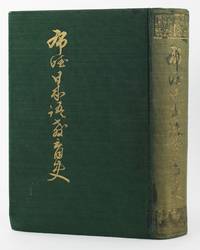
1937rif. 4006Honolulu & Tokyo 1937. About very good. 27021pp. plus plates. Original green silk over boards gilt t.e.g. Spine faded corners bumped and rubbed. Contents clean. A very rare history of Japanese-language schools in Hawaii between 1911 and 1937. The work is written entirely in Japanese and illustrated with several plates depicting school children teachers and other officials. "Once the Issei had decided to settle in Hawaii they wanted their children to become good Americans of Japanese ancestry with a command of both the English and Japanese languages and cultures. In the mid-1910s they came to feel the impact of the Americanization movement and feared that Hawaii's Japanese language schools would be attacked. Thus in 1914 to cope with this pressure the Hawaii Kyoiku Kai Japanese Educational Association of Hawaii was organized by the school principals and teachers to unify over 130 schools. In 1917 the Kyoiku Kai published their own textbooks with content suitable to Hawaii born Nisei and decided to teach only the Japanese language and moral lessons eliminating Japanese patriotic lessons and adding new lessons to encourage Japanese to become loyal Americans who would nonetheless also cherish their Japanese heritage" -- Davidann. We could not locate any copies in OCLC. Davidann Jon: Hawaii at the Crossroads of the U.S. and Japan Before the Pacific War 2008. unknown
1937rif. 4006Honolulu & Tokyo 1937. About very good. 27021pp. plus plates. Original green silk over boards gilt t.e.g. Spine faded corners bumped and rubbed. Contents clean. A very rare history of Japanese-language schools in Hawaii between 1911 and 1937. The work is written entirely in Japanese and illustrated with several plates depicting school children teachers and other officials. "Once the Issei had decided to settle in Hawaii they wanted their children to become good Americans of Japanese ancestry with a command of both the English and Japanese languages and cultures. In the mid-1910s they came to feel the impact of the Americanization movement and feared that Hawaii's Japanese language schools would be attacked. Thus in 1914 to cope with this pressure the Hawaii Kyoiku Kai Japanese Educational Association of Hawaii was organized by the school principals and teachers to unify over 130 schools. In 1917 the Kyoiku Kai published their own textbooks with content suitable to Hawaii born Nisei and decided to teach only the Japanese language and moral lessons eliminating Japanese patriotic lessons and adding new lessons to encourage Japanese to become loyal Americans who would nonetheless also cherish their Japanese heritage" -- Davidann. We could not locate any copies in OCLC. Davidann Jon: Hawaii at the Crossroads of the U.S. and Japan Before the Pacific War 2008. unknown books
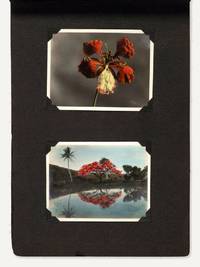
1910rif. ALB25-071910. Photo album; silver prints 174 many hand-colored. About a quarter of the album is dedicated to beautiful hand-colored photographs of native flowers plants and fruits. These images are each 3 x 4 inches and most bear subject identification in pencil on the verso of the print. There are also larger hand-colored photographs printed with holiday greetings. There are also a number of beautiful artistic views of the island completed by the well- known photographer James J. Williams including lovely moonlight views soft-focus landscape shots and some important early images of surfers. These were created earlier than the albums compilation sometimes in the teens or 20s. Also included are views of royalty; lava beds; views of traditional customs; and photographs related to the compiler's work for a Chinese mission school on the island. Back cover missing otherwise nice condition. Various sizes from 2 x 3 inches to 6 x 8 inches ; Most floral studies with specimen name on verso; other photos with J.J. Williams' stamp verso; some with personal annotations verso. ;. unknown
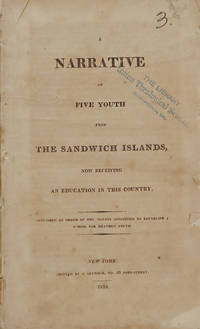
1816rif. 68845New York: Printed by J. Seymour 1816. Inspiration for the First Mission to Hawaii A rare account of the lives of the five Hawaiian youths who would come to form a core of initial students enrolled at the new Foreign Mission School established at Cornwall Connecticut in 1816. The school formed under the auspices of the American Board of Commissioners for Foreign Missions ABCFM would serve to educate foreign students in preparation for missionary work in their native lands and elsewhere. Published in 1816 A Narrative of Five Youth from the Sandwich Islands was the first of many publications intended to raise funds and stir up popular support for the new school as well as for the first Christian mission sent to the Hawaiian Islands three years later. As such it served as part of the early efforts to bring Hawaii within the cultural and commercial orbit of the United States. By the second decade of the 19th century Hawaii had become an integral part of America's burgeoning China trade serving not only as a crucial resupply hub and convenient stopover for Yankee ships sailing between North America and China and around Cape Horn but also as a lucrative source of sandalwood which American merchants traded in exchange for Chinese silk tea and porcelain. Where American merchants saw commercial possibilities however Protestant missionaries saw opportunities for Christian conversion. In April 1809 two Hawaiian youths Henry Obookiah and Thomas Hopoo arrived in New York aboard the China trade ship Triumph in the hope of receiving an education in the United States. Shortly after their arrival the two took up residence in the New Haven home of the ship's captain Caleb Brintnall. There Obookiah quickly came to the attention of several Yale students who offered to tutor him. Soon he was invited to join the household of Yale president Timothy Dwight. As John Demos explains in his history of the Foreign Mission School where Obookiah became the star student and "the most famous Hawaiian emigrant of his time" "Dwight's home was the starting point" of an eight-year odyssey "that would take Obookiah into three states eight different towns and at least a dozen separate families scattered across the New England countryside" and which culminated in his conversion to Christianity and admission to church membership in 1814. Obookiah and Hopoo were eventually joined by three other Hawaiian youths William Tennooe John Honoree and George Prince Tamoree the son of a Hawaiian king. The stories of these five youths shared "a number of common elements. All had spent time as sailors on American trade ships. Three had served at sea in the War of 1812. Most had experienced periods of extreme hardship after reaching New England.All had sooner or later found sponsors teachers and spiritual guides. All had been moved through a kind of missionary pipeline centered in New Haven but reaching out well across the Connecticut countryside" Demos. Together the five Hawaiian youths would "become the founding nucleus of an institution unlike any previously seen on American soil" Demos. The Narrative was part of a publicity campaign designed to raise funds for the new school and for an eventual mission to Hawaii. As Demos explains the Narrative originated as "a 'manuscript account'" of the "lives and prospects" of the five Hawaiian youths "written some months before by parties unknown and circulated by hand in the interim; the agents of the school were eager to arrange its publication "for the information and excitement of the Christian public.'.it was printed in New York in the last weeks of the year 1816." Such publications "capitalized on the interest in the Sandwich Islands and the islands of the Pacific that had begun gradually with the first sales of the journals and logs from the voyages of Captain Cook the much-performed pantomime of his death and the ubiquitous commercial news that related the daily comings and goings of ships from New England to the Pacific" Arista. A New Jersey issue of the Narrative appeared in the same year; it is not known which preceded the other. The text gives biographies of each of the five youths discusses their activities and experiences in America and prints various letters written by them. According to the authors the Narrative offered "a simple and authentic statement of facts respecting the youth now under the care of the agents; with specimens of their ability and improvement." The final pages discuss the establishment of the Foreign Mission School at Cornwall and include the text of the school's constitution. As the constitution states the object of the school would be "the education of heathen youth in such a manner as that.they may be qualified to become missionaries schoolmasters interpreters physicians or surgeons among heathen nations and to communicate such information in agriculture and the arts as shall tend to promote Christianity and civilization." The Narrative Demos explains "was perfectly timed to catch a rising wave of public interest in 'heathens' abroad.Not coincidentally donations to the ABCFM would soar—from just over $12000 to nearly $30000—in the year of the Mission School's founding." Tragically in 1818 two years after the publication of the Narrative Obookiah died of typhus. His Memoirs edited by Edwin Dwight were published shortly thereafter and the success of that book inspired a wave of interest in the islands which culminated in the sailing of the first missionary bark Thaddeus for Hawaii on October 23 1819. Over the course of nearly a decade from 1817 to 1826 some 100 students from around the world passed through the doors of the Foreign Mission School at Cornwall. They included Hawaiians and other Pacific Islanders; Native Americans including Cherokees Choctaws Creeks and others; students from East Asia including China India and the Malay Peninsula; and others from Europe Mexico and throughout the United States. A rare and significant piece of Hawaiiana and part of some of the earliest efforts to bring Hawaii under the cultural influence of the United States. Dbd. Stitched gathering. A few leaves loose but holding. Text lightly foxed and toned. Small section along upper edge of final leaf torn away not affecting text. Library stamp of Union Theological Seminary Richmond Virginia in blue ink to titlepage. Good. FORBES 456. SABIN 51790. AMERICAN IMPRINTS 36725 38355. John Demos The Heathen School: A Story of Hope and Betrayal in the Age of the Early Republic New York: Alfred A. Knopf 2014 pp.22 29 31-32 38-39. Noelani Arista The Kingdom and the Republic: Sovereign Hawai'i and the Early United States Philadelphia: Univ. of Pennsylvania Press 2019 pp.61-62. unknown
1816rif. 68845New York: Printed by J. Seymour 1816. Inspiration for the First Mission to Hawaii A rare account of the lives of the five Hawaiian youths who would come to form a core of initial students enrolled at the new Foreign Mission School established at Cornwall Connecticut in 1816. The school formed under the auspices of the American Board of Commissioners for Foreign Missions ABCFM would serve to educate foreign students in preparation for missionary work in their native lands and elsewhere. Published in 1816 A Narrative of Five Youth from the Sandwich Islands was the first of many publications intended to raise funds and stir up popular support for the new school as well as for the first Christian mission sent to the Hawaiian Islands three years later. As such it served as part of the early efforts to bring Hawaii within the cultural and commercial orbit of the United States. By the second decade of the 19th century Hawaii had become an integral part of America's burgeoning China trade serving not only as a crucial resupply hub and convenient stopover for Yankee ships sailing between North America and China and around Cape Horn but also as a lucrative source of sandalwood which American merchants traded in exchange for Chinese silk tea and porcelain. Where American merchants saw commercial possibilities however Protestant missionaries saw opportunities for Christian conversion. In April 1809 two Hawaiian youths Henry Obookiah and Thomas Hopoo arrived in New York aboard the China trade ship Triumph in the hope of receiving an education in the United States. Shortly after their arrival the two took up residence in the New Haven home of the ship's captain Caleb Brintnall. There Obookiah quickly came to the attention of several Yale students who offered to tutor him. Soon he was invited to join the household of Yale president Timothy Dwight. As John Demos explains in his history of the Foreign Mission School where Obookiah became the star student and "the most famous Hawaiian emigrant of his time" "Dwight's home was the starting point" of an eight-year odyssey "that would take Obookiah into three states eight different towns and at least a dozen separate families scattered across the New England countryside" and which culminated in his conversion to Christianity and admission to church membership in 1814. Obookiah and Hopoo were eventually joined by three other Hawaiian youths William Tennooe John Honoree and George Prince Tamoree the son of a Hawaiian king. The stories of these five youths shared "a number of common elements. All had spent time as sailors on American trade ships. Three had served at sea in the War of 1812. Most had experienced periods of extreme hardship after reaching New England.All had sooner or later found sponsors teachers and spiritual guides. All had been moved through a kind of missionary pipeline centered in New Haven but reaching out well across the Connecticut countryside" Demos. Together the five Hawaiian youths would "become the founding nucleus of an institution unlike any previously seen on American soil" Demos. The Narrative was part of a publicity campaign designed to raise funds for the new school and for an eventual mission to Hawaii. As Demos explains the Narrative originated as "a 'manuscript account'" of the "lives and prospects" of the five Hawaiian youths "written some months before by parties unknown and circulated by hand in the interim; the agents of the school were eager to arrange its publication "for the information and excitement of the Christian public.'.it was printed in New York in the last weeks of the year 1816." Such publications "capitalized on the interest in the Sandwich Islands and the islands of the Pacific that had begun gradually with the first sales of the journals and logs from the voyages of Captain Cook the much-performed pantomime of his death and the ubiquitous commercial news that related the daily comings and goings of ships from New England to the Pacific" Arista. A New Jersey issue of the Narrative appeared in the same year; it is not known which preceded the other. The text gives biographies of each of the five youths discusses their activities and experiences in America and prints various letters written by them. According to the authors the Narrative offered "a simple and authentic statement of facts respecting the youth now under the care of the agents; with specimens of their ability and improvement." The final pages discuss the establishment of the Foreign Mission School at Cornwall and include the text of the school's constitution. As the constitution states the object of the school would be "the education of heathen youth in such a manner as that.they may be qualified to become missionaries schoolmasters interpreters physicians or surgeons among heathen nations and to communicate such information in agriculture and the arts as shall tend to promote Christianity and civilization." The Narrative Demos explains "was perfectly timed to catch a rising wave of public interest in 'heathens' abroad.Not coincidentally donations to the ABCFM would soar—from just over $12000 to nearly $30000—in the year of the Mission School's founding." Tragically in 1818 two years after the publication of the Narrative Obookiah died of typhus. His Memoirs edited by Edwin Dwight were published shortly thereafter and the success of that book inspired a wave of interest in the islands which culminated in the sailing of the first missionary bark Thaddeus for Hawaii on October 23 1819. Over the course of nearly a decade from 1817 to 1826 some 100 students from around the world passed through the doors of the Foreign Mission School at Cornwall. They included Hawaiians and other Pacific Islanders; Native Americans including Cherokees Choctaws Creeks and others; students from East Asia including China India and the Malay Peninsula; and others from Europe Mexico and throughout the United States. A rare and significant piece of Hawaiiana and part of some of the earliest efforts to bring Hawaii under the cultural influence of the United States. Dbd. Stitched gathering. A few leaves loose but holding. Text lightly foxed and toned. Small section along upper edge of final leaf torn away not affecting text. Library stamp of Union Theological Seminary Richmond Virginia in blue ink to titlepage. Good. FORBES 456. SABIN 51790. AMERICAN IMPRINTS 36725 38355. John Demos The Heathen School: A Story of Hope and Betrayal in the Age of the Early Republic New York: Alfred A. Knopf 2014 pp.22 29 31-32 38-39. Noelani Arista The Kingdom and the Republic: Sovereign Hawai'i and the Early United States Philadelphia: Univ. of Pennsylvania Press 2019 pp.61-62. unknown books
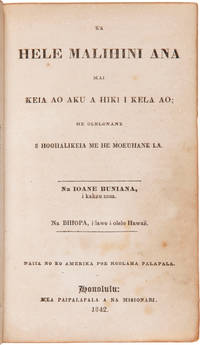
1842rif. 63627Honolulu: Mea paipalapala a na Misionari 1842. First Edition of PILGRIM'S PROGRESS in Hawaiian in a Hawaiian Binding A significant association copy of the rare first edition in Hawaiian of Bunyan's Pilgrim's Progress and the first printing in Hawaiian of an English literary classic. This copy bears a presentation inscription on the front free endpaper to C. Blake from the Rev. Elias Bond dated at Kohala Sandwich Islands September 29 1843. Reverend Bond translated at least seven books for the Mission Press between 1859 and 1868. The Hawaiian title translates as The Traveler from This World to That Which Is to Come. In 1840 the American Tract Society in Honolulu hoped to publish an abridged edition of Bunyan if a translator could be found and in 1841 Artemas Bishop took on the task promising the Society that "it will prove one of the most popular works in the Hawaiian Language." Unfortunately for Artemas and the Society the book flopped and the 10000 copies that were printed were remaindered in unbound sheets most of which were disposed of to Chinese vegetable peddlers for wrapping produce. For copies that survived this the rate of attrition as with all early Hawaiian works of this type remained very high and the book is quite scarce today. The work failed to impact the Hawaiians as the English allusions lost all meaning when translated. The names of the extensive cast of characters became incomprehensible: Mr. Lechery became Kekowale literally lust only and Mrs. Filth became Pelapela decayed flesh. Some of the surviving unbound sheets of this book were bound into limp suede in 1910. This copy on the other hand is in a contemporary Hawaiian sheep binding of the mid-19th century complete with its distinctive triangular and diamond-shaped tooling which is most unusual and notably rare. See David Forbes' BUNIANA San Francisco 1984 for an extensive discussion of the book. An important association copy in a handsome contemporary binding. 12mo. Contemporary Hawaiian sheep boards and backstrip tooled with triangular and diamond-shaped pattern rebacked with original backstrip neatly laid down. Light rubbing and staining to boards. Contemporary presentation inscription on front flyleaf see below. Minimal scattered foxing but very clean and fresh internally. Very good. FORBES 1351. JUDD 237. DAB IX p.381. hardcover
1842rif. 63627Honolulu: Mea paipalapala a na Misionari 1842. First Edition of PILGRIM'S PROGRESS in Hawaiian in a Hawaiian Binding A significant association copy of the rare first edition in Hawaiian of Bunyan's Pilgrim's Progress and the first printing in Hawaiian of an English literary classic. This copy bears a presentation inscription on the front free endpaper to C. Blake from the Rev. Elias Bond dated at Kohala Sandwich Islands September 29 1843. Reverend Bond translated at least seven books for the Mission Press between 1859 and 1868. The Hawaiian title translates as The Traveler from This World to That Which Is to Come. In 1840 the American Tract Society in Honolulu hoped to publish an abridged edition of Bunyan if a translator could be found and in 1841 Artemas Bishop took on the task promising the Society that "it will prove one of the most popular works in the Hawaiian Language." Unfortunately for Artemas and the Society the book flopped and the 10000 copies that were printed were remaindered in unbound sheets most of which were disposed of to Chinese vegetable peddlers for wrapping produce. For copies that survived this the rate of attrition as with all early Hawaiian works of this type remained very high and the book is quite scarce today. The work failed to impact the Hawaiians as the English allusions lost all meaning when translated. The names of the extensive cast of characters became incomprehensible: Mr. Lechery became Kekowale literally lust only and Mrs. Filth became Pelapela decayed flesh. Some of the surviving unbound sheets of this book were bound into limp suede in 1910. This copy on the other hand is in a contemporary Hawaiian sheep binding of the mid-19th century complete with its distinctive triangular and diamond-shaped tooling which is most unusual and notably rare. See David Forbes' BUNIANA San Francisco 1984 for an extensive discussion of the book. An important association copy in a handsome contemporary binding. 12mo. Contemporary Hawaiian sheep boards and backstrip tooled with triangular and diamond-shaped pattern rebacked with original backstrip neatly laid down. Light rubbing and staining to boards. Contemporary presentation inscription on front flyleaf see below. Minimal scattered foxing but very clean and fresh internally. Very good. FORBES 1351. JUDD 237. DAB IX p.381. hardcover books
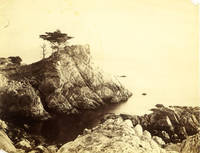
1880rif. J6SGPBJ1IXLV1880. With 12 albumen prints ranging in size from ca. 16.5 x 23 cm to 21 x 28 cm. Collection of 12 vintage photographs from the late 19th century showing China Indonesia the Hawaiian Islands California and Egypt. Of the 4 photographs of China 2 show Hong Kong including one possibly by the famous Chinese photographer Lai Fong ca. 1839-1890 showing Queen's Road Central. The two rarest photographs show several of the 7500 imperial examination cubicles in Canton Guangzhou while a photograph by A Chan Ya Zhen shows the famous five-story pagoda on Kun Yam Hill in 1870. The Indonesian island Java can be seen on 3 photographs including one of lake Telaga Warna by the British firm Woodbury & Page based in Batavia Jakarta. Taken further to the west were 3 photographs of Hawaii probably all taken in or near Honolulu. A rare undated photograph of the statue of King Kamehameha was taken probably right after the unveiling ceremony in 1883 as it shows a small wooden fence around the statue which can be seen in an illustration in The Graphic 28 April 1883 but is absent from all later images. Of the 2 final images one by Isaiah West Taber 1830-1912 shows Midway Point in Monterey California and the other by Hippolyte Arnoux fl. 1860-1890 a group of Arabs and camels waiting for the ferry near El Qantara in Egypt. Most of the photographs are worn at the edges with small tears and folds and a few have small holes; one of the images of Hawaii with a waterstain at the lower margin. AFRICA AMERICAS ART ARCHITECTURE & PHOTOGRAPHY ASIA AUSTRALIA NEW ZEALAND & PACIFIC ISLANDS Charts & Maps China Egypt Indonesia / Dutch East Indies North Africa North America Pacific Islands Photography ZZ Polynesia unknown
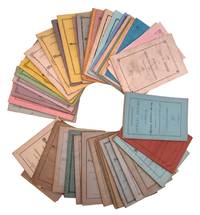
1900rif. 329931Honolulu 1900. Nearly complete run from 1853 to 1900 lacking only the Fourteenth Annual Report from 1866. 47 vols. 12mo. Original wrappers in various colors mostly in very good condition. Nearly complete run from 1853 to 1900 lacking only the Fourteenth Annual Report from 1866. 47 vols. 12mo. "This society was formed in 1852 in the 'Old Mission School House' partly as a social organization but more specifically to lend support to the Micronesian mission then getting started . reports have excerpts from letters from Luther Halsey Gulick and several native Hawaiian missionaries stationed in Micronesia. An address by Hiram Bingham Jr. on 'the cultivation of the Missionary Spirit' is in the 1857 report. The 1858 report includes an essay by Orramel Gulick on his trip to Micronesia. The president's reports found in almost every issue have continued references to local social and religious interests in Hawaii . The birth marriage and death notices and obituaries of these missionary 'Cousins' found in issue after issue are a major source of information on missionary family histories . In the twenty-fifth annual report 1876 an essay by 'Cousin' General Samuel C. Armstrong discusses his educational work with African Americans at Hampton Virginia ." Forbes. Forbes 1942; Carter p. 81; Hunnewell p. 65 unknown
1900rif. 329931Honolulu 1900. Nearly complete run from 1853 to 1900 lacking only the Fourteenth Annual Report from 1866. 47 vols. 12mo. Original wrappers in various colors mostly in very good condition. Nearly complete run from 1853 to 1900 lacking only the Fourteenth Annual Report from 1866. 47 vols. 12mo. "This society was formed in 1852 in the 'Old Mission School House' partly as a social organization but more specifically to lend support to the Micronesian mission then getting started . reports have excerpts from letters from Luther Halsey Gulick and several native Hawaiian missionaries stationed in Micronesia. An address by Hiram Bingham Jr. on 'the cultivation of the Missionary Spirit' is in the 1857 report. The 1858 report includes an essay by Orramel Gulick on his trip to Micronesia. The president's reports found in almost every issue have continued references to local social and religious interests in Hawaii . The birth marriage and death notices and obituaries of these missionary 'Cousins' found in issue after issue are a major source of information on missionary family histories . In the twenty-fifth annual report 1876 an essay by 'Cousin' General Samuel C. Armstrong discusses his educational work with African Americans at Hampton Virginia ." Forbes. Forbes 1942; Carter p. 81; Hunnewell p. 65 unknown books
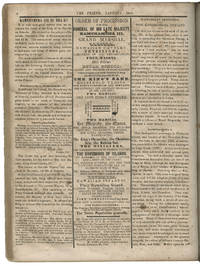
1854rif. 23745"The American Sloop-of-war SARATOGA Capt. Walker arrived at this port on the 29th ult. in 25 days from Japan which is the shortest passage ever made. The S. brings Capt. H.A. Adams U.S.N. as bearer of despatches to the Government at Washington. The point of interest in this intelligence is the fact that Com. Perry concluded a TREATY OF AMITY AND FRIENDSHIP with the EMPIRE OF JAPAN." The Friend was the mouthpiece of Congregational missionaries and reported everything from important local Hawaiian issues to international news reprinted from eastern sources. The nine months covered here feature a great deal of the news of the day ranging from war between England and Russia to lots of whaling and maritime news including shipping arrivals and departures the discovery of new sperm whaling grounds naval intelligence all peppered with a liberal dose of good old fashioned conservative proselytizing. This particular volume was sent from Sag Harbor New York to Thomas Spencer a Rhode Island sea captain who went native opening a successful ship's chandlery and marrying a local girl. HAWAII.Newspapers. Bound volume of The Friend Honolulu HI containing 22 consecutive issues dated from Feb 1 1854 through Oct 25 1855. This volume has the first report of the death of Hawaiian King Kamehameha III including the order of procession Jan 1 1855 issue and the first report of the signing of the US-Japan Treaty negotiated by Commander Matthew Perry May 6 1854 issue and an Independence Day celebration July 6 1854 issue. The Friend was a local newspaper published from 1843 to 1954. Published by and for the missionaries it is invaluable as a source of information concerning the activities experiences and accomplishments of the 19th-century Congregational missionaries to Hawaii as well as 20th-century figures and the development of the United Church of Christ in Hawaii. Today The Friend is the newsletter of the Hawaii Conference of the United Church of Christ. Thomas Spencer 1815-1884 was a whaling captain out of Warwick Rhode Island. He was stranded in the Sandwich Islands Hawaii and decided to remain there. He opened a very successful ship's chandlery in Honolulu and later purchased property on the "big" island in the village of Hilo. His brothers also joined him in Hawaii. He was a notorious celebrity well-liked by all and especially supportive of the Hawaiian royal family. He is buried in Oahu. The children of Thomas Spencer and Makaleka Margaret Robinson were Thomas Spencer Jr. and Charles Lucy Jennie Lily Helen Margaret and Kaliko Spencer.
1854rif. 23745"The American Sloop-of-war SARATOGA Capt. Walker arrived at this port on the 29th ult. in 25 days from Japan which is the shortest passage ever made. The S. brings Capt. H.A. Adams U.S.N. as bearer of despatches to the Government at Washington. The point of interest in this intelligence is the fact that Com. Perry concluded a TREATY OF AMITY AND FRIENDSHIP with the EMPIRE OF JAPAN." The Friend was the mouthpiece of Congregational missionaries and reported everything from important local Hawaiian issues to international news reprinted from eastern sources. The nine months covered here feature a great deal of the news of the day ranging from war between England and Russia to lots of whaling and maritime news including shipping arrivals and departures the discovery of new sperm whaling grounds naval intelligence all peppered with a liberal dose of good old fashioned conservative proselytizing. This particular volume was sent from Sag Harbor New York to Thomas Spencer a Rhode Island sea captain who went native opening a successful ship's chandlery and marrying a local girl. HAWAII.Newspapers. Bound volume of The Friend Honolulu HI containing 22 consecutive issues dated from Feb 1 1854 through Oct 25 1855. This volume has the first report of the death of Hawaiian King Kamehameha III including the order of procession Jan 1 1855 issue and the first report of the signing of the US-Japan Treaty negotiated by Commander Matthew Perry May 6 1854 issue and an Independence Day celebration July 6 1854 issue. The Friend was a local newspaper published from 1843 to 1954. Published by and for the missionaries it is invaluable as a source of information concerning the activities experiences and accomplishments of the 19th-century Congregational missionaries to Hawaii as well as 20th-century figures and the development of the United Church of Christ in Hawaii. Today The Friend is the newsletter of the Hawaii Conference of the United Church of Christ. Thomas Spencer 1815-1884 was a whaling captain out of Warwick Rhode Island. He was stranded in the Sandwich Islands Hawaii and decided to remain there. He opened a very successful ship's chandlery in Honolulu and later purchased property on the "big" island in the village of Hilo. His brothers also joined him in Hawaii. He was a notorious celebrity well-liked by all and especially supportive of the Hawaiian royal family. He is buried in Oahu. The children of Thomas Spencer and Makaleka Margaret Robinson were Thomas Spencer Jr. and Charles Lucy Jennie Lily Helen Margaret and Kaliko Spencer. books
1798rif. PHO-1092Deuxième reliure de la première édition. Édition originale in-4 sur grand papier, remise en circulation en 1841 avec un nouveau titre avec la mention fictive "nouvelle édition" (quelques exemplaires imprimés en 1798 n'avaient toujours pas trouvé preneur). Une édition octavo en six volumes a également été publiée. in-4 ,y compris l'atlas. Avec 16 (10 dépliantes) dont 15 cartes gravées, 1 planche gravée et table dépliante. - Beau demi-cuir contemp , dos lisse avec titre et tomaison , petits manques au dos , quelques mouillures intermittentes et vieille trace d’humidité (T1), déchirure carte hydrographique sans manque. xii, cxliv, 628, [3] ; xvi, 676, [2] ;[xi], 431, [1];[2],viii, 158pp.
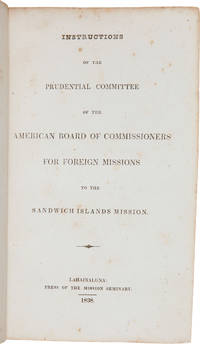
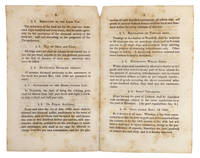
1838rif. 66226Lahainaluna: Press of the Mission Seminary 1838. Instructions for Missionaries Printed in Hawaii A collection of the original instructions issued to each of eight groups of Christian missionaries sent to Hawaii between 1819 and 1836 by the American Board of Commissioners for Foreign Missions ABCFM. It is a relatively early Lahainaluna imprint printed in an edition of 380 copies. "This work contains the Act of Incorporation of the ABCFM State of Massachusetts signed by Caleb Strong Governor and Alden Bradford Secretary of the Commonwealth 20 June 1812 together with the laws and regulations of the same body. Following this are the parting instructions given to each of the first eight companies of missionaries to the Hawaiian Islands…by Samuel Worcester Jeremiah Evarts David Greene B.B. Wisner and Rufus Anderson. A complete list of each company including the Hawaiians is found on pages 119-122.Rev. Clark's account of printing for the year ending February 28 1839 includes this work and shows a production cost of $30. The printed minutes of the 1839 General Meeting record 380 copies printed" - Forbes. The ABCFM was an interdenominational body composed primarily of New England Congregationalists and Presbyterians whose "attention.was called to the Hawaiian Islands by reports of traders and by the presence in New England of several native youth from these islands.The Protestant Christian community of New England became interested in these young Sandwich Islanders and in the possibility that they might become Christian messengers to their own people.The sending of missionaries to Hawaii followed as the next logical step" Kuykendall. This first group of missionaries sent by the ABCFM to Hawaii included two ordained ministers Hiram Bingham and Asa Thurston a physician two schoolmasters and catechists a printer a farmer; their wives and three Hawaiian youths who had been attending the Foreign Mission School in Cornwall Connecticut. In their set of instructions to this first group of missionaries the ABCFM said that it was God's ".gracious pleasure and his high command that his gospel should be preached to them the people of Hawaii; that they may be turned from darkness unto light – be baptized in the name of the Father and of the Son and of the Holy Ghost and taught to observe all things whatsoever he has commanded for their salvation and for his everlasting honor and praise." An important and uncommon text tracing the early history of the American Christian missionary movement and the ABCFM in Hawaii between 1819 and 1836 complete with the names of the missionaries sent by the ABCFM and the goals they were expected to achieve during their respective stays in Hawaii. Contemporary cloth-backed paper boards. Spine neatly repaired boards lightly soiled and rubbed. Light foxing some slight worming in gutter margin with minute loss to text. Very good. FORBES HAWAII 1086. Ralph S. Kuykendall The Hawaiian Kingdom Vol. 1 1778-1854: Foundation and Transformation Honolulu: Univ. of Hawaii Press pp.102-4. hardcover
1838rif. 66226Lahainaluna: Press of the Mission Seminary 1838. Instructions for Missionaries Printed in Hawaii A collection of the original instructions issued to each of eight groups of Christian missionaries sent to Hawaii between 1819 and 1836 by the American Board of Commissioners for Foreign Missions ABCFM. It is a relatively early Lahainaluna imprint printed in an edition of 380 copies. "This work contains the Act of Incorporation of the ABCFM State of Massachusetts signed by Caleb Strong Governor and Alden Bradford Secretary of the Commonwealth 20 June 1812 together with the laws and regulations of the same body. Following this are the parting instructions given to each of the first eight companies of missionaries to the Hawaiian Islands…by Samuel Worcester Jeremiah Evarts David Greene B.B. Wisner and Rufus Anderson. A complete list of each company including the Hawaiians is found on pages 119-122.Rev. Clark's account of printing for the year ending February 28 1839 includes this work and shows a production cost of $30. The printed minutes of the 1839 General Meeting record 380 copies printed" - Forbes. The ABCFM was an interdenominational body composed primarily of New England Congregationalists and Presbyterians whose "attention.was called to the Hawaiian Islands by reports of traders and by the presence in New England of several native youth from these islands.The Protestant Christian community of New England became interested in these young Sandwich Islanders and in the possibility that they might become Christian messengers to their own people.The sending of missionaries to Hawaii followed as the next logical step" Kuykendall. This first group of missionaries sent by the ABCFM to Hawaii included two ordained ministers Hiram Bingham and Asa Thurston a physician two schoolmasters and catechists a printer a farmer; their wives and three Hawaiian youths who had been attending the Foreign Mission School in Cornwall Connecticut. In their set of instructions to this first group of missionaries the ABCFM said that it was God's ".gracious pleasure and his high command that his gospel should be preached to them the people of Hawaii; that they may be turned from darkness unto light – be baptized in the name of the Father and of the Son and of the Holy Ghost and taught to observe all things whatsoever he has commanded for their salvation and for his everlasting honor and praise." An important and uncommon text tracing the early history of the American Christian missionary movement and the ABCFM in Hawaii between 1819 and 1836 complete with the names of the missionaries sent by the ABCFM and the goals they were expected to achieve during their respective stays in Hawaii. Contemporary cloth-backed paper boards. Spine neatly repaired boards lightly soiled and rubbed. Light foxing some slight worming in gutter margin with minute loss to text. Very good. FORBES HAWAII 1086. Ralph S. Kuykendall The Hawaiian Kingdom Vol. 1 1778-1854: Foundation and Transformation Honolulu: Univ. of Hawaii Press pp.102-4. hardcover books
1843rif. 68824Lahainaluna: Seminary Press 1843. Early Hawaiian Laws Including Those Relating to Whaling and Divorce An exceedingly rare early Hawaiian imprint. The work is a supplement to the English translation of Ke Kumu Kanawai a Me Na Kanawai o Ko Hawaii Pae Aina Forbes 1337. It contains ten laws and resolutions approved by Hawaiian King Kamehameha III and the premier Kekauluohi "at the council house at Luaehu Lahaina Maui Sandwich Islands." The laws and resolutions themselves deal with land leases taxes on land and pets the timing of the evening guns divorce whaling public auctions tonnage dues ship clearances the removal of duties on gold and silver exports and the payment of jurors. The laws had to be submitted for approval to the British commission that exercised temporary control over Hawaii between February and July 1843 and it is noted in the penultimate paragraph "All the foregoing laws.will take effect after being communicated to the British Commission and proclaimed at each of the principal islands." The resolution on "Respecting Divorced Persons" is especially interesting. This resolution allowed among other things all "divorced persons" not just men to remarry if their divorce was granted before the 1840 Constitution was adopted. The 1840 Hawaiian Constitution had placed certain restrictions on remarriage for both divorced men and women. For instance in cases of adultery the guilty party whether a man or a woman was forbidden to remarry while the former partner was alive. An absence of four years whether through criminal confinement or overseas service or some other reason was often grounds for divorce and remarriage for the party who remained in Hawaii. If a husband tried to kill his wife or vice versa the offending party was not allowed to remarry. The present resolution provided for all those who divorced before the 1840 Constitution to remarry no matter the reason for the divorce. The resolution regarding whaling ships is also notable. It allows whalers to barter or sell up to $200 worth of goods duty free "for the purpose of procuring refreshments." If a whaling ship barters or sells more than the $200 threshold "they shall pay the customary duties." This is likely a reaction to laws or regulations set down in other Pacific ports during the golden age of the whaling industry when Hawaii was an important port of call for ships of all nations. "The edition is unknown. This is not recorded in reports of either the 1843 or 1844 General Meetings. Because of its small size it was doubtless part of the category 'small jobs ship lists government protests &c.' in the 1844 minutes" - Forbes. Forbes lists no references for the work and the location of only eight copies all in Hawaii. OCLC locates copies to only three institutions: Yale University University of Hawaii at Manoa and Bishop Museum Library. An uncommon and elusive early Hawaiian legal work that touches upon women's issues and the whaling industry at the height of its prominence in the world economy. 12mo. Original printed self-wrappers. Small chip at head of spine just separating at lower fold minor foxing. Very good. FORBES 1393. OCLC 862079031. unknown
1843rif. 68824Lahainaluna: Seminary Press 1843. Early Hawaiian Laws Including Those Relating to Whaling and Divorce An exceedingly rare early Hawaiian imprint. The work is a supplement to the English translation of Ke Kumu Kanawai a Me Na Kanawai o Ko Hawaii Pae Aina Forbes 1337. It contains ten laws and resolutions approved by Hawaiian King Kamehameha III and the premier Kekauluohi "at the council house at Luaehu Lahaina Maui Sandwich Islands." The laws and resolutions themselves deal with land leases taxes on land and pets the timing of the evening guns divorce whaling public auctions tonnage dues ship clearances the removal of duties on gold and silver exports and the payment of jurors. The laws had to be submitted for approval to the British commission that exercised temporary control over Hawaii between February and July 1843 and it is noted in the penultimate paragraph "All the foregoing laws.will take effect after being communicated to the British Commission and proclaimed at each of the principal islands." The resolution on "Respecting Divorced Persons" is especially interesting. This resolution allowed among other things all "divorced persons" not just men to remarry if their divorce was granted before the 1840 Constitution was adopted. The 1840 Hawaiian Constitution had placed certain restrictions on remarriage for both divorced men and women. For instance in cases of adultery the guilty party whether a man or a woman was forbidden to remarry while the former partner was alive. An absence of four years whether through criminal confinement or overseas service or some other reason was often grounds for divorce and remarriage for the party who remained in Hawaii. If a husband tried to kill his wife or vice versa the offending party was not allowed to remarry. The present resolution provided for all those who divorced before the 1840 Constitution to remarry no matter the reason for the divorce. The resolution regarding whaling ships is also notable. It allows whalers to barter or sell up to $200 worth of goods duty free "for the purpose of procuring refreshments." If a whaling ship barters or sells more than the $200 threshold "they shall pay the customary duties." This is likely a reaction to laws or regulations set down in other Pacific ports during the golden age of the whaling industry when Hawaii was an important port of call for ships of all nations. "The edition is unknown. This is not recorded in reports of either the 1843 or 1844 General Meetings. Because of its small size it was doubtless part of the category 'small jobs ship lists government protests &c.' in the 1844 minutes" - Forbes. Forbes lists no references for the work and the location of only eight copies all in Hawaii. OCLC locates copies to only three institutions: Yale University University of Hawaii at Manoa and Bishop Museum Library. An uncommon and elusive early Hawaiian legal work that touches upon women's issues and the whaling industry at the height of its prominence in the world economy. 12mo. Original printed self-wrappers. Small chip at head of spine just separating at lower fold minor foxing. Very good. FORBES 1393. OCLC 862079031. unknown books
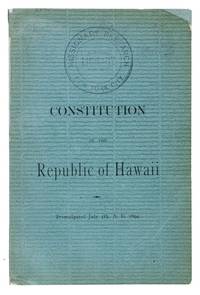
1894rif. H6TGCND412W1Honolulu 1894. Stapled leaves in publisher's original turquoise wrappers paste-paper imitating laid paper colourfully reproducing chain and laid lines with letterpress title on front. Kept in modern half morocco clamshell box. 22 x 14.5 cm. The 56-page issue plus index of the first edition of Hawaii's last constitution as a sovereign country containing 103 numbered articles. When in 1893 Queen Liliuokalani of Hawaii was overthrown she was replaced by a provisional government consisting of members of the American Committee of Safety striving to achieve annexation of Hawaii to the United States of America. When annexation was not forthcoming they set up a constitutional convention and adopted the present constitution for the Republic of Hawaii. The annexation was finally ratified four years later the transfer of sovereignty taking place in August 1898. "The present constitution is among the more important pieces of literature pertinent to these times" Streeter.Forbes notes that page 56 is unnumbered and blank "56 blank" but in this copy it is numbered and contains the last names of the members of the constitutional convention. The present copy includes the 6-page index often lacking.With a library stamp on front wrapper the spine of the wrapper reinforced. A very good copy.l Forbes 4569 55-page issue; Streeter 3766 55-page issue; cf. A.F. Lee The Hawaii state constitution: a reference guide 1993 p. 5. unknown
1850rif. 18971(Hawaii vers 1850) marie-louise et encadrement modernes
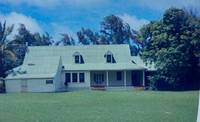
1967rif. 56001Honolulu HI & Kohala HI: Frost & Frost 1967-1972. Archive. Approx. 820 photographs 760 are 3.25 x 4.5 in. black & white silver gelatin; 40 colour photos damage to 10 or so from dampstaining at margin affecting image all photos carefully marked in black & red ink codes keyed to the film negatives also included with the archive many with photo lab stamp on verso a few with annotations on versos; more than 30 contact negative print strips; 257 strips of film photo negatives with over 1000 images majority .35 mm. film stock about 30% in colour; 70 strips of larger 4 x 5 negatives with most of those in colour nearly all preserved in original wax paper negative sleeves and almost all carefully marked in pen with numbers corresponding to the printed photos as well as manuscript annotations indicating places objects as well as some dates added in manuscript or in date codes; 8vo. 35 loose sheets held together with metal clip in pencil & ink manuscript dated 1972 diagrams illustrations some edgewear foxing to first & last leaves minor insect predation to outer leaves still VG- exemplar. This noteworthy archive consisting of over 820 original photographs and over 1000 individual negative images provides an essential visual record of the historic archaeological and architectural surveys carried out by the Frosts for the Hawaiian Mission Children’s Society beginning in 1967 in the Bond Historic District located in the Iole Ahupua’a one of the few remaining traditional land divisions in Hawaii. The Bond homestead Kalahikiola Church the Kohala Seminary and attached medical doctor’s office are all located within the Bond District and the well preserved homestead was first established by Rev. Elias Bond 1813-1896 in 1841 with the Kalahikiola Church completed in 1855 rebuilt after devastating earthquake in 2006 and the Kohala girl’s school founded in 1872. The hundreds of photos show the household objects textiles tools furnishings documents artwork books equipment and more all accumulated from 1841 through 1930 by the Bond family. Elias and his wife Ellen had sailed with the Ninth Company of Missionaries from Boston and settled at Kohala HI in the mission established by Rev. Isaac Bliss who had completed the main building before their arrival. The Bond’s immediately began adding additional buildings such as the wash house archway & walls foundations of woodshed and carpenter sheds as well as begun work on the Kalahikiola Church. Rev. Bond had founded the Kohala Sugar Co. in 1862 as “The Missionary Plantation” to support his church and schools and he refused to institute the slave-like labor conditions of other sugar growers in the Hawaiian Islands. The profits made the Kohala Sugar Co. one of the largest benefactors to other missions operating for 110 years. Many of the artifacts depicted appear to have been accumulated and used by Dr. Benjamin Bond 1853-1930 his son who finished medical school at the Univ. of Michigan in 1882 and returned to live and work on the homestead with a doctor’s office attached to the main house in 1884 for his practice. After Dr. Bond married Emma Mary Renton 1866-1951 in 1889 a wood-framed cottage was added at the East end for them. In addition a small shed was expanded to shelter a horse carriage and single horse stall for emergency medical calls. A series of photos shows the scene of the Frost’s driving to the homestead and then heading into the Bond properties. The photos meticulously document the china glassware stoneware needlepoint & embroidery samples an ABC sampler by Eliza Bond signed 1817 silver flatware bellows original photos & illustrations of homestead buildings chairs large benches and sideboards. The kitchen cooking implements cookware and equipment receive significant attention with photos showing the ancient kitchen burners hot water tank propane or oil-fired stove historic coral stone chimney dining chairs and more. Of particular interest are the extended series of images depicting the artifacts medical instruments and furnishings in Dr. Bond’s office including his book collection Chautauqua desk large safe dried medical herbs razors astronomy atlas anatomy atlas diagrams eyeglasses glass beakers pharmacy tools and much more. Also included are photos of abandoned boxes for chemical and pharmaceutical supplies in the attic. The breadth of clothing textiles toiletry items jewelry rope beds architectural elements family photos a Chinese compass art easel and more reflect the growing affluence of the family not only from Dr. Bond’s practice but also as the sugar production and mill expand however with much of the profit still being devoted to Mission Society projects. The negatives and photos also show the wagons used by the doctor and his family the extensive tools employed on the homestead to maintain not only the family holdings but also the Church and Girl’s School buildings. Photos also show a bookpress bottles sawmill equipment a rock crusher installed for road paving and more. After Dr. Bond’s death the buildings were maintained by a special trust fund which terminated in 1968 and subsequent to that time a family corporation helped finance the care of the estate. The manuscript diagrams and notes by the Frost indicate where windows were replaced from the original when electrical work was done on the property improvements to the buildings where the hallway from the shop to kitchen was located the women’s toilet pantry cupboards and rough charts and maps of locations of buildings and objects on some of the walls. For a time the Industrial Building housing 12 occupational students and one teacher continued to operate but in 1955 the school stopped functioning. For over a decade the properties were used for conferences retreats and camping grounds but eventually they became unoccupied and unused so they were in very poor condition when surveyed by the Frosts over three years. The Frosts prepared a very scarce photo album and report consisting of 6 pages of text and 12 leaves containing 82 tipped-in photos in January 1968 followed by a Feasibility Study for the Hawaiian Mission Children’s Society in 1969 but we could find no similar extant collection of these photographs or records of this historical survey. The National Register Survey was completed in 1973 and then filed in 1977 finally approved in 1978 for adding the properties to the National Register. See: Laura Souliere & Nathan Napoka Father Elias Bond District SE of Kapaau off Highway 27 National Register of Historic Places March 30 1978; Frost & Frost Report of an Inspection Visit to the Bond House Complex 1840-1968 in Kohala Hawaii January 11 & 12 1968; Land of Iole Kohala Institute 2018; Rebekah Oe-Len Kehaulani Luke My Grandfather Chong’s House Rebekah’s Studio 2011; Edward Beechert The Reverend Mr. Bond and Kohala Plantation Working in Hawaii: A Labor History 1985 pp. 71-72. Frost & Frost, hardcover
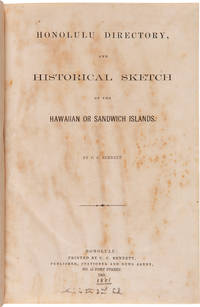
1869rif. 57593Honolulu: Printed by C.C. Bennett 1869 i.e. 1871. Revised Edition of the First Honolulu Directory The second revised edition of the first Honolulu directory printed personally by the author at his book and stationery store on Fort Street. Compared to the first edition of 1869 this 1871 edition contains an additional three pages of text which extend the historical sketch to the latter date and the directory entries are printed in a single column instead of double along with other minor adjustments. The majority of the volume is taken up by a detailed history of the islands beginning with "Discovery by Gaetano and Mendana" and featuring a "Visit by Cook" as opposed to the first edition which begins with "Discovery by Cook". The following sketch covers the reign of Kamehameha I the arrival of the first Christian missionaries and details of various political and diplomatic incidents including the arrival of Catholicism the LaPlace affair the provisional cession of 1843 a brief paragraph referencing the California Gold Rush and more. Along with historical details the author of the history who Forbes identifies as journalist Henry Sheldon provides a variety of other pieces of information including on the Bible's translation in Hawaiian the entirety of the 1852 constitution a detailed passage on Hawaiian manners and customs and a dissection of the Islands' declining population. At least one contemporary reader was unimpressed by Bennett's improvements however - H.M. Whitney reviewed the second edition in his weekly Pacific Commercial Advertiser declaring it "the worst specimen of printing in book form that has ever been given to the Honolulu public." The directory proper begins on page eighty-one and runs for the next twenty unnumbered pages. Residents and businesses are listed by name usually along with a profession and street address. At the end of the directory is an additional list of "Traders and Planters on the Other Islands." In this copy an index leaf from the first edition the second page of which is numbered 88 is bound in at the rear; interestingly despite the changes between editions the page numbers listed remain accurate. Both editions of this directory are quite scarce and this second much more so. While Rare Book Hub locates four copies of the 1869 edition at auction in the past twenty years not copy of this 1871 edition is noted since a copy at the auction of the Henry C. Carter collection at Anderson Galleries in 1908. OCLC locates only four copies at the Library of Congress University of Hawaii at Manoa American Antiquarian Society and Harvard. Forbes adds the Hawaiian Historical Society Hawaiian Mission Children's Society Library and Hawaii State Library. An uncommon and important early Hawaiian directory. Pebbled purple cloth front board stamped in gilt. Spine sunned boards lightly stained. Text lightly tanned scattered light foxing index leaves trimmed quite close at head without touching text lacking advertisement leaves. Inscription of the Library of the Hawaiian Board on front pastedown and their gilt initials on front board. A very good copy. FORBES 2890. OCLC 1091236492 71531611 191271313. hardcover
1869rif. 57593Honolulu: Printed by C.C. Bennett 1869 i.e. 1871. Revised Edition of the First Honolulu Directory The second revised edition of the first Honolulu directory printed personally by the author at his book and stationery store on Fort Street. Compared to the first edition of 1869 this 1871 edition contains an additional three pages of text which extend the historical sketch to the latter date and the directory entries are printed in a single column instead of double along with other minor adjustments. The majority of the volume is taken up by a detailed history of the islands beginning with "Discovery by Gaetano and Mendana" and featuring a "Visit by Cook" as opposed to the first edition which begins with "Discovery by Cook". The following sketch covers the reign of Kamehameha I the arrival of the first Christian missionaries and details of various political and diplomatic incidents including the arrival of Catholicism the LaPlace affair the provisional cession of 1843 a brief paragraph referencing the California Gold Rush and more. Along with historical details the author of the history who Forbes identifies as journalist Henry Sheldon provides a variety of other pieces of information including on the Bible's translation in Hawaiian the entirety of the 1852 constitution a detailed passage on Hawaiian manners and customs and a dissection of the Islands' declining population. At least one contemporary reader was unimpressed by Bennett's improvements however - H.M. Whitney reviewed the second edition in his weekly Pacific Commercial Advertiser declaring it "the worst specimen of printing in book form that has ever been given to the Honolulu public." The directory proper begins on page eighty-one and runs for the next twenty unnumbered pages. Residents and businesses are listed by name usually along with a profession and street address. At the end of the directory is an additional list of "Traders and Planters on the Other Islands." In this copy an index leaf from the first edition the second page of which is numbered 88 is bound in at the rear; interestingly despite the changes between editions the page numbers listed remain accurate. Both editions of this directory are quite scarce and this second much more so. While Rare Book Hub locates four copies of the 1869 edition at auction in the past twenty years not copy of this 1871 edition is noted since a copy at the auction of the Henry C. Carter collection at Anderson Galleries in 1908. OCLC locates only four copies at the Library of Congress University of Hawaii at Manoa American Antiquarian Society and Harvard. Forbes adds the Hawaiian Historical Society Hawaiian Mission Children's Society Library and Hawaii State Library. An uncommon and important early Hawaiian directory. Pebbled purple cloth front board stamped in gilt. Spine sunned boards lightly stained. Text lightly tanned scattered light foxing index leaves trimmed quite close at head without touching text lacking advertisement leaves. Inscription of the Library of the Hawaiian Board on front pastedown and their gilt initials on front board. A very good copy. FORBES 2890. OCLC 1091236492 71531611 191271313. hardcover books
1980rif. 2080202102900002Honpo shoseki 1980. Soft Cover. Fine. Books: 14 books Honpo shoseki paperback
1833rif. PHO-2302Paris, Imprimerie Royale, Arthus Bertrand, au dépôt général de la marine, 1833-1839. 5 vol. in-8 (25,5x16,5cm) demi-chevrette rouge, dos à nerfs orné (reliure de l'époque), supplément lépidoptères broché de I. [2] ff.-xli-558-[1] pp. ; II. [2] ff.-481-[1] pp., grande carte dépliante (piqûres, coupures aux pliures sans manque) ; III. [2] ff.-510-[1] pp. ; IV. [2] ff.- 480 pp. ; V. [2] ff., 195-200 pp., Supplément Lépidoptères 30pp., 70 planches dont 61 soigneusement aquarellées. Rousseurs touchant principalement le texte et très peu les planches, mouillures claires par endroits au texte, feuillets volants pour le supplément. Sans les deux grands atlas historique et hydrographique, mais bien complet du très rare 5e volume d'histoire naturelle, paru ultérieurement qui manque presque toujours et complet des planches. Ce rarissime cinquième et dernier volume de texte, qui comporte 2 parties, renferme le rapport fait à l'Académie des sciences le 4 février 1833 sur les collections d'histoire naturelle recueillies pendant le voyage de la corvette La Favorite…, les Recherches sur les marsupiaux par Fortuné Eydoux et Laurent, la 2e partie Zoologie par Fortuné Eydoux et Paul Gervais, le supplément sur les Lépidoptères nouveaux par Feisthamel.
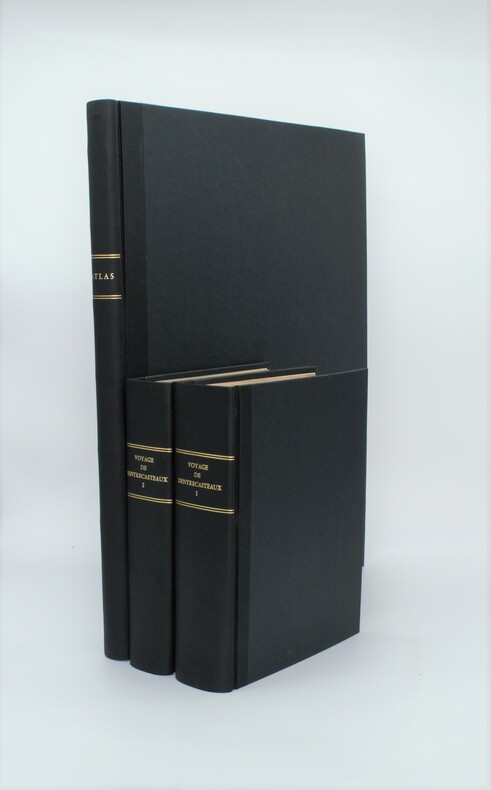
1807rif. PHO-1A Paris, Dépôt général des Cartes et Plans de la Marine et des Colonies, 1807 et De L’Imprimerie Impériale, 1808 RARE ENSEMBLE COMPLET en 3 volumes TEXTE ; 2 forts vol. in-4° ; (2)-LVI-704 pp.-32 pl. h.-t. repliées in-fine (I-XXXII)/(2)-VIII-692 pp.-1 pl. h.-t. Repliée sur papier bleuté , relié demi cuir , dos lisse avec titre et tomaison , tranches mouchetées , mouillure angulaire sur 7 planches, petites rousseurs sur les planches . ATLAS ; 1 volume grand in-folio (560x445) ,page de titre-1 fnch. (Table )-39 cartes et vues h.-t. , dont 29 à double page ,dressées par l'ingénieur hydrographe C. F. Beautemps Beaupré et gravées sur cuivre par E. Collin , relié demi cuir , dos lisse ,cachets répétés , petites rousseurs .