1 157 résultats
réf. SONG0813930944Used: Good unknown
réf. SONG082483075XUsed: Good unknown
réf. SONG0910240264Used: Good unknown
réf. SONG0916630544Used: Good unknown
réf. SONG1558680632Used: Good unknown
réf. SONG0824817303Used: Good unknown
réf. SONG9810226837Used: Good unknown
1819réf. 377917Elizabethtown NJ: Edson Hart 1819. Second edition. Frontispiece portrait. 104 32 33 10 10 pp. Five parts in one with sectional title pages. 12mo. Contemporary mottled sheep red morocco spine label. Joints rubbed and just starting. Light foxing throughout. Very good. Second edition. Frontispiece portrait. 104 32 33 10 10 pp. Five parts in one with sectional title pages. 12mo. ʻŌpūkahaʻia c.1792-1818 came from Hawaii to New Haven Connecticut in 1807 following the death of his parents. There he met Dwight and was eventually housed and tutored by relative Timothy Dwight IV then president at Yale College and a founder of the American Board of Commissioners for Foreign Missions. Today ʻŌpūkahaʻia is best known as one of the first Hawaiians to convert to Christianity and an early translator of the Hawaiian language into English. His desire to become a missionary was among the inspirations for the opening of the Foreign Mission School in Cornwall Connecticut which published this posthumous biography. It was issued with a sermon delivered at ʻŌpūkahaʻia's funeral by Lyan Beecher and three other pieces related to the founding of the Foreign Mission School. Sabin 56429; Felcone 556 Edson Hart unknown
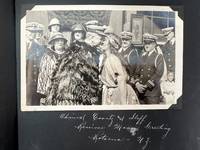
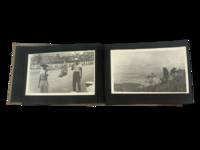
1925réf. 239961925. U.S. Navy Pacific fleet cruise photo album documenting naval service and Indigenous encounters during Admiral Robert E. Coontz's 1925 deployment to Australia and New Zealand. The inscription "Property of J. J. Prieskop. U.S.S. Seattle band" identifies its owner as a musician associated with the fleet flagship. Following major exercises in Hawaiian waters the fleet crossed the Pacific for a voyage combining naval training with public receptions and a demonstration of American maritime reach. www.history.navy.mil At Rotorua Te Arawa hosts welcomed the visiting officers at Ohinemutu where speeches and exchanges of gifts connected MÄori hospitality with hopes for closer British-American friendship. Photo album containing approximately 260 silver gelatin photographs ranging from 2.5 x 3 to 8.5 x 5.5 inches United States and Pacific locations chiefly circa 1925 mostly mounted with corner holders on black paper leaves with numerous contemporary handwritten captions. Coontz wears a feather cloak while exchanging a hongi the MÄori greeting involving the pressing together of noses beneath "Admiral Coontz and staff receives Maori greeting Rotorua - N.Z." Samoan performers carry weapons beneath "Samoan warriors in war dance" while other scenes record sailors visiting vendors and a canoe approaching the ship. Hawaiian women perform with musicians before a commercial backdrop beneath "Hula dancers in Lahaina - 6/25." A portrait printed "'Maori' South Sea Island Belle" presents a woman holding a patu its promotional wording distinguishing commercial souvenir portraiture from the formal Rotorua reception. Sailors handle coal beneath "Coaling ship" and "In coal barge"; additional naval scenes include USS Tennessee's 14-inch gun turrets and costumed equator-crossing festivities. A band portrait dated June 1925 at Lahaina Roads Maui bears handwritten identifications of individual musicians including Prieskop while supporting scenes include horses and a rodeo captioned Oak Grove Portland Oregon. Additional photographs document encounters with Samoan communities including ceremonial performers groups of local residents and American sailors interacting with vendors. One image bears the contemporary caption "Samoan Warriors in War dance" reflecting both the cultural performance depicted and the terminology employed by American observers. Another photograph captioned "Hula dancers in Lahaina - 6/25" records Hawaiian women performing with musicians before a commercial backdrop documenting the presentation of Indigenous culture to visiting naval personnel. The album is particularly valuable for its combination of naval history and Indigenous Pacific encounters. It records the broader cultural and diplomatic dimensions of American naval expansion including the ways MÄori Samoan and Hawaiian communities received interacted with and were represented by visiting American servicemen. Visible wear includes chipped album leaves vacant mounts scattered fading and staining and tears or edge losses to some photographs. Overall good condition. A substantial and historically engaging photographic record of the U.S. Navy's 1925 Pacific deployment distinguished by its identified images of Admiral Coontz and the USS Tennessee a MÄori diplomatic greeting at Rotorua Samoan ceremonial performances Hawaiian hula dancers and named naval musicians-documenting both American maritime power and its encounters with Indigenous Pacific cultures during the interwar era. unknown
réf. 8901276577.Gpaperback. Good. Access codes and supplements are not guaranteed with used items. May be an ex-library book. paperback
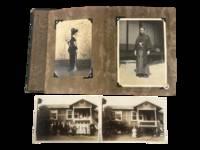
1930réf. 227421930. Japanese-American Hawaii Japanese American military family photograph album 1930s documenting everyday life of a Nisei household in interwar Hawaii and tracing the transpacific connections linking Japanese American communities with Japan and Japanese occupied Manchuria. The photographs record family relationships social gatherings military friendships and overseas travel at a time when second generation Japanese Americans were negotiating identity within both American and Japanese spheres of influence. Handwritten captions written in the first person suggest the compiler was a Nisei man with associations to the United States Army referring to relatives and companions as "My father" "My sis Chiyo" and identifying a group of men in a tropical field as "China Souza Manuel myself Choy" further captioned "Army Buddies." During the 1930s Japanese Americans faced significant barriers to military advancement on the mainland United States yet Hawaii's National Guard accepted some Nisei soldiers prior to the Second World War due in part to the islands' large Japanese population. The album therefore documents a rare prewar moment when Japanese American military participation and family life intersected within the broader social landscape of Hawaii. Photo album compiled during the 1930s containing approximately 103 original silver gelatin photographs mounted to brown paper leaves and annotated in ink identifying individuals and locations. Bound in green pebbled boards titled "Photo Album" in gilt on the cover. Each photo measures approximately 2.5 x 3.5 inches to 5 x 7 inches. Album measures approximately 6 x 9.5 inches. The images depict family gatherings beach excursions on Oahu graduations and informal portraits of relatives and friends. Early pages include a graduation photograph of Edna Omatsu and portraits of family members including Uneiko members of the Takayama family Jeanette Ayako and a military dressed man identified as Rob Ogawa. One family group portrait shows individuals wearing leis with the caption "Honolulu - Hakada's Departure to Japan." Several photographs document military friendships and camp environments including the previously noted "Army Buddies" image. A small sequence captioned "Manchurian Trip" records the family's travels through northern China during the period of Japanese control following the establishment of the Japanese puppet state of Manchukuo in 1932 illustrating the mobility of Japanese diaspora families moving between Hawaii Japan and imperial territories across East Asia. Interwar Hawaii contained one of the largest Japanese populations outside Japan with Japanese immigrants and their American born children forming a substantial portion of the islands' workforce and social life during the 1930s. Album spine partially detached at front cover with wear to boards; photographs remain clean and crisp with mostly legible handwritten captions. Overall very good condition. Nisei communities balanced participation in American civic institutions with continuing family linguistic and cultural ties to Japan creating networks that stretched across the Pacific. This album documents those connections through scenes of leisure education military companionship and international travel shortly before the geopolitical tensions that culminated in the Pacific War. unknown
réf. DADAX0735365458New unknown
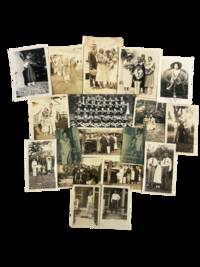
1925réf. 227841925. SS Resolute photo archive approximately 86 photographs dating to 1925 documenting a passenger voyage through the Hawaiian Islands and broader Pacific region during a period of expanding U.S. tourism and colonial presence. The material captures volcanic landscapes urban development agricultural activity and Native Hawaiian individuals providing visual evidence of both environmental features and social life. These images record the intersection of natural geography and emerging tourist infrastructure in Hawaii during the interwar period when the islands were increasingly integrated into trans-Pacific travel networks. Approximately 86 black-and-white and color photographs each measuring about 3.5 x 5 inches mounted on black album leaves with white ink captions identifying locations such as Honolulu Hilo Waimea Bay Kilauea Crater and the Royal Hawaiian Hotel. The archive includes multiple views of volcanic activity including lava flows associated with eruptions from 1868 1901 and 1924 as well as craters at Halemaumau and Kilauea steam vents and descending lava formations. Coastal landscapes and inland terrain of Oahu and the Big Island are represented alongside urban scenes in Honolulu including hotels streetscapes and institutional buildings such as the Moana Hotel and the Mormon Temple at Laie. Agricultural images show sugarcane cultivation and rural labor environments while market scenes and portraits depict local residents in daily settings. A group of photographs includes Duke Kahanamoku posed with a surfboard marked "DUKE" alongside additional images referencing Pacific locations such as Tutuila and Upolu indicating the voyage extended beyond Hawaii. Produced during the 1920s expansion of Pacific tourism these photographs document how Hawaii and surrounding islands were visually framed for travelers within a colonial and commercial context. The combination of landscape infrastructure and human subjects reflects both the promotion of the islands as a destination and the presence of established local communities and industries. The archive supports research into tourism history Pacific colonial networks environmental documentation and Native Hawaiian cultural representation. Mild toning and occasional rippling to prints with minimal edge wear; captions remain clear; overall very good condition. A comprehensive visual record of a trans-Pacific यातà¥à¤°à¤¾ and its documentation of Hawaii and neighboring islands in the early twentieth century. unknown
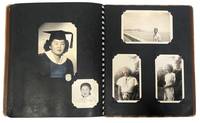
1946réf. 230681946. Japanese-American Women's Education Postwar Hawaiʻi identified Japanese-American university school girl's photo album. Oʻahu Territory of Hawaiʻi 1946-1950 spanning the years right after World War II. Approximately 260 silver gelatin photographs documenting the daily life friendships education and civic participation of a Japanese American young woman living on Oʻahu in the immediate postwar period. The photographs are mounted in a 9" x 11" woven album with photos cornered in on black board pages. Images range from small snapshot-format prints to larger horizontal photographs. Following Pearl Harbor Hawaii was initially considered a war zone and the Japanese Americans there were subject to heavy surveillance and civil rights violations until the war ended in 1945. This album ranges 1946 to circa 1950 with one loose photograph predating the album by approximately a decade likely depicting the compiler as a child. The compiler is identified by name in captions as Reiko who also went by "Rei" Reiko was a Japanese American college student and Pre-Med Club member residing on Oʻahu. This substantial and unusually well-captioned album offers a deeply personal record of Japanese American civilian life in Hawaiʻi following the end of World War II and the lifting of martial law. The first third of the album features extensive handwritten captions frequently identifying individuals locations and events while the latter portion contains fewer annotations but continues the visual narrative of family friendship and place. Reiko's life is documented across academic social and community spheres depicting college friendships Pre-Med Club activities leisure outings and participation in Laulima a Hawaiian community support organization emphasizing mutual aid and collective responsibility. Numerous images record friendships among young women posed confidently in dresses skirts slacks and swimsuits as well as traditional Japanese dress and Hawaiian dress and leis showcasing cross-cultural identity. Family life appears alongside repeated photographs of Lorraine Nakamuta age 2½ likely a relative shown in candid domestic and outdoor scenes some in western attire and a few photos playfully dancing in a straw hula skirt. The album also serves as a visual geographic survey of mid-century Hawaiʻi with identified sites including Halemaʻumaʻu Crater sugar cane fields irrigation infrastructure such as a wooden pipe transporting water Robert Louis Stevenson's hut beaches valleys and residential neighborhoods. Public and civic life figure prominently. Several sequences document an Hawaiian beauty pageant as well as floats marching bands and crowds celebrating the Philippine Islands Independence Day Parade July 4 1946 Honolulu situating Japanese American life within Hawaiʻi's broader multiethnic and postcolonial Pacific context. These images underscore the reemergence of public celebration and civic participation after wartime restriction while highlighting interethnic solidarity and shared urban space. Taken together the album constitutes a rare large-scale vernacular record of Japanese American womanhood education and community engagement during the transitional years between World War II and Hawaiʻi's statehood era. The album remains intact and structurally sound with thick board pages and photographs securely attached using original corner mounts. A few photos loose. Minor age-related wear is present including light scuffing to covers. Handwritten captions remain largely legible throughout. Overall very good condition. This album is an exceptional primary-source document for institutional collections offering sustained visual evidence of Japanese American youth culture women's education in the sciences and everyday resilience in postwar Hawaiʻi enriched by named individuals identified locations and detailed contemporaneous annotations. unknown
1940réf. 222391940. Photographs of a Chinese American family in Hawaii dating primarily to the early 1940s document transpacific mobility family structure and cultural adaptation during World War II when Hawaii served as a critical military and social hub in the Pacific. The images capture multiple generations of a Chinese diaspora family in formal Western dress situating them within a community that had established significant economic and social presence in Honolulu by the wartime period. Produced in a context shaped by military buildup and shifting racial dynamics in the Pacific theater these photographs support research into Asian American history migration and family life during World War II. Archive consists of eighteen original black and white silver gelatin photographs ranging in size from approximately 3.25 x 4.5 inches to 4 x 6 inches. Several larger images depict the family posed on the deck of a passenger ship with individuals wearing flower lei garlands and formal attire indicating participation in departure or arrival ceremonies associated with transpacific travel. These shipboard photographs include men women children and elderly family members emphasizing intergenerational presence. Additional images show posed group portraits in outdoor settings such as gardens and residential yards documenting family gatherings and social presentation. A small number of later photographs extend beyond the wartime period maintaining continuity of the family group across time. These photographs were produced during a period when Chinese American communities in Hawaii occupied a distinct position within the islands' ethnic and economic structure with access to certain forms of integration not available to other groups under wartime racial policies. The presence of formal attire staged portraiture and travel imagery reflects both assimilation into American cultural norms and sustained connections across the Pacific. The shipboard scenes provide visual evidence of mobility and exchange at a moment when wartime conditions reshaped migration and identity in the region. Minor edge wear and light toning to a few photographs; images remain clear and well preserved; overall very good condition. This archive provides a focused visual record of Chinese American family life and transpacific movement in wartime Hawaii. unknown
1944réf. 224221944. Olson Laverne Edwin vernacular photo album circa 1944-1946 documents U.S. Navy enlisted service across the Philippines and Hawaii during the final phase of World War II and the immediate postwar occupation period providing direct visual and documentary evidence of military presence local communities and wartime social life in the Pacific Theater. The album is anchored by Olson's official U.S. Navy Certificate of Satisfactory Service confirming duty from December 18 1944 through April 23 1946 situating the material within the aftermath of the U.S. return to the Philippines following the Leyte landings and the transition into occupation and reconstruction. The photographs support research into Pacific War military infrastructure American servicemen's daily life and interactions with local populations in recently contested and strategically critical regions. Album titled "Snapshots: The Philippines and The Islands of Hawaii" compiled circa 1944-1946 contains 25 items: 23 silver gelatin photographs one wallet-sized U.S. Navy Certificate of Satisfactory Service and one Roosevelt Commemorative Birthday Ball exchange coupon dated January 30 1946. Album measures approximately 4.5 x 3.5 inches with most photographs approximately 4 x 2.5 inches. Images include candid and landscape views from the Philippines likely including Leyte depicting rural villages shoreline activity docked naval vessels and local labor such as fishing and canoe transport. One photograph shows a group of Filipino children and young men gathered along a beach while another captures men and boys navigating shallow coastal waters in a canoe. Hawaiian images include group recreation scenes and coastal landscapes reflecting off-duty life within a major U.S. naval hub. The Roosevelt Birthday Ball coupon printed with the slogan "Dance That Others May Walk" provided access to multiple Honolulu venues and connects the album to wartime charitable campaigns supporting polio treatment through organized social events. Created during the closing campaigns of the Pacific War and the first year of U.S. postwar presence in the Philippines the album situates an enlisted sailor within a broader military and geopolitical transformation that included amphibious warfare territorial reoccupation and the reestablishment of American administrative and logistical systems. The Philippines served as a critical site of both combat and reconstruction while Hawaii functioned as a central staging and support base for naval operations. The inclusion of both official documentation and leisure-related ephemera demonstrates how military service encompassed bureaucratic recordkeeping mobility across strategic locations and participation in organized morale and fundraising activities tied to the American home front. Light wear to album covers minor handling and edge wear to photographs with images remaining sharp; service certificate shows toning and wear; pages largely intact. Overall very good condition. unknown
1947réf. 219701947. Japanese-American WWII Official yearbook of the 1947 graduating class at Punahou School in Honolulu Hawaiʻi which serves as a vivid document of postwar life in a multiracial student body that included a notable presence of Japanese American students. Bound in embossed dark blue leatherette. 8.5" x 11". Heavily illustrated. Published two years after the end of World War II this year's volume shows the continued presence and leadership of Nisei students despite the hardship faced in school years prior. With numerous signed messages by students-including Japanese American classmates such as W. Kobayashi G. Ogawa and H. Takakuwa-this volume provides rare evidence of social reintegration and interracial camaraderie in the wake of a war that saw Japanese Americans subjected to mass suspicion and surveillance across the United States. While Japanese Americans in Hawaiʻi were spared the large-scale incarceration endured by their mainland counterparts they still lived under martial law from 1941 to 1944. During this time thousands were dismissed from government jobs arrested without charge or pressured to prove loyalty-conditions that deeply affected the Nisei generation. Many of the students represented here likely had family members who served in the famed 100th Infantry Battalion or the 442nd Regimental Combat Team the most decorated unit in U.S. military history. Others may have experienced community surveillance loss of employment or restricted freedoms under Hawaiʻi's military government. In this context the 1947 Oahuan is not simply a yearbook-it is a document of recovery dignity and the quiet persistence of young Japanese Americans reclaiming space in public life through scholarship athletics and social visibility. This particular copy is especially notable for its extensive endpaper inscriptions with dozens of students having signed their names in ink making this a personalized artifact of postwar student life. The volume features photographs of senior portraits student clubs athletic teams and lively candid montages with Nisei students prominently and equitably featured. Sports team photos show a remarkable ethnic diversity with surnames like Kobayashi and Koneshige appearing beside those of white and Hawaiian students. The visual presentation echoes Hawaiʻi's unique multiracial culture and hints at the relative integration of elite schools like Punahou in contrast to the segregation typical of many mainland institutions during this era. Endpapers are completely filled with original signatures. Wear to covers with some cracking at interior hinge and one corner of the pastedown torn. Overall very good condition. A rare signed witness to Nisei perseverance in a racially stratified but uniquely hybrid territory on the cusp of statehood. unknown
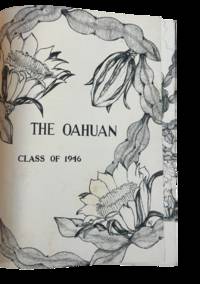
1946réf. 219301946. Japanese-American WWII Official yearbook of the 1946 graduating class at Punahou School in Honolulu Hawaiʻi which serves as a vivid document of postwar life in a multiracial student body that included a notable presence of Japanese American students. Bound in embossed dark blue leatherette. 8.5" x 11". Heavily illustrated. Published just one year after the conclusion of World War II the yearbook offers a rare and humanizing portrait of Japanese American youth in a period when many of their families were still reeling from forced incarceration surveillance or military service. While Japanese Americans in Hawaiʻi were spared the large-scale incarceration endured by their mainland counterparts they still lived under martial law from 1941 to 1944. During this time thousands were dismissed from government jobs arrested without charge or pressured to prove loyalty-conditions that deeply affected the Nisei generation. Many of the students represented here likely had family members who served in the famed 100th Infantry Battalion or the 442nd Regimental Combat Team the most decorated unit in U.S. military history. Others may have experienced community surveillance loss of employment or restricted freedoms under Hawaiʻi's military government. In this context the 1947 Oahuan is not simply a yearbook-it is a document of recovery dignity and the quiet persistence of young Japanese Americans reclaiming space in public life through scholarship athletics and social visibility. This yearbook reflects a moment of restoration and resilience capturing a cohort of Nisei students reclaiming normalcy through education sports and extracurricular life in a territory that would not become a state for another thirteen years. The 1946 Oahuan features dozens of portrait photographs and detailed bios of Japanese American seniors-including Florence Takahashi Alice Asahina and Raymond Akana-who were active in campus life through clubs like Hui Eleu Ka Punahou and the Camera Club. The prominence of these students across social and athletic leadership roles demonstrates the partial reabsorption of Japanese Americans into Hawaiʻi's civic fabric even as anti-Japanese sentiment lingered nationally. Particularly striking is the equal treatment of Asian and white students a stark contrast to the segregated yearbooks of most mainland U.S. high schools at the time. The layout includes numerous posed group photos framed by Oʻahu's lush volcanic landscape a reminder of the local terrain that shaped these students' hybrid island identities. Minor toning and faint edgewear; overall very good condition. A poignant and timely artifact from a transitional moment in Japanese American history reflecting the endurance and reintegration of Nisei students in a society still reckoning with its wartime policies. unknown
1947réf. 219311947. Japanese-American WWII Official yearbook of the 1947 graduating class at Punahou School in Honolulu Hawaiʻi which serves as a vivid document of postwar life in a multiracial student body that included a notable presence of Japanese American students. Bound in embossed dark blue leatherette. 8.5" x 11". Heavily illustrated. Published two years after the end of World War II this year's volume shows the continued presence and leadership of Nisei students despite the hardship faced in school years prior. With numerous signed messages by students-including Japanese American classmates such as W. Kobayashi G. Ogawa and H. Takakuwa-this volume provides rare evidence of social reintegration and interracial camaraderie in the wake of a war that saw Japanese Americans subjected to mass suspicion and surveillance across the United States. While Japanese Americans in Hawaiʻi were spared the large-scale incarceration endured by their mainland counterparts they still lived under martial law from 1941 to 1944. During this time thousands were dismissed from government jobs arrested without charge or pressured to prove loyalty-conditions that deeply affected the Nisei generation. Many of the students represented here likely had family members who served in the famed 100th Infantry Battalion or the 442nd Regimental Combat Team the most decorated unit in U.S. military history. Others may have experienced community surveillance loss of employment or restricted freedoms under Hawaiʻi's military government. In this context the 1947 Oahuan is not simply a yearbook-it is a document of recovery dignity and the quiet persistence of young Japanese Americans reclaiming space in public life through scholarship athletics and social visibility. This particular copy is especially notable for its extensive endpaper inscriptions with dozens of students having signed their names in ink making this a personalized artifact of postwar student life. The volume features photographs of senior portraits student clubs athletic teams and lively candid montages with Nisei students prominently and equitably featured. Sports team photos show a remarkable ethnic diversity with surnames like Kobayashi and Koneshige appearing beside those of white and Hawaiian students. The visual presentation echoes Hawaiʻi's unique multiracial culture and hints at the relative integration of elite schools like Punahou in contrast to the segregation typical of many mainland institutions during this era. Endpapers are completely filled with original signatures. Wear to covers with some cracking at interior hinge and one corner of the pastedown torn. Overall very good condition. A rare signed witness to Nisei perseverance in a racially stratified but uniquely hybrid territory on the cusp of statehood. unknown
1997réf. SKU0612085International Press of Boston 1997-06-30. hardcover. New. 7x2x10. New Textbook Ships with Tracking International Press of Boston hardcover
réf. SONG0899979793Used: Good unknown
réf. 304792Meadville Pa. etc. 7 x 3-1/2 inches. Fine. 7 x 3-1/2 inches. Numbers 7578 79 80 81 82 84 85 8788 8990 919295 96 97 10157 of Keystone View Co. 76 93 94 and S 343 of Underwood & Underwood. unknown
1943réf. 203061943. Photographer unknown. World War II photo album 1943-1944. This album documents the daily lives of American service members and their families across multiple locations with a significant concentration of images in Hawaii shortly after the Attack on Pearl Harbor. The photographs record military personnel in uniform alongside wives girlfriends and social circles capturing leisure travel and domestic life during wartime. Scenes from Hawaii include beaches agricultural landscapes and local environments providing visual evidence of how stationed personnel experienced the Pacific setting beyond formal military activity. The material supports research into World War II social history military life outside combat and the intersection of service travel and civilian relationships during the war years. Photo album containing approximately 173 black-and-white silver gelatin photographs with 47 images loose ranging in size from 1.5 x 3 inches to 8 x 10 inches most approximately 4 x 5 inches. Album measures 9.25 x 11 inches with woven fabric covers and 62 pages. Many photographs are captioned with names ranks locations and dates. Images include men in Navy and Army uniforms posing with women in dresses and swimwear beach scenes and group outings. Hawaiian photographs depict sugar cane fields waterfalls coastal views and botanical landscapes as well as individuals hiking relaxing on beaches and interacting in social settings. Additional images show oxen plowing fields and local scenes including residents in huts and outrigger canoes. Mainland photographs include locations in Lake Michigan Florida Charlottesville Tucson and Philadelphia documenting travel and movement across the United States. Other scenes include a wedding portrait a sorority picnic and informal gatherings indicating the range of social environments captured within the album. These photographs align with broader patterns of wartime mobility and social life when military service relocated individuals across regions while maintaining connections to civilian routines and relationships. Hawaii functioned as a critical military and logistical center following the attack on Pearl Harbor while also serving as a site of recreation and daily life for stationed personnel. Personal photographic albums from this period provide primary evidence for the study of how individuals experienced wartime conditions beyond combat including leisure practices gender roles and cross-regional movement within the United States and Pacific territories. Minor wear to album covers and edges; photographs remain clear with strong contrast and legible captions. Overall very good condition. unknown
1885réf. 332943Honolulu 1885. 16pp. Small 8vo. Self wrappers. Minor damage in lower margins not affecting text. 16pp. Small 8vo. "The first of the pamphlets that satirized political affairs during the Kalakaua era . Although issued anonymously it was generally known at the time that the author was Honolulu lawyer Sandford B. Dole" who later became Hawaii's Governor Forbes. Forbes 3686 unknown
1900réf. 332947Honolulu: Hawaiian Gazette Print 1900. 84pp. 8vo. Publisher's stapled tan wrappers. Toning wrappers a bit brittle. 84pp. 8vo. A political pamphlet relating to the election of 1900 -- the first election following admission as a U.S. Territory -- prepared by the central committee of the Republican Party concerning the land commisssion report. Not in Forbes. Scarce. Hawaiian Gazette Print unknown