1 153 résultats
1998réf. 3734Wolfgang Krüger Ffm, 1998. 189 S., OPbd., OU, 8°. Zustand: gut. aus dem Amerik. von Vera Pagin
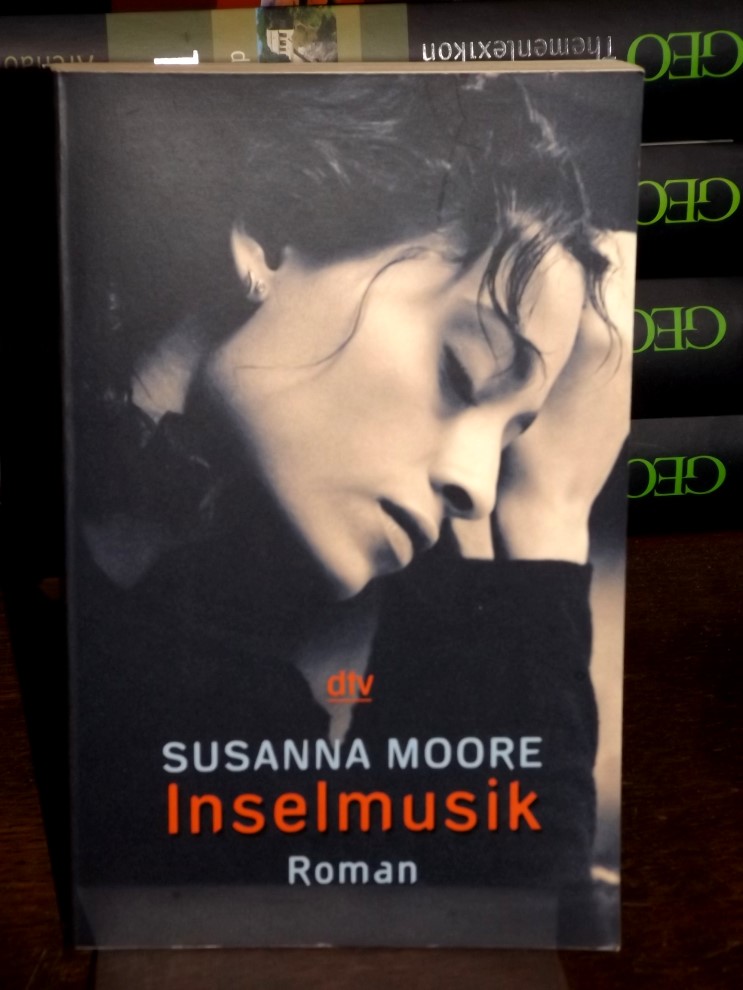
2003réf. 77070München: Deutscher Taschenbuch-Verlag dtv, 2003. 249 S.; 19 cm; OKart. (Taschenbuch);
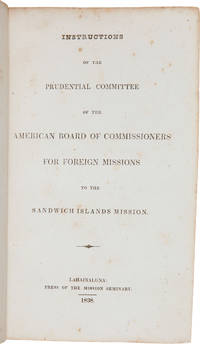
1838réf. 66226Lahainaluna: Press of the Mission Seminary 1838. Instructions for Missionaries Printed in Hawaii A collection of the original instructions issued to each of eight groups of Christian missionaries sent to Hawaii between 1819 and 1836 by the American Board of Commissioners for Foreign Missions ABCFM. It is a relatively early Lahainaluna imprint printed in an edition of 380 copies. "This work contains the Act of Incorporation of the ABCFM State of Massachusetts signed by Caleb Strong Governor and Alden Bradford Secretary of the Commonwealth 20 June 1812 together with the laws and regulations of the same body. Following this are the parting instructions given to each of the first eight companies of missionaries to the Hawaiian Islands…by Samuel Worcester Jeremiah Evarts David Greene B.B. Wisner and Rufus Anderson. A complete list of each company including the Hawaiians is found on pages 119-122.Rev. Clark's account of printing for the year ending February 28 1839 includes this work and shows a production cost of $30. The printed minutes of the 1839 General Meeting record 380 copies printed" - Forbes. The ABCFM was an interdenominational body composed primarily of New England Congregationalists and Presbyterians whose "attention.was called to the Hawaiian Islands by reports of traders and by the presence in New England of several native youth from these islands.The Protestant Christian community of New England became interested in these young Sandwich Islanders and in the possibility that they might become Christian messengers to their own people.The sending of missionaries to Hawaii followed as the next logical step" Kuykendall. This first group of missionaries sent by the ABCFM to Hawaii included two ordained ministers Hiram Bingham and Asa Thurston a physician two schoolmasters and catechists a printer a farmer; their wives and three Hawaiian youths who had been attending the Foreign Mission School in Cornwall Connecticut. In their set of instructions to this first group of missionaries the ABCFM said that it was God's ".gracious pleasure and his high command that his gospel should be preached to them the people of Hawaii; that they may be turned from darkness unto light – be baptized in the name of the Father and of the Son and of the Holy Ghost and taught to observe all things whatsoever he has commanded for their salvation and for his everlasting honor and praise." An important and uncommon text tracing the early history of the American Christian missionary movement and the ABCFM in Hawaii between 1819 and 1836 complete with the names of the missionaries sent by the ABCFM and the goals they were expected to achieve during their respective stays in Hawaii. Contemporary cloth-backed paper boards. Spine neatly repaired boards lightly soiled and rubbed. Light foxing some slight worming in gutter margin with minute loss to text. Very good. FORBES HAWAII 1086. Ralph S. Kuykendall The Hawaiian Kingdom Vol. 1 1778-1854: Foundation and Transformation Honolulu: Univ. of Hawaii Press pp.102-4. hardcover
1929réf. 91958Honolulu 1929. Paperback. Very Good. 14p. Softcover in original wrapper. 20 cm. Rust marks from paper clips on first few pages. Inked note "Clinic - Thursday 9-10 a.m." on front cover. Many of the instructions from this military hospital seem badly dated. Here is the entire section on Crying: "a. While crying is a baby's way of showing that something dissatisfies it don't be alarmed by a moderate amount of crying. See that the baby doesn't need changing see that it isn't too hot nor to sic cold and that it is in a comfortable position. If these things are satisfactory go away and leave the baby alone. Don't pick it up nor walk the floor with it nor rock it in the arms etc. If it seems to have the colic having it lie face down with a hot water bottle beneath its abdomen is frequently all that it needs. Some of the bad habits of childhood are learned in infancy. A baby learns very quickly that it can get what it wants by crying for it. b. If your baby is plump pink in color has from 1 to 3 bowel movements a day and nurses well it can't be seriously ill. paperback
1929réf. 91958Honolulu 1929. Paperback. Very Good. 14p. Softcover in original wrapper. 20 cm. Rust marks from paper clips on first few pages. Inked note "Clinic - Thursday 9-10 a.m." on front cover. Many of the instructions from this military hospital seem badly dated. Here is the entire section on Crying: "a. While crying is a baby's way of showing that something dissatisfies it don't be alarmed by a moderate amount of crying. See that the baby doesn't need changing see that it isn't too hot nor to sic cold and that it is in a comfortable position. If these things are satisfactory go away and leave the baby alone. Don't pick it up nor walk the floor with it nor rock it in the arms etc. If it seems to have the colic having it lie face down with a hot water bottle beneath its abdomen is frequently all that it needs. Some of the bad habits of childhood are learned in infancy. A baby learns very quickly that it can get what it wants by crying for it. b. If your baby is plump pink in color has from 1 to 3 bowel movements a day and nurses well it can't be seriously ill. paperback books
1838réf. 66226Lahainaluna: Press of the Mission Seminary 1838. Instructions for Missionaries Printed in Hawaii A collection of the original instructions issued to each of eight groups of Christian missionaries sent to Hawaii between 1819 and 1836 by the American Board of Commissioners for Foreign Missions ABCFM. It is a relatively early Lahainaluna imprint printed in an edition of 380 copies. "This work contains the Act of Incorporation of the ABCFM State of Massachusetts signed by Caleb Strong Governor and Alden Bradford Secretary of the Commonwealth 20 June 1812 together with the laws and regulations of the same body. Following this are the parting instructions given to each of the first eight companies of missionaries to the Hawaiian Islands…by Samuel Worcester Jeremiah Evarts David Greene B.B. Wisner and Rufus Anderson. A complete list of each company including the Hawaiians is found on pages 119-122.Rev. Clark's account of printing for the year ending February 28 1839 includes this work and shows a production cost of $30. The printed minutes of the 1839 General Meeting record 380 copies printed" - Forbes. The ABCFM was an interdenominational body composed primarily of New England Congregationalists and Presbyterians whose "attention.was called to the Hawaiian Islands by reports of traders and by the presence in New England of several native youth from these islands.The Protestant Christian community of New England became interested in these young Sandwich Islanders and in the possibility that they might become Christian messengers to their own people.The sending of missionaries to Hawaii followed as the next logical step" Kuykendall. This first group of missionaries sent by the ABCFM to Hawaii included two ordained ministers Hiram Bingham and Asa Thurston a physician two schoolmasters and catechists a printer a farmer; their wives and three Hawaiian youths who had been attending the Foreign Mission School in Cornwall Connecticut. In their set of instructions to this first group of missionaries the ABCFM said that it was God's ".gracious pleasure and his high command that his gospel should be preached to them the people of Hawaii; that they may be turned from darkness unto light – be baptized in the name of the Father and of the Son and of the Holy Ghost and taught to observe all things whatsoever he has commanded for their salvation and for his everlasting honor and praise." An important and uncommon text tracing the early history of the American Christian missionary movement and the ABCFM in Hawaii between 1819 and 1836 complete with the names of the missionaries sent by the ABCFM and the goals they were expected to achieve during their respective stays in Hawaii. Contemporary cloth-backed paper boards. Spine neatly repaired boards lightly soiled and rubbed. Light foxing some slight worming in gutter margin with minute loss to text. Very good. FORBES HAWAII 1086. Ralph S. Kuykendall The Hawaiian Kingdom Vol. 1 1778-1854: Foundation and Transformation Honolulu: Univ. of Hawaii Press pp.102-4. hardcover books
1945réf. 76709Honolulu: Tongg Publishing Company 1945. Second edition. Twelvemo 3 3/4 x 6 inches. 314 pp. Publisher's blue cloth with printed paper cover label. Front panel of dust jacket laid in. A very good copy.Compiled by Henry P. Judd Mary Kawena Pukui & John F. G. Stokes. Mary Kawena Pukui is rightly regarded as a central figure in the Hawaiian language revival movement of the 20th century. She a native Hawaiian was a driven scholar and spent much of her life in documenting and preserving Hawaiian language folklore proverbs place names and colloquial speech. Aside from her contributions to dictionaries like this one she published numerous books and articles concerning the Hawaiian language & culture. Tongg Publishing Company hardcover
1970réf. 62747Honolulu HI: Department of Anthropology Bernice P. Bishop Museum County of Hawaii Planning Dept. 1970. 4to. 53 1 pp. Yellow-printed softcovers stapled at gutter margin as issued minor shelfwear scuffing still VG copy w/ faint remnants of former ownership stamp front cover. First edition of this invaluable archaeological and anthropological report prepared during the 1960’s in order to locate identify and interpret Native Hawaiian sites for land developers and businesses as large area were opened for development during the Mid-20th-Century. Of particular interest are the identification and listing of a majority of the finds encompassing petroglyph rock carvings fishing village remnants human remains battle fields burial fields and more. Department of Anthropology, Bernice P. Bishop Museum, County of Hawaii Planning Dept., paperback
2026réf. x-1108720161Cambridge University Press 2026. Paperback. New. 312 pages. 6.00x0.66x9.00 inches. Cambridge University Press paperback
réf. 51907019like new. unknown
1788réf. 245411788 1788 Gravure a l'aquatinte du 18e siecle (1788) par Labrousse, d'apres le dessin de Grasset St Sauveur. Coloriee a la main a l'époque.Kolorierte Aquatinta, Darstellung: 11 x 17 cm
réf. 0824821629.Ghardcover. Good. Access codes and supplements are not guaranteed with used items. May be an ex-library book. hardcover
1998réf. Q-0824821629Univ of Hawaii Pr 1998-10-01. Hardcover. New. New. In shrink wrap. Looks like an interesting title! Univ of Hawaii Pr hardcover
réf. SONG08248216290000-00-00. hardcover. Used: Good. 6.00x1.25x9.25. Buy with confidence. Excellent Customer Service & Return policy. hardcover
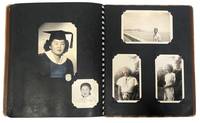
1946réf. 230681946. Japanese-American Women's Education Postwar Hawaiʻi identified Japanese-American university school girl's photo album. Oʻahu Territory of Hawaiʻi 1946-1950 spanning the years right after World War II. Approximately 260 silver gelatin photographs documenting the daily life friendships education and civic participation of a Japanese American young woman living on Oʻahu in the immediate postwar period. The photographs are mounted in a 9" x 11" woven album with photos cornered in on black board pages. Images range from small snapshot-format prints to larger horizontal photographs. Following Pearl Harbor Hawaii was initially considered a war zone and the Japanese Americans there were subject to heavy surveillance and civil rights violations until the war ended in 1945. This album ranges 1946 to circa 1950 with one loose photograph predating the album by approximately a decade likely depicting the compiler as a child. The compiler is identified by name in captions as Reiko who also went by "Rei" Reiko was a Japanese American college student and Pre-Med Club member residing on Oʻahu. This substantial and unusually well-captioned album offers a deeply personal record of Japanese American civilian life in Hawaiʻi following the end of World War II and the lifting of martial law. The first third of the album features extensive handwritten captions frequently identifying individuals locations and events while the latter portion contains fewer annotations but continues the visual narrative of family friendship and place. Reiko's life is documented across academic social and community spheres depicting college friendships Pre-Med Club activities leisure outings and participation in Laulima a Hawaiian community support organization emphasizing mutual aid and collective responsibility. Numerous images record friendships among young women posed confidently in dresses skirts slacks and swimsuits as well as traditional Japanese dress and Hawaiian dress and leis showcasing cross-cultural identity. Family life appears alongside repeated photographs of Lorraine Nakamuta age 2½ likely a relative shown in candid domestic and outdoor scenes some in western attire and a few photos playfully dancing in a straw hula skirt. The album also serves as a visual geographic survey of mid-century Hawaiʻi with identified sites including Halemaʻumaʻu Crater sugar cane fields irrigation infrastructure such as a wooden pipe transporting water Robert Louis Stevenson's hut beaches valleys and residential neighborhoods. Public and civic life figure prominently. Several sequences document an Hawaiian beauty pageant as well as floats marching bands and crowds celebrating the Philippine Islands Independence Day Parade July 4 1946 Honolulu situating Japanese American life within Hawaiʻi's broader multiethnic and postcolonial Pacific context. These images underscore the reemergence of public celebration and civic participation after wartime restriction while highlighting interethnic solidarity and shared urban space. Taken together the album constitutes a rare large-scale vernacular record of Japanese American womanhood education and community engagement during the transitional years between World War II and Hawaiʻi's statehood era. The album remains intact and structurally sound with thick board pages and photographs securely attached using original corner mounts. A few photos loose. Minor age-related wear is present including light scuffing to covers. Handwritten captions remain largely legible throughout. Overall very good condition. This album is an exceptional primary-source document for institutional collections offering sustained visual evidence of Japanese American youth culture women's education in the sciences and everyday resilience in postwar Hawaiʻi enriched by named individuals identified locations and detailed contemporaneous annotations. unknown
1946réf. 230681946. Japanese-American Women's Education Postwar Hawaiʻi identified Japanese-American university school girl's photo album. Oʻahu Territory of Hawaiʻi 1946-1950 spanning the years right after World War II. Approximately 260 silver gelatin photographs documenting the daily life friendships education and civic participation of a Japanese American young woman living on Oʻahu in the immediate postwar period. The photographs are mounted in a 9" x 11" woven album with photos cornered in on black board pages. Images range from small snapshot-format prints to larger horizontal photographs. Following Pearl Harbor Hawaii was initially considered a war zone and the Japanese Americans there were subject to heavy surveillance and civil rights violations until the war ended in 1945. This album ranges 1946 to circa 1950 with one loose photograph predating the album by approximately a decade likely depicting the compiler as a child. The compiler is identified by name in captions as Reiko who also went by "Rei" Reiko was a Japanese American college student and Pre-Med Club member residing on Oʻahu. This substantial and unusually well-captioned album offers a deeply personal record of Japanese American civilian life in Hawaiʻi following the end of World War II and the lifting of martial law. The first third of the album features extensive handwritten captions frequently identifying individuals locations and events while the latter portion contains fewer annotations but continues the visual narrative of family friendship and place. Reiko's life is documented across academic social and community spheres depicting college friendships Pre-Med Club activities leisure outings and participation in Laulima a Hawaiian community support organization emphasizing mutual aid and collective responsibility. Numerous images record friendships among young women posed confidently in dresses skirts slacks and swimsuits as well as traditional Japanese dress and Hawaiian dress and leis showcasing cross-cultural identity. Family life appears alongside repeated photographs of Lorraine Nakamuta age 2½ likely a relative shown in candid domestic and outdoor scenes some in western attire and a few photos playfully dancing in a straw hula skirt. The album also serves as a visual geographic survey of mid-century Hawaiʻi with identified sites including Halemaʻumaʻu Crater sugar cane fields irrigation infrastructure such as a wooden pipe transporting water Robert Louis Stevenson's hut beaches valleys and residential neighborhoods. Public and civic life figure prominently. Several sequences document an Hawaiian beauty pageant as well as floats marching bands and crowds celebrating the Philippine Islands Independence Day Parade July 4 1946 Honolulu situating Japanese American life within Hawaiʻi's broader multiethnic and postcolonial Pacific context. These images underscore the reemergence of public celebration and civic participation after wartime restriction while highlighting interethnic solidarity and shared urban space. Taken together the album constitutes a rare large-scale vernacular record of Japanese American womanhood education and community engagement during the transitional years between World War II and Hawaiʻi's statehood era. The album remains intact and structurally sound with thick board pages and photographs securely attached using original corner mounts. A few photos loose. Minor age-related wear is present including light scuffing to covers. Handwritten captions remain largely legible throughout. Overall very good condition. This album is an exceptional primary-source document for institutional collections offering sustained visual evidence of Japanese American youth culture women's education in the sciences and everyday resilience in postwar Hawaiʻi enriched by named individuals identified locations and detailed contemporaneous annotations. unknown books
réf. 75-0302Victoria AU: Center Art Galleries - Hawaii Circa 1984. Dealer Catalogue. Quarto. 20 pp. Soft Covers. Very Good. Color plates. Victoria, AU: Center Art Galleries - Hawaii, [Circa 1984]. paperback
1928Boards a bit darkened and with light rubbing to extremities. Light foxing to first few pages; B&W Illustrations; 8vo; 461 pages
PARIS, Musée de l'homme - 1950-1951 - 2 tomes en 1 volume - Grand in-8 - Relié dos lisse, 1/2 toile, reliure frottée, épidermures au dos - Plats et gardes marbrés - Couvertures conservées - Nombreuses illustrations NB dans le texte et HT - 338 et 372 pages - Très propre intérieurement
1828Seconda edizione, in -12°, pp. 408, inclusa una mappa ripiegata delle isole e tre tavole fuori testo incise e protette da velina, mezza pelle, dorso mancante. Stewart fu mandato nel Pacifico nel 1822 e fu uno dei primi predicatori residenti nelle Hawaii: questo è uno dei primi resoconti strutturati della vita e delle abitudini delle popolazioni indigene. Stewart was send on the Pacific Ocean in 1822 and was one of the first preachers to establish in Hawaii Islands.
réf. 8190Honolulu, Advertiser Publishing Company, Ltd. 1 volume in-8, 342 pp., hardback decorated by red marbled paper and faux leather, enriched with a frontispiece of a portrait of William Ellis, a foldable map of the Sandwich Islands and multiple illustrations, very good condition.
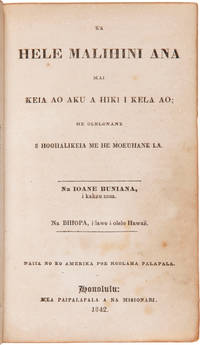
1842réf. 63627Honolulu: Mea paipalapala a na Misionari 1842. First Edition of PILGRIM'S PROGRESS in Hawaiian in a Hawaiian Binding A significant association copy of the rare first edition in Hawaiian of Bunyan's Pilgrim's Progress and the first printing in Hawaiian of an English literary classic. This copy bears a presentation inscription on the front free endpaper to C. Blake from the Rev. Elias Bond dated at Kohala Sandwich Islands September 29 1843. Reverend Bond translated at least seven books for the Mission Press between 1859 and 1868. The Hawaiian title translates as The Traveler from This World to That Which Is to Come. In 1840 the American Tract Society in Honolulu hoped to publish an abridged edition of Bunyan if a translator could be found and in 1841 Artemas Bishop took on the task promising the Society that "it will prove one of the most popular works in the Hawaiian Language." Unfortunately for Artemas and the Society the book flopped and the 10000 copies that were printed were remaindered in unbound sheets most of which were disposed of to Chinese vegetable peddlers for wrapping produce. For copies that survived this the rate of attrition as with all early Hawaiian works of this type remained very high and the book is quite scarce today. The work failed to impact the Hawaiians as the English allusions lost all meaning when translated. The names of the extensive cast of characters became incomprehensible: Mr. Lechery became Kekowale literally lust only and Mrs. Filth became Pelapela decayed flesh. Some of the surviving unbound sheets of this book were bound into limp suede in 1910. This copy on the other hand is in a contemporary Hawaiian sheep binding of the mid-19th century complete with its distinctive triangular and diamond-shaped tooling which is most unusual and notably rare. See David Forbes' BUNIANA San Francisco 1984 for an extensive discussion of the book. An important association copy in a handsome contemporary binding. 12mo. Contemporary Hawaiian sheep boards and backstrip tooled with triangular and diamond-shaped pattern rebacked with original backstrip neatly laid down. Light rubbing and staining to boards. Contemporary presentation inscription on front flyleaf see below. Minimal scattered foxing but very clean and fresh internally. Very good. FORBES 1351. JUDD 237. DAB IX p.381. hardcover
1842réf. 63627Honolulu: Mea paipalapala a na Misionari 1842. First Edition of PILGRIM'S PROGRESS in Hawaiian in a Hawaiian Binding A significant association copy of the rare first edition in Hawaiian of Bunyan's Pilgrim's Progress and the first printing in Hawaiian of an English literary classic. This copy bears a presentation inscription on the front free endpaper to C. Blake from the Rev. Elias Bond dated at Kohala Sandwich Islands September 29 1843. Reverend Bond translated at least seven books for the Mission Press between 1859 and 1868. The Hawaiian title translates as The Traveler from This World to That Which Is to Come. In 1840 the American Tract Society in Honolulu hoped to publish an abridged edition of Bunyan if a translator could be found and in 1841 Artemas Bishop took on the task promising the Society that "it will prove one of the most popular works in the Hawaiian Language." Unfortunately for Artemas and the Society the book flopped and the 10000 copies that were printed were remaindered in unbound sheets most of which were disposed of to Chinese vegetable peddlers for wrapping produce. For copies that survived this the rate of attrition as with all early Hawaiian works of this type remained very high and the book is quite scarce today. The work failed to impact the Hawaiians as the English allusions lost all meaning when translated. The names of the extensive cast of characters became incomprehensible: Mr. Lechery became Kekowale literally lust only and Mrs. Filth became Pelapela decayed flesh. Some of the surviving unbound sheets of this book were bound into limp suede in 1910. This copy on the other hand is in a contemporary Hawaiian sheep binding of the mid-19th century complete with its distinctive triangular and diamond-shaped tooling which is most unusual and notably rare. See David Forbes' BUNIANA San Francisco 1984 for an extensive discussion of the book. An important association copy in a handsome contemporary binding. 12mo. Contemporary Hawaiian sheep boards and backstrip tooled with triangular and diamond-shaped pattern rebacked with original backstrip neatly laid down. Light rubbing and staining to boards. Contemporary presentation inscription on front flyleaf see below. Minimal scattered foxing but very clean and fresh internally. Very good. FORBES 1351. JUDD 237. DAB IX p.381. hardcover books
1868réf. 332700Honolulu: Paiia e Henry M. Whitney 1868. 15 1; 15 1pp. 2 vols. 8vo. Stitched. 15 1; 15 1pp. 2 vols. 8vo. The first two reports of the Sunday School Association of a series of annual reports by the Hawaiian Evangelical Association. Each includes a table in the rear listing statistics for all the religious schools on the island. Scarce. Forbes 2749 Paiia e Henry M. Whitney unknown
1868réf. 332700Honolulu: Paiia e Henry M. Whitney 1868. 15 1; 15 1pp. 2 vols. 8vo. Stitched. 15 1; 15 1pp. 2 vols. 8vo. The first two reports of the Sunday School Association of a series of annual reports by the Hawaiian Evangelical Association. Each includes a table in the rear listing statistics for all the religious schools on the island. Scarce. Forbes 2749 Paiia e Henry M. Whitney unknown books