PELBARTUS DE THEMESWAR.Livre Rare Book

20 234 résultats
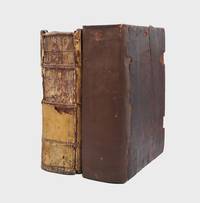
réf. 5759Haguenau, Henri Gran, pour Jean Rynman, 1500. In-folio gothique à deux colonnes de (264) ff., le dernier blanc [Collation: cahier signé de chiffres 8, a-g8, h6, i-k8, l6, m-n8, o6, p-q8, r6, s8, t6, cahier signé de chiffres 6, v-x8, y6, z8, A-B8, C6, D-K8]. Relié à la suite : PELBARTUS DE THEMESWAR. Sermões quadragesimales pomerii fratris Pelbarti de Themeswar diui ordinis sancti Francisci incipiut feliciter. Haguenau, Henri Gran, pour Jean Rynman, 10 juillet 1500. In-folio gothique à deux colonnes de (110) ff. [Collation: a-b8, c6, d-e8, f6, g-h8, c6, k-l8, m6, n10, o6, p6]. 2 ouvrages en 1 fort vol. in-folio, aies de bois recouverts de peau de truie estampée à froid de motifs de Vierge à l'Enfant, de lion, d'oiseau et de fleur, dans de grands croisillons, dos à quatre nerfs, fermoirs de cuirs avec attaches en laiton (reliure de l'époque).
1483réf. 372162Strasbourg: Johann Grüninger 1483. Fifth 'Fontibus ex Graecis' edition. 678 ff. Collation: A-ZAA-DD⸠FF⸠EE⸠GG-IIkkLL-PP⸠14-18⸠19¹²; a-long ss-v⸠uâ´ x⸠1-89-13¹Ⱐ14-17⸠18¹Ⱐ19¹². Signatures 14-19 Interpretationes hebraicorum nominorum & Nominorum hebraicorum printed in both volumes; signatures EE and FF in Vol. I bound in reverse; 2 leaves in signature 18 in Vol. II duplicated. Complete. Text in two columns 45 lines per page. 37-line capital in purple green and yellow on leaf A2 many initials completed in red ink Vol. I rubricated throughout in red. Manuscript title to Vol. I initial blank and table of contents to Vol. II initial blank Vol. II has early ink numbering in top corners. 2 vols. Chancery folio. Contemporary blind-stamped calf over wooden boards early vellum reback to Vol. I twentieth-century plain brown calf reback to Vol. II brass catches to fore-edges clasps lacking manuscript title "prima pars biblie" to bottom edge of Vol. I text block. Front board of Vol. I detached its spine mostly perished front catches of Vol. II lacking minor worming to pastedowns of Vol. I endpapers of Vol. II renewed. Minor worming to margins of first and final few leaves occasional light soiling and faint staining mostly confined to margins clean tear to foot of leaf 11⸠extending into three lines of text block without loss small hole to leaf 14-6 Vol. II with loss to a word upper inside corner of final leaf torn away with loss missing text supplied in manuscript in an early hand. Worn and crudely repaired but a complete copy in a mostly contemporary binding and with good margins. Fifth 'Fontibus ex Graecis' edition. 678 ff. Collation: A-ZAA-DD⸠FF⸠EE⸠GG-IIkkLL-PP⸠14-18⸠19¹²; a-long ss-v⸠uâ´ x⸠1-89-13¹Ⱐ14-17⸠18¹Ⱐ19¹². Signatures 14-19 Interpretationes hebraicorum nominorum & Nominorum hebraicorum printed in both volumes; signatures EE and FF in Vol. I bound in reverse; 2 leaves in signature 18 in Vol. II duplicated. Complete. Text in two columns 45 lines per page. 37-line capital in purple green and yellow on leaf A2 many initials completed in red ink Vol. I rubricated throughout in red. Manuscript title to Vol. I initial blank and table of contents to Vol. II initial blank Vol. II has early ink numbering in top corners. 2 vols. Chancery folio. The colophon dated but without publisher or place notes this as a Fontibus ex Graecis Bible: part of "a series of corrected Latin Bibles which claim for themselves-apparently with justice-a superiority above all contemporary editions. They are known as the 'Fontibus ex Graecis' editions from the opening words of the Latin distichs found in them. Masch enumerates ten genuine 'Fontibus ex Graecis' editions the other nine bearing the dates 1479 1481 1482 1483 1485 1486 2 editions 1487 and 1489-all without name of printer or place" Darlow & Moule. A unique copy with the indexes of Hebrew names appearing twice at the end of each volume. ISTC ib00577000; Goff B-577; GW 4242; Darlow & Moule II pp. 911-912 note following 6083. Provenance: General Theological Seminary Copinger Collection gift of Cornelius Vanderbilt and Dean Augustus Hoffman bookplates and blindstamps Johann Grüninger] unknown
réf. 92376Strasbourg 1735. . Watercolour map on thick paper the title on a flap. Dimensions: 540 x 1017 mm. Mounted. Large manuscript plan of Strasbourg - a unique item with fine colours very unusual. The map dating from 1753 depicts a plan of the French city with the river Rhine running through it alongside that of the German city of Kehl and markings of nearby castles. It pays tribute to Strasbourg as a historical city showing the old quarters as well as the medieval fortification wall built in 1412. The map also contains a depiction of the Vauban citadel built between the city and the Rhine in 1681 and designed by one of France's most famous military engineers. Kehl depicted on the map is equally an example of Vauban's work. The city in its entirety is said to have been designed by him in 1683 following the French take-over in 1678. Kehl was first joined to Strasbourg in 1338 by the bridge seen on the map although this has since been replaced and stands as a monument to the changing relationship between France and Germany. It is even said that on one of the small islands between Strasbourg and Kehl Marie Antoinette was officially handed over to France by Austria in 1770. Such maps of Strasbourg are rare. We could trace only a similar very detailed map in Strasbourg's public library showing to the west a scene of the local justice and to the east the castle of Kehl BNS m. caret 10. 686. Strasbourg, 1735. unknown
réf. 6927Complete set of 20 original albumen photographs image sizes: 170 x 250 mm. & 230 x 190 mm. by Charles David Winter mounted on card boards 440 x 350 mm. Folio orig. portfolio with large printed title pasted on upper cover cloth spine a little worn some rubbing to boards orig. cloth ties. Strasbourg: Winter Fassoli 1870. A fine set of this extremely rare portfolio of 20 albumen photographs by the Strasbourg photographer Charles David Winter 1821-1904. These photographs reveal the devastation that took place during the siege of Strasbourg in August and September 1870 by Germany in the Franco-Prussian War. This siege was the first example of “total war” a new kind of warfare with indiscriminate violence. Winter began his career as a lithographer but later turned to photography and opened his own daguerreotype studio in 1848. By 1852 he was making salted paper prints and using the collodion process. Winter made portraits landscapes and studies of sculptures. The photographs in this album were made in October 1870 under the supervision of the German engineer Major Albrecht. “Winter’s greatest accomplishments however are his photographs documenting the urban transformation of Strasbourg in the second half of the nineteenth century including the building and demolition in the city center 1855-1880 the construction of a railroad bridge over the Rhine 1858-61 and the restoration of the Cathedral in 1857-59. Striking for both their large size and their fine detail his photographs revealed the formal beauty in new forms of architecture and engineering. Winter also recorded in wrenching detail the devastating destruction of Strasbourg following the Franco-Prussian war of 1870.”–Sarah Kennel in John Hannavy ed. Encyclopedia of Nineteenth-Century Photography p. 1501. “In contrast to Germany’s triumphal framing of Strasbourg’s damaged cityscape Charles Winter one of France’s most eminent nineteenth-century photographers provided an alternative Alsatian perspective on the disfigured city in his album of the Siege of Strasbourg the present work. The album’s photographs silent witnesses to Strasbourg’s devastation offered a dark premonition of the total wars to envelop Europe in the twentieth century.”–Dunlop Cartophilia p. 172. Apart from some dustiness to the covers and boards a fine and complete set of photographs with strong tonality. The boards are a little foxed. unknown
réf. 6927Complete set of 20 original albumen photographs image sizes: 170 x 250 mm. & 230 x 190 mm. by Charles David Winter mounted on card boards 440 x 350 mm. Folio orig. portfolio with large printed title pasted on upper cover cloth spine a little worn some rubbing to boards orig. cloth ties. Strasbourg: Winter Fassoli 1870. A fine set of this extremely rare portfolio of 20 albumen photographs by the Strasbourg photographer Charles David Winter 1821-1904. These photographs reveal the devastation that took place during the siege of Strasbourg in August and September 1870 by Germany in the Franco-Prussian War. This siege was the first example of "total war" a new kind of warfare with indiscriminate violence. Winter began his career as a lithographer but later turned to photography and opened his own daguerreotype studio in 1848. By 1852 he was making salted paper prints and using the collodion process. Winter made portraits landscapes and studies of sculptures. The photographs in this album were made in October 1870 under the supervision of the German engineer Major Albrecht. "Winter's greatest accomplishments however are his photographs documenting the urban transformation of Strasbourg in the second half of the nineteenth century including the building and demolition in the city center 1855-1880 the construction of a railroad bridge over the Rhine 1858-61 and the restoration of the Cathedral in 1857-59. Striking for both their large size and their fine detail his photographs revealed the formal beauty in new forms of architecture and engineering. Winter also recorded in wrenching detail the devastating destruction of Strasbourg following the Franco-Prussian war of 1870."-Sarah Kennel in John Hannavy ed. Encyclopedia of Nineteenth-Century Photography p. 1501. "In contrast to Germany's triumphal framing of Strasbourg's damaged cityscape Charles Winter one of France's most eminent nineteenth-century photographers provided an alternative Alsatian perspective on the disfigured city in his album of the Siege of Strasbourg the present work. The album's photographs silent witnesses to Strasbourg's devastation offered a dark premonition of the total wars to envelop Europe in the twentieth century."-Dunlop Cartophilia p. 172. Apart from some dustiness to the covers and boards a fine and complete set of photographs with strong tonality. The boards are a little foxed. hardcover books
1644réf. 4649Frankfurt, Merian, 1643 - 1644. 2 Werke in 1 Bd. 1 Kupfertitel, 2 (statt 3) doppelblattgr. Kupferstichkarten und 41 (statt 58) teils gefalt. Kupfertafeln. 2 doppelblattgr. Kupferstichkarten und 25 (statt 38) Kupfertafeln. 4°. Mod. HLwd. mit Rückenschild (Gebrssprn.).
1846réf. 86647Bâle 18 mai[1846] | 13.6 x 21.8 cm | 2 pages sur un feuillet
1745réf. 94286Nancy, A. Leseure, 1745, 1757 1745 7 volumes in-folio, plein veau granité, dos à nerfs, caissons ornés, dentelles, roulettes en coupes. I : 13 ff. n. ch. 300 col.- 902- 286- 86 col. 10 cartes et plans repliés ; II : 4 pp. 112- 618- 352- 14 col. 1 carte et 20 pl. ; III : 4- IV pp. 240- 620- 40- 378 col. 12 pl. ; IV : 4- 28 pp. 1047- 118 col.- 7 pp. 84 col. ; V : 276 col.- 932 col.- 280 col. ch. CCC par erreur, 5 pl. ; I Notice : VII pp. - 144 col.- 2 ff.- - 946 col.- 224 col., 1 plan et 6 pl. ; II Notice : 116 col.- 1024 col.- 74 col.- 5 pl. Figures dans le texte, lettrines et culs-de-lampe. Usures et épidermures, quelques tomaisons effacées. Humidité éparse pour les 3 premiers volumes 3 plans affectés, soutenue pour 10 ff. du tome III, par ailleurs assez frais.
1630réf. 73261630 Edition allemande : Strasbourg 1630 In Folio , plein vélin , contenant deux ouvrages datés de 1630 Parfait état Plus de détails sur demande
1523réf. 44374Cologne, Eucharius Cervicornus pour Gottfried Hittorp, s.d. , (1523). In-8 de 139-(13) ff., (sign. a-s8, *8), table, titre à encadrement gravé, bois gravé, caractères grecs et romains.ÉRASME. Parabolarum, seu Similium liber elegantissimus. Argentinae, apud J. Knoblouchum (Strasbourg, Johann Knobloch) 1521. 103-(5) ff., (sign. A-O8), titre à encadrement gravé, caractères italiques.ÉRASME. Opus de conscribendis epistolis, quod quidam & mendosum & mutilum ediderant, recognitum ab authore, & locupletatum. Argentorati (Strasbourg) Knobloch, 1522. 178 (i.e. 180) ff., (sign. A-Y8, Z4), titre à encadrement gravé, caractères italiques.3 pièces reliées en 1 vol. in-8 (105 x 170 mm), peau de truie sur ais de bois biseautés, décor estampé à froid à encadrement de motifs floraux et animaliers, dos à trois nerfs, titre manuscrit au dos, deux fermoirs (reliure de l'époque).
1592réf. 73221592 Strasbourg, Bernard Jobin, 1592. [16]-155-1bl-239-1bl-131-1bl-312-233-3bl-[3]-1bl. pages.Tres fort volume in-folio, maroquin rouge (reliure de l'époque). Décors à froid , tranche ciselées Nombreuses gravures sur bois illustrant les différentes armoiries des anciennes familles d'Alsace.( grande planche double), la première véritable histoire de l'Alsace, qui est également un armorial Alsacien.Saffroy, II, n° 16386 : "Ce beau livre forme le joyau des bibliothèques alsatiques."Rare dans cet état et sa reliure d'époque .... Ex Libris : Henry Edouard Weber Plus de photos sur demande .
1782réf. PHO-1140Dessau, Librairie des auteurs et des artistes, 1782, XII-255pp.-2ff, relié demi basane postérieure, dos à nerfs avec auteur, titre et date en pied.
1698réf. 42187, , 1698. 1 vol. in-folio de (4)-270 ff., veau brun, dos orné à nerfs, pièce de titre en maroquin rouge (reliure de l'époque).
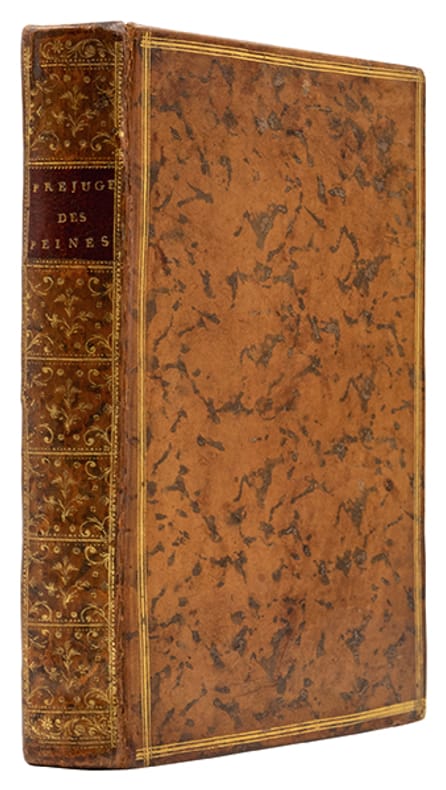
1785réf. 384201785 2 ouvrages reliés en un volume in-8 (195 x 124 mm), plein veau marbré de l'époque, dos lisse orné de compartiments fleuronnés et cloisonnés, pièces de titre de maroquin bordeaux, triples filets d'encadrement sur les plats, roulette sur les coupes, tranches jaspées.
2 ouvrages reliés en un volume in-8 (195 x 124 mm), plein veau marbré de l'époque, dos lisse orné de compartiments fleuronnés et cloisonnés, pièces de titre de maroquin bordeaux, triples filets d'encadrement sur les plats, roulette sur les coupes, tranches jaspées. 1- Édition originale, rare. Le premier essai politique de Robespierre, alors jeune avocat âgé de 26 ans, qu’il composa en réponse à un concours ouvert par la Société royale littéraire de Metz en 1784, et pour lequel il obtint une médaille d’or ainsi qu’un prix de 400 livres. En homme des Lumières disciple de Montesquieu et de Beccaria, sur un mode modéré mais en un style lyrique et enflammé qui sera sa marque, Robespierre critique l’arbitraire de la justice de son temps et soumet un plan de réforme de la justice pénale. Il propose de bannir le déshonneur imposé aux familles des condamnés, plaide pour la suppression de la confiscation de leurs biens, pour l’égalité devant le châtiment et pour que les bâtards puissent accéder à la condition de citoyen à part entière. (Martin & Walter, 29526/1). 2- Edition originale. L'essai, en tête du volume, composé par le juriste et académicien Pierre-Louis Lacretelle (1751-1824) fut couronné en même temps que celui de Robespierre. Devançant celui-ci, Lacretelle obtint le premier prix, Robespierre le second, mais on décida que la récompense serait la même. Si les deux mémoires comportaient "nombre d'idées semblables", de celui de Lacretelle, on vanta "la hauteur de ses considérations philosophiques et morales, la sagacité de son esprit, la justesse de ses idées et l’humanité de ses sentiments". En 1823, en publiant ses Œuvres complètes, Lacretelle revint sur cette rencontre avec Robespierre : "Rien, dans ce début, ne promettait le personnage qu’on a vu sept ans après. On pourrait croire qu’il s’ignorait encore lui-même. Il faut avoir vu toute une révolution pour savoir à quel point elle peut transformer un homme, ou plutôt développer en lui des poisons cachés et encore sans fermentation". Infimes accrocs à un mors. Très bel exemplaire, très frais, grand de marges, très bien relié à l'époque.
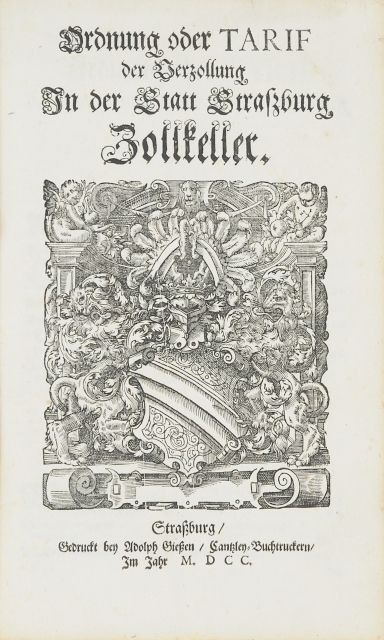
1770réf. 61168Straßburg, versch. Drucker bzw. Verleger, 1685-1770. Fol. Titelbll. tlw. m. großen Holzschn.-Wappenvignetten sowie mit einigen Holzschn.-Vignetten im Text. Späterer HPgmt.-Bd. m. goldgepr. Rückenschild (?Zolltarife der Stadt Straßburg?).
réf. 7324Rare impression de Strasbourg , orné d'une figure sur bois au Ve du titre (l'auteur offre son livre à un Evèque )le feuillet suivant est occupé par un épitre de l'auteur , Jacobus Wympheling de Seletsat à Philippus de Duno . Bel exemplaire ayant appartenu à Fernand Heitz (ex-libris ) et Edouard Weber Reliure moderne certainement debut XX realisée avec parchemin ancien
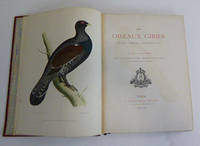
réf. 51-7337Paris : J. Rothschild 1876. . Large 4to 365 x 280mm. half-title 45 plates after Benjamin Fawcett vignettes and ornamental initials in text contemporary red half-morocco original wrappers bound in edges uncut.“Beau volume assez rare qui d’après Souhart n’aurait été tiré qu’à 300 ex.” Thiébaud 538 - Souhart 277.Édition originale de ce rare ouvrage qui n’aurait été tiré selon Souhart qu’à 300 exemplaires composé par le photographe et naturaliste Henri de La Blanchère 1821-1880.L’illustration comporte plusieurs vignettes en noir et en bistre gravées sur bois ainsi que 45 superbes planches d’oiseaux en chromotypographie en couleurs. .LITERATURE:.Nissen IVB 109; Ronsil 1574; Souhart 277; Schwerdt 1:294; Thiébaud 538.; OCLC Number / Unique Identifier:7391892940.PROVENANCE; Bookplate of H. Gallice: Henri Gallice was a third-generation owner and director of Champagne Perrier-Jouët stepping into leadership after tis uncle Charles Perrier passed away in 1878. While Henri managed the winery operations in Épernay Octave his brother spent time in Paris where he was heavily involved in the Belle Époque art.The H. Gallice bookplate dates to the fin de siècle. It is a design in the Art Nouveau or Liberty style .Second bookplate of Marcel Jeanson born June 2 1885 in Paris; died May 6 1942 in Paris was a French industrialist and passionate collector of hunting literature.Alongside his professional activities he was a dedicated bibliophile and built one of the most important private hunting libraries in France.Expertise by : Gaëlle CAMBON. Paris : J. Rothschild, 1876. unknown
1525réf. 73981525 Augsbourg , 1525, 15, 7 x 20 cm , In 8 , recouvert d'un vélin , triple filets sur les plats , 54 pages , incunable , parfait état , 60 pages ,
1566réf. 73021566 Chez Theodore Rihellius (Rihel),initiale en page de garde Argentorati (Strasbourg) 1566, grand in-8 14, 5 x 20 , (16) pagination une page sur deux : 512 pages donc 1024 plus index,(numerotation uniquement recso) plus index 28 pages Reliure en pleine peau de truie sur ais de bois de l'époque. Dos à trois nerfs. Plats estampés de plusieurs frises et encadrements floraux et portraits , ainsi que d'une guirlande Trace de présence de fermoirs.Nombreuses mentions manuscrites de l'époque, Etat de conservation exceptionnel .... "Face aux rigueurs mises en œuvre par François Ier à l'encontre des Protestants, l'historien et philologue Jean Sleidan fut contraint de s'installer à Strasbourg, c'est là qu'il rédigea son Commentaire sur l'état de la religion et de la république sous le règne de Charles Quint. L'ouvrage, par son étude des dessous politiques, constitue une rigoureuse histoire de la Réforme de 1517 à 1556, base de l'historiographie moderne pour toute histoire du protestantisme, non seulement allemand mais européen. . "
1820réf. 14959Strasbourg, Imprimerie de P.J. Dannbach, 1820. Prospectus, 34 livraisons et et 1 numéro spécial reliés en 1 vol. in-folio à deux colonnes par page en caractères latins et gothiques, demi-basane marbrée, dos lisse orné, pièce de titre en maroquin rouge (reliure de l'époque).
réf. 201001857Mulhouse, Imprimerie veuve bader, 1876-1959 ; in-8, broché. Les 67 volumes. Bon état général qlq vol abimés, de 1876 à 1959 bien complet (du tome I au tome LXVII ) -.
réf. 201300208Strasbourg, Istra - nuée bleue, 1962 ; in-8, br. Bon et très bon état collection complète au n° -Revue trimestrielle - 7e année NOUVELLE SÉRIE (NOUVELLE NUMÉROTATION N°1 HIVER 1962 - contient du n° 1 au n°141- suite en HH211.
1810réf. 42288Paris, Clament frères, 1810. In-8 de VI-166 pp., demi-basane marbrée, dos à nerfs orné à la grotesque, couverture muette conservée, non rogné (Creuzevault).
1901réf. 11115Paris, Calmann-Lévy, [1901]. In-8 de [4]-396-[2] pages, plein maroquin marron, dos à nerfs, double filet doré sur les coupes, doublé de maroquin caramel, gardes de soie moirée, couvertures et dos conservés, à savoir celle abricot, usuelle à la série, et la verte, réservée aux 20 exemplaires de la série des XX. Restauration à un nerf. Etui bordé de maroquin marron. La reliure est signée Canape.