272 résultats
1927réf. 2003San Antonio: Imprenta Universal 1927. About very good. 124pp. Printed in blue ink. Original cream printed wrappers. Moderate wear spine chipped at ends corners worn. Lightly soiled. Light soiling and foxing to text mostly to outer leaves. Biographical work documenting those who died in defense of the Catholic Church during the Cristero War which followed the Mexican Revolution and constitution of 1917. During the Cristero War the secular government sought to crack down on the influence of the Catholic Church banning local religious festivities. This work comprises more than fifty entries providing date and circumstances of death of those killed in 1926 and 1927 illustrated with a portrait or other image of the victim or victims. Only a handful of copies in OCLC. Imprenta Universal unknown books
1867réf. H120737Warendorf, J. Schnell 1867 xiv + 328pp. + frontispiece, 18cm., text in German in Gothic script, text is clean and bright, original softcover (some loss of paper at frontcover without loss of text, spine re-inforced), copy of the Dutch Prof. J.W.L. Smit (with his signature), H120737
1830pp. 226, 288, [2] + Twelve leaves of plates, each with two wood engraved images. One image with a (paper fault?) hole. Foxed. 12 mo. 195 mm. XLib. (Juniata College - Withdrawn). Early manuscript ownershipts of: David Hahn & Michael Row(?), August 1850. Attractive original full leather binding. Full Title: GESCHICHTE DER MARTYRER, nach dem ausfuhrlichen Original des Ehrw. Johann Fox und Anderer. Kurz gefasst und, besonders fur den gemeinen deutschen Mann in den Vereinigten Staaten von Nordamerica, aus dem Englischen ubersetzt von J. Daniel Rupp. [One line in Latin] ; Zwei Bande. Erster[-zweiter] Band. Attractive full leather binding. This first German American edition of 'Actes and Monuments' by John Foxe (1516-1587), was translated, abridged and edited by Israel Daniel Rupp (1803-1878), 'especially for the common German man in the United States of North America.' JUN GER 2. SE 1/2
réf. 245294DMM, 1984 18 x 13 cm., 121 pp, Broché
réf. 0849944228New. paperback. New. Satisfaction Guaranteed or your money back. paperback
2012réf. Q-0849944228W. Publishing 2012-02-21. Paperback. New. In shrink wrap. Looks like an interesting title! W. Publishing paperback
réf. 0849943825New. paperback. New. Satisfaction Guaranteed or your money back. paperback
2002réf. Q-0849943825W Pub Group 2002-08-01. Paperback. New. In shrink wrap. Looks like an interesting title! W Pub Group paperback
1900Remains of prize plate inside front cover. Fingermarks to a few pages. No creasing to covers or to spine. A tight copy with dull lightly marked boards, dusty page edges, browning to pages and a little bumping to lower corners. Very scarce. 159pp. With fifteen true stories of women who remained steadfast to the Christian faith and who suffered execution as a result.
1947Folio, First Edition, text in French, with illustrated title, very numerous photographs and illustrations (a number full-page) in the text, and pictorial front free endpaper; red fuax-morocco cloth, upper board lettered in gilt and blocked in blind, gilt back, covers moderately age-faded, upper joint rubbed else a very good, bright, clean copy. Sold from an institution with its stamp on front free endpaper and title verso [only]. SCARCE.
1878viii + 144pp. rijkelijk geïll. + 8 uitslaande gravures, gecart.band (gemarbreerde platten, bruinlederen rug met titel in goudopdruk), gemarbreerde schutbladen, 2 stempeltjes op titelblad, goede staat, zeldzaam, R21396
1744réf. PHO-2327Paris, chez Didot, 1744, 1 volume (3) in-4 (25,5x20cm), 3ff.-xxvi-664pp., veau époque, dos à nerfs avec pièces de titre et tomaison, tranches rouges. Coins émoussés, coiffes arasées, accroc au plat, frottements, dos noirci, rousseurs, 1 feuillet détaché et déchiré sans manque, mouillure claire, petit travail de ver en marge Exemplaire sans les cartes.
1744réf. PHO-2328Paris, chez la Veuve Ganeau, 1744, 1 volume (3) in-4 (25,5x20cm), 2ff.-xiv-543pp., veau marbré époque, dos à nerfs orné avec pièces de titre et tomaison, tranches jaspées bleues, coins usés, coiffes arasées, début de fente, frottements, ex-libris au titre. Exemplaire sans les cartes et gravures.
réf. 2054A la Librairie Ecclésiastique de Rusand, Lyon, 1828.
réf. 7570Bourg, P.F. Bottier, 1834 - 1835 ; deux tomes, in-8 ; demi-basane prune, dos à nerfs, titre doré, non rogné (reliure mi-XXe) ; 403, (1) pp. de table ; 432 pp. et en tout 6 lithographies hors-texte par Béraud-Lauras de Lyon.
1655réf. H96551Namurci [Namur], s.n. 1655 [xxxii +] 400pp., later hardcover binding binding (spine in leather with gilt title and decorations, some traces of use at edges of boards and corners), 17cm., text in latin, text clean and bright with only very few contemporary underlinings and annotations (in margin of text) in ink, small wormhole in margin (not in the text) of first pages, good condition, [This is a rare second Latin edition, (first edition = Douai Balthasar Bellerus 1603). Willem Estius, born at Gorcum 1542, died at Douai 1613, based his work on the eye-witness account of his brother Rutger Estius and on his own investigations afterwards ; the author felt personally involved since his uncle and some of his friends (both priests of Gorcum & Hieronymus) were among the martyrs. // Continuation of the title: "Quibus pro coronide subiuncta est, eodem Authore appendix de martyrio Guilielmi Gaudani, item Minoritae quod contigit anno 1573. Habes & aliorum quorumdam martyria, opportunis locis commemorari: nominatim Cornelii Musii Delfii theologi & poëtae."], H96551
1867réf. H104459Lovanii [Louvain], Peeters 1867 x + 342pp., 18cm., text in Latin, modern black hordcover, spine in cloth with gilt title, some occasional foxing, good condition, H104459
réf. 5274Paris, Henri Laurens, s.d. Un volume fort in-4 demi chagrin rouge, dos à nerfs orné, titre doré, tranches dorées, 50 ff. , 50 ff., 50ff., 50 ff., 50 ff., texte sur 2 colonnes. Ressauts, néanmoins bon exemplaire.
1814réf. ARC-114217Paris, chez l'auteur, 1814. 2 volumes in-8 ; T.1 : XL et 479 pages ; T.2 : 2 feuillets non chiffrés et 520 pages. Pleine basane flammée havane , dos lisse orné de motifs dorés, pièces de titres rouges et vertes.
1867x + 342pp., 18cm., text in Latin, modern black hordcover, spine in cloth with gilt title, some occasional foxing, good condition, H104459
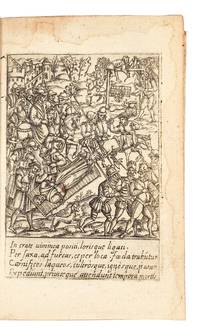
1583réf. 5484Macerata: Appresso Sebastiano Martellini con licenza de' superiori 1583. FIRST ITALIAN EDITION the second edition overall and the FIRST ILLUSTRATED EDITION. Hardcover. Fine. Bound in 19th c. ivory vellum hinges repaired at head and foot light soiling spine label fragmentary the boards ruled in gold the spine gold-tooled with repeating floral tools. Illustrated with six engraved plates of Catholic priests being abused apprehended tortured and executed described in detail below. With a woodcut title vignette of the Crucifixion a woodcut of the Pietà on leaf D7 verso printer's ornaments and woodcut initials. The text is type-ruled throughout. The text is in very good condition aside from damp-staining in gathering B and the six plates; the title page is soiled and has a small area of restoration at the upper corner as well as a clean tear mended and a little staining in the gutter. There is a light oil stain on leaf H6 and a marginal paper flaw on leaf N5. A translation with additional material of Allen's "A briefe historie of the glorious martyrdom of XII. reuerend priests executed vvithin these tvveluemonethes for confession and defence of the Catholike faith." Rheims: J. Foigny 1582. The English edition exists in only 2 copies British Library and Westminster Cathedral Library. This edition the first edition to include the six engraved illustrations is also rare. OCLC locates copies of the Macerata edition at 7 institutions in North America. see notes below for holdings. The central figure of Allen's martyrology is the Jesuit Edmund Campion 1540-1581 who at Allen's request and along with Robert Parsons led the first Mission to England. Campion and his companions were arrested on 17 July 1581. The present work recounts the arrest trial and eventual execution of Campion as well as the priests Ralph Sherwin Alexander Briant Thomas Ford John Shert Robert Johnson William Filby Luke Kirby Lawrence Richardson John Payne and Everard Hanse; as well as the Jesuit Thomas Cottam. Included in these accounts are the transcripts of Campion's final letter to the Jesuit General Claudio Aquaviva Ralph Sherwin's letter from the Tower and Alexander Briant's letter written while imprisoned to the Jesuit fathers in England requesting admission to the Society which was granted. Allen who continued to receive material up to the time of publication appended the martyrdoms of Cuthbert Maine John Nelson and Thomas Sherwood all of whom died in 1577 and 1578 to his account of the martyrs of 1581 and 1582. The translator of the present edition added an additional account not found in the English edition of the martyrdom of 4 English priests in 1583. The Engravings: The six engravings in this work first appeared in the first edition of Robert Parson's "De Persecutione Anglicana Libellus" published by the Jesuit College at Rome in 1582. Each of the six images is accompanied by a four-line explanation in hexameter verse. "The first plate depicts priests being apprehended in private houses and marched off to prison; the second in amplification shows various priests some still in their vestments being led away either on horseback or on foot but always securely bound two gentlewomen who had sheltered them being led to the same destination. In the third a priest is being scourged while tied to the back of a cart and below in the foreground an examination is in progress as preparations are made for torture. The fourth picture illustrates a racking with three other victims lined up to await their turn. In the fifth the priests are being dragged to execution on hurdles while the instruments of death are prepared; and the final plate represents the different stages of martyrdom from the hanging to the drawing quartering and burning of entrails."Anthony G. Petti in Recusant History April 1966 pp. 288-91 Edmund Campion: "Campion was arrested with his companions on 17 July 1581. Amid scenes of violent excitement Campion was derisively paraded through the streets of his native city bound hand and foot riding backwards with a paper stuck in his hat to denote the 'seditious Jesuit'. First thrown into Little Ease at the Tower he was carried privately to the house of his old patron the Earl of Leicester; there he encountered the queen herself and received earnest proffers of liberty and preferments would he but forsake his papistry. Hopton having tried in vain the same blandishments on Campion's return to the Tower the priest was then examined under torture and was reported to have betrayed those who had harboured him. Several arrests were made on the strength of the lie. He had asked for a public disputation. But when it came off in the Norman chapel of the Tower before the Dean of St. Paul's and other divines Campion had been denied opportunity to prepare his debate and had been severely racked. Thus weakened he stood through the four long conferences without chair table or notes and stood undefeated. Philip Howard Earl of Arundel who was looking on in the flush of worldly pride became thereby inspired to return to God's service. "The privy council at its wits' end over so purely spiritual a 'traitor' hatched a plot to impeach Campion's loyalty and called in the hirelings Eliot and Munday as accusers. A ridiculous trial ensued in Westminster Hall 20 Nov. 1581. Campion pleading not guilty was quite unable to hold up his often-wrenched right arm seeing which a fellow prisoner first kissing it raised it for him. He made a magnificent defence. But the sentence was death by hanging drawing and quartering: a sentence received by the martyrs with a joyful shout of 'Haec dies' and 'Te Deum'."Catholic Encyclopedia Cardinal William Allen: "On the accession of Elizabeth and the re-establishment of Protestantism William Allen was one of those who remained most staunch on the Catholic side and it is chiefly due to his labours that the Catholic religion was not entirely stamped out in England. Having resigned all his preferments he left the country in 1561 and sought a refuge in the university town of Louvain. The following year however we find him back in England devoting himself though not yet in priest's orders to evangelizing his native county. His success was such that it attracted notice and he had to flee for safety. For a while he made himself a missionary centre near Oxford where he had many acquaintances and later for a time he sought protection with the family of the Duke of Norfolk. In 1565 he was again forced to leave England this time as it turned out for good. He was ordained priest at Mechlin shortly afterwards. "Convinced that Protestant domination of England could only be temporary and that the whole future depended on there being a supply of trained clergy and controversialists ready to come into the country whenever Catholicity should be restored Allen founded the College at Douay since identified with his name. Douay was a new university founded by Pope Paul IV under the patronage of King Philip of Spain in whose dominions it then was for the special object of combating the errors of the Reformation; and what is still more to the purpose it was already under Oxford influences. The first chancellor Richard Smith was an Oxford man as were several of the most influential members of the university at the time when Allen began. It was his ambition to perpetuate Oxford influences and traditions and to make his new college practically a continuation of Catholic Oxford. "The means of support included besides Allen's private income and other voluntary donations a yearly pension of 200 ducats from the King of Spain and later on one of 100 gold crowns a month from the Pope. The number of students grew rapidly. Often more were received than the income warranted a course rendered necessary by the urgent state of Catholic affairs which Allen met in the spirit of faith; and in the long run means were never wanting. The names of Thomas Stapleton Richard Bristowe Gregory Martin Morgan Philips and others are still well known to English Catholics and are themselves a sufficient record of the ability of Allen's early companions and of the work done at the college. Allen had the power of instilling his spirit into his followers. They lived together without written rule but in perfect mutual harmony working for the common cause. From the Douay press came forth a constant stream of controversial and other Catholic literature which could not be printed in England on account of the Penal Laws. In this Allen himself took a prominent part. His writings are distinguished by extent of learning and theological acumen. One of the chief works undertaken in the early years of the college was the preparation of the well-known Douay Bible. The New Testament was published in 1582 when the college was at Rheims." "In 1575 Allen made a journey to Rome his second where he helped Pope Gregory XIII to found another college to send missionaries to England. For this purpose possession was obtained of the ancient English hospice in the city which was converted into a seminary. Returning to Douay Allen found a storm gathering against the English and in 1578 they were expelled from the town. The collegians took refuge at the University of Rheims where they were well received and continued their work as before Allen being soon afterwards elected canon of the Cathedral Chapter. In 1579 he paid his third visit to Rome being summoned thither in order that he might use his unique personal influence to adjust the dispute between the English and Welsh students at the new college there. It was during this visit that he was appointed a member of the Pontifical Commission for the revision of the Vulgate. Up to this point the career of Allen had won the universal admiration and gratitude of English Catholics for what he himself termed his 'scholastical attempts' to convert England. Such was not however the case with his political labors to secure the same end which may be said to have begun about this time and were far less successful. The famous Bull 'Regnans in excelsis' was issued by Pius V in 1570 deposing Queen Elizabeth and releasing her subjects from their allegiance but it did not take practical shape till seventeen years later when preparations were made for the invasion of England by the King of Spain. Allen was then once more in Rome whither he had been summoned by the Pope after a dangerous illness two years before. He never left the Eternal City again but he kept in constant communication with his countrymen in England. It had been due to his influence that the Society of Jesus to which he was greatly attached undertook to join in the work of the English mission; and now Allen and Father Parsons became joint leaders of the 'Spanish Party' among the English Catholics. "At the request of King Philip Allen was created cardinal in 1587 and held himself in readiness to go to England immediately should the invasion prove successful. In estimating the number of those who would be adherents to the scheme however Allen and Parsons were both at fault. The large majority of English Catholics generously forgetting the past sided with their own nation against the Spanish and the defeat of the Armada 1588 was a subject of rejoicing to them no less than to their Protestant fellow countrymen. Allen survived the defeat of the Armada six years. To the end of his life he remained fully convinced that the time was not far distant when England would be Catholic again. . He continued to reside at the English College Rome until his death 16 October 1594. He was buried in the chapel of the Holy Trinity adjoining the college." Catholic Encyclopedia. Appresso Sebastiano Martellini, con licenza de' superiori hardcover
1655[xxxii +] 400pp., later hardcover binding binding (spine in leather with gilt title and decorations, some traces of use at edges of boards and corners), 17cm., text in latin, text clean and bright with only very few contemporary underlinings and annotations (in margin of text) in ink, small wormhole in margin (not in the text) of first pages, good condition, [This is a rare second Latin edition, (first edition = Douai Balthasar Bellerus 1603). Willem Estius, born at Gorcum 1542, died at Douai 1613, based his work on the eye-witness account of his brother Rutger Estius and on his own investigations afterwards ; the author felt personally involved since his uncle and some of his friends (both priests of Gorcum & Hieronymus) were among the martyrs. // Continuation of the title: "Quibus pro coronide subiuncta est, eodem Authore appendix de martyrio Guilielmi Gaudani, item Minoritae quod contigit anno 1573. Habes & aliorum quorumdam martyria, opportunis locis commemorari: nominatim Cornelii Musii Delfii theologi & poëtae."], H96551
réf. 160995o. O.: o. V. (2016). 86 Seiten. Gr. 8° (22,5-25 cm). Orig.-Broschur. [Softcover / Paperback].