[MIE PREFECTURE?] 三重県?Biblio.com

55 résultats
1892réf. 170411No details of publisher. Circa1892. 2 volumes. Volume I: Two leaves with black and white line illustrations showing a uniform 583pp prior owner's seal on first leaf. Volume 2: Folding table at rear variously paginated over 600 pages prior owner's seal on cover. Some light occasional soiling and corners trifle creased. Wrappers with string ties. These two thick volumes were published in the 1890s probably by Mie prefectural government for managing their prison system. The volumes give details of all the rules and legislation relating to prisoners and prison guards. They offer rare historical information on the Japanese prison system in the late 19th century at the time when Japan was in the process of westernisation. The prison system and related legislation was set up in Meiji Japan and followed two European systems French and German. Until 1900 prisons were run by both local and central governments when their management was transferred to the central government. These 2 volumes were published by Mie Prefectural government prior to the transfer to central government and reflect the local system as it was before transition. The Japanese prison system to this day is well known for its strict and detailed rules and regulations. The first of these volumes covers the treatment daily schedules and inspections of prisoners as well as the handling prisoners with infectious diseases. The volume also lists numerous regulations relating to prison guards' work. The second volume is a collection of relevant rules and legislation on prison and prisoner handling. An important detailed resource for anyone interested in the prison system in the late 19th century. We have been unable to find this handbook in any institutional holdings. . No details of publisher. unknown
réf. BN103269INSEE Picardie. Hardcover. Picardie diagnostic et perspectives : Dynamiques humaines économiques territoriales Picardie diagnostic et perspectives : Dynamiques humaines économiques territoriales INSEE Picardie hardcover
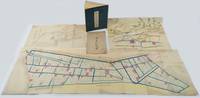
1880réf. 220946Japan. Circa1880. Coloured bird's eye view map 38.3 x 52cm with original envelope somewhat worn folded colour map with neat washi repairs to the verso 39.2 x 127.7cm black and white diagram 28.2 x 52.8cm colour illustrated book 27.7 x 20cm 28 double-folded leaves four hole string binding title label on front cover with minor chips. Covers discoloured and worn but holding firmly internally bright and clean. This collection of three historical maps one diagram and an original envelope offers a detailed view of land use and planning in the Tsu’u region of Okayama Prefecture during the early Meiji period. The area had a long history of human habitation with fertile soil and abundant water sources. From the beginning of the Edo period in the 17th century land in the area was progressively reclaimed leading to an expansion of agricultural land. The collection comprises the following five items: Detailed Map of Hayashima Shinden Village in Tsu’u County Bitchū 備中國都宇郡早嶋新田村明細地圖 Land Division Map untitled in Japanese Diagram of Natsukawa Village Primary School in Tsu’u County Okayama 備中國都宇郡撫川村小學校見取繪圖 Pictorial Map of Additionally Registered Lands 地積追番雛形繪圖 Original envelope with title Item 1 shows the divisions of rice-growing land in Hayashima Shinden Village with area measurements and registration numbers. Water channels are coloured in blue. Item 2 is a large map showing land divisions in an adjacent area of Hayashima although it does not have a title. Item 3 is a diagram of a primary school established in Natsukawa at the beginning of the Meiji period probably in the 1870s. An existing Buddhist temple and its compound were used for the school. The diagram identifies a fenced school yard pupils’ entrances to the classrooms at the rear and a flagpole standing beside the school gate. Item 4 is a beautifully drawn bird’s-eye view map showing a settlement with a temple and shrine along a river surrounded by mountains forests and rice paddies. Item 5 is the original envelope titled Hayataka Village Map and most likely belongs with Item 4. . unknown
réf. 11073Yamagata Prefecture: 1819-68. Ushu province today's Yamagata Prefecture has a long tradition of making sake. The region has abundant fresh water and the climate is well-suited for growing sake rice. This archive of 22 manuscript reports was produced for local tax collectors by two sake manufacturers in Higashine village Murayama Ushu province: GenshirÅ æºå››éƒŽ 20 reports and Hachizaemon 八左衛門 two reports. Neither is in business today. Sake was a heavily regulated industry in Edo Japan and a major source of tax revenue. The shogunate also controlled production levels in order to conserve rice in times of shortage and to regulate prices. The government also required manufacturers to brew only in winter time to improve quality. These official reports contain statements of amounts of sake-making rice used and production levels of sake by number of barrels. One report was prepared in 1819 one in the 1820s five in the 1830s four in the 1840s two in the 1850s and nine in the 1860s. Most of the reports consist of four folding leaves of text. In fine condition. The archive's original wrapper is present. unknown
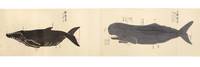
réf. 6620Scroll 273 x 13760 mm. At end in trans.: “All the images are of the whaling at Taiji…April 1857 Tennojiya Shinsuke owned.” A remarkable long and vividly rendered whaling scroll from Wakayama Prefecture depicting the whaling activities in unusual detail of the famous town of Taiji and its bay “Taiji ura” the site of the annual dolphin slaughter featured in the 2009 Oscar-winning documentary The Cove. Taiji has long been known as a whaling town and its history is essentially the history of whaling in Japan. In the 17th century whalers of the town developed a series of more sophisticated whaling techniques including the group hunting system 1606 a handheld harpoon and the whaling net technique 1675. The scroll begins with a quite detailed history of whaling in Japan written in a very legible hand describing the above-mentioned new methods of whaling with dates of introduction. There is information on when certain species of whales pass by during the year signaling systems other technical aspects of whaling etc. The first images depict six species of whales found off the coast of Taiji: Semi kujira North Pacific right whale Zato kujira humpback whale Nagasu kujira fin whale Katsuo kujira Bryde’s whale Koku kujira gray whale and Makko kujira sperm whale. Each of the dramatically and richly painted whales have notes regarding their most notable identifying features. The next scene takes place at Taiji: it shows the captured Semi kujira whales being winched onto shore and the highly specialized butchering of the carcasses. The slaughter area is fenced off and there are observation decks for government officials to review the work. We see a cross-section of the whale and the various products rendered from it in various stages of dismemberment: skin flesh bone intestines fins penis all displayed in large piles. Spectators stand to the side watching the work. A shrine is depicted in the background. This scene has been heightened with metallic pigments. All the harpoons in this scroll are depicted with metallic pigments. Following this is a scene of the different kinds of boats entering the greater bay towing a whale. The scenes of the houses on shore reveal what a prosperous community it once was. The subsequent scene depicts the specialized boats going out to sea passing two elevated signal posts “Kajitorizaki” & “Shomyozaki” which receive news of whales in the distance and sends signals by a flag system. Smoke is rising a signal to the boats. One of the boats is a “tool” boat containing special harpoons to kill the whale after it had been entangled in a net. Other boats are “net” boats each of which requires 81 sailors; they are seen spreading out the net. There are other boats — seko bune — which guide the whale into the net. Another vessel is fast-moving messenger boat giving directions to the others. In the following two scenes the sky and ocean are very beautifully depicted with delicate gradations of colors. The whale a humpback is shown caught in the net writhing and fighting for its freedom desperately spouting water. The enormous motion of the whale has caused the water to turn white with foam which is very expressively painted on the scroll with almost a 3-D Jackson Pollock splashed effect. A young whaler is seen climbing on the whale to stab it in the nose. The whalers all have special tasks to fulfill and the scroll provides the names of each special function. The next scene shows whalers catching a North Pacific right whale just off the Mikisaki peninsula. Following this we are on shore again at the enormous supply storage compound. The first scene shows government observers at the security gate of the compound with men shown mending and storing the whaling nets. The workers wear different head gear and colors of clothes denoting their jobs and ranks. One room has bundles of poles for harpoons. The next building shows men making boat paddles blacksmiths making harpoon heads barrel makers men assembling the harpoons and men making ropes. The subsequent scene depicts men painting three “leader” whaling boats in vivid colors and patterns. The designs on the boats have been highlighted with metallic pigments. The finished boats are stored in sheds which are shown behind. This is followed by a scene of the sheds where boats are constructed. We see a group of shipbuilders constructing a seko bune using saws planes and various other woodworking tools. The next scene depicts the tools of the whalers: various harpoons of different weights and lengths with different metal heads and large knives on long poles. Each harpoon’s specific purpose is mentioned. The ropes attached to the harpoons are contained in a series of bundles to avoid tangling. In fine and fresh condition. This is the finest whaling scroll we have yet encountered with a number of scenes of specific and well-known sites. Preserved in the original but rather decrepit wooden box with metal clasps. Accompanying the scroll is an original metal harpoon tip with the name “Eishichi” engraved. unknown