(Maine)Biblio.com

4373 risultati
1919rif. 307722Boston 1919. 291 photographs usually four to a page on 75 black album leaves captioned throughout in white ink. 1 vols. Oblong folio. Post bound album in black leather over limp boards edges rubbed front joint tender. A few photographs loosened but all present and complete one photo folded at left edge long ago. Black cloth folding box red morocco spine label. 291 photographs usually four to a page on 75 black album leaves captioned throughout in white ink. 1 vols. Oblong folio. An excellent and fully captioned photograph album of summer trout fishing and camping in the Rangeley district at Loon Lake Maine and other places of interest. The photographer is unnamed but evidently from Boston or the north shore with some connections further south on Long Island. The album records two trips to Maine: the first to Loon Lake in 1915 and the J. Lewis York family fishing camp including several fine images of York often with a bear cub on a lead 66 photographs on 17 leaves ; and the second undated to Green Lake Mike Marr's camp at Indian Pond to Squaw Mountain Pond with Fred Lessor guide and to Moosehead Lake and the Kennebec 36 photographs on 9 leaves. Three trips to Nova Scotia in 1914 1919 and 1923 to the Kedgemakoogee Rod and Gun Club on Kedgemakoogee Lake the Shelburne River and other trout fishing excursions 139 photographs on 37 leaves. In the June 1923 trip Irving Lake Dam on the Shelburne is described as the best fishing water of the trip. A few participants are identified: E.L. Matlack O.H. Muir and Wilson Forrest and the unidentified grinning angler with a large string of trout may well be the compiler. As well as scenes from the Piping Rock Horse Show Long Island noting Miss Lansdale up in several snapshots 22 photographs on 5 leaves; and a trip to Atlantic City at the end with the Shriners parade and seaside scenes 27 photographs on 7 leaves. Cf. Bibliotheca Salmo Salar 186 for a similar album unknown
1919rif. 307722Boston 1919. 291 photographs usually four to a page on 75 black album leaves captioned throughout in white ink. 1 vols. Oblong folio. Post bound album in black leather over limp boards edges rubbed front joint tender. A few photographs loosened but all present and complete one photo folded at left edge long ago. Black cloth folding box red morocco spine label. 291 photographs usually four to a page on 75 black album leaves captioned throughout in white ink. 1 vols. Oblong folio. An excellent and fully captioned photograph album of summer trout fishing and camping in the Rangeley district at Loon Lake Maine and other places of interest. The photographer is unnamed but evidently from Boston or the north shore with some connections further south on Long Island. The album records two trips to Maine: the first to Loon Lake in 1915 and the J. Lewis York family fishing camp including several fine images of York often with a bear cub on a lead 66 photographs on 17 leaves ; and the second undated to Green Lake Mike Marr's camp at Indian Pond to Squaw Mountain Pond with Fred Lessor guide and to Moosehead Lake and the Kennebec 36 photographs on 9 leaves. Three trips to Nova Scotia in 1914 1919 and 1923 to the Kedgemakoogee Rod and Gun Club on Kedgemakoogee Lake the Shelburne River and other trout fishing excursions 139 photographs on 37 leaves. In the June 1923 trip Irving Lake Dam on the Shelburne is described as the best fishing water of the trip. A few participants are identified: E.L. Matlack O.H. Muir and Wilson Forrest and the unidentified grinning angler with a large string of trout may well be the compiler. As well as scenes from the Piping Rock Horse Show Long Island noting Miss Lansdale up in several snapshots 22 photographs on 5 leaves; and a trip to Atlantic City at the end with the Shriners parade and seaside scenes 27 photographs on 7 leaves. Cf. Bibliotheca Salmo Salar 186 for a similar album unknown books
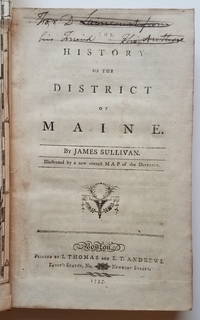
1795rif. 3732This is the first general history of Maine written in the post-Revolutionary War time period that saw several state histories published including those by Belknap Jefferson and Ramsay. Despite its distinctly chilly initial reception and the less than impressive editorial standards Sullivan's Historyis a cornerstone work in any collection of Maine material. The Historyincludes as the frontispiece Osgood Carleton's A Map of the District of Maine Drawn from the latest Surveys and other best Authorities by Osgood Carleton. The map measuring 20 5/16 x 16 3/8" includes an inset titled A Map of those parts of the Country most famous for being harassed sic by the Indians. Carleton's map was the most detailed done of Maine to that time. At the head of the title page is an inscription which has been lined out: "For D. Laincourt from his Friend the Author." References: Evans: 29589. Howes USiana: S-1122. Sabin: 93499. Williamson A Bibliography of the State of Maine: 9608. Thompson: Important Maine Maps Books Prints and Ephemera: 18A. For the map: Wheat & Brun Maps and Charts Published in America before 1800: 171. McCorkle New England in Early Printed Maps 1513-1800: Me795.1. Condition: vii iv 421 pp. With folding map frontispiece.Original full calf with worn red title label. Boards scuffed and bumped with areas of abrasion; joints cracked. Text block is very tight. Occasional light foxing and staining throughout. The map is in remarkably good condition especially in comparison to the usual state in which it is found. Trimmed close as usual along the binding edge. A sharp dark impression with minimal foxing or offsetting. ICN 7660.3. Printed by I. Thomas and E.T. Andrews hardcover
rif. 535894to. 10 pages rectos only though Gould has sketched a map with troop placements and annotations on the verso of one leaf approximately 1200 words. Folded corners of two leaves chipped some edgewear. Some browning but quite legible throughout. After a quarter century during which time he published a history of his regiment John M. Gould. History of the First-Tenth-Twenty Ninth Maine Regiment; Portland 1871 Gould is still searching for the identity of the Confederate regiment that faced his near the East Woods at Antietam. Reporting to Law the commander of the 4th Alabama Infantry in that bloody battle Gould relates his findings in excruciating detail quoting correspondents from a dozen regiments commanders junior officers and non-commissioned officers from both sides who have given him conflicting reports almost all of which stand at odds with official published reports as to the deployment of their units in the chaos of Hood's counter attack against Hooker's corps that blunted the initial Union assault early on the morning of 17 September 1862. _"It is quite clear that Hooker's fragments did not offer very serious resistance to Hood's advance. As far as the East Wood is concerned the 10th Maine was their first real obstacle . Judge Smith of the 5th Texas writes of the exceedingly severe fight the 1st was having with some Union forces & that both parties were showing their best 'staying qualities.' Then Gen. Hood noticing a force coming out of the East Wood said to Capt. Turner 'You may attend to those people!' I can't understand who this Union force was . this succession of events is extremely puzzling." Gould closes by asking Law not to refer to printed sources all of which he was familiar with but asked for any personal comments on his long commentary. "At present it appears to me that Gordon's Brigade did not follow up Hood sharply or at all & that Ripley & Colquitt replaced Hood but the latter line was considerably south of yours. How does that accord with your idea" In addition to his history of the regiments he served in during the Civil War Gould contributed a number of articles to the "National Tribune" relating to Antietam and corresponded with veterans from both sides as referred to often in this letter seeking information on various controversies surrounding the battle. He later donated hundreds of these letters to the Antietan Battlefield Board. Detailed letters on major Civil War battles by participants even those fueled by recollections shaded by decades of discussion and dispute are uncommon in trade. unknown
rif. 535894to. 10 pages rectos only though Gould has sketched a map with troop placements and annotations on the verso of one leaf approximately 1200 words. Folded corners of two leaves chipped some edgewear. Some browning but quite legible throughout. After a quarter century during which time he published a history of his regiment John M. Gould. History of the First-Tenth-Twenty Ninth Maine Regiment; Portland 1871 Gould is still searching for the identity of the Confederate regiment that faced his near the East Woods at Antietam. Reporting to Law the commander of the 4th Alabama Infantry in that bloody battle Gould relates his findings in excruciating detail quoting correspondents from a dozen regiments commanders junior officers and non-commissioned officers from both sides who have given him conflicting reports almost all of which stand at odds with official published reports as to the deployment of their units in the chaos of Hood's counter attack against Hooker's corps that blunted the initial Union assault early on the morning of 17 September 1862. _"It is quite clear that Hooker's fragments did not offer very serious resistance to Hood's advance. As far as the East Wood is concerned the 10th Maine was their first real obstacle . Judge Smith of the 5th Texas writes of the exceedingly severe fight the 1st was having with some Union forces & that both parties were showing their best 'staying qualities.' Then Gen. Hood noticing a force coming out of the East Wood said to Capt. Turner 'You may attend to those people!' I can't understand who this Union force was . this succession of events is extremely puzzling." Gould closes by asking Law not to refer to printed sources all of which he was familiar with but asked for any personal comments on his long commentary. "At present it appears to me that Gordon's Brigade did not follow up Hood sharply or at all & that Ripley & Colquitt replaced Hood but the latter line was considerably south of yours. How does that accord with your idea" In addition to his history of the regiments he served in during the Civil War Gould contributed a number of articles to the "National Tribune" relating to Antietam and corresponded with veterans from both sides as referred to often in this letter seeking information on various controversies surrounding the battle. He later donated hundreds of these letters to the Antietan Battlefield Board. Detailed letters on major Civil War battles by participants even those fueled by recollections shaded by decades of discussion and dispute are uncommon in trade. unknown books
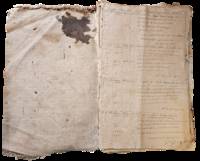
1898rif. List2965United States and Caribbean 1898. Approximately twenty-nine pieces: logbook of eighty-four double-sided pages measuring 13 x 20 inches; eight letters seventeen documents and forms and three pieces of miscellany. Much wear and significant damage to logbook including water damage mildew and tearing; log book overall fair to good minus. Other materials good to very good. Overall good. William Higgins 1791–1872 was a farmer sea captain and owner of and investor in ships from Bowdoinham Maine. According to the Maine Maritime Museum which holds his family papers Higgins’ ships traded mainly in lumber which they took from Wilmington North Carolina to the Caribbean. Offered here is a logbook recording the travels of several of Higgins’ ships particularly the brigs Mary Jane and Llewellyn alongside related documents and personal letters. The logbook dating between 1832 and 1836 extensively documents the course wind data and weather remarks for travels of the ships between east coast US port cities and various locations in the Caribbean including Barbados St. Thomas and Martinique. The logbook also contains a copy of astronomer and mathematician Elijah Burritt’s illustration “A Plan of the Solar System Exhibiting its Relative Magnitudes and Distances” engraved by W. G Evans and printed in 1835 by F.J. Huntington. The letters and documents date from 1830 to 1867 and are also mostly business-related including an insurance document for the brig William Parrington a roll of sailors enlisted to work on a six-month journey between the Caribbean and the US in 1845 a bill of sale for ¼ stake in the brig Mary Jane and receipts and logs for items including various liquors sugar molasses casks and so on. One letter from a young man in Wilmington requests advice on how to start his own business in the style of Higgins’; other letters concern family matters. One interesting undated document is a writ addressed to the Marshal of the District of Maine concerning a lawsuit filed against Higgins and Rufus Carr master of the William Parrington by Zachrisson Nelson Co. The suit alleged that Carr acting as an agent for the ship’s owners that is Higgins had agreed to an affreightment involving shipping from Jamaica to Spain to New York but had then “wholly neglected and refused to do so”. Of interest to scholars of maritime history and trade in the mid-19th century. unknown
1898rif. List2965United States and Caribbean 1898. Approximately twenty-nine pieces: logbook of eighty-four double-sided pages measuring 13 x 20 inches; eight letters seventeen documents and forms and three pieces of miscellany. Much wear and significant damage to logbook including water damage mildew and tearing; log book overall fair to good minus. Other materials good to very good. Overall good. William Higgins 1791–1872 was a farmer sea captain and owner of and investor in ships from Bowdoinham Maine. According to the Maine Maritime Museum which holds his family papers Higgins’ ships traded mainly in lumber which they took from Wilmington North Carolina to the Caribbean. Offered here is a logbook recording the travels of several of Higgins’ ships particularly the brigs Mary Jane and Llewellyn alongside related documents and personal letters. The logbook dating between 1832 and 1836 extensively documents the course wind data and weather remarks for travels of the ships between east coast US port cities and various locations in the Caribbean including Barbados St. Thomas and Martinique. The logbook also contains a copy of astronomer and mathematician Elijah Burritt’s illustration “A Plan of the Solar System Exhibiting its Relative Magnitudes and Distances” engraved by W. G Evans and printed in 1835 by F.J. Huntington. The letters and documents date from 1830 to 1867 and are also mostly business-related including an insurance document for the brig William Parrington a roll of sailors enlisted to work on a six-month journey between the Caribbean and the US in 1845 a bill of sale for ¼ stake in the brig Mary Jane and receipts and logs for items including various liquors sugar molasses casks and so on. One letter from a young man in Wilmington requests advice on how to start his own business in the style of Higgins’; other letters concern family matters. One interesting undated document is a writ addressed to the Marshal of the District of Maine concerning a lawsuit filed against Higgins and Rufus Carr master of the William Parrington by Zachrisson Nelson Co. The suit alleged that Carr acting as an agent for the ship’s owners that is Higgins had agreed to an affreightment involving shipping from Jamaica to Spain to New York but had then “wholly neglected and refused to do so”. Of interest to scholars of maritime history and trade in the mid-19th century. unknown books
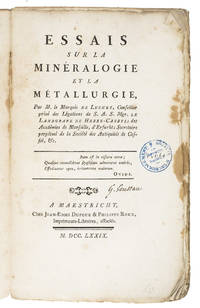
1779rif. K89BNAR73VU7Maastricht 1779. 8vo 22.5 x 13.5 cm. J.E. Dufour & P. Roux Contemporary decorated paper wrappers. 3 parts in 1 volume. 4 XXVII 1 232 pp. Very rare first edition printed in Maastricht of a mining manual by a French enlightened marquis who worked as chief librarian at the Hessen-Kassel court of Friedrich II 1720-1785. Although mentioned reference literature the book is very rare on the market and we found no copy in auction records. Luchet was an acquaintance of Voltaire and in fact had a letter of recommendation from him that helped him obtain his position at the Hessen-Kassel court. Luchet's other writings concerned literature and theatre which makes this mining manual a curious standout. It is unclear why this work was printed in Maastricht except that the Maastricht south Limburg region does have a long history of mining. In a lengthy discourse on mining in the preliminaries Luchet makes a strong pro-mining statement. This is followed by reflections on several aspects of mining often in a question and answer form. He goes into the medical consequences of mining and names several minerals and metals such as coal quartz lead tin gold silver copper and more.A second edition appeared in 1797 often bound with H. Struve Methode analytique des fossils Lausanne 1797.Bookplate on front paste-down owner's name on title-page small stamp on title-page and pages 9 99 199 and 232. First few pages with marginal stains. Binding worn. Otherwise in good condition and wholly untrimmed.l Geology emerging 1404; Hoover 549; Wellcome III p. 451; Worldcat 3 copies; not in Margerie. SCIENCE & TECHNOLOGY Earth Sciences Geology Mineralogy & Gems unknown
1565rif. 42526Poitiers, Enguilbert de Marnef et les Bouchetz frères, 1565. In-12 de de (24)-255-(1)-(16)-(8) pp., table, vélin rigide (reliure de l'époque).
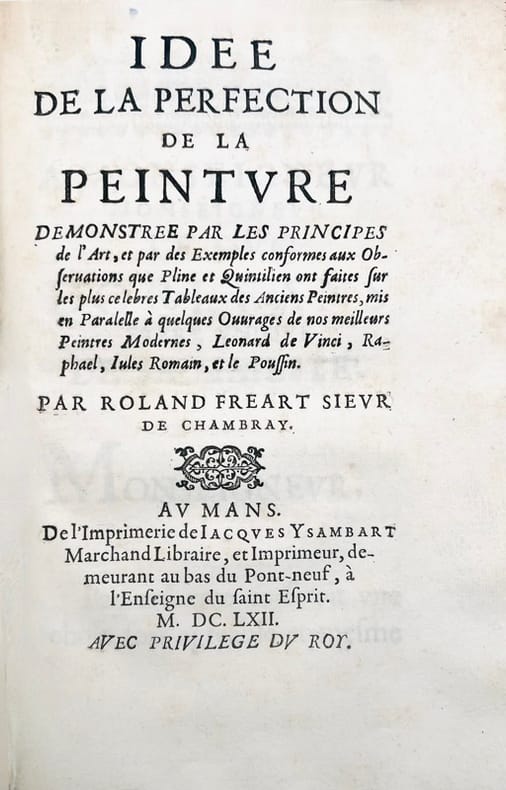
1663rif. 44530Le Mans, Jacques Ysambart, 1663. In-4 de (16)-128 pp., figures dans le texte.2 pièces reliées en 1 vol. petit in-4, veau brun, dos orné à nerfs (reliure de l'époque).
1890rif. 1146c. 1890. Pencil chalk and watercolor. Margins: 21 ¼ x 14 ½. Roosevelt-Richards is just recently being recognized for her place in American artBorn: Known for: Juvenile book and magazine illustration 1905 was the year she came to Wilmington.Delaware and studied with Howard Pyle remaining there for 7 years.By the time Richards had begun her studies under Pyle she was a published illustrator with works appearing in juvenile literature books.In a 1927 interview she recalled Pyle's attitude toward his teaching: "Twice a week we would come together and Mr. Pyle would criticize our efforts and offer suggestions. He always acted as if it were a privilege we gave him." After her stay in Wilmington Richards settled permanently in New Haven actively participating in the art community there.
1890rif. 1146c. 1890. Pencil chalk and watercolor. Margins: 21 ¼ x 14 ½. Roosevelt-Richards is just recently being recognized for her place in American artBorn: Known for: Juvenile book and magazine illustration 1905 was the year she came to Wilmington.Delaware and studied with Howard Pyle remaining there for 7 years.By the time Richards had begun her studies under Pyle she was a published illustrator with works appearing in juvenile literature books.In a 1927 interview she recalled Pyle's attitude toward his teaching: "Twice a week we would come together and Mr. Pyle would criticize our efforts and offer suggestions. He always acted as if it were a privilege we gave him." After her stay in Wilmington Richards settled permanently in New Haven actively participating in the art community there. books
1691rif. 002926A Paris, Galerie-Neuve du Palais, G.de Luyne, T. Girard, Veuve M. Guérout, avec Privilège du Roy, 1691
1938rif. 12984COLLECTION OF EARLY BRITISH FANZINES: THE SATELLITE FANTAST NEW WORLDS GARGOYLE & ZENITH Various places 1938 to 1942 first editions mostly vg copies. 17 SATELLITES being volume 1 #1 thru volume 3 #5 the complete run; 14 FANTASTS being volume 1 #1 thru volume 3 #2 the complete run; 4 NEW WORLDS the complete run of the first incarnation; 5 ZENITHS & 3 GARGOYLES. All sets contain issue 1 #1 with original and no where else reprinted contributions by: Arthur C. Clarke C. S. Youd John Burke Ted Carnell John Russell Fearn Eric Maine William Temple et.al. A literal Who's Who of early British Fandom. All from the library of author and publisher of The Satellite John Burke. Rare! 43 different issues. Various unknown
1938rif. 12984COLLECTION OF EARLY BRITISH FANZINES: THE SATELLITE FANTAST NEW WORLDS GARGOYLE & ZENITH Various places 1938 to 1942 first editions mostly vg copies. 17 SATELLITES being volume 1 #1 thru volume 3 #5 the complete run; 14 FANTASTS being volume 1 #1 thru volume 3 #2 the complete run; 4 NEW WORLDS the complete run of the first incarnation; 5 ZENITHS & 3 GARGOYLES. All sets contain issue 1 #1 with original and no where else reprinted contributions by: Arthur C. Clarke C. S. Youd John Burke Ted Carnell John Russell Fearn Eric Maine William Temple et.al. A literal Who's Who of early British Fandom. All from the library of author and publisher of The Satellite John Burke. Rare! 43 different issues. Various unknown books
1715rif. 21151London 1715. Broadsheet. 1p. plus printed docket title on verso. Small folio. Bound to style in half calf over marbled paper-covered boards. Ornamental border. Minor foxing. Very good. A project for colonizing Maine in 1715. One of only two surviving copies. A rare early petition relating to British settlement in the eastern part of present-day Maine. The authors refer to petitioning "his Majesty in Council on the 6th Day of December last for having a Colony settled between New England and Nova Scotia" with "over one thousand disbanded men" and to be funded with the proceeds of a proposed coinage operation. The only copy of this document listed by OCLC and ESTC is at the New-York Historical Society which estimates merely that the document was printed during the 1700s. The historical context the text cited above and discovery of this broadsheet among similar petitions dating almost exclusively to 1714 and 1715 however make 1715 an extremely likely date of printing. In the Treaty of Utrecht 1713 the French ceded the land east of the Kennebec River presumably the area in question here to the British; this event and the reference to "disbanded soldiers" suggest that the War of the Spanish Succession had recently ended which it finally did in 1714. George I succeeded Queen Anne in late 1714 meaning that the petitioning of "December last" could not have been earlier than that year. With the new monarchy and a major upheaval in the House of Commons following the general election of 1715 petitionary literature distributed in the lobby of Parliament surged with this document almost certainly among the examples from that year. The petitioners evidently officers who had served in the recent war call attention to the fact that the lands they hope to settle "were formally survey'd and given by King Charles the Second to the Duke of York" and that the area has been confirmed as rich for farming. They ask that Parliament allow them to present their formal proposals for the settlement or "if not thought proper to have a Colony settled in that part of North-America" at least still to grant them a contract to coin 1000 tons' worth of half-pence and farthings. A very important Maine document one of only two surviving copies. unknown
1715rif. 21151London 1715. Broadsheet. 1p. plus printed docket title on verso. Small folio. Bound to style in half calf over marbled paper-covered boards. Ornamental border. Minor foxing. Very good. A project for colonizing Maine in 1715. One of only two surviving copies. A rare early petition relating to British settlement in the eastern part of present-day Maine. The authors refer to petitioning "his Majesty in Council on the 6th Day of December last for having a Colony settled between New England and Nova Scotia" with "over one thousand disbanded men" and to be funded with the proceeds of a proposed coinage operation. The only copy of this document listed by OCLC and ESTC is at the New-York Historical Society which estimates merely that the document was printed during the 1700s. The historical context the text cited above and discovery of this broadsheet among similar petitions dating almost exclusively to 1714 and 1715 however make 1715 an extremely likely date of printing. In the Treaty of Utrecht 1713 the French ceded the land east of the Kennebec River presumably the area in question here to the British; this event and the reference to "disbanded soldiers" suggest that the War of the Spanish Succession had recently ended which it finally did in 1714. George I succeeded Queen Anne in late 1714 meaning that the petitioning of "December last" could not have been earlier than that year. With the new monarchy and a major upheaval in the House of Commons following the general election of 1715 petitionary literature distributed in the lobby of Parliament surged with this document almost certainly among the examples from that year. The petitioners evidently officers who had served in the recent war call attention to the fact that the lands they hope to settle "were formally survey'd and given by King Charles the Second to the Duke of York" and that the area has been confirmed as rich for farming. They ask that Parliament allow them to present their formal proposals for the settlement or "if not thought proper to have a Colony settled in that part of North-America" at least still to grant them a contract to coin 1000 tons' worth of half-pence and farthings. A very important Maine document one of only two surviving copies. unknown books
PARIS, Alphonse Picard, CAEN,Henri Delesques, 1893, N° 1, 3, 5 & 6 - Broché - In-8 - Couverture imprimée avec médaille au nom d'Arcisse de CAUMONT - Importante iconographie : nombreuses planches PP Ht & illustrations en texte - 85 pages & Pagination 191 à 589 - Bon exemplaire, Intérieur très frais. chaque fascicule peut-être vendu individuellement au prix de 20 € pièce
1893rif. 160511893 PARIS, Alphonse Picard, CAEN,Henri Delesques, 1893, N° 1, 3, 5 & 6 - Broché - In-8 - Couverture imprimée avec médaille au nom d'Arcisse de CAUMONT - Importante iconographie : nombreuses planches PP Ht & illustrations en texte - 85 pages & Pagination 191 à 589 - Bon exemplaire, Intérieur très frais.
1535rif. 44940Paris, François Regnault, 1535. In-folio gothique (31 x 21 cm) de (28, le dernier blanc)-CXXXVII-(5) ff. (sig. +6, A8-B8, C5, a-r8, s6), veau brun, dos orné à nerfs, pièce de titre havane, roulette dorée sur les coupes, tranches mouchetées (reliure du XVIIIe siècle).
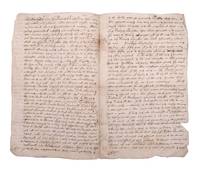
1680rif. 353098Likely Boston 1680. 4pp. Clerically signed Robert Warwick and Edward Gorges above an additional reaffirmation of grant dated June 1631 clerically countersigned by Thomas Wiggin James Parker James Watts and George Donglan. Docketed "Patent Saco: east of the river". Bifolium. Usual folds minor separations two repaired. 4pp. Clerically signed Robert Warwick and Edward Gorges above an additional reaffirmation of grant dated June 1631 clerically countersigned by Thomas Wiggin James Parker James Watts and George Donglan. Docketed "Patent Saco: east of the river". Bifolium. In 1629 less than a decade after the Pilgrims landed at Plymouth Rock the Council of New England an English joint stock company founded to establish colonial settlements in America issued a series of grants subdividing their royal charter that had ceded to them all land between "degrees 34 and 44" from sea to sea. These grants were important being among the earliest grants independently issued within the colonies. The present grant is of particular note for the history of Maine being the grant made to Thomas Lewis and Captain Richard Bonython for the land north of the Swanckadocke River i.e. the Saco River. The text of the grant reads in part: ".Whereas King James of famous memory late King of England Scotland France and Ireland by his Highness' letters patent and royal grant under the great seal of England bearing date the third day of November in the eighteenth year of his reign of England France and Ireland etc. for the causes therein expressed did absolutely give grant and confirm to the said Council for the affairs of New England in America and their successors forever all the land of New England lying and being from forty to forty-eight degrees of northerly latitude and in length by all that breadth aforesaid from sea to sea throughout the main land . that the said council for the affairs of New England in America as well for and in consideration that Thomas Lewis Gentleman has already been at the charge to transport himself and others to take a view of New England in America aforesaid for the bettering of his experience in advancing of a plantation and does now wholly intend by God's assistance with his associates to plant there both for the good of his Majesty's realms and dominions and for the propagation of Christian religion among those infidels and in consideration also that the said Thomas Lewis together with Captain Richard Bonighton and also with their associates and company have undertaken at their own proper costs and charges to transport fifty persons there within seven years next ensuing to plant and inhabit there to the advancement of the general plantation of that country and the strength and safety thereof among the natives or any other invaders also for the encouragement of the said Thomas Lewis and Captain Richard Bonighton and other considerations the said council thereunto moving have given granted enfeoffed and confirmed and by this present writing do fully clearly and absolutely give grant enfeof and confirm to the said Thomas Lewis and Captain Richard Bonighton their heirs and assigns for ever all that part of the main land in New England in America aforesaid commonly called or known by the name of Swanckadocke or by whatsoever other name or names the same is or shall be hereafter called or known by situated lying and being between the cape or bay commonly called Cape Elizabeth and the cape or bay commonly called Cape Porpoise containing in breadth from northeast to southwest along by the sea four miles in a straight line or accounting seventeen hundred and three score yards according to the standard of England to every mile and eight English miles upon the main land on the north side of the river Swanckadock after the same rate from the sea through all the breadth aforesaid ." The original vellum grant with seals is located in the archives of the Maine Historical Society. The present example is one of several extant early manuscript copies made during the subsequent conflicts and competing claims between the crown Massachusetts and Maine. In 1652 commissioners were appointed to determine the correct boundary between Massachusetts and several of the early patents with the former gradually extending their claim northward. In 1653 the settlers of Saco and other parts of Maine yielded to Massachusetts and the region was renamed Yorkshire or County of York. In 1664 after the Restoration the region was restored as an independent province but much of the region sold back to Massachusetts in 1678. After the charter of Massachusetts was annulled in 1684 and James II ascended to the crown in 1685 the region was once again assigned as part of the Province of Massachusetts Bay. Maine would remain part of Massachusetts until the final separation in 1820. The present undated copy likely dates from the period circa 1664 when a royal commission consisting of Richard Nicolls Sir Robert Carre George Cartwright and Samuel Maverick was sent to oversee the government of the colonies in New England. However it could also date as late as the period from the 1680s when Sir Edmund Andros became the Commissioner for the Dominion of New England. Documentary History of the State of Maine vol. 7 p. 117 unknown books
1828rif. 41555, , 1828-1877. Manuscrit in-folio à l’encre brune (42 x 27 cm) de (1)-160-(8) ff. en belle page, 187 grandes miniatures dans le texte finement coloriées à l'époque, demi-vélin à coins, dos lisse muet (reliure de l'époque).
MAYENNE, Imprimerie de l'Ouest, A. Nézan, 1895 - Tirage à 50 Exemplaires sur Japon, Celui-ci N° 2 - Complet en 2 volumes in-4, 25 x 17 cm- Reliure 1/2 basane fauve - dos à nerfs, orné - Gardes ornées - Édition augmentée de Généalogies inédites : de Montécler [Branche de Bourgon - Branche de Launay-Péan], et de Moré.- III-509 et III-549 pages - Dos insolé, sinon très bel exemplaire - Envoi rapide et soigné André René Le Paige, La Suze-sur-Sarthe,14 avril 1701, Le Mans, 2 juillet 1781. Chanoine de la cathédrale du Mans, estimant que la province du Maine manquait d'un bon ouvrage de statistique et d'économie civile, Le Paige se lança dans l'entreprise. Après avoir rassemblé un grand nombre de mémoires particuliers, qui lui furent adressés par les curés du diocèse et par les seigneurs de paroisse, en réponse à une circulaire qu'il avait publiée en 1772, il mit au jour son Dictionnaire topographique, historique, généalogique et bibliographique de la province et du diocèse du Maine en 1777. Ce livre contient des notions détaillées sur l'histoire naturelle, ecclésiastique, civile et littéraire, l'agriculture, l'industrie, le commerce et les arts de chaque commune. On y trouve sur le Mans, Laval, Mayenne, la Ferté-Bernard, Sablé, Mamers, etc., des notices et des faits qu'on chercherait vainement ailleurs. Cet ouvrage constitue un monument de l'histoire de la Province du Maine en général et de chaque commune en pârticulier.