MAINE DE BIRANBiblio.com

5 144 résultats
1802réf. 85218Paris: Henrichs 1802. Fine. Henrichs Paris An XI 1802 13.50 x 21 cm broché First edition of Maine de Biran's first work. Rare and handsome copy in original wrappers. Henrichs unknown
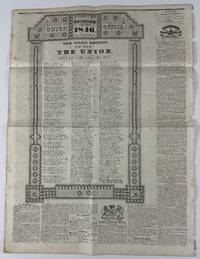
1846réf. 13085Saco ME: January 7 1846. 4pp. on a single large folio sheet of newsprint. Old folds minor foxing disbound from larger volume with tell-tale chips along binding edge. Still very good condition. An unusual appearance of a carrier's address printed on most of the back page of the January 7 1846 issue of The Union newspaper published in Saco Maine. The address itself is printed in three columns and contains typical news of the day particularly the imminent statehood of Texas and Oregon the election of Polk and Liberty Party presidential candidate James Birney former slave owner turned abolitionist and with several lines decrying the issue of slavery. An example of the latter from the middle column reads: "But change we now a while our verse Disunion threatens with its curse The land the great and good have blest With pure example wise behest And slavery rears her hideous head Among the sons of Freedom's dead. Was it t'enslave dark Afric's race Our country braved a tyrant base Unloosed our chains from England's Throne To rivet them on those at home How false the cry for Freedom dear From those who've strove from year to year T'extend to lands which should be free The blight of endless slavery!" There is also a passage concerning both Texas AND slavery also involving Birney: "As on the banks of Rio Grande The future slave of Texas stands And sees his children from him torn To bear the wrongs which he has borne Hie eyes suffused with bitter tears Glance up the long vista of years Among the sufferings of his race In hopes their author's name to trace; How does he start and heave a groan Birney he sees stands out alone!" The address is also interesting for the elaborate ornamental border composed of printer's ornaments including floral elements and patriotic symbols. This is the first time we have seen a carriers address integrated into the newspaper itself. January 7 unknown
1846réf. 13085Saco ME: January 7 1846. 4pp. on a single large folio sheet of newsprint. Old folds minor foxing disbound from larger volume with tell-tale chips along binding edge. Still very good condition. An unusual appearance of a carrier's address printed on most of the back page of the January 7 1846 issue of The Union newspaper published in Saco Maine. The address itself is printed in three columns and contains typical news of the day particularly the imminent statehood of Texas and Oregon the election of Polk and Liberty Party presidential candidate James Birney former slave owner turned abolitionist and with several lines decrying the issue of slavery. An example of the latter from the middle column reads: "But change we now a while our verse Disunion threatens with its curse The land the great and good have blest With pure example wise behest And slavery rears her hideous head Among the sons of Freedom's dead. Was it t'enslave dark Afric's race Our country braved a tyrant base Unloosed our chains from England's Throne To rivet them on those at home How false the cry for Freedom dear From those who've strove from year to year T'extend to lands which should be free The blight of endless slavery!" There is also a passage concerning both Texas AND slavery also involving Birney: "As on the banks of Rio Grande The future slave of Texas stands And sees his children from him torn To bear the wrongs which he has borne Hie eyes suffused with bitter tears Glance up the long vista of years Among the sufferings of his race In hopes their author's name to trace; How does he start and heave a groan Birney he sees stands out alone!" The address is also interesting for the elaborate ornamental border composed of printer's ornaments including floral elements and patriotic symbols. This is the first time we have seen a carriers address integrated into the newspaper itself. January 7 unknown books
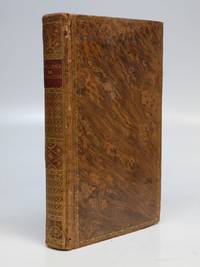
1802réf. 169027Paris: Henrichs 1802. hardcover. very good. 12mo 402pp. contemporary boards. Paris: Chez Henrichs AN XI 1802. Very good copy in slightly rubbed boards. Maine de Biran's first psychological book emphasizing will and activity which has remained an important theme in French psychology. Early ownership name and stamp including that of art historian Meyer Schapiro. Henrichs unknown
1802réf. 169027Paris: Henrichs 1802. hardcover. very good. 12mo 402pp. contemporary boards. Paris: Chez Henrichs AN XI 1802. Very good copy in slightly rubbed boards. Maine de Biran's first psychological book emphasizing will and activity which has remained an important theme in French psychology. Early ownership name and stamp including that of art historian Meyer Schapiro. Henrichs unknown books
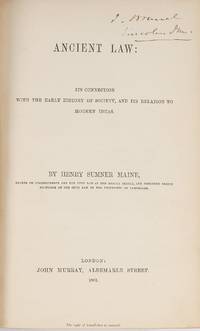
1861réf. 854901861. London: John Murray 1861. 1st ed. London: John Murray 1861. 1st ed. Copy of a Landmark of Legal Thought Owned by the Son of Isambard Kingdom Brunel Maine Henry Sumner 1822-1888. Ancient Law: Its Connection with the Early History of Society And Its Relation to Modern Ideas. London: John Murray 1861. viii 415 1 pp. Octavo 8-1/2" x 5-1/2"; 21.6 x 14 cm. Contemporary calf retaining existing gilt spine with raised bands and lettering piece gilt rules and corner fleurons to boards gilt tooling to board edges marbled endpapers and edges hinges mended. Minor nicks and scratches to boards moderate rubbing to extremities with wear to corners gilding mostly rubbed away from spine and board edges. Light toning to interior owner inscription of Isambard Kingdom Brunel Jr. to head of title page marks in pencil most likely in his hand to margins of a few leaves. A very good copy with an interesting association. $950. First edition. Famous for its dictum that civilization progresses "from status to contract" this landmark work in legal history and anthropology traces the evolution of legal systems from divine command to customary law and finally contracts and codified law. Maine's historical model resembled the biological model of Darwin's On the Origin of the Species 1859 though there is no evidence that it was a direct influence. Brunel 1837-1902 a London barrister of Lincoln's Inn was the eldest child of the eminent civil and mechanical engineer. Grace's Guide to British Industrial History "Isambard Brunel Junior 1837-1902" accessed online. Dauchy et al. The Formation and Transmission of Western Legal Culture: 150 Books that Made the Law in the Age of Printing 115. unknown
1861réf. 854901861. London: John Murray 1861. 1st ed. London: John Murray 1861. 1st ed. Copy of a Landmark of Legal Thought Owned by the Son of Isambard Kingdom Brunel Maine Henry Sumner 1822-1888. Ancient Law: Its Connection with the Early History of Society And Its Relation to Modern Ideas. London: John Murray 1861. viii 415 1 pp. Octavo 8-1/2" x 5-1/2"; 21.6 x 14 cm. Contemporary calf retaining existing gilt spine with raised bands and lettering piece gilt rules and corner fleurons to boards gilt tooling to board edges marbled endpapers and edges hinges mended. Minor nicks and scratches to boards moderate rubbing to extremities with wear to corners gilding mostly rubbed away from spine and board edges. Light toning to interior owner inscription of Isambard Kingdom Brunel Jr. to head of title page marks in pencil most likely in his hand to margins of a few leaves. A very good copy with an interesting association. $950. First edition. Famous for its dictum that civilization progresses "from status to contract" this landmark work in legal history and anthropology traces the evolution of legal systems from divine command to customary law and finally contracts and codified law. Maine's historical model resembled the biological model of Darwin's On the Origin of the Species 1859 though there is no evidence that it was a direct influence. Brunel 1837-1902 a London barrister of Lincoln's Inn was the eldest child of the eminent civil and mechanical engineer. Grace's Guide to British Industrial History "Isambard Brunel Junior 1837-1902" accessed online. Dauchy et al. The Formation and Transmission of Western Legal Culture: 150 Books that Made the Law in the Age of Printing 115. unknown books
réf. 46599Nantes.1816.In-8,cartonnage d'époque.Recueil de 6 textes avec corrections de l'Auteur.Discours ou Oraison Funèbre.Relation des évènemens qui ont eu lieu dans la Vendée en 1815.Relation de ce qui s'est passé le 24 Juin 1815,à la Tessoualle,près Chollet.Mémoire relatif à l'Armée Royale du Maine.Pièces contenues dans le mémoire.Détails historiques sur les services de Françoise Desprès. Bon état.Rare.
1925réf. 31477Angers 1925 Grand In-4 Manuscrit Inédit ? - épais volume de 925 pp signé de Rousseau Angers 1925 probablement inédit de la Région des Mauges qui correspond au sud du Maine et Loire et du Choletais, l'auteur cite ses sources , une quarantaine d'ouvrages dont ceux de célestin Port , Crétineau-joly, Dom Chamard, Claude Robin, et divers abbés érudits , le manuscrit est rédigé d'une écriture fine et très lisible , Il n y a pas de ratures, la rédaction en feuillets à probablement permis d'établir une copie très lisible et sans remords , l'auteur cite de très nombreuses Communes sans ommettre de préciser d'où viennent ses sources . l'ouvrage consiste en une agréable et généreuses compilation de divers auteurs pour une région très marquée par les guerres de vendées . Le tout constitue un monumental travail . Une table importante clos le volume
réf. 51-0639Circa 19th Century. Oil on board. 8.5 x 12 inches. Titles and notes in the margins; possible signed as well. Circa 19th Century. unknown
1802réf. 262552Paris: Henrichs 1802. hardcover. 12mo 402pp. occasional toning full tree calf decoratively gilt spine with leather label. Paris: Chez Henrichs AN XI 1802. Very good copy. Maine de Biran's first psychological book emphasizing will and activity which has remained an important theme in French psychology. Early ownership name and stamp including that of art historian Meyer Schapiro. Henrichs unknown
1802réf. 262552Paris: Henrichs 1802. hardcover. 12mo 402pp. occasional toning full tree calf decoratively gilt spine with leather label. Paris: Chez Henrichs AN XI 1802. Very good copy. Maine de Biran's first psychological book emphasizing will and activity which has remained an important theme in French psychology. Early ownership name and stamp including that of art historian Meyer Schapiro. Henrichs unknown books
1890réf. Alibris.0036220LONDON: JOHN MURRAY 1890. Hard cover. Good. No dust jacket. POPULAR GOVERNMENT Four Essays; Propects OF POPULAR GOVERNMENT Nature OF DEMOCRACY Age of Progress and U.S. CONSTITUTION OF THE UNITED STATES Hardcover CONDITION GOOD-LEATHER BOUND SPINE AND BOOK EDGES. COPYRIGHT 1890. 261 p. POPULAR GOVERNMENT Four Essays; Propects OF POPULAR GOVERNMENT Nature OF DEMOCRACY Age of Progress and U.S. CONSTITUTION OF THE UNITED STATES Hardcover CONDITION GOOD-LEATHER BOUND SPINE AND BOOK EDGES. COPYRIGHT 1890 PUBLISHED BY JOHN MURRAY ALBE POPULAR GOVERNMENT Four Essays; Propects OF POPULAR GOVERNMENT Nature OF DEMOCRACY Age of Progress and U.S. CONSTITUTION OF THE UNITED STATES Hardcover CONDITION GOOD-LEATHER BOUND SPINE AND BOOK EDGES. COPYRIGHT 1890 PUBLISHED BY JOHN MURRAY ALBEMARLE STREET LONDON.261 PAGES. PRINTED BY SPOTTISWOODE AND CO. NEW STREET SQUARE LONDON by Sir Henry Sumner Maine Author JOHN MURRAY hardcover
1789réf. 8436Imprimerie Impériale / Chez Pillet / Delaunay / J.C. Cotta / Poussielgue / Asselin / Gaultier - Laguionie 13 x 20,5 1789 Petit in-8, reliure à la bradel pleine toile bleue moderne, titre "France 1789-1815" doré au dos, réunissant 8 pièces rares, parues entre 1789 et 1840, concernant l'histoire de la période qui s'étend de 1789 à 1815. I./ La galerie des Etats-Généraux, 1789, 204-[1] pp. Ecrit à plusieurs mains (Luchet, Mirabeau ?), la "Galerie" est une succession de portraits (31) satiriques des hommes de 1789, de Narsès (Necker) à (Francus l'archevêque de Vienne/Lefranc de Pompignan, affublé chacun d'un nom codé, dont la clé figure sur la dernière page. L'ensemble compte 3 volumes, il s'agit ici du seul premier volume. II. Notice abrégée sur la vie, le caractère et les crimes des principaux assassins aux gages de l'Angleterre qui sont aujourd'hui traduit devant le Tribunal de la Seine, Paris, Imprimerie Impériale, An XII, 1804, 72 pp. Notice à charge, attribuée à l'agent de Napoléon Roques de Montgaillard, qui dresse la biographie des hommes autour de Cadoudal qui fomentèrent le complot de 1804. III. Procès de M. Marie Chamans de Lavalette, accusé de complicité dans l'attentat qui a ramené l'usurpateur en France et condamné à mort le 21 novembre à la peine de mort, précédé d'une notice historique sur la carrière civile et militaire de M. de Lavalette, Paris, chez Pillet, 1815, 50 p. IV. Mémoire de M. le Maréchal Masséna duc de Rivoli, prince d'Essling, sur les événements qui ont eu lieu en Provence, pendant les mois de mars et d'avril 1815, suivi de pièce justificatives et d'une carte géographique, Deuxième édition; Paris, Delaunay, 1816, 89 pp. Réponse du maréchal d'Empire (1758-1817) aux accusations des Ultras de ne pas avoir voulu arrêter Bonaparte à son retour lors de sa traversée de la Provence en mars 1815. V. Projet de pétition au Parlement d'Angleterre par le comte de Las Cases, Stuttgart, dans la librairie de J.G. Cotta, 1818, 51 pp. Page de titre en allemand également (Entwurf einer Bittschrift an das brittische Parlament vom Grafen de Las Cases) et texte allemand et traduction française page à page. Après Waterloo, Las Cases (1766-1842) accompagne Napoléon à Sainte-Hélène. Pétition que Las Cases aurait transmise lors de son arrivée au Cap de Bonne Espérance, après avoir laissé Napoléon à Longwood. VI. Appel à tous les Français contre les calomnies par lesquelles on a cherché à flétrir la conduite du comte de Bourmont en 1815, Paris, Imprimerie de Poussielgue, 1840, 40 pp. Plaidoyer de Charles de Bourmont lors du retour d'exil de son père le maréchal d'Empire. VII. Documents inédits sur la campagne de 1815 publiés par le duc d'Elchingen, Paris, 1840, Asselin - Laguionie, 87 pp. Défense de la mémoire de Ney maréchal d'Empire, par son fils Michel Ney (1804-1854), duc d'Elchingen, qui avait réuni d'importants documents sur la bataille de Waterloo et sur le rôle joué par son père. Mais carte dépliante absente. Ce texte est suivi par une note du général Jomini (pp. 265-280), adressée à Michel Ney en septembre 1841. VIII. Relation de la campagne de 1815, dite de Waterloo, pour servir à l'histoire du maréchal Ney, par le colonel Heymès, son premier aide de camp, témoin oculaire, Paris, imprimerie de Gaultier-Laguionie, Paris 1829. Exemplaire de bibliothèque avec ses cotes au dos, très bon état de cet ensemble de pièces peu fréquentes. Ex-libris gravé sur le premier contre plat du collectionneur et prêtre californien Joseph M. Gleason (1869-1942) et petit ex-libris récent.(B56). PHOTOS NUMERIQUES DISPONIBLES PAR EMAIL SUR SIMPLE DEMANDE-DIGITAL PHOTOGRAPS MAY BE AVAILABLE ON REQUEST
1789réf. 8436Imprimerie Impériale / Chez Pillet / Delaunay / J.C. Cotta / Poussielgue / Asselin / Gaultier - Laguionie 13 x 20,5 1789 Petit in-8, reliure à la bradel pleine toile bleue moderne, titre "France 1789-1815" doré au dos, réunissant 8 pièces rares, parues entre 1789 et 1840, concernant l'histoire de la période qui s'étend de 1789 à 1815. I./ La galerie des Etats-Généraux, 1789, 204-[1] pp. Ecrit à plusieurs mains (Luchet, Mirabeau ?), la "Galerie" est une succession de portraits (31) satiriques des hommes de 1789, de Narsès (Necker) à (Francus l'archevêque de Vienne/Lefranc de Pompignan, affublé chacun d'un nom codé, dont la clé figure sur la dernière page. L'ensemble compte 3 volumes, il s'agit ici du seul premier volume. II. Notice abrégée sur la vie, le caractère et les crimes des principaux assassins aux gages de l'Angleterre qui sont aujourd'hui traduit devant le Tribunal de la Seine, Paris, Imprimerie Impériale, An XII, 1804, 72 pp. Notice à charge, attribuée à l'agent de Napoléon Roques de Montgaillard, qui dresse la biographie des hommes autour de Cadoudal qui fomentèrent le complot de 1804. III. Procès de M. Marie Chamans de Lavalette, accusé de complicité dans l'attentat qui a ramené l'usurpateur en France et condamné à mort le 21 novembre à la peine de mort, précédé d'une notice historique sur la carrière civile et militaire de M. de Lavalette, Paris, chez Pillet, 1815, 50 p. IV. Mémoire de M. le Maréchal Masséna duc de Rivoli, prince d'Essling, sur les événements qui ont eu lieu en Provence, pendant les mois de mars et d'avril 1815, suivi de pièce justificatives et d'une carte géographique, Deuxième édition; Paris, Delaunay, 1816, 89 pp. Réponse du maréchal d'Empire (1758-1817) aux accusations des Ultras de ne pas avoir voulu arrêter Bonaparte à son retour lors de sa traversée de la Provence en mars 1815. V. Projet de pétition au Parlement d'Angleterre par le comte de Las Cases, Stuttgart, dans la librairie de J.G. Cotta, 1818, 51 pp. Page de titre en allemand également (Entwurf einer Bittschrift an das brittische Parlament vom Grafen de Las Cases) et texte allemand et traduction française page à page. Après Waterloo, Las Cases (1766-1842) accompagne Napoléon à Sainte-Hélène. Pétition que Las Cases aurait transmise lors de son arrivée au Cap de Bonne Espérance, après avoir laissé Napoléon à Longwood. VI. Appel à tous les Français contre les calomnies par lesquelles on a cherché à flétrir la conduite du comte de Bourmont en 1815, Paris, Imprimerie de Poussielgue, 1840, 40 pp. Plaidoyer de Charles de Bourmont lors du retour d'exil de son père le maréchal d'Empire. VII. Documents inédits sur la campagne de 1815 publiés par le duc d'Elchingen, Paris, 1840, Asselin - Laguionie, 87 pp. Défense de la mémoire de Ney maréchal d'Empire, par son fils Michel Ney (1804-1854), duc d'Elchingen, qui avait réuni d'importants documents sur la bataille de Waterloo et sur le rôle joué par son père. Mais carte dépliante absente. Ce texte est suivi par une note du général Jomini (pp. 265-280), adressée à Michel Ney en septembre 1841. VIII. Relation de la campagne de 1815, dite de Waterloo, pour servir à l'histoire du maréchal Ney, par le colonel Heymès, son premier aide de camp, témoin oculaire, Paris, imprimerie de Gaultier-Laguionie, Paris 1829. Exemplaire de bibliothèque avec ses cotes au dos, très bon état de cet ensemble de pièces peu fréquentes. Ex-libris gravé sur le premier contre plat du collectionneur et prêtre californien Joseph M. Gleason (1869-1942) et petit ex-libris récent.(B56). PHOTOS NUMERIQUES DISPONIBLES PAR EMAIL SUR SIMPLE DEMANDE-DIGITAL PHOTOGRAPS MAY BE AVAILABLE ON REQUEST
1961réf. 10426GOLDMANN WILHELM 1961. 1. softcover. GOLDMANN, WILHELM paperback
réf. 216189Paris, A. Durand et Pedone-Lauriel, 1877-1897 2 parties en 10 vol. in-8, brochés, dos cassés sur trois volumes.
réf. 218883Saumur, S. Milon fils, (1890) 2 forts vol. gr. in-8, XIII-593-[1] pp. et 774-[1] pp., 52 gravures h.-t. dont certaines à double page, demi-chagrin rouge à coins, dos à nerfs orné, couv. cons. (reliure de l'époque). Usures aux coins, infime accroc à la coiffe supérieure du tome 1.
1856réf. 0048741856 Nantes, Typographie de Vincent Forest & Émile Grimaud [et] Paris, Imprimerie Lithographique d'Auguste Bry, sans date [circa 1856]. Deux volumes grand in folio (346 X 478 mm) demi-chagrin vert lierre, dos lisse cloisonné d'un triple filet doré, auteur, titre et tomaison dorés, premier plat de la couverture vert eau conservé en tête du second volume (reliure de l'époque). Volume I : (1) f. de titre, XL pages, 10 pages, (1) f. d'errata et supplément, 6 pp.-8 pp.-4 pp.-4 pp.-2 pp.-6 pp.-6 pp.-4 pp.-4 pp.-4 pp.-4 pp.-8 pp.-4 pp.-8 pp.-4 pp.-2 pp.-6 pp.-8 pp.-6 pp.-4 pp.-2 pp.-6 pp.-8 pp.-2 pp.-4 pp.-6 pp.-6 pp. [=136 pages] de descriptif des planches, 36 planches hors-texte montées sur onglets - Volume II : 2 pp.-12 pp.-2 pp.-6 pp.-8 pp.-12 pp.-6 pp.-8 pp.-6 pp.-4 pp.-2 pp.-14 pp.-6 pp.-4 pp.-6 pp.-4 pp.-4 pp.-4 pp.-4 pp.-6 pp. [=130 pages], 24 planches hors-texte montées sur onglets. Cernes marginaux de mouillure claire sans gravité, quelques rousseurs éparses.
1998réf. SBBIH-UFYAXGLCHC6HDisney Hachette Edition 1998. paperback. Good. Our good condition books are generally good for reading but not for gifting or collecting. They could have imperfections such as creasing fanning inscriptions margin notes yellowing staining on edge or cover or pages bumps scuffs etc etc sometimes multiple of these. It's a wide category that encompasses anything that isn't almost-new down to anything that is slightly better than poor. We would NOT recommend gifting Good books - these should be considered reading copies. Our books are dispatched from a Yorkshire former cotton mill. We list via barcode/ISBN so please note that the images are stock images and may not be the exact copy you receive furthermore the details about edition and year might not be accurate as many publishers reuse the same ISBN for multiple editions and as we simply scan a barcode or enter an ISBN we do not check the validity of the edition data when listing. If you're looking for an exact edition please don't order at least not without checking with us first although we don't always have time to check. We aim to dispatch prompty the service used will depend on order value and book size. We can ship to most countries see our shipping policies. Payment is via Abe only. Disney Hachette Edition paperback
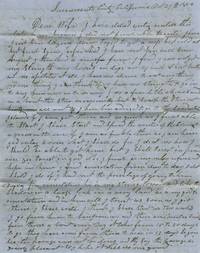
1850réf. BK0017Sacramento City California 1850. Autograph letter signed "Sam'l Locke" to his wife in Belfast Maine. 6 pp. Stampless folded letter with clear circular "SACRAMENTO CITY / CAL." postmark and "40" rate handstamp; manuscript notation recording receipt in Maine on December 19 1850. Light soiling; very good. A bleak California Gold Rush letter written during the 1850 Sacramento cholera epidemic by Samuel Locke a Maine emigrant suffering from prolonged fever and unable to regain his strength. Surrounded by sickness failed mining ventures violent crime and men too poor or ill to return home Locke plans to seek recovery in the Sandwich Islands while relying upon his religious faith for consolation. Locke had been ill since August and was now so weak that ordinary work exhausted him: "My limbs or legs are very weak short breath and no appetite at all. I have no desire to eat anything not one thing I can think of. I have no strength to go into any business or to do any. I do a few little chores round or about the store occasionally but to sweep the store it beats me all out . O how I long to get out of this place. Can't get any strength don't know as I can anywhere but I long to try." Friends advised him to spend the winter in the Sandwich Islands. He expected to travel first to San Francisco and then make the fifteen- to twenty-day passage to Hawaii though he feared that continued illness might leave him unable either to support himself there or return to Maine. He states that he will "trust in providence yes trust in God who I feel is my only refuge". Locke gives a grim account of California's climate and the spread of cholera through Sacramento claiming that the climate in California prevented the sick from recovering their strength as the "air is very light & bad middle of the day very hot and nights very cool." The previous week's report had stated forty dead but "nothing near all the cases were reported" with Locke himself knowing of several unreported cases personally. A local blacksmith died overnight after his companions borrowed Locke's syringe and "We can hardly see a healthy looking individual in the streets." The letter also records the uncertain fortunes of men from Locke's home region scattered through the mines. William Beckett and his partners had spent the summer constructing a mining dam had struck gold on the first day and then immediately "the dam was washed away so they lost all their summer's labor." Other acquaintances had moved to Kelsey's Bar the southern mines or Oregon or were preparing to return east by way of Panama. Some remained convinced that California would reward perseverance while others had "seen enough" after accomplishing nothing. Locke regarded success as largely accidental: "Thousands are here and in the mines who want to get home and cannot-not able to do seamen's duty and no money to pay but they have got to stay in the mines and do the best they can. Some it is true have been lucky. It is all luck. If they happen to hit a good place they do well." News that cholera had entered the mining districts increased his alarm. Locke feared especially for men living in tents as the rainy season approached with poor food and little protection from exposure. Sacramento itself was marked by nightly violence: "There are murders or robberies about every night. One man killed in front of our house a few nights ago. We heard him holler and heard the blows. Next morning he died. His head was dreadfully mangled." Locke closes with an emotional message to his wife and children. His health finances and prospects all appeared uncertain and he repeatedly asked his family and church to pray for him: "Tell the dear Children to be good and if they never see me again when I am gone they will have the satisfaction . of knowing they acted as thy Father requested . Pray for me ask the Church to pray for me indeed I know I have your prayers and you have mine often." A particularly bleak account of the human cost of the California Gold Rush documenting epidemic disease physical collapse failed mining schemes violent crime religious faith and the predicament of emigrants unable to escape California after their health and resources were exhausted. . unknown
1850réf. BK0017Sacramento City California 1850. Autograph letter signed "Sam'l Locke" to his wife in Belfast Maine. 6 pp. Stampless folded letter with clear circular "SACRAMENTO CITY / CAL." postmark and "40" rate handstamp; manuscript notation recording receipt in Maine on December 19 1850. Light soiling; very good. A bleak California Gold Rush letter written during the 1850 Sacramento cholera epidemic by Samuel Locke a Maine emigrant suffering from prolonged fever and unable to regain his strength. Surrounded by sickness failed mining ventures violent crime and men too poor or ill to return home Locke plans to seek recovery in the Sandwich Islands while relying upon his religious faith for consolation. Locke had been ill since August and was now so weak that ordinary work exhausted him: "My limbs or legs are very weak short breath and no appetite at all. I have no desire to eat anything not one thing I can think of. I have no strength to go into any business or to do any. I do a few little chores round or about the store occasionally but to sweep the store it beats me all out . O how I long to get out of this place. Can't get any strength don't know as I can anywhere but I long to try." Friends advised him to spend the winter in the Sandwich Islands. He expected to travel first to San Francisco and then make the fifteen- to twenty-day passage to Hawaii though he feared that continued illness might leave him unable either to support himself there or return to Maine. He states that he will "trust in providence yes trust in God who I feel is my only refuge". Locke gives a grim account of California's climate and the spread of cholera through Sacramento claiming that the climate in California prevented the sick from recovering their strength as the "air is very light & bad middle of the day very hot and nights very cool." The previous week's report had stated forty dead but "nothing near all the cases were reported" with Locke himself knowing of several unreported cases personally. A local blacksmith died overnight after his companions borrowed Locke's syringe and "We can hardly see a healthy looking individual in the streets." The letter also records the uncertain fortunes of men from Locke's home region scattered through the mines. William Beckett and his partners had spent the summer constructing a mining dam had struck gold on the first day and then immediately "the dam was washed away so they lost all their summer's labor." Other acquaintances had moved to Kelsey's Bar the southern mines or Oregon or were preparing to return east by way of Panama. Some remained convinced that California would reward perseverance while others had "seen enough" after accomplishing nothing. Locke regarded success as largely accidental: "Thousands are here and in the mines who want to get home and cannot-not able to do seamen's duty and no money to pay but they have got to stay in the mines and do the best they can. Some it is true have been lucky. It is all luck. If they happen to hit a good place they do well." News that cholera had entered the mining districts increased his alarm. Locke feared especially for men living in tents as the rainy season approached with poor food and little protection from exposure. Sacramento itself was marked by nightly violence: "There are murders or robberies about every night. One man killed in front of our house a few nights ago. We heard him holler and heard the blows. Next morning he died. His head was dreadfully mangled." Locke closes with an emotional message to his wife and children. His health finances and prospects all appeared uncertain and he repeatedly asked his family and church to pray for him: "Tell the dear Children to be good and if they never see me again when I am gone they will have the satisfaction . of knowing they acted as thy Father requested . Pray for me ask the Church to pray for me indeed I know I have your prayers and you have mine often." A particularly bleak account of the human cost of the California Gold Rush documenting epidemic disease physical collapse failed mining schemes violent crime religious faith and the predicament of emigrants unable to escape California after their health and resources were exhausted. . unknown books
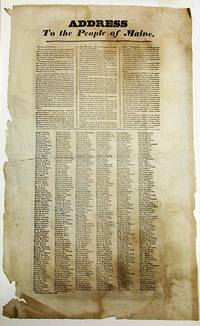
1832réf. 34328Portland 1832. Broadside 11-3/4" x 19". Lightly foxed generously margined and untrimmed with lower blank margins chipped some old folds. Else Very Good. Matted. Dated in type at the end: Portland Oct. 25th 1832." The text of this rare broadside urging the defeat of President Jackson in the upcoming presidential election is printed in three columns. It is followed by six columns consisting of hundreds of printed names of Portland citizens endorsing its sentiments. Despite his promises to the contrary Jackson has expanded the power of the presidency reneged on his promise to serve only one term and enthusiastically practiced the Spoils System. "The expenses of his administration have largely exceeded those of any of his six predecessors." He has claimed the power of "interpreting for himself" the Constitution although contradicted by "the Supreme Judiciary." AI 10824 1- Harvard. OCLC 58786948 3- AAS NYHS Harvard as of November 2023. unknown
1832réf. 34328Portland 1832. Broadside 11-3/4" x 19". Lightly foxed generously margined and untrimmed with lower blank margins chipped some old folds. Else Very Good. Matted. Dated in type at the end: Portland Oct. 25th 1832." The text of this rare broadside urging the defeat of President Jackson in the upcoming presidential election is printed in three columns. It is followed by six columns consisting of hundreds of printed names of Portland citizens endorsing its sentiments. Despite his promises to the contrary Jackson has expanded the power of the presidency reneged on his promise to serve only one term and enthusiastically practiced the Spoils System. "The expenses of his administration have largely exceeded those of any of his six predecessors." He has claimed the power of "interpreting for himself" the Constitution although contradicted by "the Supreme Judiciary." AI 10824 1- Harvard. OCLC 58786948 3- AAS NYHS Harvard as of November 2023. unknown books
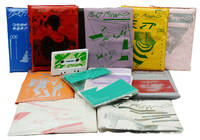
réf. 140940258Melbourne Australia: Fast Forward 1982. Complete run of 13 issues in 12 #008/009 is a double issue. Magazines often folded and sometimes staple bound with a variety of folded inserts with cassettes housed in silk-screened colored plastic wallets. Near Fine condition overall appearing to contain all inserts etc.; slightly rubbed and soiled occasional slight creasing to inserts or oxidation to staples. Small tear to rear wallet of #005. Issue 008/009 wallet gilt lettering well-rubbed. Offsetting to wallet of #011. Rare as a set. One of the very first cassette magazines which was popular financially successful and proved to be influential in the burgeoning global "cassette culture" of '80s independent music directly spawning such other projects as Sub Pop editor/ label head Bruce Pavitt was a contributor to the double-issue and the UK's Mix. The audio portion was structured somewhat like an old-timey news broadcast featuring new music as well as interviews with musicians. In addition to featuring the sounds of Aussies The Birthday Party Primitive Calculators Dead Can Dance Scientists and the Go-Betweens et al many prominent cutting-edge British and American musicians such as Pere Ubu The Clash The Fall The Residents Adam and the Ants and Gang of Four were interviewed and sometimes provided songs. Being Australian the magazine was bound to have a sense of humor. Robert Smith of The Cure got in on the act and provided "A Few Stylish Tips" in #013 about how he obtained that perfect lift for his '80s hair: soap and water. Crossword puzzles became a feature early on. Also Michael Trudgeon's design of the magazine was inspired growing in sophistication throughout the run adding inserts steadily stylishly utilizing only one or two colors in the printing process. A real acme of early '80s independent music print and design cultures. Its run lends credence to the idea that post-punk truly went beyond punk in many ways. Fast Forward unknown