4 363 résultats
1908réf. 73317Bethel: E.C. Bowler 1908. Hardcover. Very good. Hardcover. 833pp index. Small blindstamp on title page else very good in later blue buckram. E.C. Bowler hardcover books
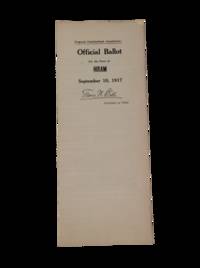
1917réf. 199681917. Maine Secretary of State Frank W. Ball. Hiram Maine ballot sheet is a 1917 election document recording a statewide vote on women's suffrage before ratification of the Nineteenth Amendment. Proposed Amendment No. 1 states "The right to vote or to hold office shall not be denied or abridged on account of sex" placing the sheet within Maine's contested suffrage campaign which was defeated by male voters by roughly a two-to-one margin on September 10 1917. The ballot supports research into women's voting rights state constitutional reform local election administration and suffrage politics during World War I. Proposed Constitutional Amendments Ballot. Issued by Frank W. Ball Secretary of State. Hiram Maine: State of Maine September 10 1917. Unfolded sheet measuring 25" x 9". The sheet presents five proposed amendments for local voters including Proposed Amendment No. 1 on women's suffrage and Proposed Amendment No. 4 concerning Article 7 of the Maine Constitution and the deployment of American troops during World War I. The recto bears Ball's facsimile signature identifying the document as an official election form used in the town of Hiram. The ballot's date gives it particular significance within Maine suffrage history: Maine rejected the 1917 state amendment then ratified the federal woman suffrage amendment in 1919 before national certification in 1920. Quarter-folded; very minor age-toning to extremities and creases. Overall very good. A local Maine voting document preserving the exact ballot language of a failed state suffrage referendum shortly before federal enfranchisement. unknown books
1972réf. 558505Garden City New York: Nelson Doubleday Inc 1972. Hardcover. Good/Very Good. Book Club edition. Boards warped with an indentation and wrinkles on the rear board faint foxing on the topedge good only in a rubbed very good dust jacket with corresponding indentation and abrasions on the rear panel and a few small chips along the edges. Nelson Doubleday, Inc hardcover books
1972réf. 552061London: Dent 1972. Hardcover. Near Fine/Very Good. Reprint. Introduction by J.H. Morgan. xvi 237pp. Inked underlining and highlighting on two pages near fine in a very good dust jacket with light toning and a faint stain on the cover. Dent hardcover books
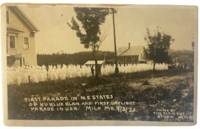
1923réf. 177341923. Clement Studio Ku Klux Klan march in Milo Maine 1923 documents the public visibility of the 1920s Klan revival in a rural Northeastern town. The image records the first daylight Ku Klux Klan parade and the first Klan parade in New England held during Milo's centennial celebration on September 3 1923. Its research value lies in its direct visual evidence of white supremacist performance anti-Catholic and anti-immigrant intimidation and the spread of Klan organizing beyond the South during the interwar period. Clement Studio. Ku Klux Klan march Milo Maine. Milo Maine: Clement Studio September 3 1923. Black-and-white silver gelatin real photo postcard. 5.25 x 3.5 inches. The photograph shows hooded Klansmen in white robes marching through Milo with several participants carrying American flags. The Metropolitan Museum of Art records a related Clement Studio image with the negative inscription: "First Parade in N.E. States of Ku Klux Klan. Milo. Maine Sept 3. 1923. Centennial Celebration." The photograph belongs to the period when the revived Klan used parades recruitment flags robes and public ceremony to normalize racial religious and nativist exclusion. In Maine Klan activity particularly targeted Catholic and immigrant communities including French Canadian and Irish populations while also drawing on national anti-Black anti-Jewish and anti-immigrant ideology. Minor small stain along upper margin not affecting image; very good. A stark local record of the Klan's Northeastern expansion and its use of daylight public spectacle as intimidation. unknown books
1912réf. 167751912. Unidentified compiler. Photograph album of women's education and collegiate life 1912-1920 documents student experience leisure activities and social networks across Maine including institutions such as Colby College and the University of Maine. The album captures young women's participation in academic environments alongside outdoor recreation travel and community life situating female education within broader patterns of early twentieth-century mobility and social interaction. The material provides visual evidence of women's presence in expanding educational institutions and their integration into both structured and informal aspects of student life. Photograph album. Maine and various U.S. locations 1912-1920. Quarto format album with 187 silver gelatin photographs mounted across 42 pages with image sizes ranging from approximately 1.5 x 3.5 inches to 3.5 x 5.5 inches. The photographs depict locations throughout southern Maine including Portland Waterville Lamoine Boothbay North Pond and Ogunquit along with additional images from Texas Florida and New Hampshire. Academic settings are represented through images identified as Colby College including a figure labeled "Prof. Johnson Colby '18" and references to the Alpha Tau Omega fraternity "Hurrah for A.T.O.". Additional institutional references include "Nasson Institute 1912" a women's school in Springvale and the Phi Eta Kappa fraternity house at the University of Maine. Human subjects include students and faculty such as "Dean Hunt" as well as classmates in graduation attire. Recreational and social scenes include young women snowshoeing playing tennis and participating in outings labeled "Picnic to the quarry" "Clam Bake" and "Hot Dog Roast." Automotive travel appears in images of early motorcars while other photographs depict children in Sunday school groups bicycle riding and staged performances of "Pied Piper" and "Red Riding Hood." Additional images include a man in World War I-era military uniform "Adrian Old Top" and an individual identified as "Texas Bill" posing with a biplane. Informal scenes include three girls reading on a rooftop space labeled "The Sun Porch" with a related image documenting their ascent assisted by a male companion. The album spans a period of expanding access to higher education for women in the United States particularly in regional institutions across New England. The inclusion of both coeducational and women-focused institutions reflects the varied educational pathways available during this period. Recreational imagery including athletics and social outings demonstrates the integration of leisure into student identity while references to World War I-era figures situate the album within a broader national context. Original cloth boards with minor wear and three small holes to lower right quadrant of front cover; photographs well-preserved with strong clarity; overall very good condition. A substantial visual record of women's collegiate and social life in early twentieth-century Maine. unknown books
1946réf. 375512London: John Westhouse 1946. Hardcover. Very Good/Very Good. Reprint. 129pp. Introduction by Sir Adrian Boult. Slightly cocked with some wear on the board edges else very good in a very good dust jacket with toning and edgewear. John Westhouse hardcover books
1957réf. 374281London: The Epworth Press 1957. Hardcover. Near Fine/Very Good. First edition. 156pp. Introduction by Sir Compton Mackenzie. Slight rubbing on the board edges and remnants from sticker removal else near fine in a very good price-clipped dust jacket with rubbing toning and a short tear on the rear panel. The Epworth Press hardcover books
1961réf. 26558London: Hodder and Stoughton. Near Fine in Near Fine dj. 1961. First Edition. Hardcover. price-clipped nice tight clean copy just the teensiest bumping to the lower front corner; the jacket is virtually flawless downgraded from Fine only because of the price-clipping and a touch of soiling to the rear panel. "John Soames is thirty years old and physiologically speaking alive. But by some trick of fate he has never become conscious. He is awoken and brought to full consciousness by a surgeon's knife a newborn baby with the body of a healthy young man." Basis for the 1970 British-American film of the same name starring Terence Stamp and Robert Vaughn; a critical and box-office disappointment on its original release the film has gained a bit of a retrospective cult reputation with one online critic calling it "a dark gem and a worthy pretender to the British horror hall of fame." Uncommon in the first edition all the more so in such outstanding condition. . Hodder and Stoughton hardcover books
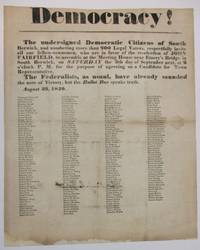
1840réf. 37337South Berwick ME 1840. Broadside 11-3/4" x 14-1/2." Text as recited above in bold type of various sizes. Beneath are the printed signatures in smaller type of about 200 local citizens endorsing the call for assembly. Old folds as usual with several small pinholes along the folds which do not affect text. Ink signature on blank verso "Micajah Grant" preceded by "Mrs" "Hon.". Good plus. South Berwick Democrats seek support for the re-election of Maine Governor John Fairfield 1797-1847. Elected in 1838 he beat his Whig i.e. "Federalist" opponent in the 1840 campaign. Not located on OCLC as of May 2024 or online AAS Bowdoin Colby U ME U So. ME sites. unknown books
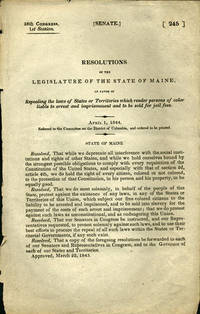
1844réf. 36140Washington D.C.: n.p. 1844. First edition. Removed. A very good copy. 1 pp. 8vo. The Maine resolution was an attack on the heinous process of re-enslaving freed blacks: "Resolved. That we do most solemnly in behalf of the people of this State protest against the existence of any laws in any of the States of Territories of this Union which subject our free colored citizens to the liability to be arrested and imprisoned and to be sold into slavery for the payment of the costs of such arrest and imprisonment; that we do protest against such laws as unconstitutional and as endangering the Union." Maine approved this on March 22 1843 sent a copy to all members of the House and Senate and to all the governors of States and Territories. OCLC locates no copies. Not in Sabin Blockson Dumont Work LCP. Afro-Americana Clark: New England in U.S. Government Publications 1789-1849: 1145. n.p. unknown books
1885réf. 19536London: John Murray 1885. Fourth edition 8vo pp. 2 viii 2 412 32 ads; later cloth spine gilt lettered light wear to covers overall very good. The result of a series of lectures delivered at Oxford Lectures deals with Indian law Mahametan law feudalism inclosure family tradition usury laws etc. Maine a highly respected legal historian a vigorous critic of democracy convinced many legal historians that law and legal institutions must be studied historically if they are to be understood. John Murray unknown books
1860réf. 12953Augusta ME: Stevens & Sayward 1860. First Edition. Hardcover. Very Good. First Edition. Hardcover. "Sheep husbandry and wool production to which broad sections of our State seem well adapted are receiving increased attention. This branch of stock husbandry is gradually establishing itself as a specialty in those localities specially suited to it and much attention is being given to the improvement of the flocks by increased care and attention and by the introduction of improved blood." Volumes includes several pages with laid in hair. "Locks of hair have long served as sentimental and tangible reminders of deceased or far-away friends and close relations. Among family friends and romantic partners exchanging a lock of hair was a sign of mutual esteem and deep affection. Upon the death of a loved one locks of hair were often cut and kept as a way to both honor and remember the dead" "Hairwork Jewelry" FIDM Museum Blog 5/16/2011. Heavy peeling and rubbing to boards cracking to hinge but intact creasing bending to block moderate wear to extremities slightly shaken foxing throughout else tight bright and unmarred. Printed card boards with brown cloth spine. 8vo. 267pp.; 239pp. Illus b/w engravings Two volumes in one. Laid in loose hair specimens. Stevens & Sayward hardcover books
1915réf. 5545Portland ME: Lefavor-Tower Co 1915. First Editions. Hardcover. Near Fine to Very Good Textblocks Fine. No DJ. First Editions. Hardcover. Arguably the more important collection of Maine related Civil War papers. Includes several essays from Joshua Chamberlain the capture of Mobile AL and Richmond VA an essay on "Colored Troops" the "Attitude of Women" about the war etc. Uncommon to find as a complete set and this one was clearly "built". Volume Four bears a presentation inscription to the Paris Hill Library N.B. there are no library markings from Henry W. Lyon "The first paper Hamlin Centennial Celabration will interest all citizens of Paris Hill." Overall a handsome set. Light shelf/edge wear tips of Vol. 3 gently bumped spine of Vol. 3 shows light toning Vol. 3 shows lightening at front lower corner Vol. 4 shows lightening spot near tail presentation inscription at fep of Vol. 4 bookplate lifted from Vol. 4 else tight bright and unmarred. Navy boards gilt lettering and decorative elements teg. 352pp plus errata; 349pp; 357pp; and 344pp. Illus. b/w plates. Index. Lefavor-Tower Co hardcover books
1919réf. 4707New York: The American Historical Society 1919. First Edition. Hardcover. Very Good Textblocks Fine. No DJ. First Edition. Hardcover. A detailed and respected history of Maine from the colonial period through the wars and boundary disputes statehood the Civil War and a wide variety of social economic religious and other aspects of the evolution of the state. A handsome set seldom found in such nice condition nor complete with the Biographical volumes. Light shelf/edge wear light toning to spines hint of toning to gilt else tight bright and unmarred. Halfbound black cloth spine and tips green cloth boards four raised bands gilt lettering and decorative elements marbled endpages speckled dye at textblock edges frontispieces. 4to. 306pp; 629pp 936pp; 339pp; 425pp. Illus. b/w plates. Index. The American Historical Society hardcover books
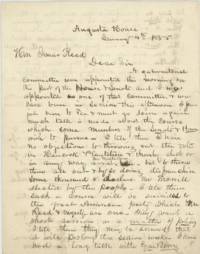
1855réf. 45251Augusta House Augusta ME 1855. Very good folded small tear to one edge minor soiling and ink bleed through. 3 pp. Bifolium. 8 x 10 inches. Letter dated January 4th 1855 one day after the Maine elections from Maubec Mitchell Rawson newly elected Whig member of the Maine House of Representatives to fellow Whig party member and candidate for Governor Isaac Reed reporting on the efforts to fix the vote in favor of Reed's opponent Anson Morrill. Rawson had been appointed as a member of a gubernatorial committee that morning so was privy to the shenanigans: "Much talk is made about the course which some members of the Senate & House wish to pursue. I tell them I have no objections to throwing out the votes in the Hancock Plantation & thereby elect or in any way assist Mr. Milliken but to throw them all out & by so doing disfranchise some thousand & declare Mr. Morrill elected by the people. I tell them such a course will be suicidal to the great American party which Mr. Reed & myself are one." He goes on to report who is opposed to these moves and who might be witnesses: "When I see you I will inform you who are the men who are so conscientious about this matter. I am perfectly quiet & cool but I have been at work. most of the time for the last 24 hours. They the Committee propose to spend the night in the committee room so as to have it said that we are doing up business in shape but they are more anxious to declare Mr. Morill Gov by the dear people. I have heard nothing from you but I think my course is patriotic or an honest one & I shall pursue it unless you suggest otherwise. Don't show my letters to anyone. I shall be glad when this session shall close." Anson Morrill 1803-1887 was elected Maine's Governor in 1855 and served until 1856. He had been a candidate under the Know Nothing and then Republican parties. John F. Milliken however was not among the list of Representatives in 1855 but seems to have gotten himself appointed Postmaster in his hometown. Isaac Reed 1809-1887 was a merchant and shipbuilder. He served in the Maine Senate 1839-1840; 1850 1863; the Maine House of Representatives 1842-1843; 1846; 1870-1871; as State Treasurer 1856; and in the U.S. House of Representatives 1852-1853. Maubec Mitchell Rawson b. 1825 was from Waldoboro Maine. unknown books
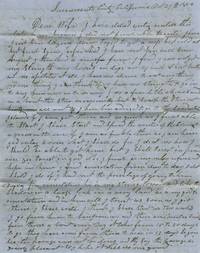
1850réf. BK0017Sacramento City California 1850. Autograph letter signed "Sam'l Locke" to his wife in Belfast Maine. 6 pp. Stampless folded letter with clear circular "SACRAMENTO CITY / CAL." postmark and "40" rate handstamp; manuscript notation recording receipt in Maine on December 19 1850. Light soiling; very good. A bleak California Gold Rush letter written during the 1850 Sacramento cholera epidemic by Samuel Locke a Maine emigrant suffering from prolonged fever and unable to regain his strength. Surrounded by sickness failed mining ventures violent crime and men too poor or ill to return home Locke plans to seek recovery in the Sandwich Islands while relying upon his religious faith for consolation. Locke had been ill since August and was now so weak that ordinary work exhausted him: "My limbs or legs are very weak short breath and no appetite at all. I have no desire to eat anything not one thing I can think of. I have no strength to go into any business or to do any. I do a few little chores round or about the store occasionally but to sweep the store it beats me all out . O how I long to get out of this place. Can't get any strength don't know as I can anywhere but I long to try." Friends advised him to spend the winter in the Sandwich Islands. He expected to travel first to San Francisco and then make the fifteen- to twenty-day passage to Hawaii though he feared that continued illness might leave him unable either to support himself there or return to Maine. He states that he will "trust in providence yes trust in God who I feel is my only refuge". Locke gives a grim account of California's climate and the spread of cholera through Sacramento claiming that the climate in California prevented the sick from recovering their strength as the "air is very light & bad middle of the day very hot and nights very cool." The previous week's report had stated forty dead but "nothing near all the cases were reported" with Locke himself knowing of several unreported cases personally. A local blacksmith died overnight after his companions borrowed Locke's syringe and "We can hardly see a healthy looking individual in the streets." The letter also records the uncertain fortunes of men from Locke's home region scattered through the mines. William Beckett and his partners had spent the summer constructing a mining dam had struck gold on the first day and then immediately "the dam was washed away so they lost all their summer's labor." Other acquaintances had moved to Kelsey's Bar the southern mines or Oregon or were preparing to return east by way of Panama. Some remained convinced that California would reward perseverance while others had "seen enough" after accomplishing nothing. Locke regarded success as largely accidental: "Thousands are here and in the mines who want to get home and cannot-not able to do seamen's duty and no money to pay but they have got to stay in the mines and do the best they can. Some it is true have been lucky. It is all luck. If they happen to hit a good place they do well." News that cholera had entered the mining districts increased his alarm. Locke feared especially for men living in tents as the rainy season approached with poor food and little protection from exposure. Sacramento itself was marked by nightly violence: "There are murders or robberies about every night. One man killed in front of our house a few nights ago. We heard him holler and heard the blows. Next morning he died. His head was dreadfully mangled." Locke closes with an emotional message to his wife and children. His health finances and prospects all appeared uncertain and he repeatedly asked his family and church to pray for him: "Tell the dear Children to be good and if they never see me again when I am gone they will have the satisfaction . of knowing they acted as thy Father requested . Pray for me ask the Church to pray for me indeed I know I have your prayers and you have mine often." A particularly bleak account of the human cost of the California Gold Rush documenting epidemic disease physical collapse failed mining schemes violent crime religious faith and the predicament of emigrants unable to escape California after their health and resources were exhausted. . unknown books
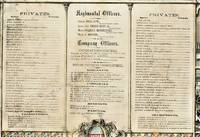
1863réf. 38843Cincinnati: Ehrgott Forbriger & Co. Lithographers 1863. Folio lithograph broadside 18" x 22." Matted in a wood frame. Some soil and closed tears. The lists of Regimental Officers Company Officers Musicians Wagoneer and Privates are surrounded by lithograph vignettes of battle flags and rural household and battle scenes. Good. The Company was mustered into service on December 4 1861 at Augusta by Lieut. Col. S. Eastman. Ehrgott, Forbriger & Co., Lithographers unknown books
1838réf. 36115Bangor 1838. Folio sheet folded to 9" x 11-1/4". Printed on first page only middle two pages blank. Last page addressed in ink to Moses Emery of Saco faint postal cancel from Bangor in September folded for mailing. Tear from blank seal a remnant of the seal remaining. Good. Ink note unrelated to the text dated Sept 3 in blank inner margin appointing three commissioners to survey a boundary. This appeal from the Whig State Committee is signed in type at the bottom by nine Committee members including Moses Emery the addressee. "Is there a Whig in the State who does not feel anxious to share the honors of a victory that shall prostrate Locofocoism forever in Maine and swell the advancing triumph of Whig principles that will soon plant the Whig Banner upon the Capitol of the Union. The eyes of the whole Union are upon us." Whigs are urged not "to fall into the arms of Loco focoism. unknown books
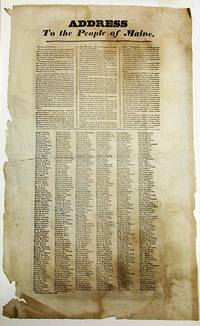
1832réf. 34328Portland 1832. Broadside 11-3/4" x 19". Lightly foxed generously margined and untrimmed with lower blank margins chipped some old folds. Else Very Good. Matted. Dated in type at the end: Portland Oct. 25th 1832." The text of this rare broadside urging the defeat of President Jackson in the upcoming presidential election is printed in three columns. It is followed by six columns consisting of hundreds of printed names of Portland citizens endorsing its sentiments. Despite his promises to the contrary Jackson has expanded the power of the presidency reneged on his promise to serve only one term and enthusiastically practiced the Spoils System. "The expenses of his administration have largely exceeded those of any of his six predecessors." He has claimed the power of "interpreting for himself" the Constitution although contradicted by "the Supreme Judiciary." AI 10824 1- Harvard. OCLC 58786948 3- AAS NYHS Harvard as of November 2023. unknown books
1844réf. 34352Kennebunkport Maine 1844. Folio broadsheet 11" x 16" printed in four columns recto and verso. Light scattered foxing old folds else Very Good. On July 4 1844 Maine's Democratic Party Convention was held in Alfred. Joshua Herrick a farmer was Maine's Democratic Congressman for its First Congressional District during the 1843-1845 Session. He sought renomination. But he was challenged by Judge William Alen Hayes. Hayes's campaign manager was future Supreme Court Justice Nathan Clifford whose manipulations aroused deep resentment over lawyers' control of the democratic process. This broadside reflects those class divisions emerging within the Democratic Party. Hayes who "is without doubt the richest man in the District-- has all the monied institutions at his control or in his interest-- all the aristocracy a queer idea in a dem. party but nevertheless true all or nearly all the Lawyers. Now what has Col. Herrick to go against this tremendous influence He is what we call self-made. has comparatively but little property but he has the confidence of the yeomanry of the District." Despite this appeal Herrick abandoned his effort to secure the Party's renomination and withdrew his name from consideration. He ran without the nomination and lost. Not located on OCLC or the online site of AAS. Not in Williamson American Imprints or Sabin. unknown books
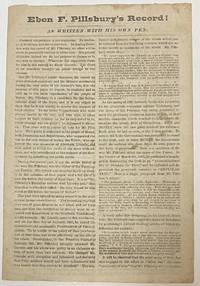
1866réf. 34393Augusta 1866. 4 pp. Folded. Caption title as issued. Printed in two columns per page. Lightly foxed and worn Good. Pillsbury the Democrats' candidate for Governor of Maine had been editor of the Farmington Patriot during the Civil War. His editorial comments-- expressing "disloyal sentiments during the very crisis of his country's fate"-- disqualify him from public office. Pillsbury "charged Mr. Lincoln with deception and falsehood" called the draft unconstitutional and otherwise "encouraged the hosts of Rebeldom." Pillsbury's opponent Joshua Lawrence Chamberlain was meanwhile in the thick of the most crucial battles of the War. His record is "WRITTEN WITH HIS OWN SWORD." "Voters of Maine!! Read them both and choose between them on the 14th of September.!" Not located on OCLC as of August 2021 or the online sites of Harvard or Bowdoin. unknown books
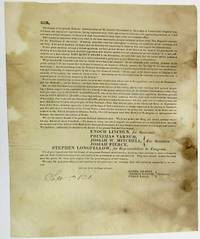
1826réf. 34420Maine 1826. Folio sheet folded to 8" x 9-1/2". One printed page followed by three blanks. Addressed on final blank with folds for mailing and remnant of wax seal to William Thomas of Gorham Maine. Spotted Good or so. The document is signed in type at the end by Committee Members Daniel Gilbert Thomas Browne and Ethan Earle. It is dated in ink "Sept. 5th 1826." The Committee urges Maine "to send forth from our state an unequivocal voice in favor of the Head of the National Government" by voting for Adams supporters Enoch Lincoln Governor Stephen Longfellow Congress and other members of the State ticket. Allusions to the bitter 1824 presidential contest are numerous; the wounds inflicted by that campaign are obviously still open: "We have placed the man of our choice at the head of our government." If "we abandon him to the rude tempest of a bitter opposition how shall we answer it to our consciences and our country. What then has the President done that we should leave him to his enemies. We do not profess one thing and intend another-- we do not cry 'Adams' but mean 'Crawford'." Not located on OCLC as of November 2017. unknown books
1845réf. 25979Augusta: Wm. T. Johnson Printer to the State 1845. 141 1 pp. Light rubberstamp in top margin of page 3 widely scattered light foxing. Senate Document 34 25th Maine Legislature. Very Good. Bound in modern cloth bookplate on front pastedown with gilt-lettered spine. The claims are for Maine's expenditures "for the protection of her northeastern frontier" from "the unlawful intrusion of trespassers and depredators from the neighboring British Provinces." With a minority report and material on the Northeast Boundary dispute and its settlement by the Treaty of Washington. AI 45-4116 1. Wm. T. Johnson, Printer to the State unknown books
1850réf. 25184Rockville CT: Press of the Tolland County Republican 1850. 8pp untrimmed. Folded fold splitting pinned. Tanned with some spotting. Good. The author writes humorous poetry to express his distress at new and excessive tax laws. A complete list of taxable property would take "Methuselah's hours.Although I have little that now commands cash; I've plenty in 'ruins' all broken to smash; A fine dish of 'all-sorts' to publish in form; Would make out a list thrice as long as my arm. So I must abbreviate and name them in groups; then let our great ASSES-ors examine to boot." OCLC 15328280 9. Press of the Tolland County Republican unknown books