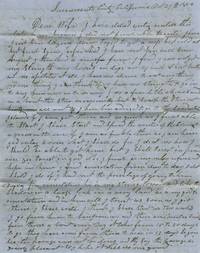
1850réf. BK0017Sacramento City California 1850. Autograph letter signed "Sam'l Locke" to his wife in Belfast Maine. 6 pp. Stampless folded letter with clear circular "SACRAMENTO CITY / CAL." postmark and "40" rate handstamp; manuscript notation recording receipt in Maine on December 19 1850. Light soiling; very good. A bleak California Gold Rush letter written during the 1850 Sacramento cholera epidemic by Samuel Locke a Maine emigrant suffering from prolonged fever and unable to regain his strength. Surrounded by sickness failed mining ventures violent crime and men too poor or ill to return home Locke plans to seek recovery in the Sandwich Islands while relying upon his religious faith for consolation. Locke had been ill since August and was now so weak that ordinary work exhausted him: "My limbs or legs are very weak short breath and no appetite at all. I have no desire to eat anything not one thing I can think of. I have no strength to go into any business or to do any. I do a few little chores round or about the store occasionally but to sweep the store it beats me all out . O how I long to get out of this place. Can't get any strength don't know as I can anywhere but I long to try." Friends advised him to spend the winter in the Sandwich Islands. He expected to travel first to San Francisco and then make the fifteen- to twenty-day passage to Hawaii though he feared that continued illness might leave him unable either to support himself there or return to Maine. He states that he will "trust in providence yes trust in God who I feel is my only refuge". Locke gives a grim account of California's climate and the spread of cholera through Sacramento claiming that the climate in California prevented the sick from recovering their strength as the "air is very light & bad middle of the day very hot and nights very cool." The previous week's report had stated forty dead but "nothing near all the cases were reported" with Locke himself knowing of several unreported cases personally. A local blacksmith died overnight after his companions borrowed Locke's syringe and "We can hardly see a healthy looking individual in the streets." The letter also records the uncertain fortunes of men from Locke's home region scattered through the mines. William Beckett and his partners had spent the summer constructing a mining dam had struck gold on the first day and then immediately "the dam was washed away so they lost all their summer's labor." Other acquaintances had moved to Kelsey's Bar the southern mines or Oregon or were preparing to return east by way of Panama. Some remained convinced that California would reward perseverance while others had "seen enough" after accomplishing nothing. Locke regarded success as largely accidental: "Thousands are here and in the mines who want to get home and cannot-not able to do seamen's duty and no money to pay but they have got to stay in the mines and do the best they can. Some it is true have been lucky. It is all luck. If they happen to hit a good place they do well." News that cholera had entered the mining districts increased his alarm. Locke feared especially for men living in tents as the rainy season approached with poor food and little protection from exposure. Sacramento itself was marked by nightly violence: "There are murders or robberies about every night. One man killed in front of our house a few nights ago. We heard him holler and heard the blows. Next morning he died. His head was dreadfully mangled." Locke closes with an emotional message to his wife and children. His health finances and prospects all appeared uncertain and he repeatedly asked his family and church to pray for him: "Tell the dear Children to be good and if they never see me again when I am gone they will have the satisfaction . of knowing they acted as thy Father requested . Pray for me ask the Church to pray for me indeed I know I have your prayers and you have mine often." A particularly bleak account of the human cost of the California Gold Rush documenting epidemic disease physical collapse failed mining schemes violent crime religious faith and the predicament of emigrants unable to escape California after their health and resources were exhausted. . unknown books
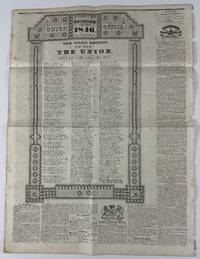
1846réf. 13085Saco ME: January 7 1846. 4pp. on a single large folio sheet of newsprint. Old folds minor foxing disbound from larger volume with tell-tale chips along binding edge. Still very good condition. An unusual appearance of a carrier's address printed on most of the back page of the January 7 1846 issue of The Union newspaper published in Saco Maine. The address itself is printed in three columns and contains typical news of the day particularly the imminent statehood of Texas and Oregon the election of Polk and Liberty Party presidential candidate James Birney former slave owner turned abolitionist and with several lines decrying the issue of slavery. An example of the latter from the middle column reads: "But change we now a while our verse Disunion threatens with its curse The land the great and good have blest With pure example wise behest And slavery rears her hideous head Among the sons of Freedom's dead. Was it t'enslave dark Afric's race Our country braved a tyrant base Unloosed our chains from England's Throne To rivet them on those at home How false the cry for Freedom dear From those who've strove from year to year T'extend to lands which should be free The blight of endless slavery!" There is also a passage concerning both Texas AND slavery also involving Birney: "As on the banks of Rio Grande The future slave of Texas stands And sees his children from him torn To bear the wrongs which he has borne Hie eyes suffused with bitter tears Glance up the long vista of years Among the sufferings of his race In hopes their author's name to trace; How does he start and heave a groan Birney he sees stands out alone!" The address is also interesting for the elaborate ornamental border composed of printer's ornaments including floral elements and patriotic symbols. This is the first time we have seen a carriers address integrated into the newspaper itself. January 7 unknown
1846réf. 13085Saco ME: January 7 1846. 4pp. on a single large folio sheet of newsprint. Old folds minor foxing disbound from larger volume with tell-tale chips along binding edge. Still very good condition. An unusual appearance of a carrier's address printed on most of the back page of the January 7 1846 issue of The Union newspaper published in Saco Maine. The address itself is printed in three columns and contains typical news of the day particularly the imminent statehood of Texas and Oregon the election of Polk and Liberty Party presidential candidate James Birney former slave owner turned abolitionist and with several lines decrying the issue of slavery. An example of the latter from the middle column reads: "But change we now a while our verse Disunion threatens with its curse The land the great and good have blest With pure example wise behest And slavery rears her hideous head Among the sons of Freedom's dead. Was it t'enslave dark Afric's race Our country braved a tyrant base Unloosed our chains from England's Throne To rivet them on those at home How false the cry for Freedom dear From those who've strove from year to year T'extend to lands which should be free The blight of endless slavery!" There is also a passage concerning both Texas AND slavery also involving Birney: "As on the banks of Rio Grande The future slave of Texas stands And sees his children from him torn To bear the wrongs which he has borne Hie eyes suffused with bitter tears Glance up the long vista of years Among the sufferings of his race In hopes their author's name to trace; How does he start and heave a groan Birney he sees stands out alone!" The address is also interesting for the elaborate ornamental border composed of printer's ornaments including floral elements and patriotic symbols. This is the first time we have seen a carriers address integrated into the newspaper itself. January 7 unknown books
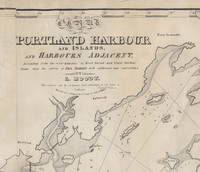
1828réf. 3754Important Early Chart of Portland Maine Harbor Lemuel Moody 1767-1846 was an enterprising sea captain and nautical entrepreneur in Portland Maine. Realizing "the great necessity of a correct Chart of Portland Harbour and the dangerous Rocks near Cape Elizabeth also of Winter Harbour and the numerous islands in Casco Bay" Moody decided to produce such a chart. By 1825 the Atlantic Neptune charts that included this area were more than 50 years old and in need of updating. Moody took advantage of the opportunity and produced this chart using the Atlantic Neptune charts as the foundation. In a notation on the original agreement for producing the chart Moody states that "I did the whole of the survey." This impressive chart of Casco Bay was his sole cartographic undertaking. The chart covers the area from Saco Bay to Seguin Island. A large inset at the upper left focuses on the immediate area around Portland harbor including a detailed layout of streets and wharves. Small drawings of several sailing ships decorate the chart. Of particular interest is one sailing vessel being towed by a steam-belching vessel southeast of Small Point an early record of steam-powered ships in Maine waters. One of the prominent landmarks that Moody included on the chart is the Portland Observatory an 86' high tower that still stands atop Portland's Munjoy Hill. The Observatory one of Moody's entrepreneurial undertakings was built in 1807 and served as a marine signaling tower. Using a telescope from the tower and a flag-based signaling system Moody would – for an annual fee – alert ship owners of the arrival of their vessels well in advance of their arrival in the harbor. The chart went through at least five states of which this is the second. The fortuitous survival of Moody's business records and the known construction dates of certain marine landmarks make it possible to identify the dates and production run of the various states of the chart with a fair degree of specificity. While all the charts produced include the initial publication date of 1825 in the title later states were known to have been printed in 1828 1832 1838 and 1857. The initial 1825/6 printing was 191 charts. For this second state only 49 charts were struck from the plates. The second state is distinguished by the addition of two light towers that were constructed in Cape Elizabeth in 1828. Known now appropriately enough as "Two Lights" the two structures still stand though one has been decommissioned as a navigation aid. The updates to the copperplate and printing of this state were by Andrew Allen of Boston. Moody's chart is very uncommon in any of its states. OCLC identifies three institutional holders as of September 2021: State Library of Massachusetts Osher Map Library and Boston Public Library. Additional examples are held at the Maine Historical Society Library of Congress Yale and at least one private collector. No examples of the chart were identified in the Antique Map Price Record during its run from 1983 to 2011. A very attractive example of an important and scarce early Maine chart. Reference: Phillips A List of Maps of the United States: p. 717 Mistakenly titled as Map of Portland Harbour and Islands… Acknowledgment: I am indebted to Ms. Frances Pollitt formerly of the Maine Historical Society for sharing her research on the dating and production of Moody's chart. Condition: Lined on reverse mending several tears. Very minor recreation of image loss and restoration of blank margin areas. ICN 7690.3. [Lemuel Moody.] .] Engd by D. G. Johnson. Entered According to Act of Congress July 13th, 1825. [but 1828.]
2003réf. LFA-126733106Revue spécialisée dans les camions anciens : 82 pages, format 210 x 295 mm, illustrée, brochée couverture couleurs, bon état
2003réf. LFA-126733107Revue spécialisée dans les camions anciens : 82 pages, format 210 x 295 mm, illustrée, brochée couverture couleurs, bon état
réf. 201907431Paris, France loisirs, 1996 ; grand in-4, 159 pp., cartonnage de l'éditeur.
réf. 207494Mamers, Fleury et Dangin, 1886 in-4, VIII-355 pp., frontispice, 4 planches, nbses ill. in-t., bradel papier marbré, couv. cons. (reliure moderne).
réf. 237566Mamers, Fleury et Dangin, 1886 in-4, VIII-355 pp., frontispice, 4 planches, nbses ill. in-t., bradel papier marbré, couv. cons. (reliure moderne).
réf. 234793Le Mans, Chaudourne, 1920 in-8, 48 pp., broché, couverture rempliée.
réf. 201106751Paris, Editions alpina, 1931 ; grand in-8, 155 pp., broché, couverture illustr.
réf. 102321Marolles, le 7 frimaire an 5, 27 nov.-1796 4 pp. in-4,
réf. 102325Saint Come, le 11 brumaire an 8, 2 nov.-1799 2 pp. in-4,
réf. 102326Saint Come, s. d. 2 pp. in-4,
réf. 102328Mamers, 12 brumaire an 8, 3 nov.-1799 2 p. in-4 (28 x 21 cm.),
réf. 102997Mamers, 19 fructidor an 7 (5 sept. 1799), in-folio, 2 pp.,
réf. 102998Mamers, 19 fructidor an 7 (5 sept. 1799), in-folio, 2 pp. 1/3,
1890réf. 52035Rockland Me.: First Maine Cavalry Association 1890-1892. A significant run of nine of fourteen total issues with two additional supplements of a periodical for Civil War veterans of the First Maine Cavalry. "Published four times a year and will contain the proceedings of the yearly reunions of the First Maine Cavalry matters of historic value to the regiment and items of personal interest to all the members." The volunteer cavalry regiment served with the Army of the Potomac for the duration of the war and participated in many of the critical battles including Brandy Station the largest cavalry engagement of the entire Civil War. Original printed wrappers mostly detached and chipping heavily. A few chips to initial leaves of one issue otherwise internally very good. unknown
1890réf. 52035Rockland Me.: First Maine Cavalry Association 1890-1892. A significant run of nine of fourteen total issues with two additional supplements of a periodical for Civil War veterans of the First Maine Cavalry. "Published four times a year and will contain the proceedings of the yearly reunions of the First Maine Cavalry matters of historic value to the regiment and items of personal interest to all the members." The volunteer cavalry regiment served with the Army of the Potomac for the duration of the war and participated in many of the critical battles including Brandy Station the largest cavalry engagement of the entire Civil War. Original printed wrappers mostly detached and chipping heavily. A few chips to initial leaves of one issue otherwise internally very good. unknown books
réf. 240841Paris, Pierre-Guillaume Simon, 1775 in-4, 4 pp., en feuille.
2003réf. LFA-126745099N° 198 Hors-série (2003) 32 pages, format 215 x 285 mm, illustré, broché couverture couleurs, bon état
2002réf. LFA-126711613Numéro Spécial de la revue d'art "Connaissance des Arts" : 66 pages, format 215 x 285 mm, illustré, broché couverture couleurs, publié en 2002, bon état
1994réf. 18621Paris, Centre international de synthèse / Albin Michel, 1994 1 volume 15,5 x 23,4cm Broché. 314p. 3 feuillets. Très bon état.
1994N°1-2, de janvier-juin 1994, 4è série, tome CXV de la série générale de cette revue trimestrielle fondée en 1900 par Henri Berr, consacré à la "Classification des sciences": "A travers des exemples empruntés soit aux grandes classifications ("Encyclopédie", "Cours de philosophie positive"), soit à des domaines particuliers (physique, chimie, histoire naturelle, etc), les études rassemblées ici s'inscrivent au point de confluence entre systèmes philosophiques de classification des sciences et institutionnalisation des disciplines, conjugués pour définir une hiérarchie des sciences et, au-delà, les traditions culturelles d'un pays" (4è de couverture). Français