5 140 résultats
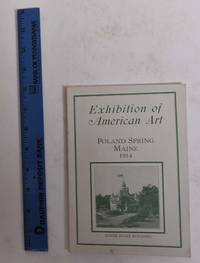
1909réf. 1361241909. Softbound. VG old inked name on cover at top. Greenish wraps. 42 pp. 14 bw plates. 164 paintings and 9 sculptures. Rare. Artists biographies at rear. Great copy with many prominent Boston artists represented. Some of the artists represented include Frank Benson William John Bixbee Anne Blake Dwight Blaney J.G. Brown Adelaide Cole Chase Colin Campbell Cooper Emma Lambert Cooper Charles Courtney Curran Leon Dabo John Enneking Ben Foster Henry Gallison Abbott Graves Robert Vonnah Childe Hassam Jean N. Oliver Hugh Bolton Jones Cullen Yates Isidore Konti Bela Lyon Pratt Philip Little Rhoda Holmes Nicholls Adelaide Palmer Ben Foster Alexander Pope etc. paperback books
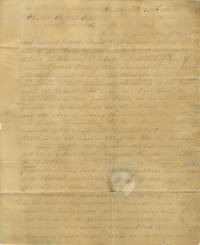
1812réf. 216429Portland Maine 1812. unbound. 1 page 10 x 8 inches Portland Maine August 6 1812. Interesting merchant's letter written during the War of 1812 while under British occupation requesting an accounting based on an unpaid invoice in part: ".shipped on board the Schooner Eagle.twenty jugs of the extract of the bark of Angostura which I consigned to the House of Mssrs. Anth Merchants in Havana.which has arrived out.but I have not received any remittance on account of it yet. My orders were for them to sell it and remit the proceeds in molasses and sugar." Two-inch closed tear at the right margin; otherwise very good. It's possible that this letter is not from a disgruntled merchant but from a smuggler who has been cheated. Smuggling and Piracy as well as the pursuit of Prizes of War the capturing of another nation's vessel and cargo for profit were commonplace during the War of 1812. unknown
1812réf. 216429Portland Maine 1812. unbound. 1 page 10 x 8 inches Portland Maine August 6 1812. Interesting merchant's letter written during the War of 1812 while under British occupation requesting an accounting based on an unpaid invoice in part: ".shipped on board the Schooner Eagle.twenty jugs of the extract of the bark of Angostura which I consigned to the House of Mssrs. Anth Merchants in Havana.which has arrived out.but I have not received any remittance on account of it yet. My orders were for them to sell it and remit the proceeds in molasses and sugar." Two-inch closed tear at the right margin; otherwise very good. It's possible that this letter is not from a disgruntled merchant but from a smuggler who has been cheated. Smuggling and Piracy as well as the pursuit of Prizes of War the capturing of another nation's vessel and cargo for profit were commonplace during the War of 1812. unknown books
1828réf. BK0113Beverly Massachusetts 1828. Autograph letter signed 3 pp. measuring 8 x 9 ½ inches addressed to Charles Coffin Esq. Buxton Maine. Stampless folded letter with manuscript "Beverly Ms Nov 26" postmark and "18¾" rate. Separation reinforced with archival tape due to brittle paper; otherwise very good. A research letter from jurist and statesman Nathan Dane to Maine antiquarian Charles Coffin concerning the seven Narragansett townships granted to veterans and descendants of veterans of King Philip's War. Dane reports an effort to trace Narragansett No. 1 incorporated as Buxton in 1772 and discusses the difficulty created when the original grants acquired new names in proprietary and governmental records: "I have examined the doings of the legislature of Massachusetts as far as I have them for more than a century past. I find the name Narragansett No. 1 &c. mentioned but three times once in the year 1760 when in erecting the counties of Cumberland and Lincoln in describing the boundaries of them Narragansett No. 1 is mentioned; again in 1764 it is mentioned in the act incorporating the town of Gorham; again in 1772 Narragansett No. 1 was incorporated and made a town by the name of Buxton." Dane suggests reconstructing the history of the grants through a combination of legislative records proprietary papers and the memories of "aged persons" as he "sees no other way to trace back to their origin these seven grants or proprietaries." He also provides information on Major Samuel Appleton a military officer during King Philip's War and on the early Dane family in Ipswich carefully distinguishing the surnames Dane and Dean through deeds wills and signed documents. The recipient Charles Coffin later published historical work on the Narragansett townships. A record of early nineteenth-century antiquarian method showing Dane's methodology for reconstructing the colonial history of Maine and Massachusetts. . unknown
1828réf. BK0113Beverly Massachusetts 1828. Autograph letter signed 3 pp. measuring 8 x 9 ½ inches addressed to Charles Coffin Esq. Buxton Maine. Stampless folded letter with manuscript "Beverly Ms Nov 26" postmark and "18¾" rate. Separation reinforced with archival tape due to brittle paper; otherwise very good. A research letter from jurist and statesman Nathan Dane to Maine antiquarian Charles Coffin concerning the seven Narragansett townships granted to veterans and descendants of veterans of King Philip's War. Dane reports an effort to trace Narragansett No. 1 incorporated as Buxton in 1772 and discusses the difficulty created when the original grants acquired new names in proprietary and governmental records: "I have examined the doings of the legislature of Massachusetts as far as I have them for more than a century past. I find the name Narragansett No. 1 &c. mentioned but three times once in the year 1760 when in erecting the counties of Cumberland and Lincoln in describing the boundaries of them Narragansett No. 1 is mentioned; again in 1764 it is mentioned in the act incorporating the town of Gorham; again in 1772 Narragansett No. 1 was incorporated and made a town by the name of Buxton." Dane suggests reconstructing the history of the grants through a combination of legislative records proprietary papers and the memories of "aged persons" as he "sees no other way to trace back to their origin these seven grants or proprietaries." He also provides information on Major Samuel Appleton a military officer during King Philip's War and on the early Dane family in Ipswich carefully distinguishing the surnames Dane and Dean through deeds wills and signed documents. The recipient Charles Coffin later published historical work on the Narragansett townships. A record of early nineteenth-century antiquarian method showing Dane's methodology for reconstructing the colonial history of Maine and Massachusetts. . unknown books
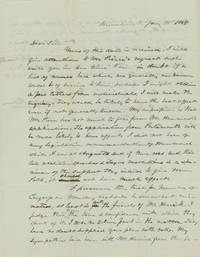
1845réf. List2966Kennebunk Maine 1845. Two 7 ½ x 9 ¾ inch pages. Near fine. A letter from Barnabas Palmer in Kennebunk to Charles G. Bellamy Esquire in Kittery. Bellamy 1811–1892/1899 was a captain in the Maine militia a member of the Maine House of Representatives 1842–3 and State Senate 1846–7 York County Sheriff and then Inspector of Timber at the Navy Yard in Portsmouth.1 Palmer 1791–1867 may have been military; he appears in Maine state records as an agent for the Kennebunk Gun House which is listed in other records as under the purview of the Quartermaster General. Palmer gives Bellamy his opinion on the political prospects of “Pierce” versus “Hammond” commenting: “I did not hear of any legislative recommendation of Hammond while I was at Augusta and if there was and their late abolition speeches & Texan resolutions is a specimen of the support they intend to give Mr Polk it should not have much effect.” The US under President Polk had not yet annexed Texas and Palmer is apparently underwhelmed by Maine’s support for the cause. He also remarks on Joshua Herrick’s 1793–1874 bid for re-nomination to Congress; though he feels that he had “been badly treated” by Herrick’s competition “Judge Hayes” Palmer nonetheless feels compelled to vote for Hayes over Herrick. Of interests to historians of Maine state politics. 1 John E. Frost Colonial Village Gundalow Club: 1948 28. unknown
1845réf. List2966Kennebunk Maine 1845. Two 7 ½ x 9 ¾ inch pages. Near fine. A letter from Barnabas Palmer in Kennebunk to Charles G. Bellamy Esquire in Kittery. Bellamy 1811–1892/1899 was a captain in the Maine militia a member of the Maine House of Representatives 1842–3 and State Senate 1846–7 York County Sheriff and then Inspector of Timber at the Navy Yard in Portsmouth.1 Palmer 1791–1867 may have been military; he appears in Maine state records as an agent for the Kennebunk Gun House which is listed in other records as under the purview of the Quartermaster General. Palmer gives Bellamy his opinion on the political prospects of “Pierce” versus “Hammond” commenting: “I did not hear of any legislative recommendation of Hammond while I was at Augusta and if there was and their late abolition speeches & Texan resolutions is a specimen of the support they intend to give Mr Polk it should not have much effect.” The US under President Polk had not yet annexed Texas and Palmer is apparently underwhelmed by Maine’s support for the cause. He also remarks on Joshua Herrick’s 1793–1874 bid for re-nomination to Congress; though he feels that he had “been badly treated” by Herrick’s competition “Judge Hayes” Palmer nonetheless feels compelled to vote for Hayes over Herrick. Of interests to historians of Maine state politics. 1 John E. Frost Colonial Village Gundalow Club: 1948 28. unknown books
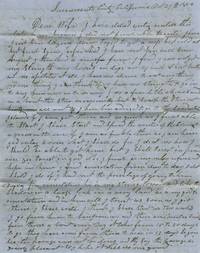
1850réf. BK0017Sacramento City California 1850. Autograph letter signed "Sam'l Locke" to his wife in Belfast Maine. 6 pp. Stampless folded letter with clear circular "SACRAMENTO CITY / CAL." postmark and "40" rate handstamp; manuscript notation recording receipt in Maine on December 19 1850. Light soiling; very good. A bleak California Gold Rush letter written during the 1850 Sacramento cholera epidemic by Samuel Locke a Maine emigrant suffering from prolonged fever and unable to regain his strength. Surrounded by sickness failed mining ventures violent crime and men too poor or ill to return home Locke plans to seek recovery in the Sandwich Islands while relying upon his religious faith for consolation. Locke had been ill since August and was now so weak that ordinary work exhausted him: "My limbs or legs are very weak short breath and no appetite at all. I have no desire to eat anything not one thing I can think of. I have no strength to go into any business or to do any. I do a few little chores round or about the store occasionally but to sweep the store it beats me all out . O how I long to get out of this place. Can't get any strength don't know as I can anywhere but I long to try." Friends advised him to spend the winter in the Sandwich Islands. He expected to travel first to San Francisco and then make the fifteen- to twenty-day passage to Hawaii though he feared that continued illness might leave him unable either to support himself there or return to Maine. He states that he will "trust in providence yes trust in God who I feel is my only refuge". Locke gives a grim account of California's climate and the spread of cholera through Sacramento claiming that the climate in California prevented the sick from recovering their strength as the "air is very light & bad middle of the day very hot and nights very cool." The previous week's report had stated forty dead but "nothing near all the cases were reported" with Locke himself knowing of several unreported cases personally. A local blacksmith died overnight after his companions borrowed Locke's syringe and "We can hardly see a healthy looking individual in the streets." The letter also records the uncertain fortunes of men from Locke's home region scattered through the mines. William Beckett and his partners had spent the summer constructing a mining dam had struck gold on the first day and then immediately "the dam was washed away so they lost all their summer's labor." Other acquaintances had moved to Kelsey's Bar the southern mines or Oregon or were preparing to return east by way of Panama. Some remained convinced that California would reward perseverance while others had "seen enough" after accomplishing nothing. Locke regarded success as largely accidental: "Thousands are here and in the mines who want to get home and cannot-not able to do seamen's duty and no money to pay but they have got to stay in the mines and do the best they can. Some it is true have been lucky. It is all luck. If they happen to hit a good place they do well." News that cholera had entered the mining districts increased his alarm. Locke feared especially for men living in tents as the rainy season approached with poor food and little protection from exposure. Sacramento itself was marked by nightly violence: "There are murders or robberies about every night. One man killed in front of our house a few nights ago. We heard him holler and heard the blows. Next morning he died. His head was dreadfully mangled." Locke closes with an emotional message to his wife and children. His health finances and prospects all appeared uncertain and he repeatedly asked his family and church to pray for him: "Tell the dear Children to be good and if they never see me again when I am gone they will have the satisfaction . of knowing they acted as thy Father requested . Pray for me ask the Church to pray for me indeed I know I have your prayers and you have mine often." A particularly bleak account of the human cost of the California Gold Rush documenting epidemic disease physical collapse failed mining schemes violent crime religious faith and the predicament of emigrants unable to escape California after their health and resources were exhausted. . unknown
1850réf. BK0017Sacramento City California 1850. Autograph letter signed "Sam'l Locke" to his wife in Belfast Maine. 6 pp. Stampless folded letter with clear circular "SACRAMENTO CITY / CAL." postmark and "40" rate handstamp; manuscript notation recording receipt in Maine on December 19 1850. Light soiling; very good. A bleak California Gold Rush letter written during the 1850 Sacramento cholera epidemic by Samuel Locke a Maine emigrant suffering from prolonged fever and unable to regain his strength. Surrounded by sickness failed mining ventures violent crime and men too poor or ill to return home Locke plans to seek recovery in the Sandwich Islands while relying upon his religious faith for consolation. Locke had been ill since August and was now so weak that ordinary work exhausted him: "My limbs or legs are very weak short breath and no appetite at all. I have no desire to eat anything not one thing I can think of. I have no strength to go into any business or to do any. I do a few little chores round or about the store occasionally but to sweep the store it beats me all out . O how I long to get out of this place. Can't get any strength don't know as I can anywhere but I long to try." Friends advised him to spend the winter in the Sandwich Islands. He expected to travel first to San Francisco and then make the fifteen- to twenty-day passage to Hawaii though he feared that continued illness might leave him unable either to support himself there or return to Maine. He states that he will "trust in providence yes trust in God who I feel is my only refuge". Locke gives a grim account of California's climate and the spread of cholera through Sacramento claiming that the climate in California prevented the sick from recovering their strength as the "air is very light & bad middle of the day very hot and nights very cool." The previous week's report had stated forty dead but "nothing near all the cases were reported" with Locke himself knowing of several unreported cases personally. A local blacksmith died overnight after his companions borrowed Locke's syringe and "We can hardly see a healthy looking individual in the streets." The letter also records the uncertain fortunes of men from Locke's home region scattered through the mines. William Beckett and his partners had spent the summer constructing a mining dam had struck gold on the first day and then immediately "the dam was washed away so they lost all their summer's labor." Other acquaintances had moved to Kelsey's Bar the southern mines or Oregon or were preparing to return east by way of Panama. Some remained convinced that California would reward perseverance while others had "seen enough" after accomplishing nothing. Locke regarded success as largely accidental: "Thousands are here and in the mines who want to get home and cannot-not able to do seamen's duty and no money to pay but they have got to stay in the mines and do the best they can. Some it is true have been lucky. It is all luck. If they happen to hit a good place they do well." News that cholera had entered the mining districts increased his alarm. Locke feared especially for men living in tents as the rainy season approached with poor food and little protection from exposure. Sacramento itself was marked by nightly violence: "There are murders or robberies about every night. One man killed in front of our house a few nights ago. We heard him holler and heard the blows. Next morning he died. His head was dreadfully mangled." Locke closes with an emotional message to his wife and children. His health finances and prospects all appeared uncertain and he repeatedly asked his family and church to pray for him: "Tell the dear Children to be good and if they never see me again when I am gone they will have the satisfaction . of knowing they acted as thy Father requested . Pray for me ask the Church to pray for me indeed I know I have your prayers and you have mine often." A particularly bleak account of the human cost of the California Gold Rush documenting epidemic disease physical collapse failed mining schemes violent crime religious faith and the predicament of emigrants unable to escape California after their health and resources were exhausted. . unknown books
1955Broch?. 24 pages.
1912réf. 28601912. Softbound. VG. Greenish wraps. 48 pp. 16 bw plates. 124 artists and sculptors are represented by 101 oils 30 watercolors 24 miniatures and 30 works of sculpture. Rare. paperback books
réf. 1333034997.Gpaperback. Good. Access codes and supplements are not guaranteed with used items. May be an ex-library book. paperback
réf. 0484554786.Ghardcover. Good. Access codes and supplements are not guaranteed with used items. May be an ex-library book. hardcover
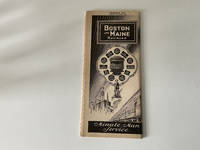
1935réf. 2481935 Boston & Maine Railroad Motor Coach Service pamphlet published by the Boston & Maine Railroad. It outlines motor coach routes introduced on March 8 1935 as part of their passenger network. It was produced by the railroad's marketing department. It focuses on bus services complementing their rail lines and it's considered a collectible piece of railroad ephemera. It's tan inside and out has a small nick on the bottom right corner of the pamphlet. Overall it's in very actually some edge wear on the right side. Yes it's in very good condition." See Photos Boston & Maine Railroad paperback
1937réf. w281c-10Generic 1937. Hardcover. Used - Good. Year: 1937. This preowned item is in good condition with some visible wear and tear marks. This item may have some visible damage such as corner dings small tears/rips bent pages scuffs or scratches etc. There may be visible writing or highlighting within the cover or pages of the book. This item includes library markings including stickers barcodes and additional writing. Additional materials such as CD's and access codes may or may not be included. If the book has a dust jacket it may not be included. This book may be rebound if the original edition was damaged. Free tracking provided. International shipping available. 4. Generic hardcover
réf. 220704Sainte-Suzanne, Chez l'Auteur, 1947 petit in-8, 29 pp., agrafé, sous couverture.
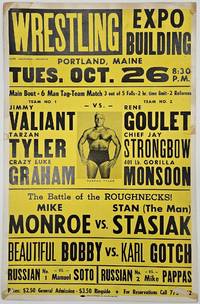
1971réf. BK0129Portland Maine: Jack Laurence promoter 1971. Large illustrated wrestling poster for an evening at the Expo Building 17 x 26 inches. Printed in black and yellow with central portrait of Tarzan Tyler. Light wear old folds and small losses at margins; very good. A locally produced wrestling poster for a 1971 card at Portland's Expo Building promoted by longtime Maine sports promoter Jack Laurence. The main event was a six-man tag-team match pitting Jimmy Valiant Tarzan Tyler and "Crazy" Luke Graham against Rene Goulet Chief Jay Strongbow and Gorilla Monsoon advertised as three out of five falls with a two-hour time limit and two referees. The undercard included "The Battle of the Roughnecks" Mike Monroe against Stan "The Man" Stasiak; "Beautiful Bobby" against Karl Gotch; and Manuel Soto and Mike Pappas billed as "The Russians." Tyler and Graham were then the WWWF tag champions while Monsoon Strongbow Valiant Gotch and Stasiak were among the promotion's familiar stars. The evening followed immediately after the October 25 Madison Square Garden card where many of the same wrestlers appeared: Monsoon defeated Monroe Gotch defeated Beautiful Bobby and Strongbow and Victor Rivera defeated Tyler and Graham.1 Interestingly this Portland event does not appear in the extensive published 1971 WWWF results compilation we consulted which records the October 25 Madison Square Garden event and then resumes with October 29 cards in Lowell and North Attleboro. The poster thus appears to provide primary documentation of an otherwise poorly recorded Maine card. Laurence whose name appears prominently as promoter died the following February. A memorial resolution of the Maine Legislature described him as one of the state's "most devoted and beloved sports promoters."2 1 Richard Land "WWWF - 1971 Results" The History of WWE accessed September 17 2026 https://thehistoryofwwe.com/wwwf-results-1971/. 2 Legislative Record of the One Hundred and Fifth Legislature of the State of Maine Vol. III June 16-June 24 1971 893. . Jack Laurence, promoter unknown
1971réf. BK0129Portland Maine: Jack Laurence promoter 1971. Large illustrated wrestling poster for an evening at the Expo Building 17 x 26 inches. Printed in black and yellow with central portrait of Tarzan Tyler. Light wear old folds and small losses at margins; very good. A locally produced wrestling poster for a 1971 card at Portland's Expo Building promoted by longtime Maine sports promoter Jack Laurence. The main event was a six-man tag-team match pitting Jimmy Valiant Tarzan Tyler and "Crazy" Luke Graham against Rene Goulet Chief Jay Strongbow and Gorilla Monsoon advertised as three out of five falls with a two-hour time limit and two referees. The undercard included "The Battle of the Roughnecks" Mike Monroe against Stan "The Man" Stasiak; "Beautiful Bobby" against Karl Gotch; and Manuel Soto and Mike Pappas billed as "The Russians." Tyler and Graham were then the WWWF tag champions while Monsoon Strongbow Valiant Gotch and Stasiak were among the promotion's familiar stars. The evening followed immediately after the October 25 Madison Square Garden card where many of the same wrestlers appeared: Monsoon defeated Monroe Gotch defeated Beautiful Bobby and Strongbow and Victor Rivera defeated Tyler and Graham.1 Interestingly this Portland event does not appear in the extensive published 1971 WWWF results compilation we consulted which records the October 25 Madison Square Garden event and then resumes with October 29 cards in Lowell and North Attleboro. The poster thus appears to provide primary documentation of an otherwise poorly recorded Maine card. Laurence whose name appears prominently as promoter died the following February. A memorial resolution of the Maine Legislature described him as one of the state's "most devoted and beloved sports promoters."2 1 Richard Land "WWWF - 1971 Results" The History of WWE accessed September 17 2026 https://thehistoryofwwe.com/wwwf-results-1971/. 2 Legislative Record of the One Hundred and Fifth Legislature of the State of Maine Vol. III June 16-June 24 1971 893. . Jack Laurence, promoter unknown books
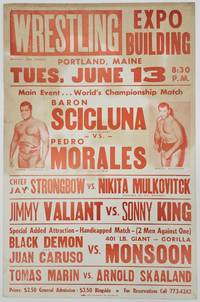
1972réf. BK0130Portland Maine: Expo Building 1972. Large printed wrestling poster 17 x 26 inches printed in orange on cream stock with photographic portraits of Pedro Morales and Baron Mikel Scicluna. Moderate toning and edge wear with strong color and printing; very good. A poster for a 1972 WWWF card at Portland's Expo Building headlined by a World Championship match between reigning champion Pedro Morales and Baron Mikel Scicluna. The undercard advertised Chief Jay Strongbow against Nikita Mulkovitch Jimmy Valiant against Sonny King and a two-against-one handicap match pitting the Black Demon and Juan Caruso against Gorilla Monsoon along with Tomas Marin against Arnold Skaaland. Contemporary wrestling records document an attendance of 1600 and preserve the results of the card. Morales retained his championship by pinning Scicluna at 20:11; Strongbow defeated Mulkovitch and Sonny King defeated Valiant. The advertised Gorilla Monsoon handicap match did not take place with the lower portion of the card rearranged into separate matches between Skaaland and Caruso and between the Black Demon and Tomas Marin.1 Morales was then in the middle of his nearly three-year WWWF championship reign having defeated Ivan Koloff for the title at Madison Square Garden in February 1971 and holding it until December 1973. The Puerto Rican-born wrestler became one of the promotion's largest draws during the period particularly among the Northeast's growing Latino audience.2 The poster is particularly appealing for the large portraits of both champion and challenger and for documenting an intact regional WWWF card during Morales's championship run. 1 Richard Land "WWWF - 1972 Results" The History of WWE accessed September 17 2026 https://thehistoryofwwe.com/wwwf-results-1972/. 2 "Pedro Morales" WWE accessed September 17 2026 https://www.wwe.com/superstars/pedromorales. . Expo Building unknown
1972réf. BK0130Portland Maine: Expo Building 1972. Large printed wrestling poster 17 x 26 inches printed in orange on cream stock with photographic portraits of Pedro Morales and Baron Mikel Scicluna. Moderate toning and edge wear with strong color and printing; very good. A poster for a 1972 WWWF card at Portland's Expo Building headlined by a World Championship match between reigning champion Pedro Morales and Baron Mikel Scicluna. The undercard advertised Chief Jay Strongbow against Nikita Mulkovitch Jimmy Valiant against Sonny King and a two-against-one handicap match pitting the Black Demon and Juan Caruso against Gorilla Monsoon along with Tomas Marin against Arnold Skaaland. Contemporary wrestling records document an attendance of 1600 and preserve the results of the card. Morales retained his championship by pinning Scicluna at 20:11; Strongbow defeated Mulkovitch and Sonny King defeated Valiant. The advertised Gorilla Monsoon handicap match did not take place with the lower portion of the card rearranged into separate matches between Skaaland and Caruso and between the Black Demon and Tomas Marin.1 Morales was then in the middle of his nearly three-year WWWF championship reign having defeated Ivan Koloff for the title at Madison Square Garden in February 1971 and holding it until December 1973. The Puerto Rican-born wrestler became one of the promotion's largest draws during the period particularly among the Northeast's growing Latino audience.2 The poster is particularly appealing for the large portraits of both champion and challenger and for documenting an intact regional WWWF card during Morales's championship run. 1 Richard Land "WWWF - 1972 Results" The History of WWE accessed September 17 2026 https://thehistoryofwwe.com/wwwf-results-1972/. 2 "Pedro Morales" WWE accessed September 17 2026 https://www.wwe.com/superstars/pedromorales. . Expo Building unknown books
réf. 0260365912.Ghardcover. Good. Access codes and supplements are not guaranteed with used items. May be an ex-library book. hardcover
réf. 0266100740.Gpaperback. Good. Access codes and supplements are not guaranteed with used items. May be an ex-library book. paperback
1915réf. 363211915. Softbound. Very dampstained but no pages stick together and very little rippling. Very usable. Greenish wraps. 48 pp. 17 bw plates. 140 or so artists and sculptors are represented by 120 oils 28 watercolors 14 miniatures and 22 works of sculpture. Rare. paperback books
1955Broch?. 282 pages.
1838réf. 77428Washington D. C. : Blair & Rives Printers. Very Good. 1838. Softcover. This government document has been re-bound into blue paper wrappers. The text-block is solid. The contents are bright and generally clean but with toning to the page-edges. . Blair & Rives, Printers. paperback books