8,866 results
ref. 11288N/A n/d. N/A. Hardcover. g. 8vo. 488 pp. total. Three-quarter leather over marbled boards. Raised bands. Gilt lettering to spine. Some age wearing to edges. Gilt top edge. Marbled endpapers. Reinforced back hinge with binders tape."With the bookplate and signature of Bruce Bryan the noted author and long time curator of the Southwest Museum of The American Indians in Pasadena California". 14 booklets on different subjects regarding Great Britain including Archaeology Natural History Architecture Surveys Anglo-Saxon Jewelry Abbeys and Castles in South Wales Ancient Cemetry at Saffron Walden Roman-Britain and many more all bound in one volume. Illustrated throughout with b/w lithographic plates fold out maps plans and drawings. A tight copy in good condition. N/A hardcover
1936ref. 140941960New York: Random House 1936. First Edition. First edition. Signed by Clifford Odets in the year of publication inscribed to actor Fredric March and his wife "For Mr. Mrs F. March with the appreciation of the Group Theater. Sincerely signed Clifford Odets 1/18/36." xiii i 204 pp. Bound in publisher's navy cloth with gilt spine lettering. Very Good edges foxed in Very Good dust jacket dulled spine panel light wear and stain at foot. A great association between playwright Odets with one of his more difficult plays and Hollywood actor Fredric March a major star of his day. Odets' thanking March for his patronage of the experimental Group Theater collective who put on this play is a nice bit of Great Depression-era theater context too. The Group Theater would last ten years total; their biggest success would be the following year with Odets' play Golden Boy. Random House unknown
1984ref. 25483ESecaucus: Citadel 1984. First Edition. Signed and inscribed by the actor Frederic March: “To Rose and Burrill My dear ‘old friends’ - who are so very young. With love Freddie 1972”. Oversized format. Illustrated 255 pages. Fredric March’s autograph in book form is very rare. Very good copy with some very minor use and edge wear in a very good bright dust jacket with a hint of fading to the spine and a few small chips and tears. A comprehensive look at the life and career of the great actor Fredric March winner of the Oscar for Best Actor for his films ‘Dr. Jekyll and Mr. Hyde 1931 and ‘The Best Years of Our Lives’ 1946. With stills from all of his films and many from his stage and television appearances cast lists synopses of the stories production credits critiques and reviews. Citadel unknown
18362 opere in un gr. vol. in folio, pp. IV, 185, (2); 112, bella leg. m. perg. primo '900 con angoli, piatti in carta dec. e tass. al d. Testo latino per la cronaca e testo italiano per i commenti del De Minicis. La seconda opera può ritenersi una storia della città di Fermo suddivisa per epoche, con l'elenco dei Fermani illustri. Lozzi 1580 (solo per la prima opera). Bell'esempl. in barbe. [531]
1727manoscritto cartaceo in-4 (mm.258x182), ccnn 6, leg. mod. m. tela con angoli, cart. dec. ai piatti e tass. al piatto ant. Manoscritto in chiara grafia settecentesca autografo del Lazzarini (Macerata 1668-1734) che fu professore di Lettere Greche e Latine all'Università di Padova. Con notizie sull'operato del Mauriceno (Fortunato Morosini), Vescovo di Brescia dal 1723 al 1727 anno della morte. [390]
1933ref. NATW0424_2KWien, Österr. Staatsdr. und Selbstvlg.d. Amtes f. Gewässerkunde 1914 - 1933. Folio, tls. OLn., Ln. mit aufkasch. OTit. und OBr., schwache Gebrauchsspuren, tlw. mit Bibl.-Stemp. Vorhanden sind Hefte mit Niederschlags-, vereinzelt auch mit Wasserstands-Beobachtungen der Gebiete: Donaugebiet, Murgebiet, Draugebiet und Rheingebiet. Ab dem 7. Jg. 1920 sind einige Gebiete erweitert worden bzw. neu dazugekommen u. zw.: das Inn- u. Salz?
1648ref. 259484London: Printed by I. C. for Mathew Walbanck & Richard Best ect. 1648. First Edition. Softcover. Poor copy in the original stiff-card wrappers; wear and tear as with age. Title page damaged. Text remains in fine condition and without blemish. Physical description; 241 pages ; table. Subjects; Slander. Actionable words. 17th century law. English Law. London: Printed by I. C. for Mathew Walbanck & Richard Best [ect.] paperback
1663Opera tratta dalla rara prima edizione del Theatrum Civitatum et Admirandorum Italiae ad aevi veteris & praesentis temporis faciem expressum à Ioanne Blaeu G. F., stampata ad Amsterdam nel 1663. Si tratta del primo, monumentale, libro interamente dedicato alla cartografia urbana della sola penisola, preceduto dal “tascabile” Italia Hodierna di Jodocus Hondius del 1627 e realizzato in probabile concorrenza con Johannes Janssonius che, nel 1657, aveva pubblicato il Theatrum praecipuarum urbium, contenente un volume dedicato all’Italia. Johannes Blaeu, durante la sua lunga attività editoriale pubblica tre volumi sulle città italiane. Nel 1663 i primi tre, suddivisi in Stato della Chiesa, Roma e Regno di Napoli e Sicilia. Alla sua morte i suoi eredi danno alla luce altri due volumi datati 1682 incentrati sulle città del Piemonte e della Savoia, poi ristampati da altri editori nel 1693 e 1697. Il francese Pierre Mortier pubblica una ristampa nel 1704/5, intitolata Nouveau Theatre de l’Italie. L’opera è in quattro volumi e comprende le lastre del Blaeu, ritoccate e modificate in piccola parte, integrate dall’aggiunta di numerose nuove mappe di proprio disegno, raffiguranti le città della parte settentrionale della penisola, racchiuse nel primo volume dell’opera. L’atlante del Mortier venne pubblicato con testo latino, francese ed olandese. Il grande successo dell’opera diede origine ad un’ulteriore ristampa, praticamente identica, curata da Alberts ed edita nel 1724/5. Esemplare con testo descrittivo la verso, della prima edizione del 1663. Bibliografia Koeman, Atlas Neerlandici, pp. 332/338; Cremonini pp. 49-52, 39. Map taken form the rare first edition of Theatrum Civitatum et Admirandorum Italiae ad aevi veteris & praesentis temporis faciem expressum à Ioanne Blaeu G. F., printed by Johannes Blaeu, Amsterdam, 1663. This is the first monumental town book entirely covering Italy, preceded by the "pocket-size" Italia Hodierna by Jodocus Hondius jr. (1627) and realized in likely competition with Johannes Janssonius who, in 1657, published the Theatrum praecipuarum urbium, containing a volume dedicated to Italy. Johannes Blaeu, during his long editorial activity published three volumes on Italian cities. In 1663 the first three, divided into the State of the Church, Rome and the Kingdom of Naples and Sicily. At his death his heirs gave birth to two more volumes dated 1682 focused on the cities of Piedmont and Savoy, then reprinted by other publishers in 1693 and 1697. Pierre Mortier publishes a reprint in 1704/5, entitled Nouveau Theatre de l'Italie. The work is in four volumes and includes the plates of Blaeu, retouched and modified in small part, supplemented by the addition of several new maps of his own design, depicting the cities of the northern part of the peninsula, enclosed in the first volume of the work. Mortier's atlas was published with Latin, French and Dutch texts. The great success of the work gave rise to a further reprint, virtually identical, edited by R. Alberts and published in 1724/5. Example of the first edition, showing descriptive text on the back of the map. Literature Koeman, Atlas Neerlandici, pp. 332/338; Cremonini pp. 49-52, 39.
1657EDIZIONE DE WIT. Pianta della città per la prima volta inserita nel "Theatrum praecipuarum urbium" celebre teatro delle città del Janssonius, sullo stile del "Civitates Orbis Terrarum" di Braun & Hogenberg. L'opera, pubblicata nel 1657, contiene 500 tavole raffiguranti città di ogni parte del mondo. Contrariamente al lavoro degli acerrimi rivali Blaeu, Janssonius si servì per la realizzazione dell'opera delle lastre di precedenti cartografi ed editori. In particolare nel 1653 egli acquisto da Abraham Hogenberg le lastre del "Civitates orbis Terrarum" che incorporò nella sua opera, ristampandole. Per le piante delle città olandesi, ordinò delle nuove lastre basate sull'atalnte che Johannes Blaeu diede alla luce nel 1649. Per molte delle opere contenute nel 5° volume, quello dedicato all'Italia e denominato "Theatrum celebriorum urbium Italiae..", si servì delle lastre realizzate da Jodocus Hondius per l'opera "Italia Hodierna.." del 1627. Successivamente le lastre furono ristampate da Janssonius -Waesberghe "Tooneel der vermaarste Koop-Steden", Amsterdam 1682, da Frederick de Wit e da Pieter Vander AA nel secolo succesivo. Molto rara. DE WIT EDITION. Map of the city for the first time included in the "Theatrum praecipuarum urbium" of Janssonius. The work, published in 1657, contains 500 maps of cities from all over the world.
Incisione in rame f. 48,5 x 34, f. del foglio con margini 54,5 x 43,8. Da Theatrum Celebriorum Urbium Italiae ... Amstelodami, ex Officina Joannis Janssonii (1657). I° edizione, testo latino al verso. Bell'esemplare. Rara.
1898ref. 000282Paris Mercure de France 1898
1988QUATTRO VOLUMI. Vol.I Dalle origini al Primo Rinascimento. Vol.II Dal Rinascimento alla Controriforma. Vol.III Dalla Controriforma al Barocco. Vol.IV Dal Barocco all'Eta Moderna. F.to cm 31x24, copertina rigida con sovraccoperta e astuccio in cartoncino editoriale, illustrazioni a colori e in b/n. Come nuovi
1928ref. 105118New York: Covici-Friede 1928. First Edition. First Edition. Basis for the seminal 1949 film noir directed by Robert Wise and starring Robert Wise and Audrey Totter. An epic poem about an aging African-American boxer extremely popular on its release resulting in a number of later printings. While the poem's ominous mood was maintained in the film its racial issues were replaced with a complex psychological study more consistent with the noir style. Very Good plus in a Very Good dust jacket. Slight spine lean with two small taps along the top board edges. Jacket is faded along the spine with two small closed tears to the front hinge. Covici-Friede unknown books
1663Opera tratta dalla rara prima edizione del Theatrum Civitatum et Admirandorum Italiae ad aevi veteris & praesentis temporis faciem expressum à Ioanne Blaeu G. F., stampata ad Amsterdam nel 1663. Si tratta del primo, monumentale, libro interamente dedicato alla cartografia urbana della sola penisola, preceduto dal “tascabile” Italia Hodierna di Jodocus Hondius del 1627 e realizzato in probabile concorrenza con Johannes Janssonius che, nel 1657, aveva pubblicato il Theatrum praecipuarum urbium, contenente un volume dedicato all’Italia. Johannes Blaeu, durante la sua lunga attività editoriale pubblica tre volumi sulle città italiane. Nel 1663 i primi tre, suddivisi in Stato della Chiesa, Roma e Regno di Napoli e Sicilia. Alla sua morte i suoi eredi danno alla luce altri due volumi datati 1682 incentrati sulle città del Piemonte e della Savoia, poi ristampati da altri editori nel 1693 e 1697. Il francese Pierre Mortier pubblica una ristampa nel 1704/5, intitolata Nouveau Theatre de l’Italie. L’opera è in quattro volumi e comprende le lastre del Blaeu, ritoccate e modificate in piccola parte, integrate dall’aggiunta di numerose nuove mappe di proprio disegno, raffiguranti le città della parte settentrionale della penisola, racchiuse nel primo volume dell’opera. L’atlante del Mortier venne pubblicato con testo latino, francese ed olandese. Il grande successo dell’opera diede origine ad un’ulteriore ristampa, praticamente identica, curata da Alberts ed edita nel 1724/5. Esemplare con testo descrittivo la verso, della prima edizione del 1663. Bibliografia Koeman, Atlas Neerlandici, pp. 332/338; Cremonini pp. 49-52, 39. Map taken form the rare first edition of Theatrum Civitatum et Admirandorum Italiae ad aevi veteris & praesentis temporis faciem expressum à Ioanne Blaeu G. F., printed by Johannes Blaeu, Amsterdam, 1663. This is the first monumental town book entirely covering Italy, preceded by the "pocket-size" Italia Hodierna by Jodocus Hondius jr. (1627) and realized in likely competition with Johannes Janssonius who, in 1657, published the Theatrum praecipuarum urbium, containing a volume dedicated to Italy. Johannes Blaeu, during his long editorial activity published three volumes on Italian cities. In 1663 the first three, divided into the State of the Church, Rome and the Kingdom of Naples and Sicily. At his death his heirs gave birth to two more volumes dated 1682 focused on the cities of Piedmont and Savoy, then reprinted by other publishers in 1693 and 1697. Pierre Mortier publishes a reprint in 1704/5, entitled Nouveau Theatre de l'Italie. The work is in four volumes and includes the plates of Blaeu, retouched and modified in small part, supplemented by the addition of several new maps of his own design, depicting the cities of the northern part of the peninsula, enclosed in the first volume of the work. Mortier's atlas was published with Latin, French and Dutch texts. The great success of the work gave rise to a further reprint, virtually identical, edited by R. Alberts and published in 1724/5. Example of the first edition, showing descriptive text on the back of the map. Literature Koeman, Atlas Neerlandici, pp. 332/338; Cremonini pp. 49-52, 39.
1663Opera tratta dalla rara prima edizione del Theatrum Civitatum et Admirandorum Italiae ad aevi veteris & praesentis temporis faciem expressum à Ioanne Blaeu G. F., stampata ad Amsterdam nel 1663. Si tratta del primo, monumentale, libro interamente dedicato alla cartografia urbana della sola penisola, preceduto dal “tascabile” Italia Hodierna di Jodocus Hondius del 1627 e realizzato in probabile concorrenza con Johannes Janssonius che, nel 1657, aveva pubblicato il Theatrum praecipuarum urbium, contenente un volume dedicato all’Italia. Johannes Blaeu, durante la sua lunga attività editoriale pubblica tre volumi sulle città italiane. Nel 1663 i primi tre, suddivisi in Stato della Chiesa, Roma e Regno di Napoli e Sicilia. Alla sua morte i suoi eredi danno alla luce altri due volumi datati 1682 incentrati sulle città del Piemonte e della Savoia, poi ristampati da altri editori nel 1693 e 1697. Il francese Pierre Mortier pubblica una ristampa nel 1704/5, intitolata Nouveau Theatre de l’Italie. L’opera è in quattro volumi e comprende le lastre del Blaeu, ritoccate e modificate in piccola parte, integrate dall’aggiunta di numerose nuove mappe di proprio disegno, raffiguranti le città della parte settentrionale della penisola, racchiuse nel primo volume dell’opera. L’atlante del Mortier venne pubblicato con testo latino, francese ed olandese. Il grande successo dell’opera diede origine ad un’ulteriore ristampa, praticamente identica, curata da Alberts ed edita nel 1724/5. Esemplare con testo descrittivo la verso, della prima edizione del 1663. Bibliografia Koeman, Atlas Neerlandici, pp. 332/338; Cremonini pp. 49-52, 39. Map taken form the rare first edition of Theatrum Civitatum et Admirandorum Italiae ad aevi veteris & praesentis temporis faciem expressum à Ioanne Blaeu G. F., printed by Johannes Blaeu, Amsterdam, 1663. This is the first monumental town book entirely covering Italy, preceded by the "pocket-size" Italia Hodierna by Jodocus Hondius jr. (1627) and realized in likely competition with Johannes Janssonius who, in 1657, published the Theatrum praecipuarum urbium, containing a volume dedicated to Italy. Johannes Blaeu, during his long editorial activity published three volumes on Italian cities. In 1663 the first three, divided into the State of the Church, Rome and the Kingdom of Naples and Sicily. At his death his heirs gave birth to two more volumes dated 1682 focused on the cities of Piedmont and Savoy, then reprinted by other publishers in 1693 and 1697. Pierre Mortier publishes a reprint in 1704/5, entitled Nouveau Theatre de l'Italie. The work is in four volumes and includes the plates of Blaeu, retouched and modified in small part, supplemented by the addition of several new maps of his own design, depicting the cities of the northern part of the peninsula, enclosed in the first volume of the work. Mortier's atlas was published with Latin, French and Dutch texts. The great success of the work gave rise to a further reprint, virtually identical, edited by R. Alberts and published in 1724/5. Example of the first edition, showing descriptive text on the back of the map. Literature Koeman, Atlas Neerlandici, pp. 332/338; Cremonini pp. 49-52, 39.
1663Opera tratta dalla rara prima edizione del Theatrum Civitatum et Admirandorum Italiae ad aevi veteris & praesentis temporis faciem expressum à Ioanne Blaeu G. F., stampata ad Amsterdam nel 1663. Si tratta del primo, monumentale, libro interamente dedicato alla cartografia urbana della sola penisola, preceduto dal “tascabile” Italia Hodierna di Jodocus Hondius del 1627 e realizzato in probabile concorrenza con Johannes Janssonius che, nel 1657, aveva pubblicato il Theatrum praecipuarum urbium, contenente un volume dedicato all’Italia. Johannes Blaeu, durante la sua lunga attività editoriale pubblica tre volumi sulle città italiane. Nel 1663 i primi tre, suddivisi in Stato della Chiesa, Roma e Regno di Napoli e Sicilia. Alla sua morte i suoi eredi danno alla luce altri due volumi datati 1682 incentrati sulle città del Piemonte e della Savoia, poi ristampati da altri editori nel 1693 e 1697. Il francese Pierre Mortier pubblica una ristampa nel 1704/5, intitolata Nouveau Theatre de l’Italie. L’opera è in quattro volumi e comprende le lastre del Blaeu, ritoccate e modificate in piccola parte, integrate dall’aggiunta di numerose nuove mappe di proprio disegno, raffiguranti le città della parte settentrionale della penisola, racchiuse nel primo volume dell’opera. L’atlante del Mortier venne pubblicato con testo latino, francese ed olandese. Il grande successo dell’opera diede origine ad un’ulteriore ristampa, praticamente identica, curata da Alberts ed edita nel 1724/5. Esemplare con testo descrittivo la verso, della prima edizione del 1663. Bibliografia Koeman, Atlas Neerlandici, pp. 332/338; Cremonini pp. 49-52, 39. Map taken form the rare first edition of Theatrum Civitatum et Admirandorum Italiae ad aevi veteris & praesentis temporis faciem expressum à Ioanne Blaeu G. F., printed by Johannes Blaeu, Amsterdam, 1663. This is the first monumental town book entirely covering Italy, preceded by the "pocket-size" Italia Hodierna by Jodocus Hondius jr. (1627) and realized in likely competition with Johannes Janssonius who, in 1657, published the Theatrum praecipuarum urbium, containing a volume dedicated to Italy. Johannes Blaeu, during his long editorial activity published three volumes on Italian cities. In 1663 the first three, divided into the State of the Church, Rome and the Kingdom of Naples and Sicily. At his death his heirs gave birth to two more volumes dated 1682 focused on the cities of Piedmont and Savoy, then reprinted by other publishers in 1693 and 1697. Pierre Mortier publishes a reprint in 1704/5, entitled Nouveau Theatre de l'Italie. The work is in four volumes and includes the plates of Blaeu, retouched and modified in small part, supplemented by the addition of several new maps of his own design, depicting the cities of the northern part of the peninsula, enclosed in the first volume of the work. Mortier's atlas was published with Latin, French and Dutch texts. The great success of the work gave rise to a further reprint, virtually identical, edited by R. Alberts and published in 1724/5. Example of the first edition, showing descriptive text on the back of the map. Literature Koeman, Atlas Neerlandici, pp. 332/338; Cremonini pp. 49-52, 39.
1756In 4°, 22 cm, rilegatura coeva in pergamena, p. XVI, 399, (1), Grande vignetta allegorica incisa in rame al frontespizio (la giustizia appoggiata allo stemma di Jesi), incipit finalini e iniziali decorate, testo su due colonne. Strappo ad una carta ricomposto, errore di impaginazione di 2 carte. Complessivamente bell'esemplare
1853in folio, pp. 29, bella leg. m. perg. con piatti in cart. dec., angoli. Bel front. inc. in acciaio da F. Spagnoli su dis. del Ferri raff. la casa di Loreto. Testo contornato da fine fregio. Con 18 tavv. al fine dis. raff. vedute della città, scorci delle piazze e del Santuario mariano, prese da angolazioni diverse. Manca a Lozzi. Belliss. esempl. a larghi margini. [093]
1781ref. 1099761781 Un volume In-16 (9,5 x 16cm environ), reliure pleine peau, filets, et fleurons dorés au dos, tranche marbrées en couleurs, reprenant le motif des gardes - Cinq ouvrages reliés en un volume intitulé "Recueil II" à l'aide d'une pièce de titre au dos, répartis comme suit : (1) A Amsterdam; et se trouve à Paris, Chez Méquignon l'aîné, Librairie, rue des Cordeliers - M. DCC. LXXIX. 1779 - 46 pages - (2) A Berlin, et se trouve, à Paris, Chez l'Auteur , Barrière de Reuilly; Fauxbourg Saint-Antoine. Et Chez Belin, Librairie, rue Saint-Jacques - M DCC LXXIX. 1779 - 35 pages - (3) A Paris, Chez l'Auteur, rue Croix des Petits-Champs, Maison de M. Bourdet, Chirurgien-Dentiste du Roi. et Chez Blaizot, Librire du Roi, rue Satory, à Versailles - Avec Approbation et Permission - M. DCC. LXXXI. 1781- 139 pages - Cul-de-lampe - (4) A Amsterdam; et se trouve à Paris, Chez Bastien, Libraire, rue du Petit-Lion, Fauxbourg Saint-Germain - M. DCC. LXXIV. 1774 - 56 pages - (5) A Paris, Chez Saugrain, Libraire, Quai des Augustins, près de la rue Pavée - M. DCC. LXXXI. 1781 - 116 pages
195364 pages. Features: Cover illustration by Franklin Arbuckle presents the rail line to Ungava's Iron; Editorial argues that Canadians need to read more of their authors; Elegant one-page colour 1953 Chrysler ad features red two-door New Yorker; The Crisis in Education - the Canadian education system is creaking toward chaos, Part 1 - The Teachers; Jerry (Gerald) Bull - Boy Rocket Scientist - photo-illustrated article on 24-year-old Dr. Gerald V. Bull, guided missile expert; The Dumbest Cluck on the Farm - fun article about raising chickens; When the Redskins took over Twiggeville (short story); Montreal - A City With a Heart - Karsh photos capture the spirit of the city; The Neighbours Who Sing for Canada - The Don Wright Chorus of London, Ontario - article with many photos; How the Boom Hit Seven Islands, Quebec courtesy of Mining Magnate Jules Timmins - article with many photos; Interesting one-page Massey-Harris ad examines the economic impact of farmers; Handsome one-page colour ad for the 1953 De Soto Firedome V-8 (maroon); Sensational 1953 Studebaker centrefold colour-photo ad features a canary yellow Starliner coupe; One-page two-colour Royal Canadian Air Force (R.C.A.F.) ad features photo of airman with puppy in his helmet; One-page colour ad for the 1953 Meteor car features a black on yellow car; One-page Morris Minor car ad; Nice colour one-page ad for Leonard fridges; What to do until the guests leave; Lovely colour Dofasco ad shows housewife picking peaches through her window in the middle of winter; Nice colour La-Z-Boy ad shows officeman relaxing; General Motors one-page photo ad explains how their many activities spend $350 million annually; Champion spark plugs ad features small photo of Chuck Stevenson, 1952 AAA National Racing Champion; Nice colour one-page Oldsmobile ad features green 1953 Super '88' holiday coupe; Half-page RCMP recruiting ad; Colour ad for the 1953 Ford Monarch (grey) inside back cover; Weston's ad on back cover links with the Coronation of Queen Elizabeth II; and more. Moderate wear. Unmarked. A sound copy of this nice vintage issue. Book
1725Delineata sulla scia della più grande veduta di Jeremias Wolff, l’opera offre quaranta riferimenti topografici. Il Leopold, era un modesto incisore ed editore di Augsburg; la sua serie di vedute di città, da cui questa incisione è tratta, venne pubblicata con pochissima tiratura, rendendo quindi le opere particolarmente rare. Incisione in rame, in ottimo stato di conservazione. In the wake of Jeremias Wolff’s bigger view, this work presents many topographical references. Leopold was a modest engraver and publisher in Augsburg; the series of city views, from which this one is taken, has been published in a very limited circulation, which means these works are very rare. Copperplat, in excellent condition.
Amsterdam, 1704 circa. Incisione in rame all’acquaforte, b/n, cm 48,8 x 61,2 (alla lastra) più margini, legenda a novantuno voci in riquadro nell'angolo in alto a sinistra. Esemplare tratto dal primo volume del “Nouveau Theatre de l’Italie” pubblicato ad Amsterdam nel 1704 - 1705 e poi ancora nel 1724, quale integrazione al progetto di Johannes Blaeu, iniziato nel 1663, del grande “Libro delle città”, manchevole di gran parte delle piante della parte settentrionale della penisola. L’opera del Mortier è infatti in quattro volumi e comprende le lastre del Blaeu, ritoccate e modificate in piccola parte, e integrate dall’aggiunta di numerose nuove mappe su disegno proprio, appunto relative alle città della Toscana e del Nord Italia. L’atlante del Mortier venne pubblicato con testo latino, francese e olandese e la particolarità che differenzia le edizioni del Mortier da quelle del Blaeu sta nel fatto che il testo non è al verso della singola mappa (che quindi è bianca al retro), ma si trova all’inizio di ogni singolo volume. Il grande successo dell’opera diede origine a un’ulteriore ristampa, praticamente identica, curata da R. Alberts e edita nel 1724 - '25 (Bibliografia: Cremonini, pp. 83 – 90). Veduta planimetrica a volo d'uccello della città, in bella impressione, a apieni margini e in ottimo stato di conservazione..
1933ref. 20859New York: The Frank A. Munsey Company 1933. An attractive nearly fine set. 20859. Octavo seven issues pictorial wrappers. Pulp magazine. Complete seven part serial "Lost on Venus." The second of the Carson of Venus stories. Reference: Zeuscher Edgar Rice Burroughs: The Bibliography pp. 173. The Frank A. Munsey, Company unknown
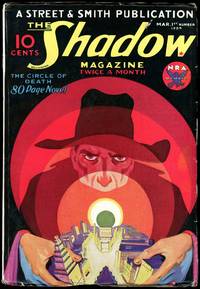
1934ref. 30826New York NY: Street & Smith Publications Inc. 1934. Text paper bright tiny nicks and tears to yapp edges a couple tiny rub marks to upper front cover a bright fine copy. 30826. Octavo pictorial wrappers. Pulp magazine. "The Circle of Death" by Maxwell Grant. Reference: Cook Mystery Detective and Espionage Magazines pp. 486-491. Tymm and Ashley Science Fiction Fantasy and Weird Fiction Magazines pp. 570-573. Street & Smith Publications, Inc. unknown
1600in-8, pp. 1cb, (24), 263, 24, (8), 1 cb, legg. p. perg. floscia con recupero di antico codice, e tit. mss al d. Fregi, final. e iniziali xilogr. Marca tipogr. al front. a due colori. Dedicat. dello Zucchi al Cardinal Galli protettore della Santa Casa, e aggiunta di un Sesto Libro dello stesso Zucchi al fine. Rara opera pubblicata nel 1597 dal padre gesuita (1545-1599) cui si deve anche una biografia su Francesco Saverio e una storia della Santa Casa di Loreto. Questa rara edizione compare per la la prima volta nella traduzione italiana di Bartolomeo Zucchi (1570-1630), storico originario di Monza. Pochi esempl. nelle biblioteche italiane sono completi anche del sesto libro aggiunto dallo Zucchi. Qualche lieve ed insignificante gora marginale e mancanza di circa 1 cm al margine bianco inf. al front., ma bell'esempl. Raro. [532]