11,653 results
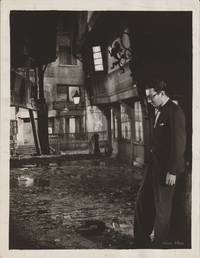
1931ref. 162334N.p.: N.p. 1931. Vintage reference photograph from the 1931 film showing director Rouben Mamoulian on the set. Provenance stamp and annotations in manuscript pencil on the verso. Based on Robert Louis Stevenson's classic 1886 novella and considered by many to be the definitive adaptation. A pre-Code film the adaptation is often remembered for its strong sexual content heavily edited after the film's 1936 re-release. Nominated for three Academy Awards winning one for Best Actor for Fredric March. 8 x 10 inches. About Near Fine with only light edgewear at the top and bottom edges to note. N.p. unknown books
1935ref. 160641Beverly Hills CA: Metro-Goldwyn-Mayer MGM 1935. Vintage reference photograph from the 1935 film showing a ballroom interior with crew members visible to the far left. MGM stamp on the verso. From the archive of film historian and author Joel Finler. Based on the classic 1877 novel by Leo Tolstoy about a young woman whose loveless marriage leads her to begin an affair with a dashing Czarist officer. Set in St. Petersburg. 10 x 8 inches. Pinholes at the corners else about Near Fine. Metro-Goldwyn-Mayer [MGM] unknown books
1934ref. 158854Beverly Hills CA: 20th Century Pictures / United Artists 1934. Vintage studio still photograph from the 1962 film here advertised under working title "The Firebrand." Based on the 1945 play by Edwin Justus Mayer. A duke and duchess both have their eyes on other people but do not want the other to know. 8 x 10 inches. Very Good plus with one small tear to the top left corner and a small chip missing from the top right corner. 20th Century Pictures / United Artists unknown books
1963ref. 153714New York: Plautus Productions 1963. Revised Draft script for the 1963 television episode originally aired on October 17 1963 on CBS. Manuscript ink annotations by screenwriter Larry Cohen to the first 19 pages noting substantive revisions and Cohen's playful annotation to the title page crossing through "The Nurses" and writing "Florence Nightmare" possibly a working title over the printed title. The series title was changed from "The Nurses" to "The Doctors and the Nurses" for the second season. The series ran from 1962 to 1965 and followed the interpersonal dramas of a group of doctors and nurses at the fictitious Alden General Hospital in New York. In this episode a man attempts suicide and is left partially paralyzed and is tended by Nurse Kelly. An early venture for screenwriter Larry Cohen who would go on to write Blaxploitation films "Bone" 1972 "Black Caesar" 1973 and "Hell Up in Harlem" 1973 as well as several popular horror and science fiction films including "It's Alive" 1974 "God Told Me To" 1976 and "The Stuff" 1985. Set in New York. Self wrappers housed in a manila envelope. Title page present dated April 5 1963 noted as Revised Mimeo and production No. 34 with credits for screenwriter Larry Cohen. 84 leaves with last page of text numbered IV-77. Mimeograph duplication on pink stock rectos only. Title page Very Good plus with light wear and dampstaining to the edges else Pages Near Fine unbound. Envelope Very Good plus overall. Plautus Productions unknown books
1975ref. 139699N.p.: American International Pictures AIP 1975. Three vintage black-and-white studio still photographs from the 1975 film. An aging movie star pining for his lost days of fame throws a lavish Hollywood party in an attempt to pique the interest of some big shot producers. However the party flops resulting in an orgiastic and murderous free-for-all. Set in Hollywood shot on location in California. 10 x 8 inches. Fine with a stamp to the verso of each. American International Pictures [AIP] unknown books
1930ref. 148911Beverly Hills CA: United Artists 1930. 16 page vintage program for the 1930 film announcing its showing at Broadway theaters in New York with abundant black and white photographs of actors aerial stunts and Howard Hughes throughout. Hughes' most expensive and ambitious production a story about World War I combat pilots today still a dazzling work of blockbuster action and actual aerial biplane footage. Originally conceived as a silent film and then retooled as a talkie in the wake of "The Jazz Singer." Most of the film is shot in black and white but one sequence is in color-the only color footage ever released of actress Jean Harlow before her untimely death. James Whale was hired by Hughes to direct the talking sequences Whale's first major effort in Hollywood but the overall production took so long that Whale's subsequent directorial effort "Journey's End" was released first. Nominated for an Academy Award for Best Cinematography. Card wrappers saddle stapled 5 x 6.5 inches. 16 pages. Near Fine. United Artists unknown books
1969ref. 150712Burbank CA: Warner Brothers / Seven Arts 1969. Eight vintage studio still photographs from the 1969 film. Based on Elmore Leonard's 1969 novel. A Vietnam veteran with a shady past falls into a secretary's scheme to steal $50000 from the owner of a California farm. Set and shot on location in Carmel and Monterey California. 10 x 8 inches. Near Fine. Grant US. Warner Brothers / Seven Arts unknown books
1969ref. 150714Burbank CA: Warner Brothers / Seven Arts 1969. Complete set of eight vintage color studio still photographs from the 1969 film. Based on Elmore Leonard's 1969 novel. A Vietnam veteran turned migrant farm laborer falls into a secretary's scheme to steal $50000 from the owner of a California farm. Set and shot on location in Carmel and Monterey California. 10 x 8 inches. Seven Near Fine one Very Good plus with a small closed tear with accompanying creasing to the right edge. Grant US. Warner Brothers / Seven Arts unknown books
1947ref. 145972Universal City: Universal International Pictures 1947. Revised First Draft script for the 1948 film. With faint manuscript pencil annotations and watermarked CONTRACT FILE COPY throughout. Based on the 1946 Broadway play and a prequel to the 1941 film "The Little Foxes." In the fictional town of Bowden Alabama the wealthy Hubbard family holds onto their old-South prominence and prestige through exploitation and cruelty. A searing portrayal of racism and class privilege in the post-Civil War American South. Set in Alabama. Green titled wrappers noted as REVISED FIRST DRAFT on the front wrapper rubber-stamped production No. 7494 dated June 9 1947 with credits for screenwriter Vladimir Pozner. Title page integral on the front wrapper. 178 leaves with last page of text numbered 169. Carbon typescript on onionskin stock rectos only. Pages Very Good plus wrapper Very Good plus with light foxing to the left edge bound with three gold brads. Universal International Pictures unknown books
1978ref. 141900Leigh-McLaughlin / Atlantic Releasing Corporation 1978. Draft script for the 1978 film. Gilroy was a writer for screen stage novels film producer and director. He received the Tony Award for Best Play and the Pulitzer Prize for Drama for his play "The Subject Was Roses" in 1965. An autobiographical tale of an American screenwriter living in Paris who has an affair with a British aristocrat. Set in and shot on location in Paris. Brown untitled wrappers manuscript ink notation of underlined title. Title page present with credits for screenwriter Frank D. Gilroy. 148 leaves with last page of text numbered 148. Mechanical duplication. Pages Near Fine wrapper Very Good plus prong binding. Leigh-McLaughlin / Atlantic Releasing Corporation unknown books
1964ref. 140570N.p.: Seven Arts Pictures 1964. Three vintage studio still photographs from the 1964 film. Nominated for two Oscars including Best Actor in a Supporting Role. Based on Fletcher Knebel and Charles W. Bailey's 1962 novel of the same name. A Cold War political thriller about an attempted coup in the US government. Although the pentagon expressed a dislike for the film President John F. Kennedy was encouraging even assisting in its production by arranging a visit to his home in Hyannis Port when the crew needed to shoot outside the White House. Shot on location in Arizona California Virginia DC and France. 8 x 10 inches. Near Fine. Newman Pg. Spicer US. Seven Arts Pictures unknown books
1891ref. 55038Southampton: To Be Had at Ye Olde Boke Shoppe 1891. original quarter leather with cloth-covered boards top edge gilt. large 8vo. original quarter leather with cloth-covered boards top edge gilt. vi 80 lxiii 3 pages. Besterman 2794. About 2500 entries in three lists: Hampeshireiana from the 16th to 19th centuries mostly 18th and 19th "books and periodicals containing references to Hampshire" and a list of Hampshire newspapers current and defunct by "F.A. Edwards" who seems to have been associated with the Hampshire Independent. An earlier much smaller Biblioteca Hantoniensis appeared in 1870 under the name of Gilbert. Backing is rubbed and cracked with head and tail worn away and splitting along shoulders. Front cover and front free endpaper are detatched. Staining discoloration of covers. To Be Had at Ye Olde Boke Shoppe unknown books
1877ref. 720201877. One Copy Located in North America None in Great Britain Broadside. Execution. March Henry 1827-1877. Execution of H. March The Wymondham Murderer. Henry March was Executed for the Murder of Thomas Mayes And Henry Bidewell At Wymondham By Beating Them to Death with a Bar of Iron. Wymondham Norfolk England: S.n. 1877. 10" x 7-1/2" broadside mounted on 10-1/2" x 8" thick-paper sheet seven-stanza verse text in two columns below headline columns and headline separated by rules typographical ornaments at end of verses. Light browning light edgewear to broadside a minor tear and a small chip near its upper-right corner. $950. Marsh and Bidwell worked at a forge owned by Mays. When Mays announced he was retiring and selling the forge both men learned they were going to lose their jobs. Marsh an employee for 37 years was particularly upset. While out on an errand Mays went to a pub. He returned to work drunk and got into an argument with Bidwell. Enraged he beat him to death with a heavy iron bar. A servant saw the attack and notified Mays. When he entered the forge Marsh killed him with the same bar. First line of the verses: "The bell has ceased tolling Henry March is now dead. His body's now lying in its cold narrow bed." This is a rare item. OCLC locates 1 copy Washington State University. No copies listed on Library Hub. unknown books
1949ref. 72710London: Poetry London 1949. September. 32 pp. Covers soiled else very good plus in illustrated wrappers. Keith Douglas Franciszka Themerson Donald Davie and others contribute. London: Poetry London, unknown books
1946ref. 66546Washington DC: Library of Congress 1946. Second printing. xix 146 pp. Fine in two-part cloth binding with gold stamping to spine. t.e.g. A facsimile of the 1488 edition with an introduction by Elizabeth Mongan. Washington DC: Library of Congress hardcover books
1836ref. 61862London: Printed and published by J. March . Effingham Wilson . and B. Steill 1836. Third edition. 8vo. 106 pp. Wood engraved frontispiece wood engraved vignettes throughout. Westwood & Satchell pp. 143-144. Heckscher 1289. Very good. Contemporary plain cloth-backed boards rubbed. 8753. Printed, and published, by J. March ... Effingham Wilson ... and B. Steill unknown books
2014ref. 28187Barcelona: Printed at The Folio Club for Sandra March 2014. Hardcover. Fine. Hardcover. Number 83 of 100 copies signed and numbered by Sandra March. Text in Spanish Catalan and English. March is a talented young book and installation artist. With this work she draws a metaphorical graphic and auditory journey captured by words illustrations and sound. Thus the contents comprise the book two posters and a CD. She writes that this project has a scientific basis with a therapeutic and artistic impulse starting on a subconscious level after losing both her sister and her father from heart diseases. The journey goes from a symbolic loss of the heart until its restoration through a tour of the beautiful and varied morphology of the cardiac systems of thirty-one different animals and the sounds of their heartbeats. The heartbeat sounds are from a jellyfish starfish black widow spider giant tortoise Nile crocodile frog parakeet and human being among many others There were a number of contributors to this project including the biologist Francesc Uribe Porta sound engineer Vicente Rosati and illustrator Raquel Bullon. Bound in a white cardboard CD case with posters attached to the back cover by a pink elastic band and CD held on the middle fold of the case. In fine condition. 58 pages. PRI/042715. Printed at The Folio Club for Sandra March hardcover books
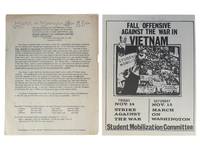
1969ref. 222141969. Student Mobilization Committee to End the War in Vietnam Fall Offensive Against the War in Vietnam handbill archive 1969 documents grassroots antiwar mobilization in the weeks surrounding the November 15 March on Washington and supports research into student organizing Vietnam War dissent protest communications and the relationship between antiwar activism and civil rights language. The material documents the system of mass antiwar protest coordination through locally distributed leaflets public calls for disciplined nonviolence strike-and-march scheduling and visual appeals to interracial and cross-movement solidarity revealing how organizers sought to convert dispersed campus opposition into a visible national demonstration. The Student Mobilization Committee was a national coalition active from 1966 to 1973 and the November 1969 Washington action drew more than 500000 demonstrators after the October Moratorium and alongside New Mobilization Committee activity making these handbills useful evidence of how antiwar organizations framed participation legality and public legitimacy during one of the largest Vietnam War protests in the United States. Two original handbills issued in connection with the November 14 and 15 1969 antiwar actions in Washington D.C. comprising one mimeographed leaflet distributed by the CWRU Student Mobilization Committee and one offset-printed graphic leaflet headed "FALL OFFENSIVE AGAINST THE WAR IN VIETNAM" each approximately 8½ x 11 inches. The mimeographed leaflet opens with a quoted November 9 1969 New York Times editorial warning that "The Administration has been following a course calculated to increase the danger that the protest march will turn into a violent confrontation" and answers with the committee's insistence that "Nov. 14-15 will be the most massive legal peaceful and non-violent demonstrations ever held in the U.S." Its text explains the functional logic of the protest effort arguing that "Only a massive peaceful demonstration of the American people can require the government to end the conflict and bring the troops home now" while also identifying government rhetoric as a threat to the movement's legitimacy: "The source of rumors about violence. is the government itself." The second leaflet uses bold graphic design and a black-and-white protest photograph showing demonstrators one raising a peace sign with placards reading "End the War Now!" and "Bring the Troops Home Now!" and a background banner declaring "End Racial Oppression!" Beneath the image the leaflet gives the coordinated schedule: "FRIDAY NOV. 14 / STRIKE AGAINST THE WAR" and "SATURDAY NOV. 15 / MARCH ON WASHINGTON" linking workplace and campus strike tactics to the mass Washington demonstration. Student Mobilization Committee to End the War in Vietnam. Nov. 14-15 peaceful and non-violent demonstrations leaflet. Cleveland: CWRU Student Mobilization Committee 1969. Mimeographed organizing handbill using press quotation rebuttal and direct appeal to defend the planned Washington demonstrations against anticipated claims of violence. The leaflet shows the mechanisms of antiwar communication in practice: organizers framed participation as peaceful legal and morally necessary urging readers that "Marching on Washington November 15 in the peaceful and non-violent demonstration is the best way to build that movement to end the war immediately. JOIN US!" 2 Student Mobilization Committee to End the War in Vietnam. Fall Offensive Against the War in Vietnam. Washington D.C.: Student Mobilization Committee to End the War in Vietnam 1969. Offset-printed handbill combining protest imagery antiwar slogans and a two-day action calendar for the November 14 strike and November 15 March on Washington. The inclusion of the banner "End Racial Oppression!" places the antiwar action within a broader field of late-1960s radical politics where opposition to U.S. military policy intersected visually and rhetorically with civil rights and racial justice claims. Light toning minor edge wear and small creases very good. Compact evidence of the messaging infrastructure behind the November 1969 antiwar mobilization preserving both the defensive language of nonviolence and the public visual vocabulary used to recruit participants for national protest. unknown books
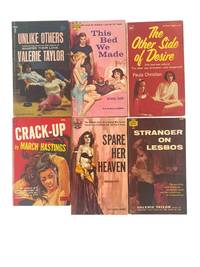
1960ref. 225421960. LGBTQ Lesbian Pulp Lesbian pulp novels published between 1960 and 1965 a crucial phase in the emergence of lesbian literature in American pulp publishing. These authors wrote about queer experience at a time when lesbian representation was largely dominated by heterosexual male writers and constrained by censorship that required publishers to present same sex desire through salacious marketing and "moralizing" tragic or heterosexual endings. Valerie Taylor Velma Nacella Young Paula Christian Yvonne MacManus and March Hastings Sally Singer were among the small group of queer women producing lesbian novels that treated relationships between women with greater emotional complexity and personal insight exploring themes of lesbian identity and the social consequences of living as an open or closeted gay woman. Several titles by these authors were later identified by lesbian bibliographer Barbara Grier as "A" tier works in The Lesbian in Literature indicating major lesbian thematic content and sympathetic narrative treatment. Archive includes: 1 Valerie Taylor Pen name of Velma Nacella Young. Stranger on Lesbos. Greenwich CT: Fawcett Crest 1960. First Crest printing February 1960. One of Taylor's most enduring works centering on Frances a discontented wife whose encounter with a vibrant lesbian social circle leads her to confront her own desires. A landmark title in Grier's A tier for its substantial lesbian content and refusal to deliver a purely punitive ending. 2 March Hastings Pen name of Sally Singer. Crack-Up. Chicago: Newsstand Library 1961. First printing. Subtitled on the cover: "The torment of a woman-frustrated in marriage-torn between desire and compassion." Hastings one of pulp's most prolific lesbian authors explores emotional collapse and the redemptive possibilities of same-sex love with more psychological nuance than the genre typically allowed. 3 Artemis Smith Pen name of Annselm Morpurgo. This Bed We Made. Derby CT: Monarch Books 1964. First Monarch edition originally published 1961. Greenwich Village-set tale of Elaine Perkins who marries to satisfy societal expectations but is drawn into a relationship with Nicole an artist's model. Back cover tagline: "Wife or Lesbian" 4 Valerie Taylor Pen name of Velma Nacella Young. Unlike Others. New York: Midwood-Tower 1963. First edition. From the author of Whisper Their Love and Stranger on Lesbos Unlike Others follows women whose relationships defy convention and societal approval. Known for infusing pulp conventions with emotional depth Taylor was one of the few openly lesbian pulp authors of her time. 5 Morgan Ives Pen name of Marion Zimmer Bradley. Spare Her Heaven. Derby CT: Monarch Books 1963. First edition. The story of Kathara a stage performer worshiped as the "Goddess of the Temple of Joy" whose allure draws both men and women into a cult-like world of pleasure. While framed through pulp's "devil or angel" dichotomy Ives weaves subversive notes of female autonomy into the sensational plot. 6 Paula Christian Pen name of Yvonne MacManus. The Other Side of Desire. New York: Paperback Library 1965. First printing. "Is it lust or love when one woman desires another woman" Carrie risks her marriage children and reputation for an affair with Kim only to find herself enslaved to "forbidden sex." The significance of these novels lies in their authorship and perspective. During the 1950s and 1960s lesbian pulp fiction formed one of the few widely distributed literary spaces where queer women could encounter representations of same sex relationships even when those narratives were sensationalized by commercial marketing. Writers such as Taylor Christian and Hastings expanded the thematic range of the genre by incorporating elements drawn from lived queer experience including emotional partnership internal conflict and the pressures of secrecy. Six volumes total. Standard mid century mass market paperback format. Moderate handling wear consistent with newsstand distribution including light edge wear and toning. Overall very good condition. unknown books
1977ref. 595809Kehl West Germany: Swan 1977. Hardcover. Good/Good. First edition. Text in German. Folio. 127pp. Heavily illustrated from photographs. Slightly cocked dampstaining on the boards about half of the pages with staining and wrinkling thus sound but good only in a good only dust jacket with chips and tears along the edges some delamination and interior staining. With an 8-page stapled pamphlet laid in. Swan hardcover books
1964ref. 185861964. Broadside 1964 announcing the "Second Giant March Up Market Street" in San Francisco documenting West Coast civil rights mobilization in advance of the July 12 1964 Human Rights March and the opening of the Republican National Convention. Issued during a period of national debate over the Civil Rights Act of 1964 and related state measures the flyer outlines the political aims of the demonstration including opposition to Proposition 14 known as the Segregation Amendment and advocacy for "the full equality of 20 million Negro American citizens." The text identifies Barry Goldwater as a focal political figure describing him as "the rallying center for the Birchers White Citizens' Councils KKK and segregationists" reflecting contemporary activist perspectives on the 1964 presidential campaign. The march which drew approximately 35000 participants followed earlier protests in San Francisco including a 1963 demonstration in response to the Birmingham church bombing and illustrates the expansion of civil rights activism beyond the American South into major urban centers on the West Coast. "Second Giant March Up Market Street." San Francisco California: Church Labor Conference 1964. Broadside measuring approximately 7 x 10 1/4 inches printed for circulation prior to the July 12 1964 march. Distributed by the Church Labor Conference a coalition of religious and labor organizations including the Interdenominational Ministerial Alliance and the Negro Labor Assembly and associated with organizing efforts by groups such as the Congress of Racial Equality CORE and the Student Non-Violent Coordinating Committee SNCC. The broadside presents the date purpose and political context of the demonstration within the national civil rights movement. Light fading to printed text; otherwise well-preserved; overall very good condition. A concise printed artifact of civil rights organizing in San Francisco during a pivotal year of legislative and political change in the United States. unknown books
1989ref. 449027Santa Fe New Mexico: John Muir Publications 1989. Softcover. Very Good. First edition. Trade paperback. 413pp. Illustrated from black and white photographs. Foxing on page edges light spine creased very good. John Muir Publications unknown books
1988ref. 244902New York: St Martins 1988. Softcover. Good. Unc. Proof. Good in wrappers a paperback. Uncorrected proof. Corners slightly flared. Crease on top corner on rear cover. Publishing info glued inside front cover. St Martins unknown books
1862ref. 1589511862. MARCH T.C. Flower and Fruit Decoration: With some Remarks on the Treatment of Town Gardens Terraces &c. viii 112 pp plus 16 pp of ads. Illustrated with a hand-coloured wood-engraved frontispiece numerous black and white wood engravings throughout and 8 plates with a total of 43 hand-coloured wood engravings juxtaposing colours for table settings and floral boarders for gardens. 8vo. 220 x 140 mm rebound in gray cloth with the original illustrated paper covers laid down. London: Harrison 1862. First Edition. A scarce work that applies colour theory to flower arrangements and small garden designs through a series of unusual hand-coloured wood engravings. The diagrams demonstrate the best colour combinations for groups of three table arrangements followed by illustrations of different coloured borders for small gardens. T.C. March participated in table arrangement competitions held by Dobson and Pearce St. James Street in 1861 and also made arrangements of the Great Exhibition of 1862. Some scattered light spotting the colour plates are bright and fresh overall very good. hardcover books
1948ref. 315710London: Editions Poetry 1948. Hardcover. Very Good/Very Good. First British edition. Very good with some light soiling in a very good dustwrapper with edgewear and a faded spine. Editions Poetry hardcover books