342 résultats
1982réf. 5401Washington DC 1982. About very good. Lithographic poster 34 x 22.75 inches printed on cheap paper. A few small chips and closed tears to edges old folds some light creasing. A striking poster advertising a "Mass Protest" in Washington D.C. in support of El Salvador and "against the Reagan Policy of Oppression at Home and Intervention in the Third World!" The poster is decorated by illustrations of about two dozen helicopters at top but is otherwise comprised of text in variously-sized fonts. The poster was issued by the March 27 Coalition whose sixteen member organizations are listed at the bottom left corner of the poster and include the American Indian Movement Black Veterans for Social Justice People's Anti-War Mobilization Puerto Rico Solidarity Committee Women's Pentagon Action and many others. According to a contemporary article in The Washington Post the protest drew an estimated 23000 demonstrators assembled to protest U.S. policy in El Salvador on the eve of elections in that country. The demonstrators accused the Reagan Administration of supporting a "civilian-military junta in El Salvador that is locked in a war against leftist insurgents." The present poster is a call to action for the protest but also calls for the U.S. to support jobs "human needs" and "Self Determination for the People of Central America and all Oppressed Nations -- No More Vietnam Wars!" The poster also calls for unity against "the Reagan Policy of Oppression at Home and Intervention in the Third World" as well as a call for "No to the Draft! No to Racism! and No to Sexism!" OCLC reports a single record of an El Salvador protest poster from San Francisco in 1981 and a handful of examples of protest posters for El Salvador from later in the 1980s but we could not locate any other copies of this 1982 protest poster. unknown books
1964réf. 185861964. Broadside 1964 announcing the "Second Giant March Up Market Street" in San Francisco documenting West Coast civil rights mobilization in advance of the July 12 1964 Human Rights March and the opening of the Republican National Convention. Issued during a period of national debate over the Civil Rights Act of 1964 and related state measures the flyer outlines the political aims of the demonstration including opposition to Proposition 14 known as the Segregation Amendment and advocacy for "the full equality of 20 million Negro American citizens." The text identifies Barry Goldwater as a focal political figure describing him as "the rallying center for the Birchers White Citizens' Councils KKK and segregationists" reflecting contemporary activist perspectives on the 1964 presidential campaign. The march which drew approximately 35000 participants followed earlier protests in San Francisco including a 1963 demonstration in response to the Birmingham church bombing and illustrates the expansion of civil rights activism beyond the American South into major urban centers on the West Coast. "Second Giant March Up Market Street." San Francisco California: Church Labor Conference 1964. Broadside measuring approximately 7 x 10 1/4 inches printed for circulation prior to the July 12 1964 march. Distributed by the Church Labor Conference a coalition of religious and labor organizations including the Interdenominational Ministerial Alliance and the Negro Labor Assembly and associated with organizing efforts by groups such as the Congress of Racial Equality CORE and the Student Non-Violent Coordinating Committee SNCC. The broadside presents the date purpose and political context of the demonstration within the national civil rights movement. Light fading to printed text; otherwise well-preserved; overall very good condition. A concise printed artifact of civil rights organizing in San Francisco during a pivotal year of legislative and political change in the United States. unknown books
1947réf. 145972Universal City: Universal International Pictures 1947. Revised First Draft script for the 1948 film. With faint manuscript pencil annotations and watermarked CONTRACT FILE COPY throughout. Based on the 1946 Broadway play and a prequel to the 1941 film "The Little Foxes." In the fictional town of Bowden Alabama the wealthy Hubbard family holds onto their old-South prominence and prestige through exploitation and cruelty. A searing portrayal of racism and class privilege in the post-Civil War American South. Set in Alabama. Green titled wrappers noted as REVISED FIRST DRAFT on the front wrapper rubber-stamped production No. 7494 dated June 9 1947 with credits for screenwriter Vladimir Pozner. Title page integral on the front wrapper. 178 leaves with last page of text numbered 169. Carbon typescript on onionskin stock rectos only. Pages Very Good plus wrapper Very Good plus with light foxing to the left edge bound with three gold brads. Universal International Pictures unknown books
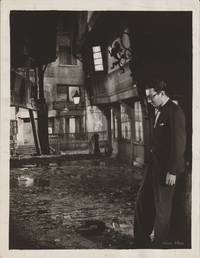
1931réf. 162334N.p.: N.p. 1931. Vintage reference photograph from the 1931 film showing director Rouben Mamoulian on the set. Provenance stamp and annotations in manuscript pencil on the verso. Based on Robert Louis Stevenson's classic 1886 novella and considered by many to be the definitive adaptation. A pre-Code film the adaptation is often remembered for its strong sexual content heavily edited after the film's 1936 re-release. Nominated for three Academy Awards winning one for Best Actor for Fredric March. 8 x 10 inches. About Near Fine with only light edgewear at the top and bottom edges to note. N.p. unknown books
réf. 11288N/A n/d. N/A. Hardcover. g. 8vo. 488 pp. total. Three-quarter leather over marbled boards. Raised bands. Gilt lettering to spine. Some age wearing to edges. Gilt top edge. Marbled endpapers. Reinforced back hinge with binders tape."With the bookplate and signature of Bruce Bryan the noted author and long time curator of the Southwest Museum of The American Indians in Pasadena California". 14 booklets on different subjects regarding Great Britain including Archaeology Natural History Architecture Surveys Anglo-Saxon Jewelry Abbeys and Castles in South Wales Ancient Cemetry at Saffron Walden Roman-Britain and many more all bound in one volume. Illustrated throughout with b/w lithographic plates fold out maps plans and drawings. A tight copy in good condition. N/A hardcover books
1936réf. 140941960New York: Random House 1936. First Edition. First edition. Signed by Clifford Odets in the year of publication inscribed to actor Fredric March and his wife "For Mr. Mrs F. March with the appreciation of the Group Theater. Sincerely signed Clifford Odets 1/18/36." xiii i 204 pp. Bound in publisher's navy cloth with gilt spine lettering. Very Good edges foxed in Very Good dust jacket dulled spine panel light wear and stain at foot. A great association between playwright Odets with one of his more difficult plays and Hollywood actor Fredric March a major star of his day. Odets' thanking March for his patronage of the experimental Group Theater collective who put on this play is a nice bit of Great Depression-era theater context too. The Group Theater would last ten years total; their biggest success would be the following year with Odets' play Golden Boy. Random House unknown books
1980réf. 2715Folio. Anthony D'Offay Gallery .ff. 48. white beige yellow peach blue. pink red orange green & cream-coloured hand-made papers from the Sri Aurobindo Ashram in Pondicherry. 85 tipped-in colour plates. endpapers & inside pages designed by Ettore Sottsass. Original half cloth spine in green. Front cover is covered with embossed copper. Back cover in copper also. In publisher's cardboard box. First Edition Limited to 1000 copies signed and nubered by the artist 502. The eighty-five pastels reproduced here were drawn in the spring of 1980 in Pondicherry on the eastern coast of India. Printed at the Kalakshetra Press under the direction of C.T. Nachiappan. Kalakshetra Press, Anthony D'Offay Gallery books
1877réf. 720201877. One Copy Located in North America None in Great Britain Broadside. Execution. March Henry 1827-1877. Execution of H. March The Wymondham Murderer. Henry March was Executed for the Murder of Thomas Mayes And Henry Bidewell At Wymondham By Beating Them to Death with a Bar of Iron. Wymondham Norfolk England: S.n. 1877. 10" x 7-1/2" broadside mounted on 10-1/2" x 8" thick-paper sheet seven-stanza verse text in two columns below headline columns and headline separated by rules typographical ornaments at end of verses. Light browning light edgewear to broadside a minor tear and a small chip near its upper-right corner. $950. Marsh and Bidwell worked at a forge owned by Mays. When Mays announced he was retiring and selling the forge both men learned they were going to lose their jobs. Marsh an employee for 37 years was particularly upset. While out on an errand Mays went to a pub. He returned to work drunk and got into an argument with Bidwell. Enraged he beat him to death with a heavy iron bar. A servant saw the attack and notified Mays. When he entered the forge Marsh killed him with the same bar. First line of the verses: "The bell has ceased tolling Henry March is now dead. His body's now lying in its cold narrow bed." This is a rare item. OCLC locates 1 copy Washington State University. No copies listed on Library Hub. unknown books
1650réf. 2747Le Potre Jean le Pautre French 1618 - 1682 French after Baptiste Alexandre Le Blond 1679 – 10 March 1719. Alexandre le Grand aualle la medicine etc. Etching. Signed "le Potre Inuent et fecit" beneath the image lower left. 9 x 12.c.1650. In good condition. Framed. books
1862réf. 1589511862. MARCH T.C. Flower and Fruit Decoration: With some Remarks on the Treatment of Town Gardens Terraces &c. viii 112 pp plus 16 pp of ads. Illustrated with a hand-coloured wood-engraved frontispiece numerous black and white wood engravings throughout and 8 plates with a total of 43 hand-coloured wood engravings juxtaposing colours for table settings and floral boarders for gardens. 8vo. 220 x 140 mm rebound in gray cloth with the original illustrated paper covers laid down. London: Harrison 1862. First Edition. A scarce work that applies colour theory to flower arrangements and small garden designs through a series of unusual hand-coloured wood engravings. The diagrams demonstrate the best colour combinations for groups of three table arrangements followed by illustrations of different coloured borders for small gardens. T.C. March participated in table arrangement competitions held by Dobson and Pearce St. James Street in 1861 and also made arrangements of the Great Exhibition of 1862. Some scattered light spotting the colour plates are bright and fresh overall very good. hardcover books
1700réf. 1270943early 1700's. Hardcover. folio unpaginated; VG; spine paneled black leather with red label gilt lettering; rebound spine 3/4 bound corners and boards not rebound; bumping and peeling to corners wear to boards; This book consists of a compilation of plates mostly from Dutch engravers featuring bible scenes. The scenes range from the creation of man to the adoration of the three kings; plates are tipped onto thicker stock; some pages have fingermark stains; shelved above Case 3. 1270943. Shelved Dupont Bookstore. hardcover books
1928réf. 008397Covici Friede 1928. Book. Fine. Cloth. First Edition. 8vo - over 7¾" - 9¾" tall. Fine copy in near fine jacket first Edition.$2.00 on flap.Small loss at Crown & Heel of jacket.Epic Poem on Boxing.Very Scarce. Covici Friede Hardcover books
1933réf. 168906London: Collins 1933. First UK Edition preceding all others published by Doubleday in the US as "The Man of Dangerous Secrets" the same year. Jacket is second state with publisher's stamped price of 3/6 on the spine. The first of three "psychological" crime novels written by Allingham under the Maxwell March pseudonym. Very Good plus in a bright Very Good plus dust jacket. Attractive bookplate and library stamp on the front pastedown with a neat owner inscription in ink on the title page see images. Book foxed to the top page edges with a bump to one corner of the crown. Jacket has a few bits of foxing to the front panel some rubbing to the rear panel and creasing at the spine ends. See images. Collins unknown books
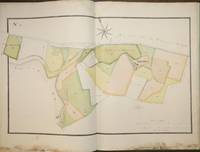
1814réf. 0072711814. Quarter Vellum. Cloth Boards. Near Fine. Spectacular manuscript estate survey maps from early 19th Century. Folio 53 by 39 cm. 6 text pages followed by ten double paged maps all handsomely colored and detailed. The first nine maps are numbered 2 to 10 per table in front showing that notwithstanding the enumeration there is not a missing map. One map with extra fold-out flap addenda. An additional double-sided hand-colored map in the back inserted into the foliio and then two additional hand-colored survey maps by de la Marche or his son loose -- never bound in -- architectural sketch of the chateau footprint done in pen-and-ink -- two other smaller less visually exciting maps and some correspondence. Maps are colored in greens reds yellows and blues. The washes of color together with the obvious precision of the draftsmanship render these maps utilitarian in purpose originally pleasing to the eye and very decorative. Tiny vignettes of churches mark villages and forests are signified by dots representing trees as was the convention. This chateau belonged to M. François Louis Barrairon at the time. It is located in the Indre-et-Loire Department and is between and equidistant to Tours and Vendome. Condition: bottom of leaves stained and sometimes slightly chipped or chewed looking. A few other minor chips. A few un-obtrusive well-executed repairs of tears. unknown books
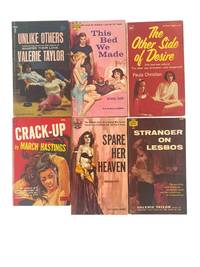
1960réf. 225421960. LGBTQ Lesbian Pulp Lesbian pulp novels published between 1960 and 1965 a crucial phase in the emergence of lesbian literature in American pulp publishing. These authors wrote about queer experience at a time when lesbian representation was largely dominated by heterosexual male writers and constrained by censorship that required publishers to present same sex desire through salacious marketing and "moralizing" tragic or heterosexual endings. Valerie Taylor Velma Nacella Young Paula Christian Yvonne MacManus and March Hastings Sally Singer were among the small group of queer women producing lesbian novels that treated relationships between women with greater emotional complexity and personal insight exploring themes of lesbian identity and the social consequences of living as an open or closeted gay woman. Several titles by these authors were later identified by lesbian bibliographer Barbara Grier as "A" tier works in The Lesbian in Literature indicating major lesbian thematic content and sympathetic narrative treatment. Archive includes: 1 Valerie Taylor Pen name of Velma Nacella Young. Stranger on Lesbos. Greenwich CT: Fawcett Crest 1960. First Crest printing February 1960. One of Taylor's most enduring works centering on Frances a discontented wife whose encounter with a vibrant lesbian social circle leads her to confront her own desires. A landmark title in Grier's A tier for its substantial lesbian content and refusal to deliver a purely punitive ending. 2 March Hastings Pen name of Sally Singer. Crack-Up. Chicago: Newsstand Library 1961. First printing. Subtitled on the cover: "The torment of a woman-frustrated in marriage-torn between desire and compassion." Hastings one of pulp's most prolific lesbian authors explores emotional collapse and the redemptive possibilities of same-sex love with more psychological nuance than the genre typically allowed. 3 Artemis Smith Pen name of Annselm Morpurgo. This Bed We Made. Derby CT: Monarch Books 1964. First Monarch edition originally published 1961. Greenwich Village-set tale of Elaine Perkins who marries to satisfy societal expectations but is drawn into a relationship with Nicole an artist's model. Back cover tagline: "Wife or Lesbian" 4 Valerie Taylor Pen name of Velma Nacella Young. Unlike Others. New York: Midwood-Tower 1963. First edition. From the author of Whisper Their Love and Stranger on Lesbos Unlike Others follows women whose relationships defy convention and societal approval. Known for infusing pulp conventions with emotional depth Taylor was one of the few openly lesbian pulp authors of her time. 5 Morgan Ives Pen name of Marion Zimmer Bradley. Spare Her Heaven. Derby CT: Monarch Books 1963. First edition. The story of Kathara a stage performer worshiped as the "Goddess of the Temple of Joy" whose allure draws both men and women into a cult-like world of pleasure. While framed through pulp's "devil or angel" dichotomy Ives weaves subversive notes of female autonomy into the sensational plot. 6 Paula Christian Pen name of Yvonne MacManus. The Other Side of Desire. New York: Paperback Library 1965. First printing. "Is it lust or love when one woman desires another woman" Carrie risks her marriage children and reputation for an affair with Kim only to find herself enslaved to "forbidden sex." The significance of these novels lies in their authorship and perspective. During the 1950s and 1960s lesbian pulp fiction formed one of the few widely distributed literary spaces where queer women could encounter representations of same sex relationships even when those narratives were sensationalized by commercial marketing. Writers such as Taylor Christian and Hastings expanded the thematic range of the genre by incorporating elements drawn from lived queer experience including emotional partnership internal conflict and the pressures of secrecy. Six volumes total. Standard mid century mass market paperback format. Moderate handling wear consistent with newsstand distribution including light edge wear and toning. Overall very good condition. unknown books
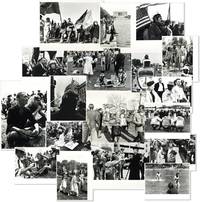
1970réf. 81746Silver Spring MD: James B. Johnson 1970. Archive consisting of 70 original double-weight silver gelatin photographs. Forty-seven 47 measuring 8" x 10" and twenty-three 23 measuring 14" x 11". Many though not all bear the photographer's rubber-stamp on verso James B. Johnson 2200 Dennis Ave. Silver Spring MD. a few bearing brief holograph captions or codes in red and black ink. Light wear to extremities subtle curling to the edges and a few photos with tiny creases to the corners; overall Very Good. A substantial group of images documenting the April 4 1970 "March For Victory" in Washington DC. This march and the victory marches that followed were organized by the Rev. Carl McIntire 1906-2002 and his wife Fairy who were fundamentalist ministers radio evangelists and founders of the International Council of Christian Churches ICCC and American Council of Christian Churches ACCC. The April 4th march drew close to 50000 protestors - the era's largest pro-war demonstration - and was stridently against the "Vietnamization" of the war which McIntire viewed as a sign of retreat and running away from America's duty to fight communism. The march was to take place from Capitol Hill down Pennsylvania Avenue and conclude at the base of the Washington Monument. "Rather than the usual college-age protesters known for demonstrating against the war the Victory March's attendees were largely middle aged and elderly featuring contingents of World War I World War II and Korean War veterans as well as Cuban exiles and members of the National Socialist White People's Party.The demonstrators carried signs and banners saying "Nixon is a No-Win Swine" "In God We Trust" and "Marxism is Jewish" as well as Confederate and American flags and many wore "Wallace for President" hats.While the war was the main point of contention the masses demonstrated for and against a plethora of other issues including support for prayer in school to stop bussing programs designed to desegregate schools and just generally against "secular universities and hippies and yippies everywhere" Mednick Avi. Blog post: "The Silent Majority Storm The National Mall." Boundary Stones: WETA's Local History Website 03/02/2017. Georgia governor Lester Maddox was present and spoke at the rally at the Washington Monument; by the time he spoke the counter-protesters who had been showing up all day outnumbered the Victory Marchers. The images in this archive capture both sides of the march. Carl and Fairy McIntire appear holding a Bible and an American flag with their followers and their children shown marching carrying flags and signs seated on the Washington Mall and stomping on North Vietnamese flags. Numerous images of the counter-protesters are present carrying signs American and North Vietnamese flags passing out flowers dancing a few covered in decorative paint and seated with instruments with a number of photos showing hippies disrobing or fully naked bathing in the reflecting pool in front of the Lincoln Memorial. We have been able to ascertain little about the photographer aside from his name and that he was a member of the Silver Spring Camera Club. A striking group of images documenting the intersection of the "Silent Majority" and the anti-war movement. 81746. James B. Johnson unknown books
1504réf. 5444Venice: Giovanni Battista Sessa June 1504. THIRD OR FOURTH EDITION of the two editions of 1504 priority has not been determined. THE FIRST TO BE EDITED BY LUCA GAURICO. Hardcover. Fine. Bound in modern vellum. Title with large woodcut showing the author in his study surrounded by books lecturing his students one of whom takes notes. Sessa's cat-and-mouse printer's device appears on the same leaf.The text is illustrated with 77 woodcut diagrams. A very fine copy crisp and bright. There is a very light stain on the title page a bit of soiling in the gutter of leaf A3 and a discreet paper repair to the fore-edge of the final leaf. "The 'Perspectiva communis' was the most widely used of all optical texts from the early fourteenth until the close of the sixteenth century and it remains today the best index of what was known to the scientific community in general on the subject" DSB. It was first printed in Milan around 1482 then in 1503 it was included in a collection by Thomas Bradwardine "Praeclarissimum mathematicarum opus"Valencia. This 1504 edition the first edited by Luca Gaurico can be considered the third although another edition of the pre-Gaurico version was also published in 1504 at Leipzig. A mathematician from Naples and teacher of Scaliger Gaurico who also edited the works of Archimedes and Ptolemy completely revised the text. "The work on which Pecham's fame has chiefly rested is the Perspectiva communis probably written between 1277 and 1279 during Pecham's professorship at the papal curia. In the first book Pecham discussed the propagation of light and color the anatomy and physiology of the eye the act of visual perception physical requirements for vision the psychology of vision and the errors of direct vision. In book II he discussed vision by reflected rays and presented a careful and sophisticated analysis of image formation by reflection. Book III was devoted to the phenomena of refraction the rainbow and the Milky Way. "The central feature of Pecham's optical system and the dominant theme of book I of the 'Perspectiva communis' is the theory of direct vision. Here as elsewhere Pecham endeavored to reconcile all the available authorities-Aristotle Euclid Augustine al-Kindi Ibn al-Haytham Ibn Rushd Grosseteste and Bacon. Following Ibn al-Haytham Pecham argued that the emission of visual rays from the observer's eye is neither necessary nor sufficient as an explanation of sight; the primary agent of sight is therefore the ray coming to the eye from a point on the visible object. But in an attempt to follow Aristotle al-Kindi and Grosseteste as well Pecham argued that visual rays do nevertheless exist and perform the important but not always necessary function of moderating the luminous rays from the visible object and making them "commensurate with the visual power." Thus Pecham like Bacon resolved the age-old debate between the emission and intromission theories of vision in favor of a twofold radiation although to be sure priority was given to rays issuing from the visible object. "The rays issuing from points on the visible object fall perpendicularly onto the cornea and penetrate without refraction to the sensitive ocular organ the glacial humor or crystalline lens; nonperpendicular rays are weakened by refraction and therefore can be largely ignored. Since only one perpendicular ray issues from each point of the visible object and the collection of such perpendicular rays maintains a fixed order between the object and the eye a one-to-one correspondence is established between points on the object and points on the glacial humor and unconfused perception of the visual field is thus achieved. Vision is not "completed" however in the glacial humor. There is a further propagation of the rays or species through the vitreous humor and optic nerve to the common nerve where species from the two eyes combine and eventually to the anterior part of the brain and the "place of interior judgment." "Pecham's optical system included significantly more than a theory of direct vision. He briefly discussed the doctrine of species; treated at length the propagation of rays; and developed a theory to explain how solar radiation when passing through noncircular apertures gives rise to circular images. He expressed the full law of reflection and applied it to image formation by plane spherical cylindrical and conical mirrors; in this analysis he revealed an implicit understanding of the nature of the focal point of a concave mirror. Although he did not possess a mathematical law of refraction he successfully applied the general qualitative principles of refraction to the images that result from refraction at plane and circular interfaces between transparent media of various densities. In his discussion of the rainbow Pecham again attempted to reconcile different theories. He argued that all three kinds of rays rectilinear reflected and refracted concur in the generation of the rainbow. "Pecham's 'Perspectiva communis' is still extant in more than sixty manuscripts and went through twelve printed editions including a translation into Italian between 1482 and 1665. It was used and cited by many medieval and Renaissance natural philosophers including Dominicus de Clavasio Henry of Langenstein Blasius of Parma Lorenzo Ghiberti Leonardo da Vinci Albert Brudzewski Francesco Maurolico Giambattista della Porta Girolamo Fabrici Johannes Kepler Willebroad Snellius and G. B. Riccioli. It was lectured upon in the late Middle Ages at the universities of Vienna Prague Paris Leipzig Cracow Würzburg Alcala and Salamanca."DSB. Giovanni Battista Sessa, June hardcover books