1 817 résultats
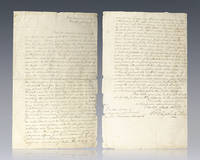
1781réf. 125872April 10 1781. Exceptionally rare autograph letter signed by George Washington as Commander-in-Chief of the Continental Army to French ally Jean-Baptiste Donatien de Vimeur comte de Rochambeau whose military assistance in the Siege of Yorktown essentially ended the Revolutionary War. The body of the letter is entirely in the hand of Alexander Hamilton and dated 10 April 1781. In the spring of 1781 officials from Massachusetts approached Rochambeau with a proposal to attack the British post at the mouth of the Penobscot river which had been established in June 1779 to secure timber for shipyards in Halifax and to protect Nova Scotia from any American advance. On April 6 Rochambeau informed Washington that he was willing to send a detachment of troops and that Admiral Destouches would offer naval assistance but observing that he was under Washington's command he would await his approval before approving the action Rochambeau to Washington 6 April 1781 Papers of George Washington Library of Congress. Washington here responds offering his gratitude that Destouches who had only recently lost a naval engagement with the British in an unsuccessful attempt to relieve Lafayette in Virginia would be willing "to undertake the expedition to Penobscot and to you for your readiness to furnish a detachment of troops for the same purpose. The object is certainly worth attention and if it can be effected will be very agreeable to the States particularly to those of the East." He trusts that Destouches "can best judge from the situation of the enemy's fleet how far it may be attempted with prudence and Your Excellency from the information you have recently received what number of troops will be sufficient for the enterprise--I am persuaded it will be calculated how far it is probable the enemy may follow with a part of their fleet--whether the post can be carried by a coup de main or may require so much time as to make it likely the operation will be interrupted before its conclusion--in case of a superior squadron being sent by the enemy what possibility there is of protection or a safe retreat for the ships and even for the land force through an unsettled country in which numbers perished for want of provision in a former attempt--All these are points too important not to have been well weighed and your conversations with the Massachusetts deputies will have been able to enlighten you upon them." Here he is referencing the unsuccessful attempt by Massachusetts in 1779 to destroy the post abandoned when British ships with reinforcements forced an arduous overland retreat by the Americans. Despite his assurances that Rochambeau and Destouches had matters well in hand Washington took the "liberty to remark on two things--one that it appears to me frigates without any ships of the line will answer the purpose as well as with them and less will be risked than by dividing the body of the fleet. Frigates especially the forty fours will afford a safe escort to the troops against any thing now in those Seas and with respect to a detachment from the enemy's fleet it would be always proportioned to the force we should send and if we have two sixty fours they would even be an object for their whole fleet. The other observation I would make is that dispatch being essential to success it will in my opinion be adviseable not to depend on any cooperation of the Militia but to send at once such a force from your army as you deem completely adequate to a speedy reduction of the post. The country in the neighbourhood of Penobscot is too thinly inhabited to afford any resource of Militia there and to assemble and convey them from remote places would announce your design--retard your operations and give leisure to the enemy to counteract you. Indeed I would recommend for the sake of secrecy to conceal your determination from the State itself." On 15 April Rochambeau replied to Washington observing that while he had sufficient troops to spare "your Excellency's observations upon the Separation of our fleet and upon the danger to be interrupted by superior forces during the course of the Expedition which Mr Destouches does not Look on as possible to be undertaken with his frigates only are the motives which cause this project to be Laid aside for the present moment." Rochambeau to Washington 15 April 1781 Papers of George Washington Library of Congress. Soon Washington and Rochambeau's attention returned again to Virginia and within months their combined forces would be closing in on Yorktown. In near fine condition. Exceptionally rare and desirable being the only communication between the storied commanders of the Yorktown campaign to appear at auction in more than a century. In 1780 French nobleman Jean-Baptiste Donatien de Vimeur comte de Rochambeau was appointed commander of land forces as part of the project code named Expedition Particuliere. He was given the rank of Lieutenant General in command of some 7000 French troops and sent to join the Continental Army under George Washington during the American Revolutionary War. He landed at Newport Rhode Island on 10 July but was held there inactive for a year due to his reluctance to abandon the French fleet blockaded by the British in Narragansett Bay. The College in the Colony of Rhode Island and Providence Plantations now known as Brown University served as an encampment site for some of Rochambeau's troops and the College Edifice was converted into a military hospital now known as University Hall.3 In July 1781 the force left Rhode Island and marched across Connecticut to join Washington on the Hudson River in Mount Kisco New York. Washington and Rochambeau then marched their combined forces to the siege of Yorktown and the Battle of the Chesapeake. On 22 September they combined with the Marquis de Lafayette's troops and forced heavily outnumbered and trapped Lord Cornwallis to surrender on 19 October. The siege of Yorktown was a decisive victory for the American Continental Army and proved to be the last major land battle of the American Revolutionary War in the North American region as the surrender by Cornwallis and the capture of both him and his army prompted the British government to negotiate an end to the conflict and ultimately resulted in the Treaty of Paris of 1783. unknown books
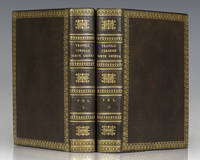
1788réf. 125980New York: Printed and Sold by J. and A. McLean 1788. First edition of The Federalist one of the rarest and most significant books in American political history which "exerted a powerful influence in procuring the adoption of the Federal Constitution." 12 mo two volumes bound in one bound in full contemporary calf rebacked preserving most of original gilt-ruled spine with red morocco label. In very good condition. Housed in a custom half morocco clamshell box. An exceptional example of this landmark book. When Alexander Hamilton invited his fellow New Yorker John Jay and James Madison a Virginian to join him in writing the series of essays published as The Federalist it was to meet the immediate need of convincing the reluctant New York State electorate of the necessity of ratifying the newly proposed Constitution of the United States. The 85 essays under the pseudonym 'Publius' were designed as political propaganda not as a treatise of political philosophy. In spite of this The Federalist survives as one of the new nation's most important contributions to the theory of government" PMM 234. The Federalist "exerted a powerful influence in procuring the adoption of the Federal Constitution not only in New York but in the other states. There is probably no work in so small a compass that contains so much valuable political information. The true principles of a republican form of government are here unfolded with great clearness and simplicity" Church 1230. "A generation passed before it was recognized that these essays by the principal author of the Constitution and its brilliant advocate were the most authoritative interpretation of the Constitution as drafted by the Convention of 1787. As a commentary and exposition of the Constitution the influence of the Federalist has been profound" Grolier American 100 56. Of the only 500 copies published Hamilton is said to have sent nearly 50 copies to Virginia for the ratifying convention. The remaining 450 copies sold poorly and "the publishers complained in October 1788 long after New York had ratified the Constitution that they still had several hundred unsold copies" Maggs 815. Printed and Sold by J. and A. McLean unknown books
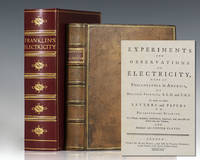
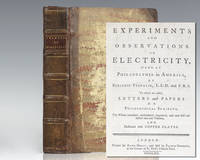
1769réf. 125438London: Printed for David Henry and sold by Francis Newbery 1769. First complete edition of "the most important scientific book of 18th-century America" and "America's first great scientific contribution" PMM. Octavo bound in full contemporary calf with gilt ruling to the spine in six compartments within raised bands red morocco spine label lettered in gilt double gilt ruling to the front and rear panels. With the rarely found half-title. Advertisement & errata leaf bound in following the preface. Illustrated with 7 copper-engraved plates 4 of which are folding. This the fourth first complete and most desirable edition of Franklin's important work contains for the first time complete notes on all of the experiments as well as correspondence between Peter Collinson Franklin and several other collaborators. The earlier editions each issued in three parts as separately published pamphlets usually bound together were carelessly published. Franklin edited this new one-volume edition himself significantly revising the text adding for the first time a number of his own philosophical letters and papers introducing footnotes correcting errors and adding an index Cohen Benjamin Franklin's Experiments. In near fine condition. Expertly rebacked. Housed in a custom full morocco clamshell box. Franklin's most important scientific publication" Experiments and Observations contains detailed accounts of the founding father's crucial kite and key experiment his work with Leiden jars lightning rods and charged clouds Norman 830. "The most dramatic result of Franklin's researches was the proof that lightning is really an electrical phenomenon. Others had made such a suggestion before him-- even Newton himself-- but it was he who provided the experimental proof" PMM. "The lightning experiments caused Franklin's name to become known throughout Europe to the public at large and not merely to men of science. Joseph Priestley in his History of Electricity characterized the experimental discovery that the lightning discharge is an electrical phenomenon as 'the greatest perhaps since the time of Isaac Newton. Franklin's achievement. marked the coming of age of electrical science and the full acceptance of the new field of specialization" DSB. Printed for David Henry and sold by Francis Newbery hardcover books
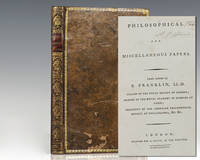
1787réf. 125345London: Printed for C. Dilly in the Poultry 1787. First edition of the last collection of Franklin's writings to appear during his lifetime; a major collection of his political philosophical and scientific writings a second volume of which was planned but never published. First issue with page 25 mispaginated "52." Octavo bound in full contemporary tree calf with elaborate gilt tooling to the spine red morocco spine label lettered in gilt gilt Greek key ruling to the front and rear panels. With four copper-engraved folding plates including diagrams of the Franklin stove and the earliest published map of the Gulf Stream. In very good condition. Armorial bookplate and early ownership inscriptions. Text and plates very clean. Rare. Intended by the publisher as a companion volume to the Experiments and Observations on Electricity 1769 and his Political Miscellaneous and Philosophical Pieces 1779 Franklin's Philosophical and Miscellaneous Papers contains a selection of important political essays including his Remarks concerning the Savages in North America 1784 The letter from Dr. B. Franklin to Benjamin Vaughan. of Privateering 1785 and Information to those who would remove to America 1784 which is "one of the clearest expressions of his belief that American society should be based on the virtues of the middle. classes" Isaacson 423. Also highly notable is Internal State of America his sharply optimistic postwar reply to "complaints of hard times in the American press. with an equally sharp consciousness of British propaganda" Crane William and Mary Quarterly XV:2 218. This volume additionally contains three major scientific writings: Description of a New Stove for the burning of Pitcoal 1785 Letter from Dr. B. Franklin to Dr. Ingenhausz On the Causes and Cure of Smoky Chimneys 1785 and Letter from Dr. Benjamin Franklin. containing sundry Maritime Observations 1785. Merging his political and scientific interests Franklin used Maritime's study of the sea and Gulf Stream to "proclaim the virtues of his nation and its people." This inspired others to also "think of the Gulf Stream in political terms. In 1790 Thomas Paine declared the French Revolution 'as fixed as the Gulf Stream' and Jonathan Williams claimed the current's waters were as distinct as 'the colors of red white and blue'" Chaplin 320-25. Printed for C. Dilly, in the Poultry unknown books
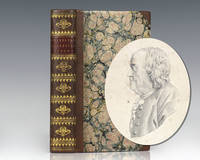
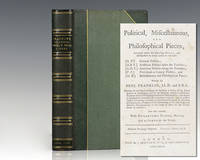
1779réf. 125035London: Printed for J. Johnson 1779. First edition of "the only edition of Franklin's writings other than his scientific printed during his lifetime" Ford. Octavo bound half diced calf over marbled boards with elaborate gilt tooling to the spine red morocco spine label lettered in gilt. With the engraved frontispiece portrait of Franklin three engraved plates one folding and folding table of the reformed alphabet. In near fine condition. Complete with index addenda and corrigenda. An exceptional example. "The only edition of Franklin's writings other than his scientific which was printed during his lifetime; was done with Franklin's knowledge and consent and contains an 'errata' made by him for it" Ford 342. Edited by his close friend Benjamin Vaughan and published in London while Franklin was serving as America's ambassador this seminal collection contains many of his writings on the rebellious American colonies and incendiary British measures such as the Stamp Act. Of particular interest is The Examination of Dr. Benjamin Franklin 255-301 a record of his 1766 appearance before Parliament. In Franklin's answers to the over 150 questions posed him in an afternoon of "highly charged testimony he would turn himself into the foremost spokesman for the American cause" Isaacson. Printed for J. Johnson hardcover books
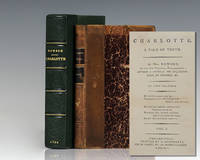
1794réf. 125183Philadelphia: Printed by D. Humphreys for M. Carey 1794. Exceedingly rare first American edition and the earliest obtainable example of the first American bestseller. Octavo two volumes bound into one in three quarter calf over marbled boards morocco spine label lettered in gilt marbled endpapers. Although it was preceded by the first English edition published in 1791 no examples of the first English edition have been traced at auction. In very good condition. Bookplate to the pastedown bibliographic description tipped in. Housed in a custom cloth chemise and half morocco clamshell slipcase. Exceedingly rare with only one other example of the first American edition traced at auction in the last 75 years. Susana Rowson's best-selling novel Charlotte Temple relates the tale of 15-year-old English schoolgirl Charlotte Temple who is lured away from her prestigious boarding school by British army officer John Montraville. While en route to New York Montraville seduces Charlotte who he swiftly abandons upon arrival to his post and after a downward spiral into remorse illness poverty and the birth of a child she dies. Seduction novels were popular in the 18th century and the widely read Charlotte Temple went through more than 200 editions. Rowson a committed republican used the success of the novel to protest the sexual double standard that ruined the lives of women like Charlotte. Later in life she wrote a sequel that was published posthumously. Printed by D. Humphreys for M. Carey hardcover books
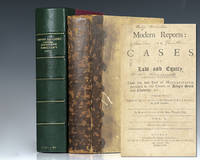
1769réf. 125709London: Printed by His Majesty's Law Printers 1769. Alexander Hamilton's copy of the tenth volume of Lucas's Modern Reports. Folio bound in one quarter contemporary calf over paper-covered boards. Signed by Alexander Hamilton and his son Philip Hamilton on the title page. In very good condition. Housed in a custom cloth chemise and half morocco slipcase. Rare and desirable books from Hamilton's library seldom appear on the market. The first treasury secretary of the United States and one of America's founding fathers Alexander Hamilton founded the nation's financial system the Federalist Party the United States Coast Guard and the New York Post newspaper. He was the main author of the economic policies of George Washington's administration and as Secretary of the Treasury established a national bank system of tariffs and trade relations with Great Britain. After the American Revolutionary War Hamilton resigned his seat in the Congress of the Confederation to practice law which he returned to in 1795 and was active in ending the legality of the international slave trade. Printed by His Majesty's Law Printers hardcover books
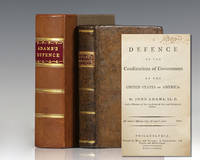
1787réf. 125308Philadelphia: Printed for Hall and Sellers; J. Cruikshank; and Young and McCulloch 1787. First edition of John Adams's greatest contribution to American political theory; from the library of one of the 39 signers of the United States Constitution Founding Father Gunning Bedford Jr. Octavo bound in full contemporary tree calf with gilt ruling to the spine red morocco spine label lettered in gilt gilt turn-ins. Signed by Gunning Bedford Jr. on the title page. Born in Philadelphia in 1747 Gunning Bedford attended the College of New Jersey where he was a classmate of James Madison and later served in the Continental Army as an aide to General George Washington. After the Revolutionary war he became a prominent political figure sitting in the legislature on the state council and in the Continental Congress 1783-85. One of the more active members of the Constitutional Convention on May 14 1787 he was one of the 39 delegates that signed the Constitution of the United States. Gunning Bedford also served as Attorney General of Delaware from 1784 until he was designated by George Washington as a federal district judge for his state in 1789 a position he held for the rest of his life. In near fine condition. Housed in a custom half morocco and chemise case. An exceptional example with fine provenance. Adams wrote this work on constitutional theory while serving as Minister to the Court of St. James as a response to liberal French statesman Turgot who had criticized the new American state constitutions for their conservative economic framework. Adams's Defence was often cited in the debates of the Constitutional Convention. "A work marked by insight breadth of views conviction courage and--we may venture to add--much wisdom" Larned Literature of American History 2287. At the start of 1787 while minister to Great Britain and a year before he returned to America John Adams "felt an urgency like that of 1776. Great events were taking place at home. Support for a stronger central government was gaining ground. A constitutional convention was in the offing and as he had been impelled in 1776 to write his Thoughts on Government so Adams plunged ahead. books piled about him his pen scratching away until all hours. By early January 1787 Adams had rushed the first installment of his effort to a London printer. Titled A Defence of the Constitutions of Government of the United States of America. copies were sent off at once to the United States and to Jefferson in Paris" McCullough John Adams 374. Of the Defence Thomas Jefferson wrote to Adams "I have read your book with infinite satisfaction and improvement. It will do great good in America. Its learning and its good sense will I hope make it an institute for our politicians old as well as young" Sowerby 3004. "From Philadelphia where the Constitutional Convention had assembled Benjamin Rush a member of the Convention wrote that the Defence had 'diffused such excellent principles among us that there is little doubt of our adopting a vigorous and compound federal legislature. To a considerable extent Adams' Defence was an expanded more erudite rendition of the case for checks and balances in government that he had championed in his Thoughts on Government 1776 and later put into operation in his draft of the Massachusetts constitution" McCullough 375. "The work did much to familiarize the European mind to the novel state of things then taking place in America" Sabin 236. This volume was issued as a stand-alone work and was followed by two supplemental volumes the following year Sabin 234. Printed for Hall and Sellers; J. Cruikshank; and Young and McCulloch unknown books
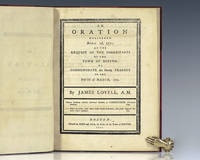
1771réf. 125360Boston: Printed by Edes and Gill by the Order of the Town of Boston 1771. First edition of the first Boston Massacre oration; a classic of the Revolutionary period. Octavo bound in three quarter morocco morocco spine label lettered in gilt. In near fine condition. American Antiquarian Society stamp to the half-title page. Rare. On March 5 1770 British Captain Preston and eight British soldiers brought to trial on the charge of murdering five Bostonians that evening were defended by young lawyer John Adams later Vice-President and President of the United States assisted by Josiah Quincy Jr. This unpopular defense Adams rightly regarded as "one of the most gallant generous manly and disinterested actions of his whole life." In observance of the first anniversary of the tragedy though not until April 2 1771 was delivered the first of a series of annual patriotic speeches known as "the Boston Massacre Orations." These speeches were contemporaneously printed. John Adams later wrote: "These orations were read I had almost said by everybody that could read and scarcely ever with dry eyes. They have now been continued for forty-five years. Adams counted in the annual Fourth of July Orations which began in Boston in 1783. Will you read them all They were not long continued in their original design; but other gentlemen with other views had influence enough to obtain a change from 'standing armies' to 'feelings which produced the Revolution'. Of these forty-five orations I have read as many as I have seen. They have varied with all the changes of our politics. They have been made the engine of bringing forward to public notice young gentlemen of promising genius whose connections and sentiments were tolerable to the prevailing opinions of the moment." Lovell a Boston schoolmaster was one of the staunchest of the local patriots. After the Battle of Bunker Hill he was arrested by the British for spying and was sent a prisoner to Halifax. Following his exchange he became a member of the Continental Congress 1777 where he was a supporter of Gates and one of the harshest critics of Washington. How active a part he played in the Conway Cabal against Washington is not known but he certainly approved it. Printed by Edes and Gill, by the Order of the Town of Boston unknown books
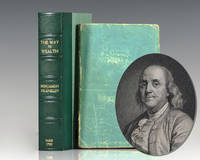
1795réf. 125491Paris: Printed for Ant. Aug. Renouard Antoine-Augustin Renouard 1795. Renouard's scarce bi-lingual edition of Franklin's popular collection of aphorisms. Octavo bound in contemporary wrappers frontispiece portrait of Franklin engraved by Alexandre Tardieu after Duplessis' painting. The Way to Wealth was first published as the preface to Poor Richard's Almanack of 1758 the last of the almanacs written by Franklin himself under the title "Father Abraham's Speech." Revered for the elegance of its printing this bi-lingual edition also includes Franklin's private letter to Madame Passy along with "Dialogue entre la goutte et Franklin" the poem "Le Sage et la goutte" and the essays "Quelques mots sur l'Amerique avis a ceux qui voudroient aller s'etablir dans cette contree" and the separately paginated "Observations sur les Sauvages du Nord de l'Amerique" which is noted by Ford to be present in only a few copies. Sabin 25596; Ford 107. In near fine condition. Exceptionally clean internally. Housed in a custom chemise slipcase within a half morocco clamshell box. A beautiful example rare in wrappers. This pithy collection of the most clever sayings garnered from the run of Poor Richard's Almanack was first printed as a separate edition by Franklin's nephew Benjamin Mecom of Boston in March of 1758. By the late 18th century the work had attained great popularity not only in American but in London and Pairs. Renouard's The Way to Wealth was revered not only as the first bi-lingual edition but for the elegance of its printing; emphasizing the tremendous esteem Franklin had earned during the years he dwelt among the French to whom his words of wisdom symbolized the freedom embodied in the newly-founded American republic of no small significance in the wake of their own revolution. Printed for Ant. Aug. Renouard [Antoine-Augustin Renouard] unknown books
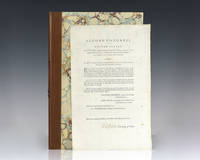
1792réf. 125388Philadelphia: Childs & Swaine 1792. Scarce printing of an early United States law providing for the funding of the national debt signed by Thomas Jefferson as Secretary of State. Folio one page. The document which also carries the printed signatures of President George Washington Vice President John Adams and House Speaker Jonathan Trumbull was approved January 23 1792. Individual acts and bills of the first Congresses were routinely printed for public consumption. A provision was made however to print a few copies of each act for dissemination to the states and to have each copy signed by Secretary of State Thomas Jefferson. One of the main priorities of the federal government in the early national period was to pay down the debt of the United States. The national debt was incurred during the Revolution and augmented in 1790 when the Congress passed the Assumption Act in accordance with a plan devised by Alexander Hamilton. Because contacting the numerous and geographically dispersed holders of the debt proved more difficult than expected it became necessary to extend the time allowed by law for making the relevant financial arrangements. The present act accomplished this and made a special extension of five months for Vermont which gave the new state time to calculate the amount of debt. Despite Jefferson's vehement opposition to Hamilton's plan when it was formulated his position as Secretary of State necessitated his signature on the presentation copies of the acts that effected it. In fine condition. Housed in a custom half morocco folding case. Scarce with only one other example signed by Jefferson located. American Founding Father Thomas Jefferson was the principal author of the Declaration of Independence and later served as the third President of the United States from 1801 to 1809. Prior to his presidency he was elected the second Vice President of the United States serving under John Adams from 1797 to 1801. A proponent of democracy republicanism and individual rights motivating American colonists to break from Great Britain and form a new nation he produced formative documents and decisions at both the state and national level. Jefferson was an avid bibliophile and by the end of his life had amassed a large library and wine collection. Childs & Swaine unknown books
1800réf. 125043Boston: From the Printing-Office of Manning & Loring 1800. First edition of Hall's famed speech tracing the history of the American Revolution. Octavo bound in paper-covered boards original wrapper bound in at rear. Presentation copy inscribed by the author on the title page "Ephraim Williams Esq. from his friend J. Hall." In very good condition. Housed in a custom cloth chemise and half morocco slipcase. Exceedingly rare. Born in Methuen Massachusetts Josesph Hall moved to Camden Maine in 1809 and engaged in mercantile pursuits. In 1814 during the War of 1812 he served as ensign in Colonel Forte's regiment Massachusetts Militia and was subsequently appointed colonel. He was appointed deputy sheriff in 1821 became sheriff in 1827 and was appointed postmaster of Camden 1830-1833. He was elected as a Jacksonian Democrat to the Twenty-third and Twenty-fourth Congresses March 4 1833 - March 3 1837 and was chairman of the Committee on Expenditures in the Navy Department in both congresses. He was an unsuccessful candidate for Mayor of Boston in 1849. From the Printing-Office of Manning & Loring hardcover books
1779réf. 125950London: Printed for J. Johnson 1779. First edition of "the only edition of Franklin's writings other than his scientific printed during his lifetime" Ford. Octavo bound in three quarters leather gilt titles to the spine raised bands. With the engraved frontispiece portrait of Franklin three engraved plates one folding and folding table of the reformed alphabet. In near fine condition. Complete with index addenda and corrigenda. A very nice example. "The only edition of Franklin's writings other than his scientific which was printed during his lifetime; was done with Franklin's knowledge and consent and contains an 'errata' made by him for it" Ford 342. Edited by his close friend Benjamin Vaughan and published in London while Franklin was serving as America's ambassador this seminal collection contains many of his writings on the rebellious American colonies and incendiary British measures such as the Stamp Act. Of particular interest is The Examination of Dr. Benjamin Franklin 255-301 a record of his 1766 appearance before Parliament. In Franklin's answers to the over 150 questions posed him in an afternoon of "highly charged testimony he would turn himself into the foremost spokesman for the American cause" Isaacson. Printed for J. Johnson hardcover books
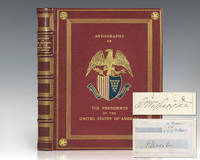
1783réf. 1253841783-1956. Elaborately bound collection of Presidential autographs containing the autograph of each of the first 34 Presidents of the United States from George Washington to Dwight D. Eisenhower. Quarto bound in full red morocco by Riviere & Son with gilt titles and ruling to the spine in six compartments within raised gilt bands gilt presidential seal to the front panel with white and blue morocco onlays gilt arms and motto of George Washington to the rear panel with white and blue morocco onlays and his gilt signature in facsimile centerpieces within quintuple gilt ruling with star emblems at each corner blue morocco doublures with multiple gilt presidential signatures blue silk endpapers. This complete series of autographs of the first 34 Presidents of the United States contains the signature of each mounted on an album leaf opposite a loosely tissue-guarded engraved portrait of each. The collection includes: the signature of George Washington on an envelope addressed to Major General Knox as Secretary of the Society of the Cincinnati November 3 1783; a clipped signature of John Adams; clipped signature of Thomas Jefferson; the signature of James Madison on an envelope addressed to Reverend Frederick Freeman of Manayunk Pennsylvania; and inscription signed by James Monroe; the signature of John Quincy Adams on an envelope addressed to William Plumer jun. Esq. in Epping New Hampshire; a partially printed land grant signed by Andrew Jackson dated 1831 registering the purchase of 20 acres in Detroit by Peter Aldrich; clipped signature of Martin Van Buren; clipped signature of William Henry Harrison; signed inscription from John Tyler; signed inscription from James Polk; clipped signature of Zachary Taylor dated Baton Rouge March 5 1841; clipped signature of Millard Fillmore; clipped signature of Franklin Pierce; clipped signature of James Buchanan on a document dated July 18 1858; clipped signature of Abraham Lincoln; endorsement signed by Andrew Johnson as President; clipped signature of Ulysses S. Grant; card signed by Rutherford B. Hayes; inscription signed by James Garfield; large card signed by Chester A. Arthur and dated May 22 1884; autograph noted signed by Grover Cleveland declining an invitation dated November 16 1890; an Executive Mansion card signed by William McKinely; clipped signature of Theodore Roosevelt; clipped signature of William Howard Taft; clipped signature of Woodrow Wilson; typed letter signed by Warren G. Harding as President dated June 4 1923 on White House letterhead; card signed by Calvin Coolidge; White House card signed by Herbert Hoover; typed letter signed by Franklin D. Roosevelt as Assistant Secretary of the Navy February 15 1917. Laid in is a typed letter signed by Harry S. Truman as President June 30 1950 on White House stationery and a typed letter signed by Dwight Eisenhower. TLS as President November 13 1956 on White House stationery. In fine condition. Housed in a custom folding chemise and half morocco slipcase. An exceptional collection and presentation. unknown books
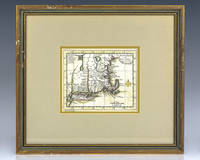
1703réf. 123177London: Seller Price & Senex 1703. Rare 17th century John Seller map of New England and New York from Daniel Fenning's A New System of Geography. One page with intricate topographical details and hand-colored borders the map displays the eastern portion of New York and New England and includes Long Island Martha's Vineyard Nantucket Block Island and Rhode Island. In near fine condition. Seventeenth century English cartographer compass maker and map seller John Seller was appointed hydrographer to the King in March of 1671. In that year he published his first volume of charts and sailing directions The English Pilot which would run through many editions until the end of the eighteenth century. The trade in maritime maps and charts had until then been dominated by the Dutch. Seller additionally published several textbooks and nautical almanacs including Practical Navigation 1669 and A Pocket Book Containing Several Choice Collections in Arithmetic Geometry Surveying Dialing &c. 1677. Seller, Price & Senex unknown books
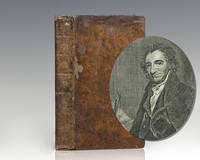
1792réf. 122960London: H. D. Symonds J. S. Jordan J. Ridgway et al 1792-1793. Sammelband collection of early printings of the treatises of Thomas Paine. Octavo bound in full contemporary tree calf with gilt tooling to the spine engraved frontispiece portrait of Paine. The collection includes: Rights of Man: Being an Answer to Mr. Burke's Attack on the French Revolution Part I London: Printed for H. D. Symonds 1792; Rights of Man Part the Second. Concerning Principle and Practice London: Printed for J. S. Jordan 1792; Letter Addressed to the Addressers on the Late Proclamation London: Printed for H. D. Symonds 1792; Dissertations on First Principles of Government London: Printed for the Proprietors; Common Sense; Addressed to the Inhabitants of America London: Printed for H. D. Symonds 1793; A Letter Addressed to the Abbe Raynal on the Affairs of North America London: Printed for J. Ridgeway 1712 1792; Miscellaneous Articles of Thomas Paine London: Printed for J. Ridgway 1793. In very good condition. One of the founding fathers of the United States Thomas Paine authored two of the most influential pamphlets at the start of the American Revolution which ultimately inspired the 1776 Declaration of Independence. Virtually every American rebel read Paine's powerful pamphlet Common Sense which crystallized the American Revolution and demand for independence from Britain. John Adams asserted "without the pen of the author of Common Sense the sword of Washington would have been raised in vain." H. D. Symonds, J. S. Jordan, J. Ridgway et al unknown books
1746réf. 1204971746. Rare 18th century Homann Heirs map of the Western Hemisphere. One page the map depicts in detail North and South America as well as western portions of Europe and Africa with a large decorative cartouche. Homann's second map of the Western Hemisphere the present map provided new details in the interior of North America particularly along the Mississippi River. At the time of publication the Northwest coast of America and the Northwest Passage were still undiscovered. Matted and framed. The entire piece measures 31.25 inches by 29.25 inches. In fine condition. German engraver and publisher Johann Baptist Homann and his family were the most famous German map publishers of the mid-18th century. Following Homann's death in 1724 the business continued under the name Homann Heirs with their most recognizable maps being the present Americae Mappa generalis and the Mappe Monde Planiglobii Terrestris. unknown books
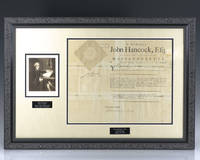
1787réf. 1196771787. Rare document signed by John Hancock Governor of Massachusetts. Boldly signed "John Hancock" on the upper left corner. Hancock's signature is an exceptional example. Countersigned by Secretary of the Commonwealth John Avery Jr. as "John Avery jun Secy" at center bottom. Featuring a large paper seal showing a gorgeous impression of the Massachusetts state seal in the upper left corner. Massachusetts Governor Hancock appointed one "Joseph Green Gentleman" as "Captain of the thirteenth company in the second Regiment and in the Ninth Division of the Militia of this Commonwealth comprehending the County of Berkshire." Matted and displayed to the right of a G. Barrie & Sons print of Hancock after the original painting by John Singleton Copley with accompanying engraved name plates. Not examined out of the frame. The size of the document is 15.5 inches by 12.5 inches. Matted and framed. The entire piece measures 28.5 inches by 19.75 inches. Rare and desirable. John Hancock was an American merchant statesman and prominent Patriot of the American Revolution. He served as president of the Second Continental Congress and was the first and third Governor of the Commonwealth of Massachusetts. He is remembered for his large and stylish signature on the United States Declaration of Independence so much so that the term "John Hancock" has become in the United States a synonym for a signature. Before the American Revolution Hancock was one of the wealthiest men in the Thirteen Colonies having inherited a profitable mercantile business from his uncle. Hancock began his political career in Boston as a protege of Samuel Adams an influential local politician though the two men later became estranged. As tensions between colonists and Great Britain increased in the 1760s Hancock used his wealth to support the colonial cause. He became very popular in Massachusetts especially after British officials seized his sloop Liberty in 1768 and charged him with smuggling. Although the charges against Hancock were eventually dropped he has often been described as a smuggler in historical accounts but the accuracy of this characterization has been questioned. Hancock was one of Boston's leaders during the crisis that led to the outbreak of the American Revolutionary War in 1775. He served more than two years in the Continental Congress in Philadelphia and as president of Congress was the first to sign the Declaration of Independence. Hancock returned to Massachusetts and was elected governor of the Commonwealth serving in that role for most of his remaining years. He used his influence to ensure that Massachusetts ratified the United States Constitution in 1788. unknown books
1800réf. 1177911800. Rare autograph letter signed by and entirely in the hand of American Founding Father John Jay as Governor of New York to Theophilus Parsons. One page folded the letter reads in full "Albany 1 July 1800 Sir On my return from New York on Friday last your obliging letter of the 5th of May which arrived during my absence was delivered to me. I am much gratified by the Information it contains & thank you for it as serious apprehensions were entertained that anti-federalism had gained considerable ground in Massachusetts; but I am happy to find. that appearances do not warrant the conclusions which have been drawn from them. The present aspect of our affairs is far from being agreeable - altho'. having abundant Reason for Content & Gratitude our nation is permitting their happiness to be part in Jeopardy by their worst passions inflamed and directed by the most reprehensible means. Whether the good Sense of the People will avert the Dangers which threaten them is not to be seen. but unfortunately their is too little unanimity on many points and the want of it exposes is to the Hazard of many Evils - It really appears to me that the. of our Envoys to France has been treated with too much asperity. The President declared to the congress that he would never send another Legation to Paris. as that declaration seems to imply that when he should receive such appearances he would again send Envoys. It was not unnatural that he should conceive himself bound in Honor to do so. Whether that Declaration was advisable and whether the nomination of the Envoys was made exactly in Reason are questions which like other of the same kind may receive different answers from different men. But having nominated the Envoys and received the requisite appearances I for my part consider the sending them as a Matter of Course; and do not concern in opinion with those Gentlemen who think they should nevertheless have been detained. I regret that my absence deprived me of the pleasure of seeing the Rev. Mr. Andrews all the more so as he would have answered my inquiries respecting many of my friends at Boston and informed me of you Health - With the best wishes that you may now and ever enjoy that valuable Blessing. I am Sir your most obt. sevt. John Jay. Theop Parsons Esq." The recipient Theophilus Parsons was a member of the state constitutional convention of 1779-1780 and one of the committee of twenty-six who drafted the constitution. He was also a delegate to the state convention of 1788 which ratified the Federal Constitution. His Commentaries on the Laws of the United States 1836 contains some of his more important legal opinions. In the present letter Jay refers to President John Adams' failed mission in 1797 to make negotiations with France following the French Revolution which the Federalists viewed as the cause of the undeclared naval war fought from 1798 to 1800 between the United States and France. Anti-federalists and many contemporary historians however view the 1794 Jay Treaty as the initial cause of hostilities between France and America. In near fine condition. Rare and desirable. American statesman and Founding Father John Jay directed U.S. foreign policy for much of the 1780s and was an important leader of the Federalist Party after the ratification of the United States Constitution in 1788. Jay was a negotiator and signor of the 1783 Treaty of Paris which ended the American Revolution and co-authored perhaps the most famous and influential American political work the Federalist Papers along with Alexander Hamilton and James Madison. After the establishment of the new federal government Jay was appointed by President George Washington the first Chief Justice of the United States serving from 1789 to 1795. Jay served as the Governor of New York from 1795 to 1801. Long an opponent of slavery he helped enact a law that provided for the gradual emancipation of slaves and the institution of slavery was abolished in New York in Jay's lifetime. unknown books
1769réf. 116750London: Printed for David Henry and sold by Francis Newbery 1769. First complete edition of "the most important scientific book of 18th-century America" and "America's first great scientific contribution" PMM. Octavo bound in contemporary half calf over marbled boards morocco spine label. Advertisement & errata leaf inserted following preface. Illustrated with 7 copper-engraved plates 2 of which are folding. In very good condition. First editions are rare exceptionally so in a contemporary binding. Franklin's most important scientific publication" Experiments and Observations contains detailed accounts of the founding father's crucial kite and key experiment his work with Leiden jars lightning rods and charged clouds Norman 830. "The most dramatic result of Franklin's researches was the proof that lightning is really an electrical phenomenon. Others had made such a suggestion before him-- even Newton himself-- but it was he who provided the experimental proof" PMM. "The lightning experiments caused Franklin's name to become known throughout Europe to the public at large and not merely to men of science. Joseph Priestley in his History of Electricity characterized the experimental discovery that the lightning discharge is an electrical phenomenon as 'the greatest perhaps since the time of Isaac Newton. Franklin's achievement. marked the coming of age of electrical science and the full acceptance of the new field of specialization" DSB. Printed for David Henry and sold by Francis Newbery hardcover books
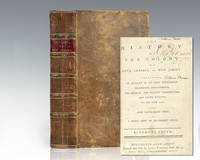
1765réf. 115584Burlington New-Jersey: James Parker 1765. First edition of the first published historical account of the state of New Jersey; one of only 600 copies printed by James Parker on a press owned by Benjamin Franklin. Octavo bound in full contemporary calf with a red morocco spine label lettered in gilt and raised bands to the spine. In very good condition. From the library of George and Rebecca Burr with their ownership names to the title page and front free endpaper and later their grand-nephew Alfred Burr with his bookplate to the pastedown. In very good condition. One of the rarest and most valuable of the Jerseyana group Smith's history was published in 1765 at Burlington by James Parker who had moved his printing press temporarily from Woodbridge for the purpose. David Hall of Philadelphia whose name appears on the title page sold the book at his shop. A century later a second edition was published containing a brief sketch of its author and a map engraved by William Faden London 1777. The original edition had no map. A third edition of the history was printed by the state of New Jersey and distributed to the schools and elsewhere in 1893. Samuel Smith was born of Quaker patronage at Burlington in 1720. He held important official positions in the province and in addition to writing his history of New Jersey he prepared material for a history of Pennsylvania which was never published. James Parker hardcover books
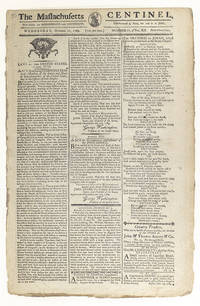
1789réf. 116337Boston: Russell Benjamin October 21 1789. Number II of Vol. XII of "the most influential and enterprising paper in Massachusetts after the Revolution" Benjamin Russell's Massachusetts Centinel issued on Wednesday October 21 1789 Hudson 147. Folio one page folded. The issue includes front-page articles on recently enacted acts allowing compensation for Members of the Senate and House of Representatives and the temporary establishment of the Post-Office and appointment of a Post-Master General both approved by Speaker of the House Frederick Augustus Muhlenburg President George Washington and Vice President John Adams on September 22nd 1789. The issue also includes sections on Foreign Intelligence News From France and advertisements for John & Thomas Armory & Co. Mr. Lewis Hayt's Auction-Room the Boston Book Store Joshua Thomas' Books and Stationary lost and found ads listings for ships and houses for rent a daily almanac. In near fine condition. Rare and desirable. The Massachusetts Centinel was published in Boston on Wednesdays and Saturdays by Benjamin Russell between 1761 and 1845. Russell a native of Boston had been apprenticed to Isaiah Thomas one of the most influential late eighteenth-century American printers and founder of the American Antiquarian Society. The paper was "the most influential and enterprising paper in Massachusetts after the Revolution" Hudson 147. In 1828 Russell sold the Centinel to Joseph T. Adams and Thomas Hudson and in 1840 the Centinel merged with a number of other Boston papers to form the Boston Semi-weekly Advertiser which eventually became the Boston Herald. Russell, Benjamin unknown books
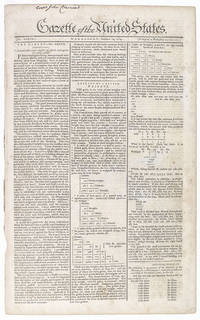
1789réf. 116518New York: John Fenno Wednesday August 19 1789. Rare original printing of the Gazette of the United States issued during the presidency of George Washington on August 19 1789. Folio one page folded this issue includes a the following articles many continued from previous issues: Extract of a Letter on Weights The Bow By Express From Paris and Sketches of the Proceedings of Congress in the House of the Representatives of the United States an Act for the Establishment of Lighthouses Beacons Buoys and Public Piers approved by George Washington as President of the United States and the obituary of George Washington Knox. In very good condition with a closed tear to the rear panel and ownership signature. First issued on April 15 1789 the Gazette of the United States was an early American partisan biweekly publication friendly to the administration of George Washington and to the policies and members of the emerging Federalist Party. The Gazette played a notable role in the development of political parties and early partisanship. It also played a leading role in inspiring the creation of its rival paper the National Gazette which was founded at the urging of anti-Federalist leaders Thomas Jefferson and James Madison as a vehicle for their party's own political self-promotion and polemics John Fenno unknown books
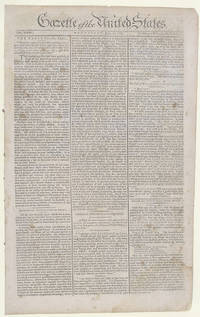
1789réf. 116728New York: John Fenno July 29 1789. Rare original printing of the Gazette of the United States issued during the presidency of George Washington on July 29 1789. Folio one page folded this issue includes a the following articles many continued from previous issues: Sketch of the Political State of America Original Specimens of Eloquence Foreign and Domestic Miscellaneous Articles and Sketches of Proceedings of Congress approved by G. Washington President of the United States. In near fine condition. First issued on April 15 1789 the Gazette of the United States was an early American partisan biweekly publication friendly to the administration of George Washington and to the policies and members of the emerging Federalist Party. The Gazette played a notable role in the development of political parties and early partisanship. It also played a leading role in inspiring the creation of its rival paper the National Gazette which was founded at the urging of anti-Federalist leaders Thomas Jefferson and James Madison as a vehicle for their party's own political self-promotion and polemics. John Fenno unknown books
1799réf. 112450London: For R. Phillips by T. Davison 1799. First edition in English of "an original source of the first class for American history at the close of the 18th century" Larned. Quarto bound in full calf gilt titles and tooling to the spine raised bands gilt tooling to the front and rear panels marbled endpapers with three engraved folding maps of North America and six folding tables. In near fine condition. An exceptional example of this landmark work. First editions are rare. "The observations of this distinguished author made during a three years' residence extend to the political constitution of the country the manners etc. of the inhabitants its physical state and natural history. The translator appears to have executed his task faithfully and to be well acquainted with the country described. His notes frequently increase the information and sometimes correct the errors of the original" Sabin. The work became a standard source book for the history of America at the close of the 18th century. An exiled French nobleman the Duke traveled in all the Eastern states in the Great Lakes region and Upper Canada visiting many towns from Maine to Georgia and making the acquaintance of people of all classes. He was especially interested in economics but had much to say about the Indian tribes natural history and social and religious communities Shakers Dunkers etc. For R. Phillips by T. Davison hardcover books