306 resultados
ref. SKU1020361Artia Records. Very Good. LP is in very good condition like new. Album cover worn around edges. Font jacket discolored. Sleeve has split seam. Artia Records unknown
1963ref. 439610Margate : W.J. Parre 1963. Facsimile Edition. Hardcover. Near fine copy in the original gilt-blocked cloth. Slightest suggestion only of dust-dulling to the spine bands and panel edges. Remains particularly well-preserved overall; tight bright clean and strong. Physical description; ill. ; 28 cm. Subjects; Freemasons England ; Periodicals. Freemasonry History ; Periodicals. Margate : W.J. Parre hardcover
1999ref. 27870ECM New Series, 1999. ECM 1694 CD CD
ref. 2090202120406337Wergo N.A. Soft Cover. Fine. Number of books: 1 Wergo paperback
ref. 2090202120407525Wergo N.A. Soft Cover. Fine. Number of books: 1 Wergo paperback
1991ref. 28113Disques Montaigne, 1991. 789007 1 CD CD
1995ref. 250817036Bayer 1995-03-24. audioCD. Used: Very Good. 6x5x1. Very good condition. From a private collection. Comes from non smoking home. Bayer unknown
1970ref. biblio38708Bibliotheca Scriptorum Graecorum Et Romanorum Teubneriana TEUBNER; Vol. 2. B. G. Teubner 1970. Fine Hardcover. DarkSlateBlue cloth Black lettering. 8.1"x5.7". be35201. B. G. Teubner hardcover
1982ref. 41855Deutsche Grammophon, 1982. 447920-2 CD audioCD
2014ref. ovscd166xDeutsche Grammophon 2014. audioCD. Like New. 8x8x5. Brand New Box Set factory sealed in original shrink wrap. Deutsche Grammophon unknown
1997ref. 2259180703041EMI Classics 1997-08-12. Audio CD. Like New. CD plays perfectly & the case looks good. EMI Classics unknown
ref. 033145307X.Gpaperback. Good. Access codes and supplements are not guaranteed with used items. May be an ex-library book. paperback
1572ref. 61735Ingolstadt, Alexander Weißenhorn, 1572. 4°. Titel verso m. großer Holzschn.-Vignetten. 8 nn. Bll., Heftstreifen.
1720ref. 39437Neapel (Neapoli), Typis, & expensis Dominici-Antonii, & Nicolai Parrino, 1720. Fol. Titeln in Rot u. Schwarz m. Holzschn.-Vignetten. Mit einer gest. Vignette u. einigen Holzschn.-Vignetten bzw. -Initialen. 10 Bll., 192; 387 S., 11 Bll.; 2 Bll., 151 S.; 1 Bl., 272; 241 (recte 341) S., Pgmt.-Bde. d. Zt. a. 6 Bünden m. handschriftl. Rückentiteln u. dreiseitig gespränkeltem Farbschnitt.
1778ref. 39468Venedig, suptibus Societatis, 1777-1778. 4°. Mit einigen Holzschn.-Vignetten bzw. -Initialen. Zus. ca. 2420 S., Pgmt.-Bde. d. Zt. m. durchzogenen Bünden, handschriftl. Rückentiteln u. dreiseitig marmor. Schnitt.
1960ref. 159905N.p.: N.p. 1960. Vintage oversize photograph of the wildly influential jazz group The Dave Brubeck Quartet featuring the classic lineup of pianist Dave Brubeck saxophonist Paul Desmond bassist Eugene Wright and drummer Joe Morello. 14 x 11 inches. Very Good plus lightly age toned with faint foxing on the left and right edges and a small piece of cello tape affixed to the center top edge. N.p. unknown books
ref. 3734764Selma Alabama n.p. ca. 1950s. Promotional display placard. Half tone illustration. Heavy staining and waviness; poor condition. Despite its poor condition this heavy cardstock photograph remains a rare image of an obscure Selma Alabama gospel quartet. Little information seems to be known about the Pilgrim Four. The image shows seven young men possibly an earlier iteration or precursor to a later group of the same name that included Bettie Mae Fikes known as “the Voice of Selma.” Fikes used her powerful voice in Civil Rights marches and participated in Bloody Sunday. unknown
1926ref. 163712N.p.: N.p. 1926. Vintage double weight photograph of the Mischa Elman String Quartet circa 1926. Annotations in manuscript ink on the verso noting the quartet's performance at the Metropolitan likely the Metropolitan Opera House along with a 1926 date stamp. Russian-American violin virtuoso Mischa Elman was born in Talnoye in the Russian Empire in 1891. Having revealed his perfect pitch and prodigious skill at the violin at a young age Elman studied at the Imperial Academy of Music then the St. Petersburg Conservatory and made his London debut in 1905. He moved to the US upon the outbreak of World War I and became an American citizen in 1923 recording and touring extensively throughout the country over the ensuing six decades. 8 x 10 inches. Very Good plus slightly wavy at the top left and right edges. N.p. unknown books
1926ref. 163712N.p.: N.p. 1926. Vintage double weight photograph of the Mischa Elman String Quartet circa 1926. Annotations in manuscript ink on the verso noting the quartet's performance at the Metropolitan likely the Metropolitan Opera House along with a 1926 date stamp. Russian-American violin virtuoso Mischa Elman was born in Talnoye in the Russian Empire in 1891. Having revealed his perfect pitch and prodigious skill at the violin at a young age Elman studied at the Imperial Academy of Music then the St. Petersburg Conservatory and made his London debut in 1905. He moved to the US upon the outbreak of World War I and became an American citizen in 1923 recording and touring extensively throughout the country over the ensuing six decades. 8 x 10 inches. Very Good plus slightly wavy at the top left and right edges. N.p. unknown
1951ref. 155677N.p.: N.p. 1951. Collection of 35 small format vernacular photographs of members of the Cecil Young Quartet including three of Sarah Vaughan circa 1951. Thirty-one photographs show Young and bandmates Gerald Brashear Jimmie Rodgers and Traff Hubert one photograph shows Young Rodgers and Hubert backstage and three photographs show Vaughan likely backstage at the Birdland Jazz Club where the quartet opened for Vaughan in 1951. "The swingin'est Bop I've ever heard" is how Nat King Cole described the Cecil Young Quartet who exploded onto the Seattle jazz scene in 1950. Young formed the quartet in 1950 alongside tenor saxophonist and bongo player Gerald Brashear drummer Jimmie Rodgers and bassist Traff Hubert. Recordings of the quartet's 1951 gigs at the Metropolitan Theatre and the Ladies Music Club got the attention of King Records' Sid Nathan who quickly signed the act and released their 1951 debut album "A Concert of Cool Jazz." The album did well throughout the Seattle area garnering attention throughout the west coast with San Francisco jazz critic Ralph Gleason declaring Brashear's solo on "Who Parked the Car" the best scat solo ever recorded. 3.5 x 3.5 inches. Near Fine. N.p. unknown books
1741ref. 36002Linz, Johann Michael Feichtinger, 1741. 8°. Mit 2 (statt 4?) Kupfertafeln u. einigen Holzschn.-Vignetten u. -Initialen. 11 Bll., 248 S., Rotbrauner Ldr.-Bd. d. Zt. a. 5 Bünden m. reicher Deckel- u. Rückenverg. sowie dreiseitigem Goldschnitt.
1966ref. 2090502113717925Not Available 1966. Soft Cover. Fine. The book is in fine condition. Not Available paperback
1660ref. 52744Wien, Matthäus Cosmerovius, 1660. Fol. Titel m. Holzschn.-Bordüre. Mit einigen Holzschn.-Initialen u. -Vignetten. Durchg. in Rot u. Schwarz gedruckt, davon überwiegend Noten (röm. Choralnotation) auf vier roten Linien. 2 Bll., 92 S., Pgmt. d. Zt. m. dreiseitigem Rotschnitt.
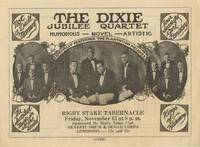
1936ref. BK0062Rigby Idaho 1936. Illustrated handbill single sheet printed on both sides with three photographic group illustrations on recto and descriptive text verso. 7 ¼ x 5 ¼ inches. Local overprint for a Friday evening performance at the Rigby Stake Tabernacle sponsored by the Rigby Lions Club for the benefit of the drum and bugle corps. Admission fifteen and twenty-five cents. Light toning and scattered spotting with old folds and minor handling wear; very good. An illustrated handbill advertising an appearance by the African American Dixie Jubilee Quartet at the Rigby Stake Tabernacle in Rigby Idaho. The local overprint announces a concert sponsored by the Rigby Lions Club for the benefit of the drum and bugle corps with the quartet appearing at 8 p.m. on Friday November 13 1936. A notice in the Rigby Star of November 5 1936 confirms the engagement at the L.D.S. tabernacle and names the four performers. The reverse identifies James Collins first tenor and soloist; Napoleon Simpson second tenor and soloist; Aramis Fouche baritone and soloist; and Arnett Williams bass and reader. Arthur D. Lawrence is listed as manager with an address on South Figueroa Street in Los Angeles. Fouché's later obituary records his work as a singer and manager of the Dixie Jubilee Quartet and notes the group's western touring activity. Under the heading "An Evening of American Folk Lore And The Old Favorites" the advertising describes a program built around plantation songs popular selections comedy and literary recitation while explicitly using the performers' racial identity as part of the appeal: "The peculiar charm of the plaintive Southern Melodies is imperishable. There is nothing so full of genuine sweetness as these old negro songs with all their simplicity and it takes the real negro to sing them as they should be sung. As rendered by the Dixie Jubilee Quartet these old plantation melodies take on new and more interesting charms." The program also included "humorous readings usually taken from Paul Laurence Dunbar's dialect works" with Arnett Williams specifically identified as the group's reader. The front promotes the quartet as "Humorous-Novel-Artistic" "Kings of Harmony" and "The Sweetest Music in All the World" while the reverse closes with the appeal: "What Would You Rather Hear Than A Real Good Harmonizing Colored Male Quartet" Overall a relatively uncommon piece of Western performance ephemera documenting a Black touring quartet in eastern Idaho and preserving the language through which such groups were marketed to white civic and church-hall audiences during the 1930s. . unknown books
1936ref. BK0062Rigby Idaho 1936. Illustrated handbill single sheet printed on both sides with three photographic group illustrations on recto and descriptive text verso. 7 ¼ x 5 ¼ inches. Local overprint for a Friday evening performance at the Rigby Stake Tabernacle sponsored by the Rigby Lions Club for the benefit of the drum and bugle corps. Admission fifteen and twenty-five cents. Light toning and scattered spotting with old folds and minor handling wear; very good. An illustrated handbill advertising an appearance by the African American Dixie Jubilee Quartet at the Rigby Stake Tabernacle in Rigby Idaho. The local overprint announces a concert sponsored by the Rigby Lions Club for the benefit of the drum and bugle corps with the quartet appearing at 8 p.m. on Friday November 13 1936. A notice in the Rigby Star of November 5 1936 confirms the engagement at the L.D.S. tabernacle and names the four performers. The reverse identifies James Collins first tenor and soloist; Napoleon Simpson second tenor and soloist; Aramis Fouche baritone and soloist; and Arnett Williams bass and reader. Arthur D. Lawrence is listed as manager with an address on South Figueroa Street in Los Angeles. Fouché's later obituary records his work as a singer and manager of the Dixie Jubilee Quartet and notes the group's western touring activity. Under the heading "An Evening of American Folk Lore And The Old Favorites" the advertising describes a program built around plantation songs popular selections comedy and literary recitation while explicitly using the performers' racial identity as part of the appeal: "The peculiar charm of the plaintive Southern Melodies is imperishable. There is nothing so full of genuine sweetness as these old negro songs with all their simplicity and it takes the real negro to sing them as they should be sung. As rendered by the Dixie Jubilee Quartet these old plantation melodies take on new and more interesting charms." The program also included "humorous readings usually taken from Paul Laurence Dunbar's dialect works" with Arnett Williams specifically identified as the group's reader. The front promotes the quartet as "Humorous-Novel-Artistic" "Kings of Harmony" and "The Sweetest Music in All the World" while the reverse closes with the appeal: "What Would You Rather Hear Than A Real Good Harmonizing Colored Male Quartet" Overall a relatively uncommon piece of Western performance ephemera documenting a Black touring quartet in eastern Idaho and preserving the language through which such groups were marketed to white civic and church-hall audiences during the 1930s. . unknown