HAYDN, Joseph 1732-1809Biblio.com
1 739 résultats
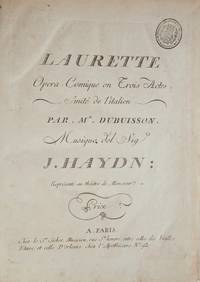
1791réf. 40111Paris: Sr. Sieber Musicien rue St honoré entre celles des Vielles Etuve et celle D'orleans chez l'Apothiciare No. 92 PN 1171 1791. Folio. Ivory vellum-backed marbled boards dark red leather label to spine with titling gilt. 1f. recto title verso blank 254 pp. with "Personnages" to lower portion of p. 12 following overture. Engraved throughout. Overture and arias with spoken dialogue provided as text; "Laurette" was performed without recitatives. Handstamp of "Cercle des amateurs de musique Strasbourg" incorporating lyre and floral motif to upper outer corner of title and first page of music. Binding worn rubbed and bumped. Light uniform browning; occasional small stains and foxing; abrasion to p. 101 affecting several bars of music; price erased from title. First Edition. Hoboken Collection Vol. 9 1615. Lesure p. 299. RISM H2563 Laurette to a libretto by Francesco Puttini was first performed on 25 April 1779. "Contrary to claims made by Haydn's early biographers insufficent evidence supports the hypothesis that Haydn wrote this opera to fulfill an imperial commission for Vienna. The libretto represents a considerably shortened version of Puttini's text for Anfossi 1776 Rome already somewhat condensed especially in Act 3 for performances later that year in Venice as La pescatrice fedele and in Vienna 1777. Andrea Totti who sang Count Errico in Venice also performed in Haydn's opera at Eszterháza. . The opera was subsequently performed as Der flatterhafte Liebhaber oder Der Sieg der or Die wahre Beständigkeit in Pressburg Bratislava 1786-7 Budapest 1789 Vienna 1790 and Brno 1792 and with numerous changes as Laurette in Paris 1791." Caryl Clark in Grove Music Online "La vera costanza 1778-9 is the subject of implausible and conflicting anecdotes in Griesinger and Dies according to which it was originally commissioned for the Burgtheater in Vienna but scuttled by intrigue neither Joseph II nor his musicians were well-disposed towards Haydn; in fact it had its première at Eszterháza on April 25 1779. It was lost in the fire that largely destroyed the Eszterháza opera theatre on November 18 1779; the surviving version represents Haydn's reconstruction of the work from 1785." Georg Feder and James Webster in Grove Music Online. Sr. Sieber, Musicien, rue St honoré entre celles des Vielles Etuve et celle D'orleans chez l'Apothiciare, No. 92 [PN 1171] unknown
1791réf. 40111Paris: Sr. Sieber Musicien rue St honoré entre celles des Vielles Etuve et celle D'orleans chez l'Apothiciare No. 92 PN 1171 1791. Folio. Ivory vellum-backed marbled boards dark red leather label to spine with titling gilt. 1f. recto title verso blank 254 pp. with "Personnages" to lower portion of p. 12 following overture. Engraved throughout. Overture and arias with spoken dialogue provided as text; "Laurette" was performed without recitatives. Handstamp of "Cercle des amateurs de musique Strasbourg" incorporating lyre and floral motif to upper outer corner of title and first page of music. Binding worn rubbed and bumped. Light uniform browning; occasional small stains and foxing; abrasion to p. 101 affecting several bars of music; price erased from title. First Edition. Hoboken Collection Vol. 9 1615. Lesure p. 299. RISM H2563 Laurette to a libretto by Francesco Puttini was first performed on 25 April 1779. "Contrary to claims made by Haydn's early biographers insufficent evidence supports the hypothesis that Haydn wrote this opera to fulfill an imperial commission for Vienna. The libretto represents a considerably shortened version of Puttini's text for Anfossi 1776 Rome already somewhat condensed especially in Act 3 for performances later that year in Venice as La pescatrice fedele and in Vienna 1777. Andrea Totti who sang Count Errico in Venice also performed in Haydn's opera at Eszterháza. . The opera was subsequently performed as Der flatterhafte Liebhaber oder Der Sieg der or Die wahre Beständigkeit in Pressburg Bratislava 1786-7 Budapest 1789 Vienna 1790 and Brno 1792 and with numerous changes as Laurette in Paris 1791." Caryl Clark in Grove Music Online "La vera costanza 1778-9 is the subject of implausible and conflicting anecdotes in Griesinger and Dies according to which it was originally commissioned for the Burgtheater in Vienna but scuttled by intrigue neither Joseph II nor his musicians were well-disposed towards Haydn; in fact it had its première at Eszterháza on April 25 1779. It was lost in the fire that largely destroyed the Eszterháza opera theatre on November 18 1779; the surviving version represents Haydn's reconstruction of the work from 1785." Georg Feder and James Webster in Grove Music Online. Sr. Sieber, Musicien, rue St honoré entre celles des Vielles Etuve et celle D'orleans chez l'Apothiciare, No. 92 [PN 1171] unknown books
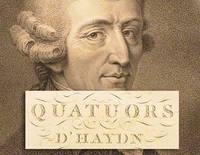
1806réf. 320511806. First Edition. HAYDN Joseph. Collection complette des Quatuors DHaydn. Paris: Pleyel 1806. Four volumes. Folio contemporary half calf marbled boards. $4500.Second collected Nouvelle edition of Haydns complete string quartets in handsome contemporary calf.Haydn won his first fame with his string quartets and continued to return to the form throughout his life. By the end of his life he was regarded as the greatest composer in this medium. Haydn achieved in his op. 33 quartets written as he declared in a new and special way a clarity of structure and balance of texture of which he rarely lost sight in later works In the late 1780s Haydn finally returned to quartet composition on a more regular basis The fine balance between unity and infinite variety is one of the most typical features of Haydns late quartets The two series of Tost Quartets opp. 54-5 and op. 64 carry the Classical quartet to a peak. They reveal a Haydn free of official restraints and obligations composing simply con amore In op. 76 a new experimentalism appears with features anticipating Beethoven New Grove 18: 278; 8: 355. Regarding Pleyels editions of the string quartets Haydn wrote: I am much obliged to you for the exceptionally beautiful edition of the Quartets because of their beautiful engravings the paperand the fact that they are so correctas well as their general appearance you will be remembered for them forever Robbins Landon 238. With engraved frontispiece portrait title pages and fully engraved music text. Hirsch III 274. ontemporary bookseller stamps.Occasional light foxing; a few small marginal tears and paper repairs. A very handsome copy of this beautiful edition. hardcover
1806réf. 320511806. First Edition. HAYDN Joseph. Collection complette des Quatuors DHaydn. Paris: Pleyel 1806. Four volumes. Folio contemporary half calf marbled boards. $4500.Second collected Nouvelle edition of Haydns complete string quartets in handsome contemporary calf.Haydn won his first fame with his string quartets and continued to return to the form throughout his life. By the end of his life he was regarded as the greatest composer in this medium. Haydn achieved in his op. 33 quartets written as he declared in a new and special way a clarity of structure and balance of texture of which he rarely lost sight in later works In the late 1780s Haydn finally returned to quartet composition on a more regular basis The fine balance between unity and infinite variety is one of the most typical features of Haydns late quartets The two series of Tost Quartets opp. 54-5 and op. 64 carry the Classical quartet to a peak. They reveal a Haydn free of official restraints and obligations composing simply con amore In op. 76 a new experimentalism appears with features anticipating Beethoven New Grove 18: 278; 8: 355. Regarding Pleyels editions of the string quartets Haydn wrote: I am much obliged to you for the exceptionally beautiful edition of the Quartets because of their beautiful engravings the paperand the fact that they are so correctas well as their general appearance you will be remembered for them forever Robbins Landon 238. With engraved frontispiece portrait title pages and fully engraved music text. Hirsch III 274. ontemporary bookseller stamps.Occasional light foxing; a few small marginal tears and paper repairs. A very handsome copy of this beautiful edition. hardcover books
réf. a015.016GB: R T Birchall - Preston 326 x 255 mm. Old half dark green leather and marbled boards. Spines heavily decorated in gold and all lettered "HAYDN - BOOK C". Leather title labels on front covers. All with the large armorial bookplate of Frederick A Heygate Lambert with small Garratts Hall Library case label. PAGINATION ERRATIC THROUGHOUT but appear to be complete as issued. Salomon is in 7 sets of 16 pages whilst Hague is about 48 pages. All fairly clean tight and sound BUT some offsetting throughout and some occasional damp and other marks. A good working set but perhaps not for the collector. Hardback. Good. R T Birchall - Preston Hardcover
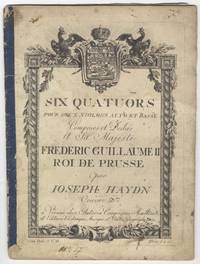
1787réf. 40066Vienne: Artaria PN 109 1787. Folio. Sewn. Violino primo: 1f. recto title with elaborate engraved border incorporating coat of arms crowned eagles crown and floral and architectural motifs verso blank i blank 2-25 pp. Violino secondo: 1f. recto title verso blank i blank 2-21 i blank pp. Viola: 1f. recto title verso blank i blank 2-21 i blank pp. Violoncello: 1f. recto title verso blank i blank 2-21 i blank pp. Engraved throughout. Occasional fingerings in contemporary ink to first violin part. 19th century annotation: "Tenor - Fundament" and "Anton Kulhanek" to head of blank page preceding music to second violin part with hand-drawn stave and scale with note names and on the same page a small chart with note or string names and transpositions and the name "Franz Rücker." Some dynamics modified in ink in viola part transforming "f" to "sf." Somewhat worn foxed soiled and stained; spines reinforced with early dark blue paper tape; edge tears with minor loss to blank margins of first violin part; outer and lower margin of final leaf reinforced just touching staff lines. First Edition of the Prussian Quartets. Hob. III:44-49. Hoboken Catalogue Vol. 7 574. BUC p. 465. RISM H3494 two copies only in North America one in Britain and none in France or Italy. The fourth quartet in this group in F sharp minor is regarded as one of Haydn's finest. "It shows for the first time in the quartets Haydn's definite renunciation of tragic ends to sonata movements and his now typical association of the minor mode with a passionate somewhat blustering temper ending with a recapitulation in these circumstances regular in the tonic major so that everything turns out well. . In striking contrast to the happy end of the first movement the final fugue quietest and deepest of all the . instrumental fugues since Bach strikes a note so tragic that Beethoven's C sharp minor quartet is the first thing that one can connect with it." Tovey in Landon: Haydn Chronicle and Works II p. 627. Artaria [PN 109] unknown
1787réf. 40066Vienne: Artaria PN 109 1787. Folio. Sewn. Violino primo: 1f. recto title with elaborate engraved border incorporating coat of arms crowned eagles crown and floral and architectural motifs verso blank i blank 2-25 pp. Violino secondo: 1f. recto title verso blank i blank 2-21 i blank pp. Viola: 1f. recto title verso blank i blank 2-21 i blank pp. Violoncello: 1f. recto title verso blank i blank 2-21 i blank pp. Engraved throughout. Occasional fingerings in contemporary ink to first violin part. 19th century annotation: "Tenor - Fundament" and "Anton Kulhanek" to head of blank page preceding music to second violin part with hand-drawn stave and scale with note names and on the same page a small chart with note or string names and transpositions and the name "Franz Rücker." Some dynamics modified in ink in viola part transforming "f" to "sf." Somewhat worn foxed soiled and stained; spines reinforced with early dark blue paper tape; edge tears with minor loss to blank margins of first violin part; outer and lower margin of final leaf reinforced just touching staff lines. First Edition of the Prussian Quartets. Hob. III:44-49. Hoboken Catalogue Vol. 7 574. BUC p. 465. RISM H3494 two copies only in North America one in Britain and none in France or Italy. The fourth quartet in this group in F sharp minor is regarded as one of Haydn's finest. "It shows for the first time in the quartets Haydn's definite renunciation of tragic ends to sonata movements and his now typical association of the minor mode with a passionate somewhat blustering temper ending with a recapitulation in these circumstances regular in the tonic major so that everything turns out well. . In striking contrast to the happy end of the first movement the final fugue quietest and deepest of all the . instrumental fugues since Bach strikes a note so tragic that Beethoven's C sharp minor quartet is the first thing that one can connect with it." Tovey in Landon: Haydn Chronicle and Works II p. 627. Artaria [PN 109] unknown books
réf. 38986A Paris, chez Pleyel, [1800] 4 volumes in-4°, 383-325-285-273p. Reliure demi-basane pour le premier volume, cartonnages d'attente (fortement défraichis) pour les 3 derniers volumes .
1814réf. 78167Paris: De l'Imprimerie de P. Didot l'aîné 1814. Fine. De l'Imprimerie de P. Didot l'aîné Paris 1814 12.50 x 20.50 cm relié De l'Imprimerie de P. Didot l'Aîné Paris 1814 125 x 205 cm bound in calf First edition of Stendhal's very first book published under the pseudonym of Louis-Alexandre-César Bombet. Contemporary binding in half brown calf spine decorated with gilt fillets and tooling as well as a red morocco title piece. Very rare according to Clouzot De l'Imprimerie de P. Didot l'aîné unknown
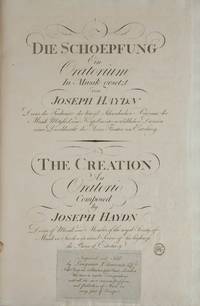
1800réf. 40127Vienna: The Composer 1800. Folio. Contemporary quarter dark tan mottled calf with ivory vellum-edged marbled boards titling gilt to spine. 1f. recto title verso blank 4ff. subscribers list 303 i blank pp. Text in German and English. Title and music engraved list of subscribers typeset. With Haydn's small circular monogrammatic handstamp "JH" to foot of title. Binding worn rubbed and bumped; minor loss to head and tail of spine. Occasional small stains and moderate browning; some signatures partially split at lower portion. In very good internal condition overall. First Edition. HWV Vol. II p. 36. Hirsch IV 799. Leipzig catalogue p. 19. Vecsey 303. Eitner V p. 66. BUC p. 456. RISM H2521. The Creation to a libretto by Gottfried von Swieten was first performed at the Palais Schwarzenberg in Vienna on 29 and 30 April 1798; its first public performance took place on 19 March of the following year at the Burghteater in Vienna. "There is hardly any doubt in the mind of the average music-lover that Haydn's Oratorio The Creation is tutto sommato his greatest single accomplishment and certainly ranks as one of the greatest products of any eighteenth-century mind. It occupies a central position in choral literature and its composition and first performances were the dominant features of Haydn's life in the late 1790s." Robbins Landon: Haydn Chronicle and Works Vol. IV: Haydn The Years of 'The Creation' 1796-1800 p. 12. Copies of the first edition of this monumental work containing the subscribers list are very scarce to the market. [The Composer] unknown
1800réf. 40127Vienna: The Composer 1800. Folio. Contemporary quarter dark tan mottled calf with ivory vellum-edged marbled boards titling gilt to spine. 1f. recto title verso blank 4ff. subscribers list 303 i blank pp. Text in German and English. Title and music engraved list of subscribers typeset. With Haydn's small circular monogrammatic handstamp "JH" to foot of title. Binding worn rubbed and bumped; minor loss to head and tail of spine. Occasional small stains and moderate browning; some signatures partially split at lower portion. In very good internal condition overall. First Edition. HWV Vol. II p. 36. Hirsch IV 799. Leipzig catalogue p. 19. Vecsey 303. Eitner V p. 66. BUC p. 456. RISM H2521. The Creation to a libretto by Gottfried von Swieten was first performed at the Palais Schwarzenberg in Vienna on 29 and 30 April 1798; its first public performance took place on 19 March of the following year at the Burghteater in Vienna. "There is hardly any doubt in the mind of the average music-lover that Haydn's Oratorio The Creation is tutto sommato his greatest single accomplishment and certainly ranks as one of the greatest products of any eighteenth-century mind. It occupies a central position in choral literature and its composition and first performances were the dominant features of Haydn's life in the late 1790s." Robbins Landon: Haydn Chronicle and Works Vol. IV: Haydn The Years of 'The Creation' 1796-1800 p. 12. Copies of the first edition of this monumental work containing the subscribers list are very scarce to the market. [The Composer] unknown books
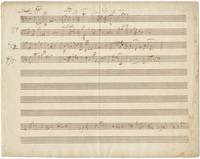
réf. 41685Large oblong quarto 241 x 309 mm. Notated in dark brown ink on the verso of the second leaf of a bifolium i.e. page 4 on 10-stave rastrum-ruled paper of British manufacture. Watermark dated 1794. Late spring or early summer 1795 see H.C. Robbins Landon: Haydn Chronicle and Works Volume III p. 495. With pencilled note in another hand to first page: "Haydn autograph notes of the 12 English Symphonies. Haydn misquotes the 2nd." Very slightly worn browned and soiled; minor foxing and very short splits to central fold; vertical crease to center of bifolium; lower edge with several miniscule tears. In addition to noting the musical incipits which comprise 25 measures spread out over 4 staves Haydn identifies the key time signature and year in which each symphony was first performed in noting the performance date of Symphony 97 however Haydn makes an error and cites 1791 instead of 1792. The sketch for the piano trio Hob. XV:25 is notated 5 staves below the symphonic incipits and consists of 9 measures of melodic material for the famous third movement. Provenance Leo Liepmannssohn auction catalogue Berlin 1907 lot 91. The Westley Manning Collection Sotheby's London 12 October 1954 lot 207. The London Symphonies were commissioned by the London impresario and violinist Johann Peter Salomon 1745-1815 and composed over the period 1791-95. Salomon was responsible for bringing Haydn to London where he became immensely popular largely through performances of his music at Salomon's concerts. "Haydn's London symphonies nos. 93-104 crown his career as a symphonic composer. Not only do they outdo the Paris symphonies stylistically but he produced them in person for rapturous audiences; this interaction stimulated him to ever bolder and more original conceptions. . The last six London symphonies are even more brilliant than the first six. . Haydn's determination to conquer new territory with each work is palpable." James Webster in Grove Music Online "The finale of Hob. XV:25 is the famous rondo "in the Gypsies Style." It seems that a composer's most popular works if not spurious are at least unusual manifestations of his style and this rondo fits this characterization. . Even though this finale was best known during the eighteenth century as a separate piece in many different settings its impact is best appreciated within the context of this keyboard trio cycle for the Andante and Poco Adagio the first and second movements hardly prepare one for its burst of energy." A. Peter Brown: Joseph Haydn's Keyboard Music Sources and Styles p. 377. ". the G major Trio 39 turned out to be Haydn's most popular piano piece because of the 'Gypsy Rondo' Finale. . It became an enormous favourite first in England and immediately afterwards on the Continent." Robbins Landon III pp. 431-432. A unique and interesting manuscript being a virtual catalogue of all the London Symphonies considered the crowning achievement of the composer's symphonic career and including music from the famous Gypsy Rondo some of Haydn's best music from his important London period. unknown
réf. 41685Large oblong quarto 241 x 309 mm. Notated in dark brown ink on the verso of the second leaf of a bifolium i.e. page 4 on 10-stave rastrum-ruled paper of British manufacture. Watermark dated 1794. Late spring or early summer 1795 see H.C. Robbins Landon: Haydn Chronicle and Works Volume III p. 495. With pencilled note in another hand to first page: "Haydn autograph notes of the 12 English Symphonies. Haydn misquotes the 2nd." Very slightly worn browned and soiled; minor foxing and very short splits to central fold; vertical crease to center of bifolium; lower edge with several miniscule tears. In addition to noting the musical incipits which comprise 25 measures spread out over 4 staves Haydn identifies the key time signature and year in which each symphony was first performed in noting the performance date of Symphony 97 however Haydn makes an error and cites 1791 instead of 1792. The sketch for the piano trio Hob. XV:25 is notated 5 staves below the symphonic incipits and consists of 9 measures of melodic material for the famous third movement. Provenance Leo Liepmannssohn auction catalogue Berlin 1907 lot 91. The Westley Manning Collection Sotheby's London 12 October 1954 lot 207. The London Symphonies were commissioned by the London impresario and violinist Johann Peter Salomon 1745-1815 and composed over the period 1791-95. Salomon was responsible for bringing Haydn to London where he became immensely popular largely through performances of his music at Salomon's concerts. "Haydn's London symphonies nos. 93-104 crown his career as a symphonic composer. Not only do they outdo the Paris symphonies stylistically but he produced them in person for rapturous audiences; this interaction stimulated him to ever bolder and more original conceptions. . The last six London symphonies are even more brilliant than the first six. . Haydn's determination to conquer new territory with each work is palpable." James Webster in Grove Music Online "The finale of Hob. XV:25 is the famous rondo "in the Gypsies Style." It seems that a composer's most popular works if not spurious are at least unusual manifestations of his style and this rondo fits this characterization. . Even though this finale was best known during the eighteenth century as a separate piece in many different settings its impact is best appreciated within the context of this keyboard trio cycle for the Andante and Poco Adagio the first and second movements hardly prepare one for its burst of energy." A. Peter Brown: Joseph Haydn's Keyboard Music Sources and Styles p. 377. ". the G major Trio 39 turned out to be Haydn's most popular piano piece because of the 'Gypsy Rondo' Finale. . It became an enormous favourite first in England and immediately afterwards on the Continent." Robbins Landon III pp. 431-432. A unique and interesting manuscript being a virtual catalogue of all the London Symphonies considered the crowning achievement of the composer's symphonic career and including music from the famous Gypsy Rondo some of Haydn's best music from his important London period. unknown books
1808réf. 95829London: Lavenu Cianchettini & Sperati 1808-1810. First editions of the first printings of the full orchestral scores of the complete symphonies of Beethoven Mozart and Hadyn. Quarto two volumes bound in three quarters morocco over marbled boards wit gilt titles and tooling to the spine including A Complete Collection of Haydn Mozart and Beethoven's Symphonies Cianchettini and Sperati and A Complete Collection of Mozart and Beethoven's Symphonies. A Compleat Collection of Haydn Mozart and Beethoven's Symphonies contains the first appearance of the full scores of Mozart's Overture to the Marriage of Figaro Mozart's Symphony no. 40 and no. 41. Fuld The Book of World-Famous Music 564-567. A Complete Collection of Mozart and Beethoven's Symphonies Lavenu contains the first appearance of the full scores of Mozart's Symphony no. 39 no 13 and no. 38. In very good condition with light toning to the text. An exceptional collection of the utmost rarity. 1786 saw the successful premiere of Mozart's The Marriage of Figaro in Vienna. Its reception in Prague later in the year was even warmer and this led to a second collaboration with Da Ponte: the opera Don Giovanni which premiered in October 1787 to acclaim in Prague but less success in Vienna in 1788. The two are among Mozart's most important works and are mainstays of the operatic repertoire today. In 1787 the young Ludwig van Beethoven spent several weeks in Vienna hoping to study with Mozart. No reliable records survive to indicate whether the two composers ever met. Beethoven would go on to become a crucial figure in the transition between the Classical and Romantic eras in classical music he remains one of the most recognized and influential of all composers with his best-known compositions including 9 symphonies; 5 piano concertos; 1 violin concerto; 32 piano sonatas; 16 string quartets; a mass the Missa solemnis; and an opera Fidelio. Lavenu, Cianchettini & Sperati hardcover