1 729 résultats
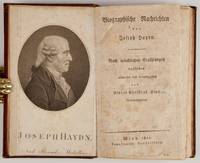
1810réf. 40444Wien: Camesinaische Buchhandlung 1810. Octavo. Full 19th century dark red calf with gilt rules and blindstamping to boards titling gilt to upper dark red doublure endpapers. Preserved in a modern quarter brown mid-tan leather clamshell box with dark ivory linen boards titling gilt to spine. 1f. fine engraved frontispiece portrait of Haydn by D. Weiss after Ihrwack's medallion 1f. recto title verso 3-line verse by D. Tomas de Yriarte 1f. recto dedication verso blank v-x 11-220 pp. 1 folding plate of engraved music. Binding slightly worn rubbed and bumped. Minor to moderate foxing throughout; small tear to lower outer corner of pp. 157/158 with no loss of text; frontispiece loose. First Edition. Catalogue of the Printed Books in the British Museum. Accessions Third Series . Books in the Hirsch Library. P. 118. Eitner III p. 197. Dies was a German writer composer and painter. "Esterhazy sponsored the publication of his Biographische Nachrichten von Joseph Haydn . for which Dies collected material from 30 conversations with the aged composer. Because of its factual tone and the typically Classical standpoint of its aesthetic judgments this work occupies a significant position in early Haydn literature alongside Griesinger and Carpani. . Many Haydn documents appeared for the first time in the Nachtrichten and it contains a 'list of all the works Haydn composed in London' taken from the lost London notebook." Horst Seeger in Grove Music Online An early and important biographical account of Haydn. Camesinaische Buchhandlung unknown books
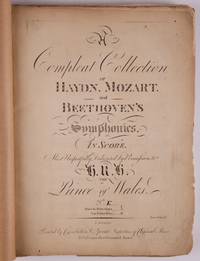
1810réf. 40477London: Printed by Lavenu & Mitchell Music sellers to his Royal Highness the Prince of Wales at their New Musical Circulating Library 26 New Bond Street 1810. Folio. Unbound and untrimmed as issued. Keyboard: i title 2-33 i blank pp. Violin: 9 pp. Somewhat worn browned and soiled a bit more heavily to outer leaves; some corners creased; two small stab holes to blank inner margins; several leaves detached including title with small tears to margins. Lacking violoncello part. Later issue of the edition first published in 1805-1808. HWV I p. 685. RISM H3629 one copy of the piano part only. Printed by Lavenu & Mitchell, Music sellers to his Royal Highness the Prince of Wales at their New Musical Circulating Library, unknown books
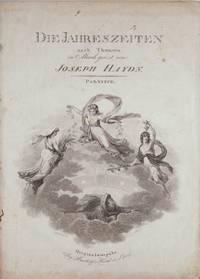
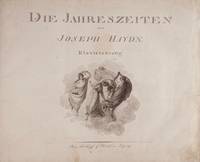
1802réf. 40133Leipzig: Breitkopf & Haertel 1802. Folio. Contemporary full dark brown suede with tooling in black to outer edges of boards. 1f. recto title with elaborate vignette engraved by W. Böhm after G.V. Kiminger incorporating allegories of the seasons floating on a bed of clouds with lyre and six-pointed stars verso blank 1f. recto secondary title "Erste Abtheilung" verso "Personen" 251 i blank. Typeset throughout. With occasional indications of instrumentation in pencil. R. Cocks & Co. handstamp to foot of secondary title. Binding worn rubbed and bumped with minor loss to lower outer corner of upper board and spine; upper partially detached. Some wear soiling staining foxing and browning; occasional minor loss to blank lower margins; worming to blank inner margin of first five leaves. First Edition issue with parallel text in German and English. Hoboken Katalog Vol. 9 1411. Hirsch IV 796. RISM H2542. One of Haydn's two masterful oratorios this secular work was written shortly after The Creation 1798 to a libretto by Baron Gottfried von Swieten 1733-1803 after the eponymous poem by James Thomson 1700-1748 published in 1730. The work was first performed on 24 April 1801 in a private première at the Schwarzenberg Palace in Vienna; the first public production took place on 29 May 1801. "Although the initial reception of The Seasons was favourable - Haydn wrote to Clementi that it had enjoyed 'unanimous approval' and that 'many prefer it to The Creation because of its greater variety' - critical opinion soon became mixed owing in part to its perceived 'lower' subject in part to a growing aesthetic resistance to its many pictorialisms. Haydn himself contributed to both strands of criticism: he supposedly said to Francis II 'In The Creation angels speak and tell of God but in The Seasons only Simon speaks' Dies; and he indiscreetly criticized Swieten's croaking frogs 'Frenchified trash' and the absurdity of a choral hymn to toil Fleiss. Nonetheless he maintained that it would join The Creation in assuring his lasting fame. For the publication he took the path of lesser resistance selling the rights to Breitkopf & Härtel. . Notwithstanding its less exalted subject The Seasons is compositionally more virtuoso than The Creation and offers greater variety of tone: Haydn's pastoral is one of the final glories of a tradition that is more than 'high' enough." Georg Feder and James Webster in Grove Music Online The music is "of wonderful freshness and unfailing originality." TNG Vol. 8 p. 347. Breitkopf & Haertel unknown books
1809réf. 40074London: Cianchettini & Sperati 1809. 11 works bound in 2 volumes. Large octavo. 19th century half dark tan calf with marbled boards spines in decorative compartments gilt with titling gilt. Engraved throughout. Contains: 1 Symphony in E-flat major. 1f. recto title No. I verso blank 41 i blank pp. Hob. I:91. Robbins Landon p. 744. 2 Symphony in C major "London." 1f. recto title No. II verso blank 39 i blank pp. Hob. I:69. Robbins Landon p. 717. 3 Symphony in G major "Oxford." 1f. recto title No. III verso blank 48 pp. Hob. I:92. Robbins Landon p. 745. 4 Symphony in G minor "La Poule." 1f. recto title No. IV verso blank 36 pp. Hob. I:83. Robbins Landon p. 734. 5 Symphony in C major. 1f. recto title No. V verso blank 23 i blank pp. Hob. I:41. Robbins Landon p. 678. 6 Symphony in B-flat major "La Reine." 1f. recto title No. VI verso blank 37 i blank pp. Hob. I:85. Robbins Landon p. 736. 7 Symphony in D major. 1f. recto title No. VII verso blank 28 pp. Hob. I:70. Robbins Landon p. 718. 8 Symphony in F-sharp minor "Farewell." 1f. recto title . No. VIII verso blank 33 i blank pp. With note to head of first page of music: "NB: This is the Fantastical Symphony in which the Performers retire one after the other." Hob. I:45. Robbins Landon p. 686. 9 Symphony in B-flat major. 1f. recto title . No. IX verso blank 38 pp. Hob. I:66. Robbins Landon p. 714 10 Symphony in E minor "Trauer-Symphonie." 1f. recto title . No. X verso blank 33 i blank pp. Hob. I:44. Robbins Landon p. 683 11 Symphony in D major. 1f. recto title . No. XI verso blank 33 i blank pp. Hob. I:57. Robbins Landon p. 702. With early manuscript inscription "Eugene Spinney from Mrs. Huxtable Sutton Waldron Dorset June 1862" in ink to free front endpapers of both volumes. Bindings worn rubbed and bumped. Light marginal foxing. In very condition overall. "From about 1775 in some respects 1773 to 1781 Haydn again changed his orientation. Symphonies nos. 53 61-3 66-71 and 73-5 are primarily in a light even popular style only no.70 is an exception perhaps reflecting his resumption of operatic composition in 1773; indeed nos. 53 62 63 and 73 include adaptations of stage-music ." Georg Feder and James Webster in Grove Music Online The Symphony in G major Hob I:92 was performed by Haydn in 1791 at Oxford University on the occasion of his receiving an honorary doctorate. "No. 45 the Farewell Symphony . had a purpose which explains its extraordinary form. Briefly the story as found the in the authentic biographies is this: the Prince so attracted by Esterháza that splendid palace erected on a wild and remote Hungarian marsh tarried there longer and longer each year. The musicians not being allowed - with the exception of Haydn - to have their families with them were restless after a long season and naturally wished to rejoin their wives and children. Towards the end of the season in 1772 the musicians became desperate and went to their beloved Capellmeister for help. The result was the Farewell symphony in which the regular Presto finale was broken off and a long Adagio began. During the course of this movement one player after another blew out his candle and departed leaving at the end two violins presumably Tomassini and Haydn himself. As these were about to leave the Prince having grasped the idea is supposed to have said 'Well if they all leave we might as well leave too.' And the whole court departed the next day." Robbins Landon: The Symphonies of Joseph Haydn p. 338. Cianchettini & Sperati unknown books
1827réf. 40402London: Printed & Sold by Rt. Birchall140 New Bond Street 1827. Folio. Disbound. Violino primo: 1f. recto title verso blank 7 pp. Violino secondo: 6 pp. Viola: 4 pp. Violoncello é basso: 4 pp. 2 copies Flauto: 4 pp. Oboe primo: 4 pp. Fagotti: 3 pp. Timpani in B. F. 1 p. Purple ink handstamp of "Stanley Hoyle Pianist" and "John Curtie" to each part. Quite worn; large tear to title some fraying tears and soiling. Lacking parts for Oboe secondo Horns and Trumpets. HWV Vol. I p. 199 Coll.Sy.3a. Printed & Sold by Rt. Birchall,140 New Bond Street unknown books
1809réf. 40096London: Cianchettini & Sperati 1809. 4 volumes. Large octavo. Disbound. Engraved throughout. Contains 8 works each with identical title excepting work number. 1 Symphony in E-flat major. 1f. recto title No. I verso blank 42 pp. Hob. I:91. Robbins Landon p. 744. 2 Symphony in C major "Laudon." 1f. recto title No. II." verso blank 39 i blank pp. Hob. I:69. Robbins Landon p. 717. 3 Symphony in G minor "La Poule." 1f. recto title No. IV verso blank 36 pp. Hob. I:83. Robbins Landon p. 734. 4 Symphony in C major No. 41. 1f. recto title No. V verso blank 23 i blank pp. Hob. I:41. Robbins Landon p. 678. 5 Symphony in B-flat major "La Reine. 1f. recto title No. VI verso blank 37 i blank pp. Hob. I:85. Robbins Landon p. 736. 6 Symphony in D major "L'Impériale." 1f. recto title No. XXI verso blank 40 pp. First Edition. Hob. I:53. Robbins Landon p. 696. 7 Symphony in B-flat major. 1f. recto title No. XXIII verso blank 33 i blank pp. Hob. I:71. Robbins Landon p. 719 8 Symphony in D major. 1f. recto title No. XXIV verso blank 27 i blank pp. First Edition. Hob. I:75. Robbins Landon p. 724 Foxing staining soiling and browning to numerous leaves; some small tears and losses to edges; several leaves detached including titles. "Although Haydn's sobriquet 'father of the symphony' is not literally true in a deeper sense it is apt: there is no other genre in Western music for which the output of a single composer is at once so vast in extent 107 works: hI:1-104 107-8 and one recently identified work K 18 not listed in Hoboken so historically important and of such high artistic quality." James Webster in Grove Music Online. Cianchettini & Sperati unknown books
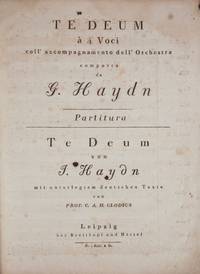
1802réf. 40447Leipzig: Breitkopf und Härtel 1802. Folio. Modern half mid-brown calf with ivory linen boards with leather title label gilt to upper spine with titling gilt. 1 title 2-42 music ii text pp. Typeset throughout. With text in Latin and German. With occasional early accidentals added in early manuscript. Some browning and foxing; minor staining. First Edition. Hoboken Collection Vol. 9 1478. RISM H2517. "The late Te Deum 'for the empress' . for chorus and very large orchestra is an ABA construction of great power and terseness; it whirls through the very long text in little more than eight minutes while still finding time for a double fugue and an immense climax at the end." Georg Feder and James Webster in Grove Music Online The autograph of the present work has been lost. Breitkopf und Härtel unknown books
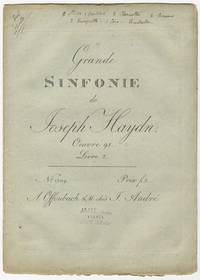
1799réf. 40334Offenbach s/m: J. André PN 1369 1799. Folio. Unbound. Violino primo: 1 title 2-7 pp. Violino secondo: 1 blank 2-6 pp. Due viole: 4 pp. Basso e violoncello: 4 pp. Flauti: 4 pp. Oboe primo: 3 pp. Oboe secondo: 2 pp. Clarinetto primo: 2 pp. Clarinetto secondo: 2 pp. Fagotti: 3 pp. Clarino primo in D: 2 pp. Clarino secondo in D: 2 pp. Corno primo in D: 2 pp. Corno secondo in D: 2 pp. Timpani in D: 2 pp. Engraved throughout. Small binder's hole to upper inner margin; early manuscript note regarding instrumentation to upper margin of title with "Comptoir Général de Musique" stamps to lower margin; "Salomon's Concert" printed to foot of first page of music of each part. Early edition of Haydn's "Clock" symphony. Robbins Landon p. 772 10 giving precedence to the Artaria edition of Autumn 1799 as the first "authentic" edition and suggesting that the present edition was most probably derived from the first edition published by Gombart in 1798 or 1799. Hoboken Catalogue 6 266. RISM H3199 and HH 3199 no copies in the U.S. J. André [PN 1369] unknown books
1795réf. 40395Offenbach sur le Mein: Jean André PN 760 1795. Folio. Unbound. Preserved in a custom-made reddish brown linen clamshell box with dark brown leather title gilt to spine. Violino primo: 1 title incorporating engraved vignette 2-5 pp. Violino secondo: 4 pp. Viola: 3 pp. Basso è violoncello: 4 pp. 2 copies Flauto: 2 pp. Oboe primo: 2 pp. Oboe secondo: 2 pp. Corno secondo in Es: 2 pp. Engraved throughout. Slightly worn and soiled; uniformly trimmed. Lacking Fagotti Corno primo Clarino primo and secondo and Timpani parts. One of the London symphonies. Published in the same year as the first "authentic edition" issued by Artaria and possibly pre-dating such. HWV Vol. I p. 95 considers this the André edition to take precedence. Robbins Landon p. 752. RISM H3188 and HH3188 no copies in the U.S. Jean André [PN 760] unknown books
1805réf. 40150Offenbach s/M: Jean André PN 2187 1805. Folio. Disbound. i title 2-5 i blank pp. Lithographed throughout. Moderate wear browning soiling and foxing; small tear extending through blank lower inner margin of all leaves not affecting music; small tear to blank outer margin of title with small dampstain to lower outer corner. HWV I p. 789. OCLC 930999647. Worldcat one copy only at the Staatsbibliothek zu Berlin An imaginative variation set incorporating rapid florid runs syncopations paired thirds and a distinctive theme with six-bar phrases a departure from the usual four-bar phrases most common at the time. Jean André [PN 2187] unknown books
1854réf. 40462Leipzig: Breitkopf & Härtel PNs 8871-76 9055 9149-50 9506-08 11060 11063 1854. 3 volumes. Large octavo. Uniformly bound in quarter light brown calf with marbled boards raised bands on spine in compartments with decorative blindstamped elements dark red leather labels gilt. Contains 14 symphonies in total. Vol. I: 1f. recto title verso blank 57 i blank; 1f. recto title verso blank 55 i blank; 1f. recto title verso blank 53 i blank; 1f. recto title verso blank 1f. recto publisher's note verso blank 69 i blank; 1f. recto title verso blank 49 i blank pp. Vol. II: 1f. recto title verso blank 52; 1f. recto title verso blank 59 i blank pp.; 1f. recto title verso blank 65 i blank; 1f. recto title verso blank 47 i blank; 1f. recto title verso blank 59 i blank pp. Vol. III: 1f. recto title verso blank 99 i blank; 1f. recto title verso blank 1f. recto publisher's note verso blank 60; 1f. recto title verso blank 48; 1f. recto title verso blank 48 pp. Engraved throughout except for numbers 1 Symphony 103 and 7 Symphony 97. With decorative bookplate of New York collector Dr. Andrew J. Werner to front pastedowns and "Tobin" in ink to fore-edges. Bindings slightly worn. Publisher's small circular handstamp to titles. Occasional wear and foxing. Very good overall. Coll.Sy.7abc. Breitkopf & Härtel [PNs 8871-76, 9055, 9149-50, 9506-08, 11060, 11063] unknown books
1824réf. 40450Offenbach: J. André PN 4768 1824. Oblong folio. Maroon leather-backed cloth boards with decorative cut paper label titled in manuscript in German to upper. 1f. recto title verso blank 1f. "Notice for the Singers" verso blank 3-115 i blank pp. Text in English and German. Lithographed. Slightly browned and foxed slightly heavier to first and last leaves; title and final leaf reinforced at inner margin with archival tape final leaf with additional tape to upper margin of recto and outer margin of verso. Constapel p. 270. Not in Hoboken Collection. RISM H4645. "There is hardly any doubt in the mind of the average music-lover that Haydn's oratorio The Creation is tutto sommato Haydn's greatest single accomplishment and certainly ranks as one of the greatest products of any eighteenth-century mind. It occupies a central position in choral literature and its composition and first performances were the dominant features of Haydn's life in the late 1790s." Robbins Landon: Haydn Chronicle and Works Vol. IV: Haydn: The Years of 'The Creation' 1796-1800 p. 12. J. André [PN 4768] unknown books
réf. 40144Amsterdam: A. Kuntze PN 9 1800. Folio. Disbound. 1f. recto title verso blank 1 blank 2-16 pp. Publisher's facsimile handstamp to lower outer corner of title. Moderate browning; some soiling primarily to lower outer corners; title slightly soiled and foxed. OCLC 1461784514. Worldcat one copy only at the Staatsbibliothek zu Berlin. The last of Haydn's "London" symphonies. "Haydn's London symphonies nos. 93-104 crown his career as a symphonic composer. Not only do they outdo the Paris symphonies stylistically but he produced them in person for rapturous audiences; this interaction stimulated him to ever bolder and more original conceptions. . No. 104 begins with a massive dotted motif on the 5th D-A which some commentators describe as dominating the entire symphony; the first movement is one of Haydn's freest and the finale has greater relative weight than that in any other of the London symphonies." James Webster in Grove Music Online Johann Peter Salomon a German-born violinist impresario and composer "played a leading part in English musical life not only in London but in the provinces as well. Having made his name as a brilliant violinist he made progressively fewer solo appearances and turned his attention to conducting and especially promoting concerts. He mounted subscription concerts from 1783 featuring such international artists as the soprano Mme Mara and his greatest triumph was to secure Haydn's visits to London in 1790-91 and 1794-5 for which the two sets of six 'Salomon' or 'London' symphonies h I:93-104 were written. Haydn's esteem for his impresario and orchestral leader can sometimes be seen in the symphonies for example the phrase marked 'Salomon solo ma piano' in the trio of no.97 and the florid violin part of no.103 second movement; the Concertante in B♭ h I:105 was composed for Salomon who played the solo violin part; and the six string quartets opp.71 and 74 h III:69-74 written between the two London visits in 1793 though dedicated to Count Apponyi were clearly designed for the public performances that Salomon's quartet gave in London. Salomon is also said to have had a hand in providing Haydn with the original model for the text of The Creation." Hubert Unverricht in Grove Music Online. A. Kuntze [PN 9] unknown books
1823réf. 40446Leipsic: Breitkopf et Härtel PN 3454 1823. Oblong folio. Newly bound in quarter dark blue morocco with marbled boards title label gilt to spine. 1f. recto lithographic title verso blank 96 pp. Typeset throughout. Some minor foxing. An attractive copy. First Edition of the Mariazeller Messe. Hoboken Collection Vol. 9 1432 plate 9. RISM H2503 "Vocal music constitutes fully half of Haydn's output. Both his first and last completed compositions were mass settings and he cultivated sacred vocal music extensively throughout his career except during the later 1780s when elaborate church music was inhibited by the Josephinian reforms and the first half of the 1790s in London . "The 'Mariazellermesse' in C 1782 resembles the Missa Cellensis in key scoring and purpose although it is more compact and more closely allied with sonata style." James Webster and Georg Feder in Grove Music Online. Breitkopf et Härtel [PN 3454] unknown books
1799réf. 40463Bonn: N. Simrock PN 81 1799. Folio. Unbound as issued. Laid into early mid-blue stiff paper folder with olive green ties decorative cut-paper manuscript title label to upper and additional label to spine. Flute: i title 12-16 pp. Violin I: iblank 16-23 i blank pp. Violin II: i blank 14-19 i blank pp. Viola: i blank2 copies in 19th century manuscript Piano: 23-31 i blank pp. Engraved throughout. With small oval handstamp of the "Musikalische Gesellschaft in Worms" to each part; early signature in dark pink ink to blank upper outer corner of violin I part; identification in early manuscript to most parts; "58" in dark pink ink to most parts. Folder worn with portions of spine and ties lacking. Slightly worn soiled foxed browned and dampstained internally. Coll.Sy.17b-3. Hoboken Collection Vol. 6 439. Not in RISM but see H4085 for related edition. An arrangement of Symphony No. 94 in G major the "Surprise Symphony" the second of the twelve London symphonies composed in London in 1791 and first performed there at the Hanover Square Rooms on 23 March 1792 with Haydn conducting. N. Simrock [PN 81] unknown books
1802réf. 40453Leipzig: Breitkopf & Härtel 1802. Oblong quarto. Half green cloth with modern marbled boards decorative cut paper label with manuscript titling to upper. 174 pp. Typeset. Text in German and French. With first part of publisher's catalogue to foot of final page of music. With "Haydn's J.Z." printed to lower margin of some pages. Light uniform browning heavier to some leaves; some minor foxing and staining; very slightly trimmed at upper and lower margins not affecting text or notation but very occasionally just touching or cropping pagination. Somewhat tightly bound occasionally just slightly affecting ease of legibility at extreme inner margins. Lacking title leaf and one leaf containing continuation of publisher's catalogue at conclusion. HWV II p. 59. Hoboken Collection 9 1419. RISM H4691. One of Haydn's two masterful oratorios this secular work was written shortly after The Creation 1798 to a libretto by Baron Gottfried von Swieten 1733-1803 after the eponymous poem by James Thomson 1700-1748 published in 1730. The work was first performed on 24 April 1801 in a private première at the Schwarzenberg Palace in Vienna; the first public production took place on 29 May 1801. "Although the initial reception of The Seasons was favourable - Haydn wrote to Clementi that it had enjoyed 'unanimous approval' and that 'many prefer it to The Creation because of its greater variety' - critical opinion soon became mixed owing in part to its perceived 'lower' subject in part to a growing aesthetic resistance to its many pictorialisms. Haydn himself contributed to both strands of criticism: he supposedly said to Francis II 'In The Creation angels speak and tell of God but in The Seasons only Simon speaks' Dies; and he indiscreetly criticized Swieten's croaking frogs 'Frenchified trash' and the absurdity of a choral hymn to toil Fleiss. Nonetheless he maintained that it would join The Creation in assuring his lasting fame. For the publication he took the path of lesser resistance selling the rights to Breitkopf & Härtel. . Notwithstanding its less exalted subject The Seasons is compositionally more virtuoso than The Creation and offers greater variety of tone: Haydn's pastoral is one of the final glories of a tradition that is more than 'high' enough." Georg Feder and James Webster in Grove Music Online The music is "of wonderful freshness and unfailing originality." TNG Vol. 8 p. 347. [Breitkopf & Härtel] unknown books
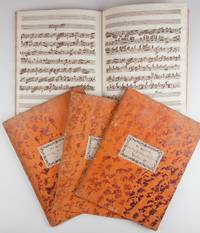
1800réf. 40069Italy 1800. 4 volumes. Small folio 218 x 291 mm. Early flexible dark orange marbled boards with manuscript title label to uppers within decorative printed border. Notated in a professional hand on fine quality l12-stave rastrum-ruled laid paper. Contents in order of appearance: 41no. 5 38 no. 2 37 no. 1 39 no. 3 42 no. 6 and 40 no. 4. Violino primo: i title 40 pp. Violino secondo: i title 38 pp. Viola: i title 36 pp. Violoncello: i title 36 pp. With several additional leaves of blank rastrum-ruled paper. Boards worn faded and abraded with very small portions of spine lacking. Occasional showthrough. In very good internal condition overall. "A decade or so after the Op. 20 set came the fateful Op. 33 again comprising six quartets. It wasn't so much Haydn's fate of which these works proved full as a Mozart's: they prompted him to return to the string quartet and write his own first six masterpieces in the medium - the set that bear a more affectionate and admiring dedication to Haydn than does any great composer's dedicated to any other great composer ." Hans Keller: The Great Haydn Quartets p. 64. unknown books
1788réf. 40118London: Longman & Broderip 1788. Folio. Disbound. 1f. recto title verso blank i blank 2-23 i blank pp. Engraved throughout. With contemporary London instrument dealer's overpaste to foot of title: "Sold at Gough's Harp and Piano-Forte Musical Instrument Warehouse No. 4 Sackville Street near the New Bridge ." Occasional light wear and foxing; several small tears with minor loss to edges; title and final leaf slightly soiled; repair to inner margin of blank verso of title. Published in the same year as the edition published in Vienna by Artaria. BUC p. 469. RISM 3850 one copy only in the U.S. at the University of Michigan. OCLC 34921913. Worldcat one copy only in the U.S. Hob. XVI:17 is most probably by Johann Gottfried Schwanenberger 1737-1804 "although authenticated by Haydn in ca. 1799-1803." Larson and Feder: The New Grove Haydn p. 187. Longman & Broderip unknown books
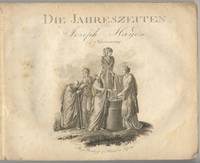
1802réf. 40481Leipzig: Breitkopf & Hartel 1802. Oblong folio. Original publisher's orange decorative printed wrappers with "Les Saisons par J. Haydn double rule Die Jahreszeiten von J. Haydn" within thick decorative rule to upper. 1f. recto title with engraved vignette by F. W. Nettling after Schubert verso blank 176 pp. with publisher's catalogue to lower portion of p. 174 and pp. 175-176. Text in German and French. Typeset throughout. The title-page vignette depicts an allegory of the seasons with two women decorating a statue with flowers and another supporting a hunched old man who carrying a walking stick. Contemporary signature to corner of upper wrapper. Wrappers somewhat worn and rubbed; small tears to upper and spine with minor loss. Light to moderate foxing; several leaves soiled at edges. First Edition later issue. HWV II p. 59. Hoboken Catalogue Vol. 9 1419 variant. RISM H4690. One of Haydn's two masterful oratorios this secular work was written shortly after The Creation 1798 to a libretto by Baron Gottfried von Swieten 1733-1803 after the eponymous poem by James Thomson 1700-1748 published in 1730. The work was first performed on 24 April 1801 in a private première at the Schwarzenberg Palace in Vienna; the first public production took place on 29 May 1801. "Although the initial reception of The Seasons was favourable - Haydn wrote to Clementi that it had enjoyed 'unanimous approval' and that 'many prefer it to The Creation because of its greater variety' - critical opinion soon became mixed owing in part to its perceived 'lower' subject in part to a growing aesthetic resistance to its many pictorialisms. Haydn himself contributed to both strands of criticism: he supposedly said to Francis II 'In The Creation angels speak and tell of God but in The Seasons only Simon speaks' Dies; and he indiscreetly criticized Swieten's croaking frogs 'Frenchified trash' and the absurdity of a choral hymn to toil Fleiss. Nonetheless he maintained that it would join The Creation in assuring his lasting fame. For the publication he took the path of lesser resistance selling the rights to Breitkopf & Härtel. . Notwithstanding its less exalted subject The Seasons is compositionally more virtuoso than The Creation and offers greater variety of tone: Haydn's pastoral is one of the final glories of a tradition that is more than 'high' enough." Georg Feder and James Webster in Grove Music Online The music is "of wonderful freshness and unfailing originality." TNG Vol. 8 p. 347. Breitkopf & Hartel unknown books
1800réf. 40445Vienne: Artaria et Comp. PN 837 1800. Folio. First violin part in early marbled wrappers with decorative cut-paper title label in manuscript to upper; other parts with thin strips of marbled paper reinforcing spines. Violino primo: 1f. recto title verso blank 19 i blank pp. Title within elaborate border engraved by J. E. Mansfeld incorporating a portrait of Haydn at head a muse holding a flute and trumpet and an angel playing a lyre. Violino 2o.: 17 i blank pp. Viola: 17 i blank pp. Violoncello: 17 i blank pp. Engraved throughout. Wrappers quite worn and torn at spine. Slightly worn foxed soiled and stained; old paper repair to inner margins of title and final leaf; margins of two leaves of first violin part trimmed with partial loss of plate number. First Edition with the noted title page incorporating a portrait of the composer. Hoboken 7 647. Hoboken Collection Vol. 7 647. BUC p. 466. RISM H3574. "The last of Haydn's six great E-flat quartets 1797 is perhaps - dare one compare on this level - the greatest of them all; in any case it is amongst the greatest of the his great quartets as well as being the very greatest of the 'celebrated' which status it no doubt again owes to its symmetrical themes - the only aspect of the work one is tempted to suggest which is not drastically innovatory. One hardly knows where to start when listing its lasting innovations . but inasmuch as they affect one's performance of the work one can concentrate on them with a quiet conscience." Keller: The Great Haydn Quartets p. 228. Artaria et Comp. [PN 837] unknown books
1801réf. 40448Leipzig: Breitkopf & Hartel 1801. Oblong folio. Orange paper boards with original publisher's printed wrappers with title within decorative borders laid down small early vellum label with "118" to spine. 1f. recto title with engraved vignette by F.W. Nettling after Schubert depicting an allegory of the seasons verso blank 176 pp. with publisher's catalogue to lower portion of p. 174 and pp. 175-176. Text in German and French. Typeset throughout. Numbering and occasional markings in pencil. Wrappers worn and abraded part of lower lacking; small early manuscript annotations to lower outer corner of upper with portion cancelled. Minor to moderate foxing; minor staining. First Edition. HWV II p. 59. Hoboken Catalogue Vol. 9 1419. RISM H4690. One of Haydn's two masterful oratorios this secular work was written shortly after The Creation 1798 to a libretto by Baron Gottfried von Swieten 1733-1803 after the eponymous poem by James Thomson 1700-1748 published in 1730. The work was first performed on 24 April 1801 in a private première at the Schwarzenberg Palace in Vienna; the first public production took place on 29 May 1801. "Although the initial reception of The Seasons was favourable - Haydn wrote to Clementi that it had enjoyed 'unanimous approval' and that 'many prefer it to The Creation because of its greater variety' - critical opinion soon became mixed owing in part to its perceived 'lower' subject in part to a growing aesthetic resistance to its many pictorialisms. Haydn himself contributed to both strands of criticism: he supposedly said to Francis II 'In The Creation angels speak and tell of God but in The Seasons only Simon speaks' Dies; and he indiscreetly criticized Swieten's croaking frogs 'Frenchified trash' and the absurdity of a choral hymn to toil Fleiss. Nonetheless he maintained that it would join The Creation in assuring his lasting fame. For the publication he took the path of lesser resistance selling the rights to Breitkopf & Härtel. . Notwithstanding its less exalted subject The Seasons is compositionally more virtuoso than The Creation and offers greater variety of tone: Haydn's pastoral is one of the final glories of a tradition that is more than 'high' enough." Georg Feder and James Webster in Grove Music Online The music is "of wonderful freshness and unfailing originality." TNG Vol. 8 p. 347. Breitkopf & Hartel unknown books
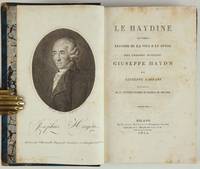
1812réf. 39523Milano: Candido Buccinelli . contrada di s. Margherita num. 1118 1812. Octavo. Dark blue calf-backed marbled boards spine in decorative compartments gilt titling gilt marbled endpapers. 1f. recto title verso publisher's note v-viii 298 i errata ii "Contorni delle Medaglie" i blank pp. First Edition of one of the first biographical accounts of Haydn preceded only by the far less important biographical pieces by Framery and Le Breton. Wolffheim II 523. The present work was translated into English in 1839 as The Life of Haydn in Letters. Carpani was an Italian librettist critic and poet. "Among various writings two books are particularly important: Le Haydine . and Le Rossininane ossia lettere musico-teatrali. . The former was plagiarized by Stendhal and this created a lively controversy. These books show that Carpani was very knowledgeable about all contemporary music and an astute judge of the renewal movement in the early 19th century. He was in touch with all the major composers of his period and accompanied Rossini on his celebrated visit to Beethoven in 1822." TNG Vol. 3 p. 818. Bound with: Majer Andrea 1765-1837. Discorse sulla Origine Progressi e Stato Attuale della Musica Italiana. Padova: Minerva 1821. 1f. recto title verso quotation from Quintil 3-173 i "Avvertimento" 1f. recto "Indice" verso colophon "Della Nuova Società Tipografica in Ditta N.Z. Bettoni e Compagni 1821". First Edition. OCLC copies in France and Italy only. With the fine engraved half-length frontispiece portrait of Haydn by J. Neidl after Zitterer often lacking. Binding slightly worn rubbed and bumped. Some minor wear and foxing but in very good condition overall. Candido Buccinelli ... contrada di s. Margherita num. 1118 unknown books
1909réf. 37397Leipzig: Breitkopf & Härtel 1909. Softcover. Very Good. Octavo. Wrappers. 64 pp. With folding plates. Breitkopf & Härtel unknown books
1959réf. 37435Zürich: Amalthea 1959. Hardcover. Very Good. Small octavo. Boards. 577 pp. With musical examples and illustrations. In dustjacket. Amalthea hardcover books
1902réf. 37485New York: E. P. Dutton 1902. Hardcover. Very Good. Octavo. Boards. xii 231 pp. Upper hinge partially split. Slightly worn. E. P. Dutton hardcover books