1 012 résultats
réf. 76-1805Paris: French Publisher circa 1761. Engraving. 26 x 18.5 cm sheet. Good scattered specks of foxing throughout. [Paris: French Publisher, circa 1761]. unknown
réf. 13967NY STEIN 1973. FIRST AMERICAN EDITION VERY GOOD. 1st Edition. NY, STEIN, 1973 unknown books
1895réf. 462014Chicago: Rand McNally & Company 1895. Hardcover. Near Fine/Near Fine. First American edition. Translayed by Annette E. Crocker. 12mo. 223pp. Partially opened. Decorated green cloth. Foredge untrimmed a few pages roughly opened but a handsome near fine copy. Rand, McNally & Company hardcover books
1890réf. 36763Paris: Choudens Père et Fils PN A.C. 9451 1 1803; A.C. 2482 A.C. 3730 1890. 4 volumes bound in 2. Large octavo. Quarter black morocco with marbled boards raised bands on spine in gilt-ruled compartments titling gilt marbled endpapers. A total of 80 songs. Vol. I: 1f. recto title verso blank 1f. recto named cast list and contents verso blank 123 pp. Named cast includes Béranger A. de Lamartine Passerat Baïf Victor Hugo Alfred de Musset Eugène Tourneux Ponsard La Fontaine Théodore de Banville and A. Porte. Vol. II: 1f. recto title verso blank 1f. recto named cast list and contents verso blank 123 pp. Named cast includes Émile Augier O. Pradère Jules Barbier H. Lefevre Louise Bertin A. de Lamartine Ernest Lebouvé Leon Gozlan L. de Peyre and Théophile Gautier. Vol. III: 1f. recto title verso blank 1f. recto named cast list and contents verso blank. 123 pp. Named cast inclues Alexandre Dumas fils Jules Barbier Louis Gallet Théophile Gautier Joseph Collin M. Carré Ch. Gounod Scribe Delavigne Émkle Augier Albert Delpit O. Pradère and Comte A. de Ségur. Vol. IV: 1f. recto title verso blank 1f. recto named cast list and contents verso blank. 119 pp. Named cast includes Paul de Choudens J. Barbier Michel Carré Comte A. de Ségur Poirson Gallet Émile Augier E. Legouvé Eugène Manuel and Pierre Barbier. Binding slightly worn rubbed and bumped. Choudens Père et Fils [PN A.C. 945(1), (1*) [1803]; A.C. 2482, A.C. 3730 unknown books
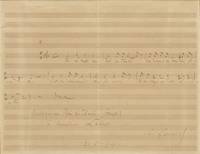
réf. 36231Oblong folio 175 x 264 mm. 30 measures in total notated on both sides of the leaf the initial 13 measures in black ink the following 17 in purple pencil possibly a continuation of the same work. With several deletions and "Notes manuscrites de Ch. Gounod" in pencil to upper right margin. Slightly worn and browned; cut from a larger leaf. "Gounod wrote in most of the major genres of his day sacred and secular. That his reputation began to wane even during his lifetime does not detract from his place among the most respected and prolific composers in France during the second half of the 19th century." Steven Huebner in Grove Music Online. unknown books
réf. 395518 measures in treble clef notated in black ink on a portion of a 14-stave rastrum-ruled album leaf 177 x 233 mm. With text in French in Gounod's hand commencing "Il etait un Roi du Thulé" Marguerite's melancholy aria from Act III. Identified in the composer's hand at foot: "Ballade du Roi de Thulé . à Monsieur Lebert. Ch. Gounod" and dated 26 August 1869. Slightly faded; browned; creased at central vertical fold; portions of leaf slightly lightened; margins of verso reinforced with brown paper tape. Faust an opera in five acts to a libretto by Jules Barbier and Michel Carré after Carré's Faust et Marguerite and Johann Wolfgang von Goethe's Faust Part I in the French translation by Gérard de Nerval was first performed in Paris at the Théâtre Lyrique on 19 March 1859 in a version with spoken dialogue; recitatives were added in 1860 and a ballet and couplets for Méphistophélès were added for a new production in 1869. "The historical importance of Faust is that it sounded a new note in French music. The conventional pomposities of the grand opera which then dominated the stage were superseded by a more intimate and poetic approach. The fashion Gounod set was one of conversational exchange rather than declamation." James Harding: Gounod p. 114. "Faust remains one of the landmarks of French 19th-century opera full of variety and with an underlying sensuality that saved it from the sentimentality and banality to which Gounod's later works especially his oratorios often descended in his quest for inspired simplicity." Robert Orledge in Grove Music Online A considerable success at its premiere the work was one of the most frequently performed works at the Opéra becoming one of the staples of the international repertory. unknown books
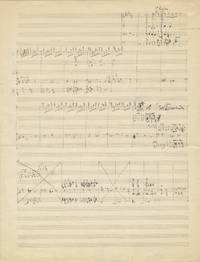
réf. 39978One bifolium 272 x 347 mm. 4 pp. Notated in black ink on 26-stave rastrum-ruled paper. Unsigned and undated. With significant corrections cancels etc. Slightly worn and browned; small tear to blank outer margin of first leaf repaired; horizontal crease; short split to head and tail of spine. In very good condition overall. Music unlocated but very likely from a sacred vocal work with orchestra. The first page contains 16 measures of music on 8-line staves the uppermost stave marked with the key signature of 5 sharps in a contrapuntal style incorporating stretto technique whereby a melody is restated in overlapping fashion in two or more voices. The second page contains 28 measures including four cancelled measures with music still visible on 4- and 5-line staves with a sharp-key signature as in the first page and passages of high-register 8th notes most likely for violin; the uppermost stave is designated "1e. Basson." The third page contains 21 measures on an 8-line stave being an alternate iteration of the material from the first page; the final 4 measures which are cancelled contain tremolo string material similar to the second page. The upper portion of the fourth and final page contains 8 measures of music similar to the first and third pages in a stretto character but with a new key signature of 3 flats. With 2 measures of music also with 3 flats to lower portion of final page. Gounod's interest in sacred music and counterpoint was awakened in his youth and continued for the span of his career. "Gounod arrived at the French Academy in Rome at the end of January 1840. Little there sustained his musical interest. He excoriated performances of operas by Donizetti Bellini and Mercadante composers he later characterized as mere 'vines twisted around the great Rossinian trunk without its vitality and majesty' and unable to match that composer's spontaneous melodic gifts. Gounod was however genuinely moved by performances of Palestrina at the Cappella Sistina and more generally by the cultural legacy of Rome in the other arts a legacy he felt that musicians could ill afford to ignore. His Roman experience laid the foundation for the stark comparison he drew in his aesthetics between on the one hand a universally appealing combination of beauty truth and Christianity and on the other egoism artifice and insularity. He described stile antico counterpoint as a selfless analogue to Michelangelo's frescoes issuing from pure Faith." Steven Huebner in Grove Music Online A fine example of a Gounod working manuscript in the composer's elegant hand displaying how he skillfully wove together counterpoint orchestration and compositional structure; well worthy of further study. unknown books
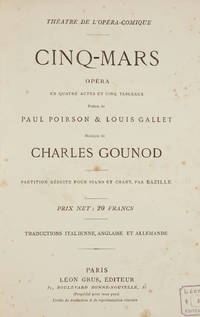
1879réf. 36741Paris: Léon Grus PN L.G. 3381 1879. Large octavo. Quarter dark red morocco with dark red pebbled cloth boards with decorative gilt cornerpieces within gilt rules to upper and lower raised bands on spine in decorative compartments gilt titling gilt moire-patterned ivory endpapers all edges gilt. 1f. recto title verso blank 1f. recto dedication verso blank 1f. recto named cast list verso blank 1f. recto contents verso blank i half-title iii overture paginated A-C 287 i blank pp. Lithographed. Named cast list includes MM. Dereims Stéphanne Giraudet Barré Alfred Maris Bernard Lefèvre Teste Collin Chenevière Villars Davoust Chevrier Franck-Duvernoy Périer P. Lévy Dorel and Laurençon and dancers Blandini Coralli Lafont Stelino Dardignac and Anck. Binding slightly worn rubbed and bumped; endpapers stained and soiled. Minor internal wear and browning; small oval publisher's partial handstamp to lower outer margin of title. Second version first issue. First performed in Paris at the Opéra-Comique on 5 April 1877. Léon Grus [PN L.G. 3381] unknown books
1879réf. 28957Paris: Léon Grus PN L.G. 3381 1879. Large octavo. Full modern dark gray cloth. 1f. recto title verso blank 1f. recto dedication to his collaborators and friends Paul Poirson and Louis Gallet verso blank 1f. recto named cast list verso blank 1f. contents i part title iii a-c 287 i blank pp. Lithographed Named cast includes Dereims Stéphanne Giraudet Barré Alfred Maris Bernard Lefèvre Teste Collin Chenevière Villars Davoust Chevrier Franck-Duvernoy Périer P. Lévy Dorel and Laurençon. With an inscription signed A. Giacometti to dedication. Columbia Broadcasting System Music Library handstamp to lower margin of free front endpaper and several leaves; tape repairs to gutters of pp. 16-1718-19 22-23 81-99 and 280-281; some soiling to title with small oval publisher's handstamp to lower margin. Second version first issue. Commissioned by Carvalho just after he took on the directorship of the Opéra Comique 1876 Cinq-Mars was "given a lavish production" there on 5 April 1877 to a libretto by Poirson and Ballet after the novel by A.V. de Vigny. "The first appearance of a new opera by as eminent a figure as Gounod attracted a flurry of attention. ." Steven Huebner in Grove Music Online. Léon Grus [PN L.G. 3381] unknown books
1881réf. 27462Paris 1881. 279 x 198 mm. Signed by the artist in pencil at lower left. A very good impression on laid paper. Remnants of hinges to upper corners of verso. Béraldi: Les Graveurs du XIXe Siècle Paris: 1885-92 XI-188. Faust an opera in five acts to a libretto by Jules Barbier and Michel Carré after Carré's Faust et Marguerite and Johann Wolfgang von Goethe's Faust Part I in the French translation by Gérard de Nerval was first performed in Paris at the Théâtre Lyrique on March 15 1859. "Faust became particularly important to the French musical establishment at the end of the century. A work by a winner of the Prix de Rome that could claim to be thoroughly modern and personal in style at its première and go on to international stages was a significant enhancement to the musical prestige of a French operatic culture previously dominated by Meyerbeer and the none-too-easily exportable genre of opéra comique. Its national value was enhanced because after some initial assessments as 'Wagnerian' Gounod's compositional voice in Faust was heard as important in the definition of a 'French' musical aesthetic." Steven Huebner in Grove Music Online. Renouard 1845-1924 was a noted painter and engraver whose works are held at the Louvre the Opéra Museum etc. unknown books
1862réf. 26503Milano: Francesco Lucca PNs 13851-13876 1862. Folio. Dark gold cloth-backed wrappers. 1f. recto with lithographic illustration of a scene from the opera verso blank. 1f. recto title verso blank 1f. recto named cast list verso table of contents with plate and page numbers 247 i blank pp. Engraved. Text in Italian. Named cast includes Giuseppe Morini Giorgio Atry Luigi Colonnese Vincenzo Paraboschi Leonilda Boschetti Maria Gualtieri and Prassede Dompieri. Lacking upper wrapper lower worn and soiled. Slightly worn and soiled; margins and outer leaves foxed; occasional fraying perforations chips and small tears not affecting music; upper portions of some leaves dampstained. First Italian edition of the second version. OCLC no. 16852458. Faust was first performed at the Théâtre Lyrique in Paris on March 19th 1859 in a version with spoken dialogue; recitatives were added in 1860 and a ballet in 1869. The libretto by Barbier and Carre is based on Goethe but focuses on the love story between Faust and Marguerite. "The historical importance of Faust is that it sounded a new note in French music. The conventional pomposities of the grand opera which then dominated the stage were superseded by a more intimate and poetic approach. The fashion Gounod set was one of conversational exchange rather than declamation." James Harding: Gounod p. 114. Francesco Lucca [PNs 13851-13876] unknown books
1900réf. 28306Paris: Choudens 1900. 1f. recto title verso blank 1f. recto named cast list and contents verso blank 132 pp. Named cast includes Barbot Balanqué Reynald Cibot Carvalho Faivre and Duclos. Bound with: Adam Adolphe 1803-1856. Le Brasseur de Preston Opéra-Comique en trois Actes Paroles de MM. de Lenven et Brunswick. Représenté pour la première fois a Paris sur le Théatre Royal de l'Opéra-Comique le 31 Octobre 1838 Partition Piano et Chant: 15 francs. Piano-vocal score. Paris: Bichault PN 4932 R. ca. 1900. 1f. recto title verso blank 1f. blank i contents 102 i blank 103-240 i blank i decorative device pp. Large octavo. Quarter red leather with textured red cloth spine in decorative compartments gilt titling gilt decorative endpapers. Binding slightly worn; remnants of label to spine. Browned; occasional foxing; some leaves trimmed; several leaves partially detached; some signatures split; annotation in pencil to verso of free front endpaper; small publisher's facsimile handstamp to upper margin of first page of music. First performed to a libretto by Jules Barbier and Michel Carré after Carré's Faust et Marguerite and Johann Wolfgang von Goethe's Faust Part I in the French translation by Gérard de Nerval in Paris at the Théâtre Lyrique on 19 March 1859. To most opera lovers today Gounod is essentially the composer of Faust and Roméo et Juliette and with good reason for it would be difficult to defend the critical position that these are not his best works for the stage." Steven Huebner in Grove Music Online. Choudens unknown books
1892réf. 28738Boston: Oliver Ditson 1892. Quarto. Original publisher's dark orange wrappers with titling within architectural border. 1f. recto title verso blank 1f. recto preface verso blank 3-5 dramatis personae synopsis and contents 6-236 pp. Wrappers detached with minor chips tears and tape repairs to edges; former owner's signature "E.B. Shinmon" to upper wrapper; spine lacking. Some signatures split; former owner's signature to title; tape repair to upper margin of p. 131 not affecting music. Third version. First American edition. First performed to a libretto by Jules Barbier and Michel Carré after Carré's Faust et Marguerite and Johann Wolfgang von Goethe's Faust Part I in the French translation by Gérard de Nerval in Paris at the Théâtre Lyrique on 19 March 1859. To most opera lovers today Gounod is essentially the composer of Faust and Roméo et Juliette and with good reason for it would be difficult to defend the critical position that these are not his best works for the stage." Steven Huebner in Grove Music Online. Oliver Ditson unknown books
1871réf. 36758Paris: Choudens PN A.C. 2260 1871. Large octavo. Quarter dark brown morocco with marbled boards spine in decorative compartments gilt titling gilt marbled endpapers. 1f. recto title printed in dark brown verso blank 3 contents 4-39 i pp. Text in French and Latin. Lithographed. Performance markings in pencil to first number; minor annotatioins in ink to p. 15. Binding quite worn and rubbed corners slightly bumped. Minor to moderate browning. First French edition the Novello Ewer & Co. edition most probably pre-dates the French edition. Bound with: Schubert Franz Collection 40 Mélodies Choisies avec accompt. de Piano . avec les Paroles Allemande s originales et une Traduction Française de Maurice Bourges et Emile Deschamps . Prix 7f. net. Paris: Brandus et Cie. PN B. et Cie. 5199 after 1850. 1f. recto full-page half-length lithographic portrait of Schubert verso blank 1f. recto title verso blank 1f. recto contents verso blank 174 pp. Text in French and German. Lithographed. Minor wear; some foxing and browning; several signatures partially detached; publisher's facsimile signature handstamp to blank foot of title. Choudens [PN A.C. 2260] unknown books
1866réf. 26259Paris: Choudens PN A.C. 738 1866. Large octavo. Quarter contemporary red calf with marbled boards rules and titling gilt to spine marbled endpapers. 1f. title i named cast list for the first performance and table of contents 148 pp. Lithographed. Text in French. Handstamps of Choudens and E. Heu to lower margin of title. Printer's note to lower margin of table of contents. Binding slightly worn bumped and scuffed; head of spine slightly torn. Some minor soiling; small tear to blank head of first two leaves. Second version first issue. Lesure II pp. 108-09. OCLC no. 15150060. The first performance of La Colombe took place at the Théatre de Bade in Baden-Baden on August 3 1860 under the direction of Edouard Bénazet. An expanded version of the opera was staged at the Opéra-Comique in Paris in 1866. "Gounod's 12 operas span a range of the generic types available in French lyric theatre. Smaller works such as Philémon et Baucis and La colombe strike a balance between spoken dialogue and set pieces typical of opéra comique of the second quarter of the 19th century: relatively small-scale numbers with many strophic types among them are joined by long passages of dialogue. Musical depictions of frivolity are relatively few by standards of the genre contributing to the general tenor of these pieces as sentimental comedy." Steven Huebner in Grove Music Online. Choudens [PN A.C. 738] unknown books
1897réf. 28954Paris: Choudens Fils PN A.C. 7409 2743 880 1897. Large octavo. Quarter dark red cloth with decorative textured blue paper boards printed in black. 1f. recto title verso blank 1f. recto named cast list and contents verso blank 222 xxii pp. Named cast includes Gueymard Hamackers Tarby Belval Grisy Marié Coulon and Fréret. Binding slightly worn; signature to upper outer corner of front pastedown. Slightly browned. Sixth version. First performed in Paris at the Opéra on February 28 1862 to a libretto by Barbier and Carré inspired by G. de Nerval's Le voyage en Orient. "The magnificent first production was directed by Eugène Cormon with costumes designed by Alfred Albert and Paul Lormier and scenery by Édouard Desplechin Act I Charles-Antoine Cambon and Joseph Thierry Acts II and IV scene 2 Hugues Martin Act III and Joseph Nolau and Auguste-Alfred Rubé Act IV scene 1." Wikipedia. Choudens Fils [PN A.C. 7409, 2743, 880] unknown books
1886réf. 36796Paris: Choudens Fils PN A.C. 1005 1886. Large octavo. Half dark red morocco with marbled boards spine in gilt-ruled compartments titling gilt moire-patterned endpapers. 1f. recto decorative title printed in dark gold verso blank 1f. recto named cast list and contents verso blank 3-32 8 33-213 pp. 15 plates of scenes from the opera printed on coated paper in sepia on one side of the leaf only. Binding slightly worn rubbed and bumped. Minor browning throughout. Third edition. Mireille to a libretto by Michel Carré after Frédéric Mistral was first performed in Paris at the Lyrique on 19 March 1864. "There are . fine moments in Mireille particularly in the title role where Gounod exhibits his particular talent for feminine characterization . Mireille . is a noteworthy contribution to the French lyric stage . It presents the unsuitability of a love match because of difference in social status entirely within the framework of a rural agrarian society and transforms the daughter of a farmer into a tragic heroine." "In his unceasing quest for what he saw as dramatic and spiritual truth Gounod succeeded in restoring a higher sense of artistic purpose to the French stage and in strictly musical terms his influence on the course of French music was substantial." Steven Huebner in Grove Music Online. Choudens Fils [PN A.C. 1005] unknown books
1890réf. 28826Paris: Choudens Fils PN A.C. 1005 1890. Large octavo. Original publisher's full red cloth flexible blindtooled boards titling in silver to upper and spine. 1f. recto title verso blank 1f. recto named cast list and contents verso blank 3-32 viii 132-328 33-213 i blank pp. Binding slightly worn soiled and bumped; front free endpaper brittle corner lacking. Browned; some signatures split. Third version fourth issue. Mireille to a libretto by Michel Carré after Frédéric Mistral was first performed at the Lyrique on March 19 1864. "There are. fine moments in Mireille particularly in the title role where Gounod exhibits his particular talent for feminine characterization. Mireille. is a noteworthy contribution to the French lyric stage. It presents the unsuitability of a love match because of difference in social status entirely within the framework of a rural agrarian society and transforms the daughter of a farmer into a tragic heroine." "In his unceasing quest for what he saw as dramatic and spiritual truth Gounod succeeded in restoring a higher sense of artistic purpose to the French stage and in strictly musical terms his influence on the course of French music was substantial." Steven Huebner in Grove Music Online. Choudens Fils [PN A.C. 1005] unknown books
1864réf. 28811Paris: Choudens PN A.C. 1005 1012 1864. Large octavo. Half dark red morocco with marbled boards original publisher's dark ivory illustrated wrappers bound in. 1f. recto title illustrated by V. Arouy verso blank 1f. recto dedication verso blank i named cast list and contents 2-191 i 192-200 201-242 pp. Named cast includes Miolan-Carvalho Morini Ismaël Petit Faure-Léfèvre Reboux and Wartel. Binding slightly worn rubbed and bumped; spine lacking; library bookplate to front pastedown; upper wrapper chipped with repair and with perforated handstamp also to title. Slightly foxed and browned; tear to inner margin of first two leaves repaired; ex-library with associated markings. First Edition later issue. Mireille to a libretto by Michel Carré after Frédéric Mistral was first performed at the Lyrique on March 19 1864. "There are . fine moments in Mireille particularly in the title role where Gounod exhibits his particular talent for feminine characterization . Mireille . is a noteworthy contribution to the French lyric stage . It presents the unsuitability of a love match because of difference in social status entirely within the framework of a rural agrarian society and transforms the daughter of a farmer into a tragic heroine." "In his unceasing quest for what he saw as dramatic and spiritual truth Gounod succeeded in restoring a higher sense of artistic purpose to the French stage and in strictly musical terms his influence on the course of French music was substantial." Steven Huebner in Grove Music Online. Choudens [PN A.C. 1005 (1012)] unknown books
1865réf. 28785Paris: Choudens PN A.C. 1005.1012 1865. Large octavo. Quarter black calf with marbled boards spine in gilt-ruled compartments titling gilt marbled endpapers. 1f. recto title illustrated by T. Laval 1f. dedication 1f. named cast list and contents 3-32 132-328 33-214 pp. Binding slightly worn rubbed and bumped; hinges split. Occasional light to moderate foxing; some signatures split; several leaves partially detached; small publisher's facsimile signature handstamp to lower margin of title; small tear to outer edge of p. 189 not affecting music. Third version. Mireille to a libretto by Michel Carré after Frédéric Mistral was first performed at the Lyrique on 19 March 1864. "There are . fine moments in Mireille particularly in the title role where Gounod exhibits his particular talent for feminine characterization . Mireille . is a noteworthy contribution to the French lyric stage . It presents the unsuitability of a love match because of difference in social status entirely within the framework of a rural agrarian society and transforms the daughter of a farmer into a tragic heroine." "In his unceasing quest for what he saw as dramatic and spiritual truth Gounod succeeded in restoring a higher sense of artistic purpose to the French stage and in strictly musical terms his influence on the course of French music was substantial." Steven Huebner in Grove Music Online. Choudens [PN A.C. 1005.(1012)] unknown books
1901réf. 28814Paris: Choudens PNs A.C. 1005 1012 7410 1901. Large octavo. Original publisher's dark ivory illustrated wrappers printed in green. 1f. recto title verso blank 1f. recto named cast list and contents verso blank 242 pp. Named cast includes Marthe Rioton Marié de L'Isle de Crapone Eyreams M.L. Rolland Marechal Dufrane Vieuiller Jacquin and Huberdeau. With an autograph inscription signed by English dramatic soprano Florence Easton 1882-1955 to upper portion of title. Wrappers worn and soiled; spine creased. Signatures partially split. Fourth version. Mireille to a libretto by Michel Carré after Frédéric Mistral was first performed at the Lyrique on March 19 1864. "There are. fine moments in Mireille particularly in the title role where Gounod exhibits his particular talent for feminine characterization. Mireille. is a noteworthy contribution to the French lyric stage. It presents the unsuitability of a love match because of difference in social status entirely within the framework of a rural agrarian society and transforms the daughter of a farmer into a tragic heroine." "In his unceasing quest for what he saw as dramatic and spiritual truth Gounod succeeded in restoring a higher sense of artistic purpose to the French stage and in strictly musical terms his influence on the course of French music was substantial." Steven Huebner in Grove Music Online. Choudens [PNs A.C. 1005 (1012), 7410] unknown books
1880réf. 28812London and New York: Boosey and Co 1880. Large octavo. Original publisher's full dark red cloth decoratively tooled in blind black dark blue and gilt titling gilt to spine all edges gilt. 1f. recto title verso printer's note 1f. recto contents verso cast list and synopsis 176 pp. Head and tail of spine very slightly frayed. Some signatures partially split; minor staining to upper margins of pp. 158-161. "There are. fine moments in Mireille particularly in the title role where Gounod exhibits his particular talent for feminine characterization. Mireille. is a noteworthy contribution to the French lyric stage. It presents the unsuitability of a love match because of difference in social status entirely within the framework of a rural agrarian society and transforms the daughter of a farmer into a tragic heroine." "In his unceasing quest for what he saw as dramatic and spiritual truth Gounod succeeded in restoring a higher sense of artistic purpose to the French stage and in strictly musical terms his influence on the course of French music was substantial." Steven Huebner in Grove Music Online. Boosey and Co unknown books
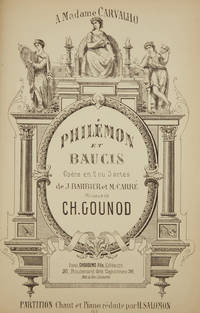
1900réf. 36764Paris: Choudens PN A.C. 703 1900. Large octavo. Quarter dark blue morocco with marbled boards raised bands on spine in gilt-ruled compartments titling gilt. 1f. recto title within decorative architectural border verso blank 1f. recto named cast list and contents verso blank 49 i 50-54 55-178 pp. Some leaves unopened. Named cast includes Nicot Chapuy Bouhy and Giraudet from the Opéra-Comique and Froment Carvalho Battaille Balanqué and Sax from the Théâtre Lyrique. Binding very slightly worn rubbed and bumped. Third version later issue. Philémon et Baucis to a libretto by Jules Barbier and Michel Carré after Jean de La Fontaine's fable was first performed in Paris at the Théâtre Lyrique on February 18 1860. "At the suggestion of Léon Carvalho director of the Théâtre Lyrique Gounod expanded his original two-act frame into three by adding a middle act that depicts the orgiastic celebrations of the townspeople in Jupiter's temple. For the 1876 revival at the Opéra-Comique which established Philémon in the repertory of that house until World War II Gounod reduced the work to two acts." Steven Huebner in Grove Music Online. Choudens [PN A.C. 703] unknown books
1900réf. 28830Paris: Choudens PN A.C. 703 1900. Large octavo. Red cloth-backed textured blue paper boards with decorative device and titling printed in black to upper titling gilt to spine. 1f. recto title within decorative architectural border verso blank 1f. recto named cast list and contents verso blank 49 i 50-54 55-178 pp. Some leaves unopened. Named cast includes Nicot Chapuyt Bouhy and Giraudet from the Opéra-Comique and Froment Carvalho Battaille Balanqué and Sax from the Théâtre Lyrique. Binding slightly worn and soiled; upper hinge partially split. Browned; some signatures split. Third version second issue. Philémon et Baucis to a libretto by Jules Barbier and Michel Carré after Jean de La Fontaine's fable was first performed in Paris at the Théâtre Lyrique on 18 February 1860. "At the suggestion of Léon Carvalho director of the Théâtre Lyrique Gounod expanded his original two-act frame into three by adding a middle act that depicts the orgiastic celebrations of the townspeople in Jupiter's temple . For the 1876 revival at the Opéra-Comique which established Philémon in the repertory of that house until World War II Gounod reduced the work to two acts." Steven Huebner in Grove Music Online. Choudens [PN A.C. 703] unknown books
1895réf. 28952London: Chappell & Co. PN 22805 1895. Quarto. Original publisher's blue wrappers with titling in dark blue within decorative border. 1f. recto title verso named cast list and notes on first English performance i contents 2-225 i publisher's catalogue pp. Named cast includes from the Royal Opera Covent Garden London production includes Melba EamesRegina Pinkert Bauermeister Edouard de Reszké Dufriche Igenio Corst Ceste Castelmary Miranda Rinaldini and Jean de Reszké and from the Carl Rosa Opera Company production Zelie de Lussan Kate Drew Annie Cook Abramoff Max Eugene John Child F. H. Celli E. Albert and Barton McGuckin. Wrappers worn and detached with remnants of tape repairs; spine reinforced with cloth tape. Tape to inner margin of title and verso of final leaf; minor soiling to edges of title with small publisher's facsimile signature handstamp to lower margin. First performed in English in Liverpool by the Carl Rosa Opera Company at the Royal Court Theatre on 15 January 1890. Chappell & Co. [PN 22805] unknown books