41 results
1970ref. 36969London: Hamlyn 1970. Hardcover. Very Good. Octavo. Boards. 157 pp. Illustrated with 70 plates in color. Hamlyn hardcover books
1970ref. 34051London: Hamlyn 1970. Hardcover. Very Good. Octavo. Boards. 157 pp. Illustrated with 70 plates in color. Hamlyn hardcover books
1984ref. 36938Genève: Minkoff 1984. Softcover. Fine. Small octavo. Wrappers. 52 pp. Facsimile of the edition published in Brussels in 1823. Minkoff unknown books
1990ref. 131495TX: Texas Instruments 1990. Softcover. Fine. Fine in wrappers. In wraps softcover. Sealed and 3 hole punched for a binder. Texas Instruments unknown books
1964ref. 37252London: Spring Books 1964. Hardcover. Very Good. Folio. Boards. 37 vi pp. 323 photographic illustrations of rare and historic musical instruments and related items. In dustjacket. Spring Books hardcover books
1975ref. 32572Wien: Sammlungskatalog des Museums fur Volkerkunde 1975. Softcover. Very Good. Octavo. Wrappers. xvi 320 pp. plates. From the collection of musicologist Stanley Boorman. Sammlungskatalog des Museums fur Volkerkunde unknown books
1977ref. 38021Edinburgh: Lyndesay G. Langwill 1977. Hardcover. Very Good. Quarto. Full dark red cloth with titling gilt to spine. xvi 307 pp. With occasional illustrations. Binding slightly bumped; dustjacket worn. Lyndesay G. Langwill hardcover books
1906ref. SJ13530Berlin Chicago & New York . . . :: Leitz 1906. 1906. 8vo. 118 pp. Illus. index. Dark green gilt-stamped cloth. Near fine. Scarce illustrated catalogue of microscopes and related accessories. Leitz, 1906. hardcover books
1986ref. M14105Stuttgart:: Museum for Medical Endoscopy Max Nitze e.V. 1986. 1986. 29 cm. 82 pp. Illustrated. Printed wrappers green cloth spine. Fine. Relating to the early history of electrical urologic endoscopes. With preface by Otto Winkelmann and commentary on the monograph by Hans J. and Matthias A. Reuter. Museum for Medical Endoscopy, Max Nitze e.V., [1986]. hardcover books
1970ref. 41219NY:: Something Else Press. Near Fine in Near Fine dust jacket. 1970. Hardcover. 0871100371 . First edition. Near fine in a near fine dust jacket. . Something Else Press, hardcover books
1960ref. 88992Leonards-on-Sea: by the Author 1960. First Limited Edition. One of a thousand numbered copies this is no. 184. Inscribed and signed by Elgar on limitation page dated March 1961. 12mo 19cm. Original russet cloth; gilt spine and cover titles; 1271pp; text illustrations including 14 tipped-in original photographic plates. Cloth a bit rubbed and faded; slightly over-opened at half-title page; a previous owner has inserted an additional plate by hand and the original invoice from bookseller Oscar Shapiro is tipped on to front endpaper. Overall a Very Good copy. by the Author unknown books
1895ref. 47419Jena: Carl Zeiss 1895. First Edition. Large slim octavo 27cm.; publisher's brown cloth over blue textured paper upper cover lettered in gilt; 4122pp.; steel-engraved text illus. throughout. Boards a bit rubbed and slightly bowed small spot of glue residue at top fore-edge corner of upper cover original gilt quite dulled though Parisian distributor's gilt-lettered cancel still brilliant contemporary American ownership inscriptions to front endpapers. Overall Very Good internally fine. Quite an attractive and uncommon trade catalog issued by the still-extant microscope manufacturer. This issue not separately catalogued in OCLC COPAC or KVK as of January 2020. Carl Zeiss unknown books
1850ref. 1310Vienna: unk. 1850. First Edition. Later stiff boards. Fine. 8vo. There are 9 large fldg. litho. plates illus. details of the instruments. A very interesting pamphlet on the techniques of constructing self recording instruments. Jelinek was known for his work on the derivation and equations for the measurment of relative humidity see Napier-Shaw. Jelinek was convinced of the importance of consistent observations over long periods of time and felt that mechanical recording devices were the only way to obtain such information. The pamphlet offered here addresses these issues and suggests various ways in which it could be accomplished. unk., hardcover books
1961ref. 36958London: The Holland Press 1961. 3 volumes. Quarto. 357; 383; 160 ccxix pp. Illustrated. In dustjackets. A facsimile of the original edition published in 1876-1878. The Holland Press unknown books
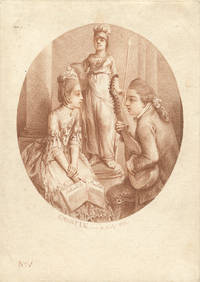
1772ref. 37112London 1772. 235 x 168 mm. On laid paper with "No. V" printed at lower left. A female singer holds an open music book on her lap entitled "Pastorale by Musolini." A Signor Mussolini is recorded as a singer and mandolin player making his first public appearance at Covent Garden on 27 April 1773 "playing a concerto on the double mandolin and royal guitar and accompanying a young gentlewoman in song." Highfill et al. Vol. 10 p. 407. unknown books
1905ref. 21058ca1920 / ca1905. Original manufacturer's fitted boxes. Near Fine. Two Planimeters in their original velvet and satin lined boxes. The Willis instrument retains its original 8 pp. instructional pamphlet. Planimeters are designed to find the area of a figure profiles plans sections indicator diagrams drawn to any scale on a plane surface by simple mechanical operation. The area is computed by tracing the outline of figure the maximum was a figure of 22 inches in diameter for this size instrument with the tracing point and reading out the result on a graduated measuring wheel; the scale on this device will read out to hundredths of a square inch. It is based on a design by the Swiss mathematician Jacob Amsler in 1856 who licensed it to Keuffel & Esser. The K & E instrument offered here has their catalog identification number 4211. The Willis design uses somewhat different construction and a novel readout design that purports to enhance accuracy because its tracing arm is able to move in a uniform "frictionless" precise manner without regard to the paper or surface quality. The readout can be changed to any of six scales provided with the mechanism. The last patent date cited is 1901 with an instrument serial number 5592. See Zoller Instruments and Methods . SIS Bulletin v. 75 2002 pp. 11-17. unknown books
1881ref. 4809West Troy: A & A F Spitzli Publishers 1881. First Edition. Original publisher's decorated cloth. Near Fine. 8vo I - 182 2 1 - 70 2 - contents pp.; II - Frontispiece 3 - 5 6 - 118 12 - adverts pp. The text is illus. throughout. Two books bound as one but clearly meant to be issued together. The first book is an extremely useful encyclopaedia of all terms used in or related to the textile trade in the 19th century. There are detailed explanations of manufacturing terms types of cloth and material weaving design etc. Accompanying this is a separately paginated trade catalogue of instruments related to the sciences technical drawing instruments microscopy and items generally used in the design and manufacture of fabrics. It is a very unusual combination of goods. Absent from Romaine. A & A F Spitzli Publishers hardcover books
1912ref. 5142Munich: Deutschen Museums 1912. First Edition. Contemporary cloth. A fine copy. Folio. Frontispiece and 7 plates. Reichenbach was known as an inventor and designer of astronomical instruments and an engineer. He spent some time in England in the early 1790s where he met Boulton Watt and Ramsden. He returned to Germany and was commissioned an officer in the Bavarian army engineering corps. By 1805 he was engaged in the construction of high quality instruments at his own works in Munich where he employed Fraunhofer. This was the beginning of the modern era in German instrument making that resulted in devices of unprecedented power and precision. His workshops became national training centers. German technical excellence in the 19th century is a direct result of Reichenbach's intiative. The book offered here is a scientific biography that covers the development of his instrument designs and engineering projects e.g. his cast iron tube construction of bridges. A superb reference. DSB XI 354 - 355. Deutschen Museums hardcover books
1828ref. 1018London: R Taylor 1828. OFFPRINT. Original plain blue wrappers. Very good. 4to 2 - title page 257 - 289 paginated 1 - blank pp. 2 steel engraved plates. This a separately issued offprint retaining the original pagination. Kater was a member of the Royal Engineers. He devised and built a number of geodetic instruments for the accurate determination of the longitude and acceleration of gravity see Turner. But his most important contribution to scientific instrumentation is the device described in this offprint. The collimator permitted the alignment of a telescope attached to a circle in any position of the instrument with negligible error. See Lenzen & Multhauf on Kater's instruments. R Taylor unknown books
1747ref. 24065London: T Heath Mathematical Instrument-maker . 1747. First Edition. Full contemporary half leather. Very good; binding rubbed; some rumpling to the extreme fore-edge of the folded plates. 8vo xxiii 1 - errata 1 - 107 1 - blank pp. 6 plates and a folding frontispiece illustrating the contents of the case of instruments. An early book explaining the use of the cased instruments. The author also provides a notable if truncated history of mathematical instruments of all sorts and a handlist of published works on the subject from the 16th century. Uncommon. See Clifton p. 131 for Thomas Heath. T Heath, Mathematical Instrument-maker .... hardcover books
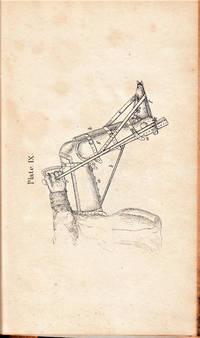
1827ref. 23078London: Printed for Thomas and George Underwood . 1827. First Edition. Contemporary three-quarter leather over binder's cloth. Very good; binding somewhat dry; two spots on the front cover. 8vo xvi 1 - 146 2 - adverts pp. 12 lithographic plates. A renown work for its introduction of new orthopedic devices for simple and complex cases. The book is an outline of the application of Amesbury's inventions and transcriptions of individual procedures from his case book. He also notes in the introduction that the various apparatus he refers to may be obtained at the shop of Mr Grafton in King Street Clifton Directory . p. 117 citing later dates and different addresses. Despite the evident hucksterism the treatise is of value for its awareness and treatment of orthopedic problems and collateral issues e.g. soft tissue trauma accompanying broken bones. In all an informed and remarkably adept treatise. Hirsch I p. 113. Printed for Thomas and George Underwood .... hardcover books
1877ref. 19034Paris: Bureaux du Journal 1877 - 1885. First Edition. Contemporary half leather and marbled paper. Very good; some modest chafing; occasional marginal notes. 8vo I - 4 368 pp. 3 plates; II - 3 - 524 12 pp.5 plates; III - 4 3 - 548 2 pp. 11 plates; V - 3 - 516 pp. 22 plates; VI - 4 3 - 646 pp. 17 plates including a mounted full-page albumen print of Pelletan's 'Continental' microscope - a 'class A' instrument of his own design selling for 600 Francs; VII - 4 3 - 666 pp. 6 plates; IX - 4. 1 - 534 pp. 5 plates plate 1 not bound in - as with other located copies. The asterisk indicating confused numbering of the plates but all are present. A run of an important journal in its formative years. The contents pages read like a who's who of nineteenth century microscopists writing on all matter of observations equipment lenses improvements and observations e.g. vol. 9 contains a number of articles and illustrations on penicillin ferments. The text is illustrated throughout. Bureaux du Journal hardcover books
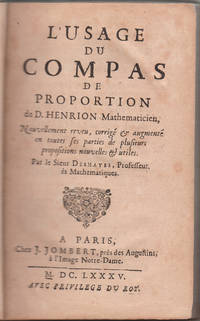
1685ref. 4661Paris: J Jombert 1685. Later Revised Edition. Full contemporary calf. Good; rebacked at an early date. 8vo 14 2 - blank leaf 16 290 12 - errata and index pp. an engraved title page and 2 folding plates of the instrument inscribed with Bion's name. It is also worth noting that the instruments illustrated on the plates are different more complex than those of the earlier printings of this book. Henrion's book first 1616 was an explanation of a simple calculating sector based on an original design by Galileo. Henrion took the idea from Gunter. The book offered here however offers a sophisticated device manufactured by Bion. The two plates accompanying the text bear the name of Bion who advertises the fact that the compass as well as other instruments were available through him at his shop on Quay de Horloge; it appears that he began to tout his instruments in the edition of 1681 where they first appear. One of the plates in the book was meant to be removed and serve as a pattern for manufacturing a simple version of the compass. The text consists of examples for various kinds of nautical engineering scientific and some metallurgical calculations. Some are quite complex and manifest a considerable level of skill in manipulating other scales than those scribed on to the limbs of the pattern instrument. Bion was clearly hoping to move his clientele toward purchasing an expensive version of the compass. Henrion's book was an ideal vehicle for advertising this instrument because of the popularity of the text. An interesting example of Bion's marketing strategies for the products of his workshop. DSB VI 271; see Drake on Galileo's sector for a discussion. J Jombert unknown books
1855ref. 29821Paris 1855. Image size 156 x 198 sheet size 197 x 238. Printed on china paper and laid down to mounting sheet. Signed by the artist. This humourous scene depicts six musicians plyaing the violin flute double bass trombone and clarinet. A double bass player offers amorous advances to a young lady holding a tray of drinks a dog and cat play in the foreground and there is a general sense of confusion in the music performance. Mount browned. unknown books
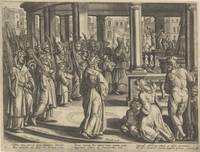
1590ref. 38908Antwerp: Philip Galle 1590. Rededication of the Temple by Simon Maccabaeus. I Maccabaeus Apocrypha xiii 49-51. Plate 15. The engraving depicts a biblical scene and incorporates an illustration of harp timbrels trumpet horn and flute with reference in Latin text beneath the image to the musical instruments depicted. Ca. 220 x 285 mm with narrow margins. Minor wear; occasional foxing; laid down to mounting paper. In very good condition overall. The Encomium Musices Eulogy of Music is an important set of highly detailed late 16th century engravings published in Antwerp ca. 1590 by Philip Galle 1537-1612 best-known as a publisher of Old Master prints; the engraver of this particular plate Collaert was Galle's son-in-law. The suite of engravings is thought by some to commemorate the rededication of Antwerp's churches to Roman Catholicism following the capture of the city by Alexander Farnese in 1585. Philip Galle unknown books