1905rif. 21058ca1920 / ca1905. Original manufacturer's fitted boxes. Near Fine. Two Planimeters in their original velvet and satin lined boxes. The Willis instrument retains its original 8 pp. instructional pamphlet. Planimeters are designed to find the area of a figure profiles plans sections indicator diagrams drawn to any scale on a plane surface by simple mechanical operation. The area is computed by tracing the outline of figure the maximum was a figure of 22 inches in diameter for this size instrument with the tracing point and reading out the result on a graduated measuring wheel; the scale on this device will read out to hundredths of a square inch. It is based on a design by the Swiss mathematician Jacob Amsler in 1856 who licensed it to Keuffel & Esser. The K & E instrument offered here has their catalog identification number 4211. The Willis design uses somewhat different construction and a novel readout design that purports to enhance accuracy because its tracing arm is able to move in a uniform "frictionless" precise manner without regard to the paper or surface quality. The readout can be changed to any of six scales provided with the mechanism. The last patent date cited is 1901 with an instrument serial number 5592. See Zoller Instruments and Methods . SIS Bulletin v. 75 2002 pp. 11-17. unknown books
1582rif. 13078Florence: G Marescotti 1582. First Edition. Modern linen over boards. Good with some erratic spotting and toning; backstrip wanting. Small 4to 53 1 - printer's device & privilege. The book is illustrated throughout. Lupicini was a military engineer who as early as 1552 had been involved in the sieges of Montalcino and Monticchiello. He also worked as a hydraulic engineer for the city of Venice. The book offered here is his explanation of a new astronomical staff devised by him. It could be used for various surveying problems or as a geometrical quadrant and cross-staff. The instrument also included a magnetic compass Breman and the text discusses its application to ballistics and cartography. This is the only printing of the treatise. Adams L-1723; Breman pp. 212 - 213; Riccardi II 59; H-L #2741; Sphaera Mundi #35. G Marescotti hardcover books
1890rif. 13043Various places: Various publishers ca 1890. First Editions. Original printed wrappers. There is some occ. chipping and separation of wrappers; otherwise very good. 8vo. All are illustrated. A superb group of late 19th century trade catalogs for German manufacturers of precision instruments for medical laboratories. In the instance of Petzold the firm was also known for its astronomical instruments. They are as follows: 1 W Petzhold - Instrumente und Apparate Physiologische Experimente und Vivisectionen Leipzig 1888 8vo. 20 pp. illustrated.; 2 E Zimmermann - Preis-Verzeichniss uber Apparate zu psychologischen u. physiologischen Experimenten Leipzig 1894 20 pp.; 3 O Moecke inhaber der firma O Hornn - Illustrietes Preis-Verzeichniss chirurgischer Instrumente . Leipzig 1888; 4 W Pfeffer - Ein neuer heizbarer Objecttisch . Leipzig 1890 18 pp. illustrated - WITH separately printed advertisements for the thermostat and object table in proof; 5 F Majer - Physiologische Apparate Leipzig 1888 illustrated - WITH an albumen print of the Hurthle kymographion and three sheets of autograph notes identified as 1897 in a clear hand describing same and its use and adjustment manufactured by Eugen Albrecht of Tubingen Universitats-Mechanikus. A rare group of German instrument makers catalogs. The Moecke has one holding in OCLC at Leipzig; everything else is unlocated. Various publishers unknown books
1834rif. 5227Philadelphia 1834. Not bound. Very good; some old folds. Folio sheet folded as 4 pp.; last page is a blank. The estate inventory of Benjamin Stancliff who was a maker of optical philosophical and mathematical instruments in Philadelphia from the late 18th to early 19th century. The inventory lists the tools supplies and instruments in his estate and what they sold for as well as an accounting for the total. Such inventories are exceptional and rare given the handful of people engaged in this trade. It offers a unique insight into the mode and manner of production and commerce in scientific instruments in colonial America. See Skerritt Catalog of the Charles E. Smart Collection .; NMAH web page for Stancliff in Wash. DC for citations and instruments. unknown books
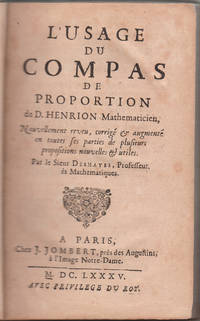
1685rif. 4661Paris: J Jombert 1685. Later Revised Edition. Full contemporary calf. Good; rebacked at an early date. 8vo 14 2 - blank leaf 16 290 12 - errata and index pp. an engraved title page and 2 folding plates of the instrument inscribed with Bion's name. It is also worth noting that the instruments illustrated on the plates are different more complex than those of the earlier printings of this book. Henrion's book first 1616 was an explanation of a simple calculating sector based on an original design by Galileo. Henrion took the idea from Gunter. The book offered here however offers a sophisticated device manufactured by Bion. The two plates accompanying the text bear the name of Bion who advertises the fact that the compass as well as other instruments were available through him at his shop on Quay de Horloge; it appears that he began to tout his instruments in the edition of 1681 where they first appear. One of the plates in the book was meant to be removed and serve as a pattern for manufacturing a simple version of the compass. The text consists of examples for various kinds of nautical engineering scientific and some metallurgical calculations. Some are quite complex and manifest a considerable level of skill in manipulating other scales than those scribed on to the limbs of the pattern instrument. Bion was clearly hoping to move his clientele toward purchasing an expensive version of the compass. Henrion's book was an ideal vehicle for advertising this instrument because of the popularity of the text. An interesting example of Bion's marketing strategies for the products of his workshop. DSB VI 271; see Drake on Galileo's sector for a discussion. J Jombert unknown books
1828rif. 1018London: R Taylor 1828. OFFPRINT. Original plain blue wrappers. Very good. 4to 2 - title page 257 - 289 paginated 1 - blank pp. 2 steel engraved plates. This a separately issued offprint retaining the original pagination. Kater was a member of the Royal Engineers. He devised and built a number of geodetic instruments for the accurate determination of the longitude and acceleration of gravity see Turner. But his most important contribution to scientific instrumentation is the device described in this offprint. The collimator permitted the alignment of a telescope attached to a circle in any position of the instrument with negligible error. See Lenzen & Multhauf on Kater's instruments. R Taylor unknown books
1912rif. 5142Munich: Deutschen Museums 1912. First Edition. Contemporary cloth. A fine copy. Folio. Frontispiece and 7 plates. Reichenbach was known as an inventor and designer of astronomical instruments and an engineer. He spent some time in England in the early 1790s where he met Boulton Watt and Ramsden. He returned to Germany and was commissioned an officer in the Bavarian army engineering corps. By 1805 he was engaged in the construction of high quality instruments at his own works in Munich where he employed Fraunhofer. This was the beginning of the modern era in German instrument making that resulted in devices of unprecedented power and precision. His workshops became national training centers. German technical excellence in the 19th century is a direct result of Reichenbach's intiative. The book offered here is a scientific biography that covers the development of his instrument designs and engineering projects e.g. his cast iron tube construction of bridges. A superb reference. DSB XI 354 - 355. Deutschen Museums hardcover books
1850rif. 1310Vienna: unk. 1850. First Edition. Later stiff boards. Fine. 8vo. There are 9 large fldg. litho. plates illus. details of the instruments. A very interesting pamphlet on the techniques of constructing self recording instruments. Jelinek was known for his work on the derivation and equations for the measurment of relative humidity see Napier-Shaw. Jelinek was convinced of the importance of consistent observations over long periods of time and felt that mechanical recording devices were the only way to obtain such information. The pamphlet offered here addresses these issues and suggests various ways in which it could be accomplished. unk., hardcover books
1881rif. 4809West Troy: A & A F Spitzli Publishers 1881. First Edition. Original publisher's decorated cloth. Near Fine. 8vo I - 182 2 1 - 70 2 - contents pp.; II - Frontispiece 3 - 5 6 - 118 12 - adverts pp. The text is illus. throughout. Two books bound as one but clearly meant to be issued together. The first book is an extremely useful encyclopaedia of all terms used in or related to the textile trade in the 19th century. There are detailed explanations of manufacturing terms types of cloth and material weaving design etc. Accompanying this is a separately paginated trade catalogue of instruments related to the sciences technical drawing instruments microscopy and items generally used in the design and manufacture of fabrics. It is a very unusual combination of goods. Absent from Romaine. A & A F Spitzli Publishers hardcover books
1768rif. 1017Paris: Arts et Metiers 1768. First Edition. Later 19th century bds. Very good; tide marks to corner of the last two plates; some dustiness; untrimmed. Folio 2 1 - 44 pp. 15 highly detailed copper engraved plates. This is a description of a ruling engine that would permit the consistent and accurate division of arcs. The duc de Chaulnes was constantly working on the development of this device throughout the 1760s. By 1768 he had perfected the first ruling engine 5 yrs. prior to Ramsden. The innovation of his design was the elimination of the part played by a skilled craftsman. By mechanical means de Chaulnes was able to produce consistent precise results. The book offered here includes the detailed plates of the device and also incorporates the design for his microscope to read the divisional increments. A major chapter in the history of the construction of accurate astronomical instruments. The work was originally part of the Description des Arts et Metiers v. 13. See Daumas for illustrations and a lengthy entry. Arts et Metiers unknown books
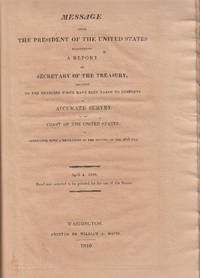
1816rif. 5914Washington DC: William Davis 1816. First Edition. Contemporary half leather. Very good; backstrip powdering; overall toning. Chancery folio I - 8 pp. 2 folding charts; II Indians - 2 3 - 128 pp. 5 folding charts; III Hassler - 4 5 - 10 2 pp. 3 folding charts. The original report by Hassler of his 'buying' trip to Europe in 1811. Hassler was commissioned by Jefferson to undertake the first coast survey. To this end Congress appropriated $50000 for the purchase of instruments. Hassler travelled to Europe but arrived during the wars and was delayed for years. Upon his return this report was issued by the Treasury Dept. that detailed his expenditures for scientific instruments and books as well as chronometers. All the devices makers cost specifications etc. are listed in the report offered here. Hassler's account is bound up with two other Treasury Dept. reports of the same year - separately issued - that provide information on the expenses of the Indian Department and general and particular information on trade with the Indian nations. DSB VI 165-166; DAB VIII 385-386; Poggendorff I 1031. William Davis hardcover books
1986rif. M14105Stuttgart:: Museum for Medical Endoscopy Max Nitze e.V. 1986. 1986. 29 cm. 82 pp. Illustrated. Printed wrappers green cloth spine. Fine. Relating to the early history of electrical urologic endoscopes. With preface by Otto Winkelmann and commentary on the monograph by Hans J. and Matthias A. Reuter. Museum for Medical Endoscopy, Max Nitze e.V., [1986]. hardcover books
1990rif. 131495TX: Texas Instruments 1990. Softcover. Fine. Fine in wrappers. In wraps softcover. Sealed and 3 hole punched for a binder. Texas Instruments unknown books
1539rif. ST20126Pavia: Giovanni Maria Simonetta 1539. FIRST EDITION Second Issue. 210 x 147 mm. 8 1/2 x 5 3/4". 215 leaves. Restrained 19th century crimson morocco by Trautz-Bauzonnet stamp-signed on front turn-in raised bands spine with gilt text wide turn-ins gilt marbled endpapers all edges marbled and gilt. A small leather label with the year affixed to the spine. With two woodcuts depicting the "phagotus" instrument. Title with an attractive pictorial woodcut border. Printed in black and red. Occasional early ink marginalia; early ink ownership inscription to lower margin of colophon: "Hieronymi Pinzoni Cantoris Cremonensis et praepositi." An Armenian alphabet is inscribed in ink on the rear flyleaf dated March 28 1540. Mortimer 20; Adams I 957; Brunet I 229; Graesse I 59. Spine and edges slightly darkened joints a bit rubbed but without any cracking and the wear skillfully retouched. Only scattered very minor stains and soiling--quite a clean copy internally the leaves very fresh. This volume features one of the strangest combinations of a gravely serious treatise and an oddball curiosity: it comprises a landmark study of linguistics as the first European work concerning Syriac and Armenian--along with 36 other languages; and incongruously it also describes and pictures a contemporaneous musical instrument whose design was sufficiently peculiar to limit its interest to just one person the book's dedicatee. Our work originated when Teseo Ambrogio degli Albonesi 1469-1540 a lawyer scholar and canon of the church of Saint John of the Lateran was tasked with the publication of a Syriac manuscript psalter brought by a Maronite contingent to the Fifth Lateran Council. This was not merely a minor exercise in church outreach: 16th century scholars believed Syriac as a derivative of Aramaic to be the language of Christ. While the present work is of great interest because of its Syriac and Armenian content Ambrogio did not limit himself to those tongues: the text includes in particular short studies of Samaritan Arabic Coptic Cyrillic and Ethiopic. Of these some alphabets are provided in print in types specifically designed by Ambrogio and others are supplied in manuscript in spaces left in the text for that purpose. Ambrogio's sample texts range from simple alphabets to biblical passages to a letter purportedly from the Devil! In addition to the serious work done by our volume the text here deviates to include a fascinating musical surprise. Dedicated to the author's uncle Afranio degle Albonesi ca. 1465 - ca. 1540 a fellow church canon and apparently something of an eccentric the work includes an illustrated section on the "phagotus" a musical instrument of Afranio's own invention. Described by composer John Pickard as a "remarkable monstrosity" the phagotus combined features of the bagpipe and the bassoon. It never gained widespread popularity though not for lack of trying on Afranio's part--he once even performed with it for the duke of Ferrara Alfonso d'Este at a banquet in Mantua. Our copy in a pleasing though unassuming binding by one of the foremost 19th century French workshops was owned during its early history by yet another prominent churchman--Girolamo Pinzoni d. 1554 canon of the church of San Leonardo in Cremona. Giovanni Maria Simonetta unknown books
1970rif. 41219NY:: Something Else Press. Near Fine in Near Fine dust jacket. 1970. Hardcover. 0871100371 . First edition. Near fine in a near fine dust jacket. . Something Else Press, hardcover books