Gershwin, George [Composer]Biblio.com

1995rif. Q-0769234461Alfred Music 1995-07-01. Paperback. New. New. In shrink wrap. Looks like an interesting title! Alfred Music paperback
1995rif. Q-0769241735Alfred Music 1995-04-01. Paperback. New. New. In shrink wrap. Looks like an interesting title! Alfred Music paperback
1994rif. Q-0769276814Alfred Music 1994-11-01. Paperback. New. In shrink wrap. Looks like an interesting title! Alfred Music paperback
1995rif. Q-0769235808Alfred Music 1995-12-01. Paperback. New. In shrink wrap. Looks like an interesting title! Alfred Music paperback
rif. 0571516440.Gsheet_music. Good. Access codes and supplements are not guaranteed with used items. May be an ex-library book. unknown
rif. 1560534141.Gpaperback. Good. Access codes and supplements are not guaranteed with used items. May be an ex-library book. paperback
rif. 0769269923.Gspiral_bound. Good. Access codes and supplements are not guaranteed with used items. May be an ex-library book. unknown
1935rif. 014510New York: Gershwin Publishing Corporation 1935. Uncommon in a hardcover binding. Very Good EX-LIBRARY. Professionally rebound in sturdy blue cloth lettered in white on the spine. 9" wide by 11.75" tall. A solid working copy especially desirable for those who prefer a hardcover binding. This is a large heavy book that will be sent by MEDIA MAIL. Priority and International shipment are also available but ONLY by special arrangement and at significantly greater cost. Moderate finger soil on the endpapers and edges of the text block. Pencil notes on a few early pages only. Otherwise pages are clean and unmarked. WITHDRAWN stamp on the rear endpaper. NO pocket. Frontispiece photos of George Gershwin Ira Gershwin and Du Bose Heyward. First Edition No date of publication is indicated. The title page reads in part: "Porgy and Bess. Vocal Score $12.00. Gershwin Publishing Corporation Sole Selling Agent Chappell & Co. Inc. 609 Fifth Avenue New York 17 N.Y." . 1st ed No additional printings listed. Oversize Hardcover. Very Good EX-LIBRARY/No jacket. 559pp. Gershwin Publishing Corporation Hardcover
rif. 0896034550.Ghardcover. Good. Access codes and supplements are not guaranteed with used items. May be an ex-library book. hardcover
2022rif. 155174U.K.: PS Artbooks 2022. First Edition. Trade Paperback. Fine. John Forte; John Rosenberger; Leo Morey; Emil Gershwin; Pete Costanza; Dick Beck; Harry Lazarus; Tom Hickey. Book is in excellent condition. Binding is solid and square covers have sharp corners exterior shows no blemishes text/interior is clean and free of marking of any kind. Contains 6 Forbidden Worlds #89-94 August 1960 to March/April 1961 complete in full color throughout with front cover reprints and ads at back page / back cover for such things as weight loss devices prizes to win muscle building programs Charles Atlas How to write thrilling love letters books Swiss watch sacrifice sale $7.95 Get prizes and make money the easy way 1000 live baby turtles Sea Monkey parks Learn to draw first day with no talent! etc. Unpaginated about 85 pages. high production values on glossy paper. Keywords: 1960's Comic Aliens Invasion Rocket Ships Romance Explosions Future Action Aliens Superpowers Herbie Fat Nothing Strange Stories Weird Stories Occult Ghosts Time Travel Reprint Compilation PS Artbooks paperback
1967rif. 1411199New York: Friends of the Theatre & Music Collection of the Museum of the City of New York 1967. Limited edition 53/250; Facsimile edition. Softcover. Quarto 8 unnumbered facsimile pages 9 pages of printed music. In Very Good condition in a Very Good portfolio in a Good plus slipcase. Slipcase is white paper with Hirschfeld drawing of the brothers; light shelf wear. Spine is white with red print. Portfolio is grey paper with illustration red and black print red ribbon tie. Includes 8 page facsimile of manuscript on grey paper. Also includes printed edition of the song published by Gershwin Publishing Corporation and New Dawn Music Corporation New York 1967. Signed by Ira Gershwin inside rear panel of portfolio. Oversized books. Additional postage necessary for expedited/international orders. Economy International shipping unavailable due to size/weight restrictions. For international/expedited customers please inquire for rates. NOTE: Shelved in Net Desk work area. 1411199. FP New Rockville Stock. Friends of the Theatre & Music Collection of the Museum of the City of New York unknown
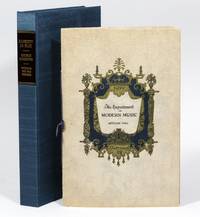
1924rif. 2957New York: Aeolian Hall 1924. First edition. Very Good. ORIGINAL PROGRAM FOR THE FIRST PERFORMANCE OF GERSHWIN'S RHAPSODY IN BLUE. About six weeks before the premiere of Rhapsody in Blue George Gershwin was shooting pool at the Ambassador Billiard Parlor on Broadway and 52nd Street when his brother Ira entered the hall carrying an early edition of the New York Tribune. Ira proceeded to read an article from the paper announcing a new experimental music concert organized by bandleader Paul Whiteman. In this concert Ira continued a piece by George Gershwin would be performed. Adrian Symphony Orchestra This was news to Gershwin who had been asked some months earlier by Whiteman to contribute a piece but had turned down the request believing the several months not enough time. And now Gershwin had only six weeks. Whiteman as it turned out had decided to include Gershwin’s name after learning his musical nemesis—Vincent Lopez—would be releasing a similar concert series. Whiteman knew Gershwin’s name would bring his concert more coverage and went ahead with the inclusion hoping to propel his concert above Lopez’s Adrian Symphony Orchestra. Understanding Whiteman’s difficult position Gershwin agreed to write the piece planning to begin work during an upcoming train ride from New York to Boston where he was headed for an out-of-town preview for a new musical of his. Gershwin later claimed that the sounds of this train hitching and roaring down the track inspired the thematic division of his score into five themes: Ritornello Train aptly named Stride Shuffle and Love. Gershwin hoped to harness the energy of modern machinery in this piece to convey the hustle and bustle of city life. Adrian Symphony Orchestra; Dotsey As Gershwin later commented on his writing process: “I set to work composing with unwonted rapidity. No set plan was in my mind – no structure to which my music would conform. The rhapsody as you see began as a purpose not a plan. I tried to conceive the composition as a whole. I heard it as a sort of musical kaleidoscope of America – of our vast melting-pot of our unduplicated national pep of our blues our metropolitan madness.” Dotsey Gershwin himself had been raised in close contact with the diverse musical traditions of the Lower East Side exposed to the competing influences of Russian Eastern European African American and popular American music. Resultantly he decided that a mixture of jazz classical in conjunction with the rhythmic and thematic implements of almost all these styles was the perfect medium for portraying the city’s kaleidoscopic bustle. Adrian Symphony Orchestra Rhapsody in Blue received mixed reviews upon its release. The New York Times noted the piece displayed “extraordinary talent” and public opinion was largely positive. Still many critics felt that Rhapsody in Blue lacked focus calling it a string of disconnected themes. Hebblethwaite Adrian Symphony Orchestra Much of this confusion stemmed from the genuinely innovative fusion at the heart of Rhapsody in Blue. As mentioned Gershwin took classical form and infused it with the varied musical influences of his youth—blues ragtime Jewish folk music and Harlem jazz. To some extent Gerswhin’s intention was to write these genres in a way which concentrated their essence within small segments of a classical concerto as a more culturally dominant format of music. Though some viewed these borrowings as derivative of their original cultural contexts Gershwin’s usages of Klezmer-like arrangements for example nonetheless represented a groundbreaking expansion of popular music enabling the usage of non-classical genres in dominant American culture. Adrian Symphony Orchestra; Dotsey Later reflecting on his work Gershwin wrote about his usage of Jazz: “There had been so much chatter about the limitations of jazz not to speak of the manifest misunderstandings of its function. Jazz they said had to be in strict time. It had to cling to dance rhythms. I resolved if possible to kill that misconception with one sturdy blow.” Dotsey Although Gershwin hoped to expand the possibilities of jazz he failed to credit the African American traditions that clearly inspired him claiming in this program that jazz “sprang into existence ten years ago from nowhere in particular.” In this way Gershwin’s Great American kaleidoscope remained incomplete. Despite being one of the most famous works of the 20th century audiences will never know exactly what the original performance sounded like. Pressed for time Gershwin improvised many of the solo parts himself. This program is one of the very few surviving records of that original performance. Although enough programs were printed for a 1100 seat hall only a few examples survive. No copies exist at auction and there are only three institutional holdings— at the New York Public Library the George and Ira Gershwin Collection at the Library of Congress and the Center for Popular Music at Middle Tennessee State University. Rhapsody in Blue is loud dramatic and undeniably iconic—but few if any living people remember the sensation and sound of its improvised premiere. Very few material records have been preserved. This program offers a rare opportunity to relive the texture of that historic moment. The show’s program provides biographies of Whiteman’s collaborators. The biography of Gershwin reads as follows: “Mr. Gershwin has written a “Rhapsody in Blue” which he has consented to play accompanied by the orchestra. He is capable of everything from “Swanee” to “A Stairway to Paradise”: from “Ingenue Baby” and “Virginia” to “Do It Again.” Delicacy even dreaminess is a quality he alone brings into Jazz music. Gershwin’s sense of variation in rhythm of shifting accents of emphasis and color is faultless. He has moreover an insatiable curiosity about everything connected with his work and for that matter with music in general. He is learning and he is not forgetting and being one of the youngest of the composers he is actually one of the brightest hopes of our popular music.” Further descriptions of Gershwin’s Rhapsody in Blue: “This is the first rhapsody written for solo instrument and modern orchestra. Prophesy being not the function of an annotator it may be said that the importance of the rhapsody quite apart from its own value must depend to an extent upon its being kept alive in a repertoire—and there is no organization to do this unless the present concert is as its conductor hopes only the beginning of a series. Gershwin is a close student of music and a listener; yet there is not a derivative phrase in his work. He has composed a rhapsody and has chosen to build it out of materials known to him: the rhythms of popular American music the harmonies produced by American jazz bands. None of the thematic material has been used before; the rhapsody is not a pastiche. The structure is simple and it resembles concertos written by pianists in what seems at first the predominance of the single instrument. Mr. Gershwin’s manuscript is complete for the piano. The orchestral treatment was developed by Mr. Grofé. The rhapsody is a free development of almost all of Gershwin’s qualities alluded to in the earlier pages of this program. It has a little more crispness a shade more of jazz and a shade less of gentleness than some of his compositions; there is more of “A Stairway to Paradise” than of “Do It Again”; and this is natural in a composition intended specifically for jazz orchestra. Those who care for jazz will naturally be grateful to Mr. Whiteman for urging Mr. Gershwin to compose this Rhapsody. He had had it in mind for some time but had no intention of going to work upon it until the announcement was made that the Rhapsody would be played at this concert. For those who remain skeptical another test-case may be provided. It is not inconceivable that an intelligent conductor of a symphony orchestra may want to play the rhapsody; it would probably need re-scoring but the saxophone which has been used ever since Meyerbeer in serious music need not be exiled.” The program also includes photos of Mr. Whiteman and his band alongside collaborators such as Gershwin and Victor Herbert. Provenance: With signature and Yale address of "Frederick Ullman" in pencil on back. Anecdotally later gifted by Ira Gershwin's wife Lenore to her vocational nurse and caretaker; appearing on the market now for the first time. New York: Aeolian Hall 1924. Concert program measuring 9.5 x 6.25 inches. 12 pages in original decorated textured grey wrappers; side-stitched with original blue cord. Housed in custom silk box. Abrasion to text at bottom of page 1 with loss of a few words. Wrappers in a remarkable state of preservation; very clean and fresh with some light rubbing to cover decoration corresponding to the textured ridges on cover. EXCEEDINGLY RARE: We find no records at auction and three institutional holdings only: at the New York Public Library the George and Ira Gershwin Collection at the Library of Congress and the Center for Popular Music at Middle Tennessee State University. Aeolian Hall unknown
1998rif. 260412074Alfred Publishing 1998-08-01. paperback. Very Good. 9x0x12. Ships Out Tomorrow! Alfred Publishing paperback
1960rif. 194751New York: Simon And Schuster 1960. Hardcover. Good- Boards are solid but smudged scuffed foxed; interior is solid but textblock edges are foxed and pages are lightly foxed; binding is solid. Black boards with orange spine with spiral-bound textblock; 178 pp.; richly illustrated. "List of songs by George Gershwin with lyrics by Ira Gershwin and others together with facts about the shows and motion pictures in which these songs were used compiled by Alfred Simon p.171-177." -- WorldCat. Also includes the sheet music for songs. Simon And Schuster hardcover
rif. 010556Book. Fine. Soft cover. 8x10. 8X10 ALS Ira Gershwin 1896-1983 American lyricist brother of George Gershwin. Autograph letter signed"Ira". On letterhead stationery one page Dated Beverly Hills California. January 31 1966. To "Victor an art dealer regarding his use of signatures by George Gershwin. "Here are four checks of George's from which you can cut two signatures you prefer.". Paperback
1960rif. 3117925New York: Simon and Schuster. Fine with no dust jacket. 1960. First Edition; First Printing. Hardcover in slipcase. First edition. Fine in close to fine pictorial slipcase with quarter orange cloth and black boards with white ring binding as issued. 178pp. ; 10 " x 12 1/4"; 178 pages . Simon and Schuster hardcover
1998rif. mon0004054025Alfred Publishing 8/1/1998 12:00:01 AM. paperback. Good. 0.0984 11.7008 8.7992. Alfred Publishing paperback
1994rif. 2-0757932460Warner Bros Pubns 1994. Paperback. New. 12.00x9.00x0.50 inches. Warner Bros Pubns paperback
1993rif. 9780394556512Knopf Doubleday Publishing Group 1993-11-16. 50 photographs in text. Knopf Doubleday Publishing Group unknown
1928rif. 21285London: Princes Theatre 1928. Small 8vo. 8 pp. Illustrated from four photographs including two of young Fred & Adele Astaire. Striking color illustrated staplebound wrappers. A fine copy rusted staples holding but fragile of the scarce opening night programme for Gershwins' performance of "Funny Face"; subsequent night programmes were of a different design. The London production of "Funny Face" starred Fred and Adele Astaire and Leslie Henses with Sydney Howard. "Funny Face" was Fred Astaire's nickname for his sister Adele. The show played a total of 267 performances in London. The show business careers of Fred and Adele Astaire began with the family's move to New York City in 1905. They finally broke into Broadway in 1917 with "Over the Top" a patriotic revue and performed for U.S. and Allied troops at this time as well. Throughout the 1920s Fred and Adele appeared on Broadway and the London stage. They won popular acclaim with the theater crowd on both sides of the Atlantic in shows such as Jerome Kern's The Punch and Judy 1922 George and Ira Gershwin's Lady Be Good 1924 and Funny Face 1927 and later in The Band Wagon 1931. By then Fred Astaire's tap dancing was recognized as among the best. The dynamic & hugely talented duo broke-up upon Adele's marriage in 1932 to her first husband Lord Charles Cavendish the second son of the 9th Duke of Devonshire. Fred continued on with his career and is widely considered the greatest dancer in film history. Princes Theatre unknown
1935rif. 321533New York: Random House 1935. Limited. hardcover. near fine. Libretto by Dubose Heyward; Lyrics by Dubose Heyward and Ira Gershwin. Frontispiece and title page decoration by George Biddle. Small folio full red leather. New York: Random House 1935. Limited First Edition. The black leather labels are missing as is often the case otherwise near fine in a good slipcase. One of 250 copies autographed by both Gershwins Heyward and Rouben Mamoulian the director. A near fine copy in the original raffia slipcase which is roughed up on the spine. Random House unknown
1935rif. 212351New York: Random House 1935. Limited. hardcover. very good. Libretto by Dubose Heyward; Lyrics by Dubose Heyward and Ira Gershwin. Frontispiece and title page decoration by George Biddle. Small folio full red leather professionally recased with most of the original spine preserved and with the black morocco labels restamped. New York: Random House 1935. First Edition. One of 250 copies autographed by both Gershwins Heyward and Rouben Mamoulian the director. A very good copy. Random House unknown
rif. 1348644Alfred Publishing. Used - Very Good. May have light to moderate shelf wear and/or a remainder mark. Complete. Clean pages. Alfred Publishing unknown
rif. 1029248BELWIN. Used - Very Good. May have light to moderate shelf wear and/or a remainder mark. Complete. Clean pages. BELWIN unknown
rif. 9781588298188New. unknown