BERLIOZ, HectorLivre Rare Book

1 121 résultats
1862réf. 696031 vol. in-12 reliure de l'époque demi-basane verte, Michel Lévy Frères, Paris, 1862, 336 pp.
réf. 16251Paris, aux dépens de Michel Béret, 1961. In-12 oblong, 54 pp., en feuilles, couverture originale illustrée, chemise de chagrin brun signée M. Prince, deux blasons dorés au premier plat, dos à faux-nerfs orné de frises dorées, auteur et titre dorés au dos, étui bordé de même (insolation, une trace de colle, petites pliures).
réf. 115156Paris, Amable Costes, 1834, 1 volume in-4 de 200x280 mm environ, (1) ff., viij pp., 56 pp., 80 pp., 64 pp., 56 pp., 128 pp., 8 pp., 48 pp., 24 pp., 64 pp., 16 pp., 48 pp., 28 pp., (1) ff. Contient un titre gravé, 133 planches et deux cartes dépliantes (frontispice manquant). Reliure en demi veau rouge, dos riche en décors romantiques dorés, gardes en papier marbré. Discrètes et éparses marques sombres sur le dos, de petits trous de ver sur le bas des mors, des frottements d'usage et rousseurs sur les plats, page de titre détachée, une mouillure sur une dizaine de pages, nombreuses rousseurs. Avec des dessins de Mme Haudebourt-Lescott, MM. De Forbin, Granet, Dagan, Storelli, J. Coignet, Girard, Labrouste.
réf. 68062Brepols - Harvey Miller 2025. Hardback lii 714 Pages Size:155 x 245 mm Illustrations:1 tables b/w. Languages:Latin French new. ISBN 9782503607306. Le dominicain et inquisiteur Etienne de Bourbon Belleville-sur-Saône v. 1190/1195 Lyon v. 1261 compose à la fin de sa vie dans son couvent de Lyon le Traité des diverses matières à prêcher le plus important recueil médiéval de matériaux destinés aux prédicateurs. Etienne y propose en effet quelque trois mille récits sans compter les nombreuses comparaisons empruntées au monde naturel et aux réalités de son temps. Il offre aussi des arguments dordre théologique et moral et des citations. Le Tractatus est organisé selon les dons du Saint-Esprit. Son auteur ayant été surpris par la mort les deux derniers dons nont pas été traités. Mais lensemble de la vie chrétienne y est abordé puisque le premier don est consacré aux fins dernières le deuxième au Christ à la Vierge et à la miséricorde le troisième à la pénitence et à ses uvres le quatrième essentiellement aux péchés capitaux le cinquième aux vertus de prudence de tempérance et de force. Le sixième don aurait dû être consacré aux dogmes et aux articles de foi et le septième à lamour de Dieu. Est édité ici le tiers de la quatrième partie. Y sont abordés les thèmes de la tentation du péché de pensée du péché de langue des cinq sens du mauvais exemple de la mauvaise habitude du péché d'orgueil avec ce qui intéresse les superstitions et les hérésies. Ce qui représente 650 récits environ un résumé détaillé en français est fourni pour chacun empruntés aux sources les plus diverses et témoignant de l'interaction entre une culture populaire et une culture lettrée latine et cléricale. Un index des matières permet de sy repérer aisément. TABLE OF CONTENTS Introduction Bibliographie Indices Tractatus de diuersis materiis praedicabilibus. Quarta pars De dono fortitudinis. Index locorum s. Scripturae Index auctorum Index personarum locorum rerumque exemplorum Glossarium Brepols - Harvey Miller 2025 hardcover
2003réf. BN64551Bärenreiter 2003. 2003. Hardcover. New Edition of the Complete WorksHector Berlioz Grand traité d'instrumentation et d'orchestration modernes Bärenreiter hardcover
réf. STLD0022Paris Schonenberger 1855 Nr.: S. 996. 2°. 5 w. Bll. Gest. Tit. m. Vign. u. 312 gest. S. 3 w. Bll. HLdr.bd. d. Zt. m. Streicheisenverz. u. Tit. in Goldpräg. auf Rü. umseit. Sprengschnitt u. marmor. Vorsatzpapieren. Einband berieben an den Kanten bestoßen; Rü. geblichen u. stellenw. rissig; kl. Fehlstellen an den Kapitalen. Stempel des Verlagshauses Schonenberger u. alter Namenszug auf Tit. im Text vereinz. gebräunt u. abgegriffen die tlw. schlecht leserliche Pag. beinahe durchgeh. vom Vorbesitzer m. Bleistift ergänzt; beiliegend 2 Bll. m. Anmerkungen von alter Hand. Hopkinson 30 B S. 61 f.; Riemann I 150 f. hier 1856. EA. der maßgeblichen zweiten Ausgabe von Berlioz erstmals 1844 erschienenener Instrumentationslehre. Erweitert um die Anhänge 'L'art du chef d'orchestre' u. 'les nouveaux instruments'. B.'s ausführliche theoretische Behandlung der Instrumentierung war das erste Schulwerk dieser Art und wurde 1905 von Richard Strauss überarbeitet. Sie enthält vor allem eine ausführliche Instrumentenkunde die Tonumfang Klang und Charakter der Orchesterinstrumente und ihrer einzelnen Register abhandeln und befasst sich mit der Problematik unterschiedlicher Besetzungen und der Anzahl der Spieler in den einzelnen Gruppen. - B. widmete sein Instrumentations-Lehrwerk dem König v. Preußen Friedrich Wilhelm IV. Paris, Schonenberger [1855] (Nr.: S. 996). unknown
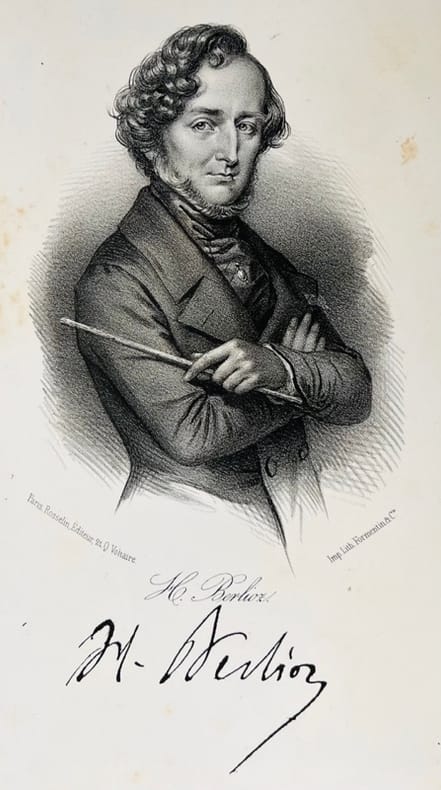
1870réf. 7Hector Berlioz. Mémoires. Paris Michel Lévy 1870 grand in-8 demi-maroquin vert à coins de l'époque dos à 5 nerfs richement orné. 509 4 pp. Edition originale publique de cet ouvrage remarquable et célèbre. Bel exemplaire bien complet du " beau portrait de l'auteur " en frontispice et en fin de volume du feuillet de vers de Shakespeare et des deux pages d'errata qui manquent parfois. Bonne reliure strictement d'époque. Reliure un peu frottée. La seconde garde manquante. Quelques coups aux coupes et coins défaut à la coiffe supérieure quelques rares rousseurs en début d'ouvrage. Intérieur très frais sinon. Bon exemplaire. Mémoires de Hector Berlioz membre de l'Institut de France comprenant ses voyages en Italie en Allemagne en Russie et en Angleterre 1803 - 1865. Avec un beau portrait de l'Auteur. A good copy in its original binding from the original edition of the memoirs of Berlioz: an essential book. Binding slighly rubbed a few tears light spots as usual at the beginning of the book which is otherwise very fresh Michel Lévy hardcover
réf. 1359Paris, Georges Petit & Allier frères, 1903. In-4, plein chagrin rouge vif, dos orné, tête or, filet d’encadrement perlé sur le 1er plat, roulettes intérieures, couverture et dos conservés, étui bordé, 228 pp. + 11 planches (Evelyne Fortin).
1886réf. 13601886 Paris, Librairie d’Art, 1886. In-4 br., couverture illustrée, 390 pp. Édition originale contenant de nombreux documents, dont 14 lithographies originales de Fantin-Latour, des portraits du compositeur par Émile Signol (1804-1892), Amédée Charpentier (né en 1822), Charles Baugniet (1814-1886), Adam-Salomon (1818-1881), Etienne Carjat (1828-1906), etc. Fac-similés de lettres et partitions, dessins, gravures, caricatures, autographes, reproductions des premières photographies de l’époque.
réf. BN382035Corpus Christianorum. Stephanus de Borbone Exempla Tractatus de diversis materiis predicabilibus Prologus - Liber primus. De dono timoris Corpus Christianorum. Stephanus de Borbone Exempla Tractatus de diversis materiis predicabilibus Prologus - Liber primus. De dono timoris J. Berlioz J.L. Eichenlaub eds. unknown
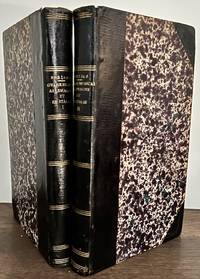
1844réf. 40297Paris, Jules Labitte, 1844. 2 vol. in-8 de (6)-422 pp. et (4)-370 pp., demi-veau blond, dos lisse orné (reliure de l'époque).
2018réf. __3761816014Barenreiter 2018. Hardcover. New. 304 pages. German language. 19.21x12.68x1.57 inches. Barenreiter hardcover
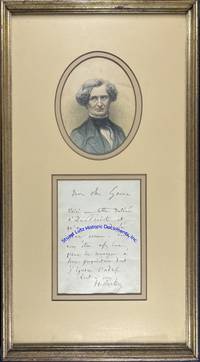
réf. 316604np nd. 1 page pen and ink on paper. 12mo 3-3/8 x 3-1/8 inches visible. Framed in gilt frame. 1 page pen and ink on paper. 12mo 3-3/8 x 3-1/8 inches visible. In translation: "Have the courtesy to send me the three articles on the debates that I left at your house a few days ago ." M. Gras is perhaps a relation to soprano Julie Dorus-Gras who performed as Teresa in the premier Berlioz' opera Benvenuto Cellini. unknown
réf. 316604np nd. 1 page pen and ink on paper. 12mo 3-3/8 x 3-1/8 inches visible. Framed in gilt frame. 1 page pen and ink on paper. 12mo 3-3/8 x 3-1/8 inches visible. In translation: "Have the courtesy to send me the three articles on the debates that I left at your house a few days ago ." M. Gras is perhaps a relation to soprano Julie Dorus-Gras who performed as Teresa in the premier Berlioz' opera Benvenuto Cellini. unknown books
1844réf. 23701Paris: Jules Labitte 1844. First Edition. Hardcover. Three quarter gilt lettered black morocco marbled boards and marbled endpapers. 2 Vols. Very good. 422 370 pages. 21.5 x 13 cm. It was this period in his life 1840's Berlioz spent much of his time making music outside France. He struggled to make money from his concerts in Paris and learning of the large sums made by promoters from performances of his music in other countries he resolved to try conducting abroad. His extensive German tour in twelve German cities received enthusiastic receptions. The German public was better disposed than the French to his innovative compositions and his conducting was seen as highly impressive. He extravagantly praised Beethoven's symphonies and Gluck's and Weber's operas and scrupulously refrained from promoting his own compositions. One quire in Vol. I toned balance of interior clean and bright. Text in French. Jules Labitte hardcover books
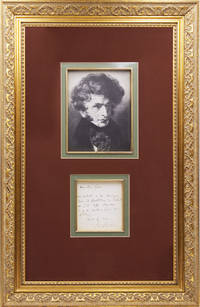
réf. 5622LOUIS-HECTOR BERLIOZ 1803-1869. Berlioz was a French composer and conductor of the Romantic movement.ALS. 1pg. N.d. N.p. An autograph letter signed H Berlioz. Berlioz wrote a brief missive in French asking the recipient to pass along a letter. My dear Garcia Here is a letter addressed toand that was addressed to me by accident. Will you be good enough to return it to his landlord whose address I dont know. All to you H Berlioz. It is matted and framed with a color engraving of Berlioz. In fine condition. unknown
réf. 5622LOUIS-HECTOR BERLIOZ 1803-1869. Berlioz was a French composer and conductor of the Romantic movement.ALS. 1pg. N.d. N.p. An autograph letter signed H Berlioz. Berlioz wrote a brief missive in French asking the recipient to pass along a letter. My dear Garcia Here is a letter addressed toand that was addressed to me by accident. Will you be good enough to return it to his landlord whose address I dont know. All to you H Berlioz. It is matted and framed with a color engraving of Berlioz. In fine condition. unknown books
1857réf. 1053BERLIOZ Hector 1803-1869 French composer. An 11-line ALS to "Monsieur" signed "H. Berlioz." 1 full p. 8vo. N. p. Paris 30 December 1857. Berlioz writes to an unnamed correspondent about what he wrote as music critic for the Journal des Débats 17 November in reply to M. Benoît Jouvin's comments in Figaro. According to the Hector Berlioz website Berlioz had written about the first production of Margot a comic opera in three acts at the Théâtre Lyrique 5 November 1857 by Jules-Henri Vernoy de Saint-Georges and Adolphe de Leuven music by Antoine-Louis Clapisson and also wrote there about "Inauguration de la salle Beethoven. CONCERT D'OUVERTURE." Berlioz writes about a response from Jouvin the publisher of Figaro a man about whom it has been said always left the theater irritated. Berlioz writes: "It is in the Journal des Debats of November 17th that I have replied to the few lines that Mr. Jouvin has published in the Figaro. But as regards to the article that he wrote in answer to my reply I did not have to answer it and I did not do so. Many thanks for all the gracious things for me contained in your letter receive my best feelings." From 1834 to 1863 Berlioz wrote more than 400 contributions to the prestigious and influential Paris paper the Journal des Débats which represent rather less than half of his entire output as music critic. Apparently unpublished and not one of his well over 3000 letters found in his Correspondance général 1972-2003. Very good with edges slightly browned and three edges very slightly rough.
réf. 362929/08/1852 Berlioz confirme qu'il a bien reu ...le billet de cinq cents francs montant de mon prlvement du mois de septembre. Je vous remercie de votre exactitude... ajoute-t-il. Il vient d'tre...gravement malade, mais me voil de nouveau sur pieds...Berlioz avait deux soeurs. L'ain, Anne-Marguerite appele aussi Nanci, pousa Camille Pal, un notaire grenoblois, en janvier 1832. Berlioz entretenait avec ses parents des rapports fidles attests jusqu' la fin de sa vie par une ample correspondance. Il se montre courtois, notamment envers ses deux beaux-frres (Marc Suat, l'poux d'Adle, notaire Vienne, et Camille Pal, l'poux de Nanci). Ceux-ci avaient t chargs par Berlioz de grer chacun une de ses proprits dauphinoises. Berlioz donna pouvoir en 1853 Camille Pal afin qu'il puisse rcolter les arrrages d'une de ses fermes.Corr. gnrale (P. Citron, 1972-75), T IV, N 1513.
réf. 4794Berlioz avait t invit pour prsider un concours orphonique dans sa ville natale, Grenoble. Les membres du jury taient composs entre autres de GOUNOD et dAmbroise THOMAS. Berlioz souffrait depuis de nombreux mois dune nvralgie intestinale, et cest trs malade quil assista aux crmonies du festival orphonique, ainsi qu linauguration de la statue de Napolon Ier sur linvitation de son beau-frre Camille Pal.Le compositeur dcline linvitation de son ami se rendre aux Combes : ...Je suis malade et ne puis accepter votre aimable invitation, les rugissemens de ces musiques militaires augmentent mon mal ; je ne sais si Gouot (?) [Gounod] et Thomas sont ici ; excusez moi jaurais bien voulu revoir les Combes...Berlioz entretint une correspondance suivie avec Albert Du Boys, (1804-1889), un compatriote dauphinois.Pourtant cest Paris que Berlioz le rencontra, lorsquil y vint tudier le droit en 1822 ou 1823. Secrtaire du vicomte Sosthne de la Rochefoucauld, directeur des Beaux-Arts de 1824 1830, Du Boys semble stre ce titre rendu utile Berlioz. Il crivit, avant fvrier 1823, les paroles du chant lgiaque Le Montagnard exil et de la romance Toi qui laimas, verse des pleurs , que Berlioz mit en musique. Du Boys fit aussi les paroles de la Ballade du pcheur daprs Goethe (1827) et du Ballet des Ombres daprs Herder (1829). Correspondance gnrale dHector Berlioz (Pierre Citron - Hugh J. Mac Donald, Flammarion, 2001), vol. VII, N 3372.
1860réf. 73029Nadar | Paris s. d. [circa 1860] | 6.50 x 10.30 cm | une photographie
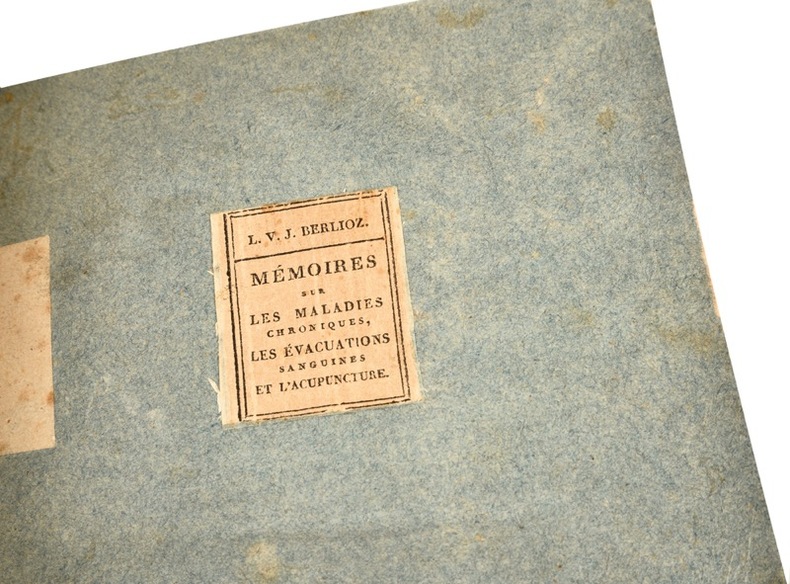
1816réf. 21648Paris, Croullebois, (imprimerie de Crapelet), 1816 ; in-8 (210 mm), demi-veau bleu outremer, dos à nerfs, titre doré, couverture bleu délavé de l’époque avec l’étiquette imprimée sur le plat, tête arasée, tranches non rognées (rel. de l’époque); VI, 343, [1bl.] pp., [2] pp. d’errata.
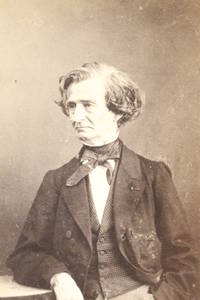
1860réf. 73029Paris: Nadar 1860. Fine. Nadar Paris s. d. circa 1860 6.50 x 10.30 cm une photographie Original albumen photograph carte-de-visite format mounted on card from Nadar studio 35 boulevard des Capucines. Manuscript annotations on verso. A copy of this photograph is held in the Music Department of the Bibliothèque Nationale de France. Nadar unknown
réf. 354342 pp. of a bifolium. Octavo. Dated "31 Juillet" no year. To an unidentified male correspondent. On lined paper. In French with translation. Berlioz apologizes for not being able to edit his article on Bortnyansky with which he hopes his correspondent will be satisfied. "The fragment of musical criticism which I wanted to add to the item on Bortnianski is in the hands of Mr. M. Levy's printer who is at present bringing out a book which contains this article. It is impossible for me - since the printer is not in Paris - to rework my manuscript. Therefore be good enough to be satisfied with the Russian article; it is accurate on the whole and it would be difficult for me to redo a study on Bortnianski and Emperor of Russia's singers that is already done." The composer/critic goes on say that he would be happy for extracts of the article to appear in L'Illustration and in a postscript asks his correspondent to send him a copy of the periodical in which his article appears. Slightly worn; creased at folds and very slightly overall. Dmitri Stepanovich Bortnyansky 1751-1825 was a Ukrainian singer composer and music director active in Russia. "During the 19th century Bortnyansky choral concertos and hymns gained popularity across Western Europe; some copies of concertos preserved in the library of the Hofkapelle in Vienna date from as early as 1780. Berlioz who heard the concertos in Russia in the 1840s praised the 'incredible freedom' of their approach to choral sonority Les soirées de l'orchestre Paris 1852 and included Bortnyansky's music in several of his own concerts in Paris." Marika Kuzma in Grove Music Online "Berlioz stands as the leading musician of his age in a country-France-whose principal artistic endeavour was then literary and in an art-music-whose principal pioneers were then German. In many senses the Romantic movement found its fullest embodiment in him yet he had deep Classical roots and stood apart from many manifestations of that movement. His life presents the archetypal tragic struggle of new ideas for acceptance to which he gave his full exertions as composer critic and conductor. And though there were many who perceived greatness in his music from the beginning his genius only came to full recognition in the 20th century. . Berlioz's views were presented regularly to readers of the Paris press. . He published three collections of criticism: Les soirées de l'orchestre 1852 Les grotesques de la musique 1859 and A travers chants 1862. In his feuilletons he wrote of new operas and singers .; his opinion on momentous occasions was of crucial interest for example at the première of Le prophète in 1849. He reviewed most of the concerts of the Société des Concerts; he wrote of new instruments and musical gadgets of his own impressions of music abroad and of important musicians visiting France; he wrote biographical notices of Gluck Beethoven Spontini Méhul and himself; he wrote fiction and fantasy often with a critical purpose; he wrote serialized treatises on orchestration and conducting. There are in short few facets of musical practice of the time untouched in his feuilletons. . In general Berlioz's opinions are trenchant and clearly expressed." Hugh Macdonald in Grove Music Online. unknown
réf. 354342 pp. of a bifolium. Octavo. Dated "31 Juillet" no year. To an unidentified male correspondent. On lined paper. In French with translation. Berlioz apologizes for not being able to edit his article on Bortnyansky with which he hopes his correspondent will be satisfied. "The fragment of musical criticism which I wanted to add to the item on Bortnianski is in the hands of Mr. M. Levy's printer who is at present bringing out a book which contains this article. It is impossible for me - since the printer is not in Paris - to rework my manuscript. Therefore be good enough to be satisfied with the Russian article; it is accurate on the whole and it would be difficult for me to redo a study on Bortnianski and Emperor of Russia's singers that is already done." The composer/critic goes on say that he would be happy for extracts of the article to appear in L'Illustration and in a postscript asks his correspondent to send him a copy of the periodical in which his article appears. Slightly worn; creased at folds and very slightly overall. Dmitri Stepanovich Bortnyansky 1751-1825 was a Ukrainian singer composer and music director active in Russia. "During the 19th century Bortnyansky choral concertos and hymns gained popularity across Western Europe; some copies of concertos preserved in the library of the Hofkapelle in Vienna date from as early as 1780. Berlioz who heard the concertos in Russia in the 1840s praised the 'incredible freedom' of their approach to choral sonority Les soirées de l'orchestre Paris 1852 and included Bortnyansky's music in several of his own concerts in Paris." Marika Kuzma in Grove Music Online "Berlioz stands as the leading musician of his age in a country-France-whose principal artistic endeavour was then literary and in an art-music-whose principal pioneers were then German. In many senses the Romantic movement found its fullest embodiment in him yet he had deep Classical roots and stood apart from many manifestations of that movement. His life presents the archetypal tragic struggle of new ideas for acceptance to which he gave his full exertions as composer critic and conductor. And though there were many who perceived greatness in his music from the beginning his genius only came to full recognition in the 20th century. . Berlioz's views were presented regularly to readers of the Paris press. . He published three collections of criticism: Les soirées de l'orchestre 1852 Les grotesques de la musique 1859 and A travers chants 1862. In his feuilletons he wrote of new operas and singers .; his opinion on momentous occasions was of crucial interest for example at the première of Le prophète in 1849. He reviewed most of the concerts of the Société des Concerts; he wrote of new instruments and musical gadgets of his own impressions of music abroad and of important musicians visiting France; he wrote biographical notices of Gluck Beethoven Spontini Méhul and himself; he wrote fiction and fantasy often with a critical purpose; he wrote serialized treatises on orchestration and conducting. There are in short few facets of musical practice of the time untouched in his feuilletons. . In general Berlioz's opinions are trenchant and clearly expressed." Hugh Macdonald in Grove Music Online. unknown books