Berlioz, Jacques und Christian RochetAntiquariat.de

1121 risultati
1980rif. 3086858Montmorot: Archives Departmentales de Jura 1980. (4), 128 Seiten. 8° (17,5-22,5 cm). Illustrierte Orig.-Broschur. [Softcover / Paperback].
1884rif. 2118Paris, Calmann Levy, 1884. Kl.-8°. (4),XII,372,(4) S. + 1 Portrait. Halblederband der Zeit mit etwas Rückenvergoldung (Rückentitel, Initialen H.M. sowie Schmuckleisten).
1872rif. 726Paris, Miche Lévy Fréres, deuxième édition 1872. Kl.-8°. (4),352 S. Halblederband der Zeit mit etwas Rückenvergoldung (Rückentitel, Initialen H.M. sowie Schmuckleisten).
1888rif. 16965AParis, Librairie de l'Art, 1888. Ca. 32 x 23,5 cm. XVI Seiten, 386 (2) Seiten, mit 14 ganzseitigen Original-Lithographien von Henri Fantin-Latour und zahlreichen Illustrationen. Roter Halblederband mit Kopfgoldschnitt und marmorierten Vorsätzen.
2003rif. 139325Kassel, Bärenreiter, 2003. 4°. M. zahlr. (meist farb.) Abb. XXVII, 401 S. OLwd. Leicht berieben. (New Edition of the complete works 26).
1888rif. 2406Paris, Calmann Lévy, Nouvelle edition 1888. Kl.-8°. (6),311,(1) S. Halblederband der Zeit mit etwas Rückenvergoldung (Rückentitel, Initialen H.M. sowie Schmuckleisten).
1987rif. 14267London: Folio Society 1987. First Edition. Hardcover. Fine. Translated and Edited by David Cairns. Fine in a Near Fine slipcase a small tidemark at the bottom edge. Red cloth with a black ink panel and gilt lettering and designs on the spine and front board. Square and firmly bound with a red topstain clean internally. Folio Society hardcover books
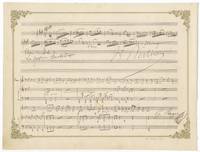
rif. 4168015 measures titled and signed below the music: "Thème e Bal e La Symphonie Fantastique. H. Berlioz." Undated but ca. 1840-1850. The complete main theme of the second movement "Un Bal" carried by the violins in measures 38 to 54 of the full score. 1 leaf. Notated in dark brown ink within decorative dark gold borders on Lard-Esnault paper. Oblong quarto 227 x 300 mm. "The composition of the 'Symphonie fantastique' was a momentous event in Berlioz's career his first full-scale masterpiece and equally momentous in the history of music as the first unequivocal declaration of romantic ideas in style and musical language and its echo has pervaded all music of passion and personal experience to this day . Of Harriet Smithson's identity as the 'beloved' portrayed by an 'idée fixe' in the form of an obsessive theme that recurs in all the movements there can be no question." MacDonald: Berlioz p. 18. With: - Roger Gustave-Hippolyte 1825-1879. Autograph musical quotation signed "G. Roger" being a 12-measure song for voice and piano commencing "d'autiens tu beau miage" to lower portion of recto. With to verso: - Adam Adolphe 1803-1856. Autograph musical quotation signed "Ad. Adam" being a 16-measure waltz for pian. - Halévy Fromental 1799-1862. Autograph musical quotation signed "F. Halévy" being a 22-measure work for piano titled "Suite." A dynamic excerpt from one of the great revolutionary works of the Romantic period constructed around a recurring "idée fixe" a concept originating with Berlioz's revolutionary Symphonie Fantastique and presenting here as a recurring theme associated with Berlioz's obsession with Irish actress Harriet Smithson. A unique artifact incorporating a rare quotation from one of the most outstanding works of the symphonic repertoire of the Romantic period the whole linking Berlioz with three important French musical figures of the mid-19th century. unknown books
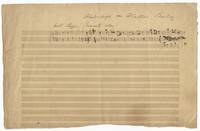
rif. 416811 leaf. Oblong folio 268 x ca. 170 mm. 7 measures notated in black ink on one side of the leaf. Unsigned. Several notes crossed out and a final passage rewritten. A first draft of a polyphonic theme. Identified in German in contemporary manuscript at head: "Handschrift von Hector Berlioz Erste Skizze. Benvenuto Cellini." Some wear and browning; slightly creased at folds; lower edge unevenly trimmed. The present manuscript not recorded in Holoman. Benvenuto Cellini an opéra semi-seria in two acts to a libretto by Léon de Wailly and Auguste Barbier assisted by Alfred de Vigny was based on the memoirs of Benvenuto Cellini. Set in 16th century Rome during the papacy of Clement VII the work premiered in Paris on 10 September 1838 at the Opéra and was produced in a revised version in Weimar at the Grossherzogliches Hoftheater on 20 March 1852 and with further revision in three acts on 17 November 1852. "Whether it originated as a serious or a comic opera the result in all its many versions is a compound a characteristic blend of idealism and farce grandeur and wit breadth and vivacity. Berlioz poured into Benvenuto Cellini every drop of invention and feeling at his command in a torrent of notes that make up a long and very lively opera and its heterogeneity so baffling to Parisians in 1838 and Londoners in 1853 is one of its main virtues." Macdonald: Berlioz p. 106. "Berlioz stands as the leading musician of his age in a country France whose principal artistic endeavour was then literary in an art music whose principal pioneers were then German. In many senses the Romantic movement found its fullest embodiment in him yet he had deep Classical roots and stood apart from many manifestations of that movement. His life presents the archetypal tragic struggle of new ideas for acceptance to which he gave his full exertions as composer critic and conductor. And though there were many who perceived greatness in his music from the beginning his genius only came to full recognition in the 20th century. . In Berlioz's own words Benvenuto Cellini 'contains a variety of ideas an energy and exuberance and a brilliance of colour such as I may perhaps never find again.' " Hugh Macdonald in Grove Music Online A rare working manuscript from one of Berlioz's important stage works evidencing the compositional process through its autograph revisions. While short musical quotations in Berlioz's hand are not rare his sketch leaves are very rare to the market; we have located only one example at auction in over 30 years. unknown books
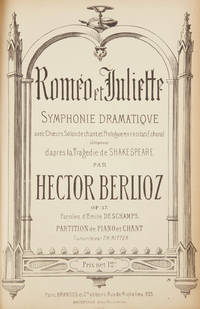
1890rif. 36788Paris: Brandus et Cie. PN 818 1890. Large octavo. Dark red morocco-backed marbled boards raised bands on spine in decorative compartments gilt titling gilt marbled endpapers. 1f. recto title verso blank 1f. recto contents verso blank 1-2 preface and foreword 3-118 pp. Text in French and German. Binding slightly worn rubbed and bumped. Slightly browned. Re-issue. "Shakespeare's plays were to supply the basis of three of Berlioz's major works Roméo et Juliette Béatrice et Bénédict and the Roi Lear overture. In addition there were at least three pieces inspired by Hamlet a fantasy on The Tempest and some direct borrowings in Les Troyens. More profoundly Shakespeare provided a framework for the structure of both Roméo et Juliette and Les Troyens and was a source in the form of dramatic truth of Berlioz's fundamental notion of expressive truth. Berlioz was to read and quote Shakespeare avidly for the rest of his life putting him alongside Virgil in his literary pantheon." Grove online. Brandus et Cie. [PN 818] unknown books
1950rif. 33715Boston: Little Brown 1950. 2 volumes. Octavo. Boards. 573; 511 pp. Head and tail of spine slightly worn. Little, Brown unknown books
1973rif. 33813Chicago: University of Chicago Press 1973. Wrappers. 381 pp. Minor annotations to rear free endpaper. Wrappers slightly worn. University of Chicago Press unknown books
1980rif. 34843London: Kahn & Averill 1980. Hardcover. Fine. Octavo. Full light brown cloth. 143 pp. With author's inscription to front free endpaper. Kahn & Averill hardcover books
1972rif. 32483London: Faber 1972. Hardcover. Very Good. Quarto. Full red cloth. 280 pp. With illustrations. In dustjacket. Faber hardcover books
1880rif. 29519New York: G. Schirmer PN 2376 1880. Large octavo. Original publisher's decorative green wrappers printed in black and red. 1f. recto decorative title verso blank 1f. recto content verso blank 236 pp. Text in english and French. Wrappers slightly worn; upper partially detached; spine split and torn with portions lacking. Some signatures split or splitting. Hopkinson 54Dq. In four parts to a libretto by the composer and Almire Gandonnière after Gérard de Nerval's French translation of Johann Wolfgang von Goethe's Faust Le Damnation de Faust was first performed in concert in Paris at the Opéra-Comique Salle Favart on December 6 1846 and as a fully staged opera in five acts by Raoul Gunsbourg for the Monte Carlo Opéra on February 18 1893. G. Schirmer [PN 2376] unknown books
1875rif. 28523Leipzig: J. Rieter-Biedermann PN 818 1875. Large octavo. Half dark brown cloth with marbled boards original publisher's printed wrappers with titling within decorative border bound in. 1f. title 3-118 pp. Text in French and German. Minor tears to lower margin of upper wrapper. Slightly browned. Hopkinson 39Dd. ". in some respects Berlioz's most interesting solutions to issues of operatic style are to be found in Roméo et Juliette Friar Laurence's scene and the superb finale which follows may be compared with the best in Meyerbeer." D. Kern Holoman in Grove Music Online. J. Rieter-Biedermann [PN 818] unknown books
rif. 354342 pp. of a bifolium. Octavo. Dated "31 Juillet" no year. To an unidentified male correspondent. On lined paper. In French with translation. Berlioz apologizes for not being able to edit his article on Bortnyansky with which he hopes his correspondent will be satisfied. "The fragment of musical criticism which I wanted to add to the item on Bortnianski is in the hands of Mr. M. Levy's printer who is at present bringing out a book which contains this article. It is impossible for me - since the printer is not in Paris - to rework my manuscript. Therefore be good enough to be satisfied with the Russian article; it is accurate on the whole and it would be difficult for me to redo a study on Bortnianski and Emperor of Russia's singers that is already done." The composer/critic goes on say that he would be happy for extracts of the article to appear in L'Illustration and in a postscript asks his correspondent to send him a copy of the periodical in which his article appears. Slightly worn; creased at folds and very slightly overall. Dmitri Stepanovich Bortnyansky 1751-1825 was a Ukrainian singer composer and music director active in Russia. "During the 19th century Bortnyansky choral concertos and hymns gained popularity across Western Europe; some copies of concertos preserved in the library of the Hofkapelle in Vienna date from as early as 1780. Berlioz who heard the concertos in Russia in the 1840s praised the 'incredible freedom' of their approach to choral sonority Les soirées de l'orchestre Paris 1852 and included Bortnyansky's music in several of his own concerts in Paris." Marika Kuzma in Grove Music Online "Berlioz stands as the leading musician of his age in a country-France-whose principal artistic endeavour was then literary and in an art-music-whose principal pioneers were then German. In many senses the Romantic movement found its fullest embodiment in him yet he had deep Classical roots and stood apart from many manifestations of that movement. His life presents the archetypal tragic struggle of new ideas for acceptance to which he gave his full exertions as composer critic and conductor. And though there were many who perceived greatness in his music from the beginning his genius only came to full recognition in the 20th century. . Berlioz's views were presented regularly to readers of the Paris press. . He published three collections of criticism: Les soirées de l'orchestre 1852 Les grotesques de la musique 1859 and A travers chants 1862. In his feuilletons he wrote of new operas and singers .; his opinion on momentous occasions was of crucial interest for example at the première of Le prophète in 1849. He reviewed most of the concerts of the Société des Concerts; he wrote of new instruments and musical gadgets of his own impressions of music abroad and of important musicians visiting France; he wrote biographical notices of Gluck Beethoven Spontini Méhul and himself; he wrote fiction and fantasy often with a critical purpose; he wrote serialized treatises on orchestration and conducting. There are in short few facets of musical practice of the time untouched in his feuilletons. . In general Berlioz's opinions are trenchant and clearly expressed." Hugh Macdonald in Grove Music Online. unknown books
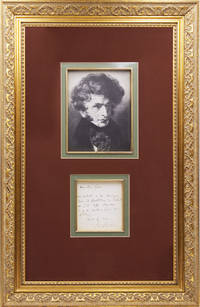
rif. 316604np nd. 1 page pen and ink on paper. 12mo 3-3/8 x 3-1/8 inches visible. Framed in gilt frame. 1 page pen and ink on paper. 12mo 3-3/8 x 3-1/8 inches visible. In translation: "Have the courtesy to send me the three articles on the debates that I left at your house a few days ago ." M. Gras is perhaps a relation to soprano Julie Dorus-Gras who performed as Teresa in the premier Berlioz' opera Benvenuto Cellini. unknown books
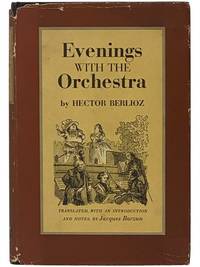
1956rif. 2353084New York: Alfred A. Knopf 1956. First American Edition. Hard Cover. Good/Good. 9x6x1. First American edition. Top corner bruised jacket edges rubbed with loss from spine head and foot ink name on front endpaper minimal pencil marks on a couple pages. 1956 Hard Cover. xviii 376 v 1 pp. Translated into English with an introduction and notes by Jacques Barzun. Originally published in 1852 the book is framed as a series of twenty-five "evenings" during which musicians in an orchestra at a provincial theater - bored by the mediocre operas they are forced to play - engage in witty storytelling gossip and sharp critical debates to pass the time. Alfred A. Knopf hardcover books
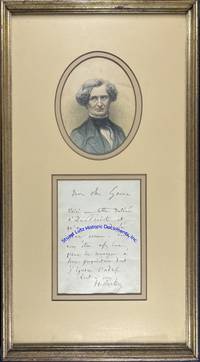
rif. 5622LOUIS-HECTOR BERLIOZ 1803-1869. Berlioz was a French composer and conductor of the Romantic movement.ALS. 1pg. N.d. N.p. An autograph letter signed H Berlioz. Berlioz wrote a brief missive in French asking the recipient to pass along a letter. My dear Garcia Here is a letter addressed toand that was addressed to me by accident. Will you be good enough to return it to his landlord whose address I dont know. All to you H Berlioz. It is matted and framed with a color engraving of Berlioz. In fine condition. unknown books
1935rif. 172766New York: Tudor 1935. Very Good. Revised. Very good. Previous owner's name and date on front inside panel back cloth cover lightly soiled. Tudor unknown books
1958rif. 70611London: William Reeves 1958. Hardcover. Very good. Hardcover. xiii 165pp; ads. Very good hardback in a darkened and slightly rubbed jacket. William Reeves hardcover books
1927rif. 87646Paris: Calmann-Levy 1927. paperback. very good. Correspondance Punliee Par Julien Tiersot. 380pp. 12mo printed wrappers. Paris: Calmann-Levy 1927. Calmann-Levy unknown books
1935rif. 47615NY: Tudor 1935. New Edition. 8vo pp. xxiii 533 xiii. Index. Illustrated. Translated from the french by Rachel Holmes and Eleanor Holmes. Annotated and the translation revised by Ernest Newman. Marfoon cloth stamped in gilt on the spine. A little pencil marking o/w a VG tight copy in worn dj. Tudor unknown books
1900rif. 44275Boston: Elias Howe 1900. New edition revised corrected augmented. Large 8vo pp. 257. Translated from the French by Mary Cowden Clarke. Owner's signature on tile same stamps on front pastedown and first page. Dark blue cloth stamped in gilt. Hinges tender cover somewhat spotted and worn. Good. Elias Howe unknown books