GLUCK, Christoph Willibald 1714-1787Biblio.com
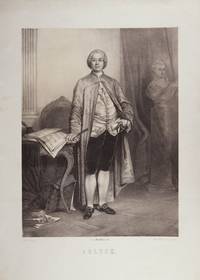
1860ref. 41452Berlin: W. Zawitz 1860. The composer is depicted full-length standing facing forward dressed in a long coat an elegant waistcoat britches and stockings. He holds a writing quill in his right hand which partially rests on an open opera manuscript resting on a table next to the composer; volumes of his works and music paper rest against a leg of the table. Image size 400 x 275 mm; sheet size 522 x 372 mm. Printed by J. Hesse on wove paper on an off-white ground. Some minor wear soiling and repairs; creases from folding faintly visible on recto. Gluck a Bohemian-Austrian composer was "a leading figure in opera of the second half of the 18th century and the person chiefly credited with the 'reform' of opera after the age of Metastasian opera seria." Jeremy Hayes Bruce Alan Brown Max Loppert and Winton Dean in Grove Music Online Hamman a Belgian painter and engraver specialized in portraying famous artists scholars and the nobility. W. Zawitz unknown
2001ref. mon0001006989Ecco Pr 01/04/2001 00:00:01. hardcover. Very Good. 1.1891 in x 23.5821 in x 16.1178 in. First edition. Pages clean and bright no markings light wear to edges. Binding tight. Ecco Pr hardcover
ref. om 9780974680057USA Edition . New. Brand New! Fast Delivery and ship within 24-48 hours. Deliver by FedEx and Dhl & Aramex UPS & USPS and we do accept APO and PO BOX Addresses. Order can be delivered worldwide within 6-10 days and we do have flat rate for up to 2LB. Extra shipping charges will be requested if the Book weight is more than 5 LB. This Item May be shipped from India United states & United Kingdom. Depending on your location and availability. unknown
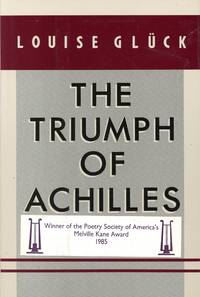
1985ref. 10027New York: Ecco Press 1985. First Edition First Printing. Hardcover. Near fine/Near fine. Octavo. 5.75 x 8.25 in. 60 pp. Near fine in original cloth-backed paper-covered boards with faint foxing around top-edge extremities and a near fine pictorial dust jacket with a sticker pasted to front panel. Glück's fourth book of poetry. Ecco Press hardcover
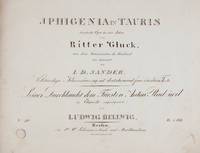
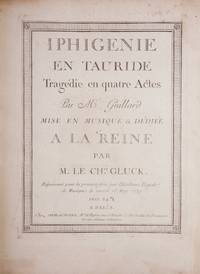
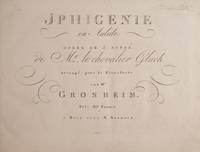
1812ref. 41214Berlin: Schlesinger's Buch= und Musikhandlung Unter den Linden No. 34. PN 50 1812. Oblong folio. Contemporary dark brown mottled calf-backed marbled boards with oval label titled in manuscript to upper. 1f. recto title verso blank 3 "Personen" and incipits 4-123 i blank pp. Provenance Noted American harpsichordist Louis Bagger 1926-2024 Binding worn rubbed and bumped. Very occasional minor soiling to blank lower margins; occasional minor showthrough; small stains to title with small circular publisher's handstamp to inner margin. Hopkinson 46Ca. Gluck's work is a tragedy in four acts to a libretto by Nicolas-François Guillard after Guymond de la Touche's Iphigénie en Tauride itself based on Euripides's work of the same name. "Iphigénie en Tauride was the crowning achievement of Gluck's career a result of the combination of his lifelong experience as an opera composer and a libretto which is arguably the best he ever set." Jeremy Hayes in Grove Music Online It was first performed in Paris at the Opéra on 18 May 1779 "with excellent singers; Rosalie Lavasseur sang Iphigénie Larrivée Oreste Legros Pylade and Moreau Thoas. . The opera had a great success immediately and even Grimm wrote of it - I do not know whether this is melody but perhaps it is something better. When I hear Iphigénie I forget I am at the opera; I seem to be listening to a Greek tragedy with music by Lekain and Mlle Clarion. It was the crowning point of Gluck's career. Guillard had provided an excellent libretto more classical than Goethe's poem less Christian and more ruthless; and Gluck had seized on the contrast between Scythians and Greeks upon the perfectly dramatic figures of Iphigenia and Orestes and had produced a work which both re-created a part of Greek tragedy and at the same time foretold a new world." Cooper: Gluck p. 258. Schlesinger's Buch= und Musikhandlung, Unter den Linden No. 34. [PN 50] unknown
ref. ANAIS-0691054495Princeton University Press. hardcover. Good. 1.8x09x2.1. Buy with confidence. Excellent Customer Service & Return policy. Princeton University Press hardcover
2024ref. SKU1709526West Academic Publishing 2024-07-18. hardcover. Good. 0x0x0. Textbook May Have Highlights Notes and/or Underlining BOOK ONLY-NO ACCESS CODE NO CD Ships with Tracking West Academic Publishing hardcover
2024ref. SKU1714243West Academic Publishing 2024-07-18. hardcover. New. 0x0x0. New Book Ships with Tracking West Academic Publishing hardcover
1980ref. 8607New York: Ecco 1980. First Edition First Printing. Hardcover. Near fine/Very good. Octavo. 5.5 x 8.5 in. 48 pp. Near fine in original purple cloth boards with remainder mark to foot of text block a slight lean to spine and very good pictorial dust jacket with minor rubbing to spine extremities and chip to foot of rear panel. Gluck's third book of poetry. Ecco hardcover
1990ref. 8666New York: Ecco Press 1990. First Edition First Printing. Hardcover. Near fine/Near fine. Octavo. 6.25 x 9.25 in. 68 pp. Near fine in original cloth-backed paper-covered boards with very light foxing to edge of text block and near fine pictorial dust jacket. First edition of Glück's fifth poetry collection. Ecco Press hardcover
2001ref. 7594New York: Ecco / HarperCollins 2001. First Edition First Printing. Hardcover. Near fine/Near fine. Octavo. 6.5 x 9.5 in. 68 pp. Near fine in original paper-covered boards remainder mark to foot of text block and near fine pictorial dust jacket. Ecco / HarperCollins hardcover
1990ref. 7602New York: Ecco Press 1990. First Edition First Printing. Hardcover. Fine/Fine. Thin octavo. 6.25 x 9.25 inches. 68 pp. A little light spotting to the top edge otherwise fine in original cloth-backed boards and fine pictorial dust jacket. First edition of Glück's fifth poetry collection. Ecco Press hardcover
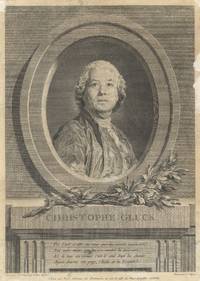
1775ref. 40412Paris: chés Miger 1775. Sheet size 284 x 204 mm. The composer is depicted in a circular frame one-third length turned left with head facing forward and eyes raised. He is dressed in a pleated coat waist-length jacket shirt and cravat. The circular frame sits on a stone shelf and is adorned with a branch of laurel with lettering below as follows: CHRISTOPHE GLUCK // De l'art d'aller au coeur par des accords touchants letzter Buchstabe verdruckt / Nul autre mieux que lui n'a montré la puissance / Et de tous ses rivaux c'est le seul dont les chants / Ayent charmé son pays l'Italie et la France." Slight browning; minor abrasions primarily to margins with minor paper loss; some paper repairs. Scarce. chés Miger unknown
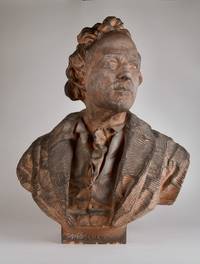
1864ref. 404171864. Height 26.75" 68 cms. With the artist's name "Francin" to truncation of left arm; integral base inscribed "Gluck." Some wear and soiling; age-toned. In quite good condition overall. Provenance Catalogue of the Collection Musicale André Meyer 1961 Vol. I p. 97 and plate 122. Auction catalogue of Pescheteau-Badin Godeau et Leroy Collection Musicale André Meyer et a divers Paris July 2 1998 Lot 101 including color photograph. Auction catalogue of Bonhams London The Roy Davids Collection London 3 October 2005 Lot 246 illustrated. Houdon: An Exhibition of Sculpture from the Collection of Michael Hall esq. Catalogue by Christine Defazio Karl Fugelso and Philip Mezzatesta. New York: Salander-O'Reilly Galleries 1998 pp. 12-15. Poulet et al.: Jean-Antoine Houdon - Sculptor of the Enlightenment. Exhibition Catalogue. The National Gallery of Art Washington D.C. 2003 pp. 102-108. Exposition du Centenaire de Houdon Paris: Galleries Buvelot 1928 pp. 40-41. Vitry: Une Liste d'oeuvres de J.-A. Houdon p. 9. The present sculpture exists in two versions: the present scarcer version with full shoulders and partial torso and a second version with partial shoulders and reduced torso "Following Houdon's plaster bust of Gluck shown in the Salon of 1775 . the marble was exhibited in 1777 . and destroyed in the fire at the Paris Opera 28-29 Oct. 1873. A faithful reproduction ordered in 1798 by Alexandre Lenoir for the Musée des monuments français and executed in marble by Guillaume Francin is in the Musée national du chateau de Versailles. The Louvre's plaster cast workshop distributed copies of this reproduction beginning in 1864." Poulet et al.: Jean-Antoine Houdon - Sculptor of the Enlightenment. Exhibition Catalogue. The National Gallery of Art Washington D.C. 2003 p. 107. "The present bust is probably one of the Louvre's copies. . It was in his depiction of Gluck that Houdon first showed the ravages of smallpox on a subject - it was a common affliction in eighteenth-century France but artists were expected to flatter their subjects in this respect at least." Bonhams catalogue "Gluck was an artist a great musician and therefore must be given the attributes of a genius. His face was deeply pockmarked and the sculptor used this fact to establish his theme. He clothed him in a heavy coat whose texture is an overall pattern of slashed grooves free and direct in their expressive impact. Here there was no attempt to stimulate the appearance of the actual material but rather in a manner almost Rodinesque to bring out the quality of the clay. The open shirt the unbuttoned vest the short disheveled hair and the alert titled pose of the head all emphasize the impact of genius." Arnason: The Sculptures of Houdon p. 34. unknown
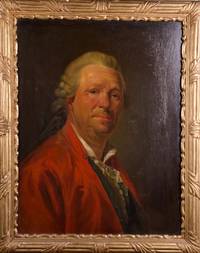
ref. 40422Paris 19th century. 61 x 47.3 cms with frame 69.5 x 56 cms. The composer is depicted bust-length turned 3/4 left facing forward wearing a red jacket blue waistcoat white collared blouse with lace and wig. For a fine full-page color illustration of the original held at the Louvre see MGG Vol. 5 plate 15. "Gluck was recognized as an extraordinary phenomenon in his lifetime as is evident from Burney's deferential treatment of the composer during his visit to Vienna in 1772. Shortly afterwards the controversy stirred in French journals resonated well beyond the capital to other countries. The daily cultural discourse of Paris concerned Gluck's 'musical revolution' a catch-phrase taken up by Gluck's opponents such as Jean-François Marmontel as well as by his defenders; in 1781 the 'revolution worked in music by M. le Chevalier Gluck' later dubbed the 'German Orpheus' was used as the title of a collection of pamphlets for and against Gluck with a heavy editorial bias in favour Lesure c1984. Although operas by Piccinni Salieri and especially Sacchini as well as French contemporaries such as Grétry continued alongside Gluck in the French repertoire beyond the Revolution and Empire revivals of Gluck constituted the principal touchstone of dramatic music into the 1820s when the last routine revivals were acclaimed by Berlioz. Opera composers including Salieri Lemoyne and Vogel in Paris were presented or presented themselves as his legitimate successors; elsewhere Mozart especially in Idomeneo and J.M. Kraus were strongly affected by Gluck's example in constructing scenes applying a dramatically motivated admixture of lyricism and more direct and declamatory vocal expression and sometimes in modelling as when the statue in Don Giovanni adopts the tone of the oracle in Alceste. After his death his direct effect can still be heard in Die Zauberflöte and in several French operas including those of Méhul Cherubini and Spontini. Among the Romantics he continued to inspire respect and from Berlioz and Wagner emulation. Berlioz supervised productions of Orphée and Alceste in Paris 1859 and 1866. In Orphée Berlioz created the basis for the version most used over the next century at least by restoring the Italian key-scheme in several scenes to accomodate the tessitura of the title role to a female singer; Pauline Viardot was the first in a line to include Giulia Ravoli Kathleen Ferrier Janet Baker and others although the French version with tenor retained some currency. Musicians close to Berlioz began to realize his ideal of a complete critical edition although only a handful of 'reform' operas were published. Wagner wrote about Gluck in Oper und Drama having learned much from deep study of Iphigénie en Aulide of which he made a modernized performing version Dresden 1847. In 1890 for Weimar Richard Strauss similarly adapted Iphigénie en Tauride. Such orchestrational revision and the melding of recitative and aria to blur Gluck's structure of closed forms represented a style of musical archaeology from which Handel and Mozart also suffered or in terms of public exposure benefited. The later 20th century witnessed not only numerous revivals of the reform operas some in musically authentic form and including the Vienna Orfeo but also a less one-sided critical view of Gluck became possible with the publication of a new critical edition and a revival of interest in works in other genres especially opéra comique and with Don Juan ballet. Winton Dean has observed that Gluck's compromise between the demands of words and music 'was one of the most satisfying and successful of all and has placed his greatest works beyond the reach of time' Grove6. None of Gluck's operas except Orfeo/Orphée is likely to become a staple work in the repertory; however to the extent that every production has the aspect of a revival continued interest in his achievement and consequently revival of an increasing proportion of his output is guaranteed so long as opera continues to occupy a central place in Western musical culture." Julian Rushton in Grove Music Online. unknown
1893ref. 694241893. Verh. Berl. med. Ges. 24 1893. - Berlin Gedruckt bei L. Schumacher 1894 8° XLII 250; 389 pp.; mit Abbildungen Halbleinenband d.Zt.; St. verso Tit. Erste Auflage! Verhandlungen der Berliner medicinischen Gesellschaft aus dem Gesellschaftsjahr 1983. Separat-Abdruck aus der Berliner klinischen Wochenschrift. Hrsg. von dem Vorstande der Gesellschaft. Themistocles Gluck 1853-1942 Chirurg. unknown
1893ref. 346831893. Verh. Berl. med. Ges. 23 1892. - Berlin Gedruckt bei L. Schumacher 1893 8° XXXI 288; 302 pp.; mit Abbildungen Halbeinenband d.Zt.; St. verso Tit. Erste Auflage! Verhandlungen der Berliner medicinischen Gesellschaft aus dem Gesellschaftsjahr 1892. Separat-Abdruck aus der Berliner klinischen Wochenschrift. Hrsg. von dem Vorstande der Gesellschaft. Weitere Beiträge von Th. Gluck in diesem Band: Resection des 2. Trigeminusastes und Demonstration einer Knochenschere I: pp.55-56. Ersatz von Sehnendefecten I: pp.83. Hemiatrophia facialis I. p.163. Themistocles Gluck 1853-1942 war ein deutscher Chirurg. unknown
1783ref. 40425Paris: Des Lauriers without PN 1783. Folio. Modern quarter dark red morocco with marbled boards black leather title label to spine gilt. i recto title verso blank i "Catalogue de Musique du fond de Des Lauriers Md. de Sapier rue St. Honoréa Paris" i dedication 211 i blank pp. Engraved throughout. With a short article from Marmontel's Mémoires laid down to blank verso of title in English translation regarding the opera's reception history. Occasional staining soiling and foxing to blank margins; small stain and hole under lowermost system of p. 65; blank upper outer margin of title through p. 7 dampstained; stain and minor loss to lower margin of pp. 18-22. In very good condition overall. Third edition unrecorded variant. Hopkinson 40A e. Wotquenne 46 pp. 215-16. Lesure p. 239 different issue. BUC p. 386. RISM G2816. "Iphigénie en Tauride was given on May 18 1778 with excellent singers; Rosalie Lavasseur sang Iphigénie Larrivée Oreste Legros Pylade and Moreau Thoas . The opera had a great success immediately and even Grimm wrote of it - I do not know whether this is melody but perhaps it is something better. When I hear Iphigénie I forget I am at the opera; I seem to be listening to a Greek tragedy with music by Lekain and Mlle Clarion. It was the crowning point of Gluck's career. Guillard had provided an excellent libretto more classical than Goethe's poem less Christian and more ruthless; and Gluck had seized on the contrast between Scythians and Greeks upon the perfectly dramatic figures of Iphigenia and Orestes and had produced a work which both re-created a part of Greek tragedy and at the same time foretold a new world." Cooper: Gluck p. 258. While Marie-Antoinette is not actually mentioned on the title she was the queen to whom the work is dedicated. Des Lauriers [without PN] unknown
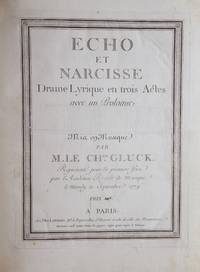
1779ref. 40424Paris: Chez des Lauriers Md. de Papiers Rue St. Honoré à côté de celle des Prouvaires Ou trouve aussi toutes sortes de papiers réglés pour copier la Musique 1779. Folio. Contemporary quarter dark brown calf with marbled boards spine in decorative compartments gilt with titling gilt to spine. 1f. recto title verso blank 256 pp. With blank overpaste to title obscuring the words "Par M. Le Baron de T." Signature "L. Wessén" in ink to front pastedown and "A. Benzinger" to free front endpaper. Binding worn rubbed and bumped; lower portion of upper joint partially split. Occasional small stains foxing browning tears and light dampstaining; minor loss to blank outer margin of pp. 139 and 149; several small holes to p. 237. Quite a good copy overall on quality paper. First Edition variant issue. Hopkinson p. 63 with attributes of 47Ac except here there is no plate number and the price "40" appears in manuscript and 47Ae as "Royale" has been erased here in pencil. Wotquenne 47. BUC p. 386. RISM G2739 First performed in Paris at the Opéra on 24 September 1779. "Echo et Narcisse was a failure at its early performances largely because the audiences and critics expected high drama along the lines of Alceste Armide and Iphigénie en Tauride. But Echo et Narcisse is a different type of work; it belongs to the pastoral tradition still popular at this date and a genre to which Gluck frequently returned. Comparisons were and are still made with Gluck's more popular dramas because Echo et Narcisse contains numbers and scenes similar to those that had made greater impressions before. It is not a weak opera and there is much fine music in it ." Jeremy Hayes in Grove Music Online Gluck was a "Bohemian-Austrian composer of Italian and French opera a leading figure in opera of the second half of the 18th century and the person chiefly credited with the 'reform' of opera after the age of Metastasian opera seria. . Force of circumstance may have led Gluck to Paris to complete his operatic career but in artistic terms Paris can be seen as his inevitable final destination. His years of grounding in opéra comique and the ballet and via Traetta his response to the French tragédie lyrique tradition had already provided the impetus for his overhaul of the opera seria; now it was time to confront that tradition on its own territory. On more than one occasion indeed Gluck explicitly owned the French influence and its particular effect on his preparation for Paris. Between them the eight operas that he produced for the Académie Royale de Musique in Paris - the two Iphigénie operas; the radical revisions for Paris of the Vienna 'reform' operas Orfeo and Alceste; the similar revisions of the Vienna opéras comiques Cythère assiégée and L'arbre enchanté; Armide a new opera on a libretto that Quinault had written for Lully more than 90 years earlier; and the last opera Echo et Narcisse - are all different attempts at the confrontation and revival of that lyric tradition." Jeremy Hayes Bruce Alan Brown Max Loppert and Winton Dean in Grove Music Online. Chez des Lauriers Md. de Papiers, Rue St. Honoré à côté de celle des Prouvaires Ou trouve aussi toutes sortes de papiers ré unknown
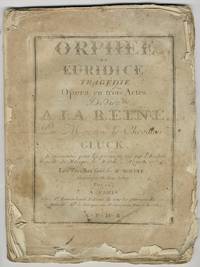
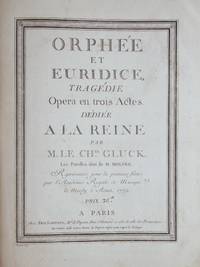
1774ref. 40430Paris: Chez Mr. Lemarchand . A.P.D.R. 1774. Folio. Unbound. Sewn. 1f. recto title verso publisher's catalogue 1f. recto dedication verso "Argument" 52 pp. Engraved. Incomplete with only first act and three pages of second act present. Worn overall with occasional staining foxing and soiling throughout primarily to blank margins; title worn and heavily browned stained and soiled with paper loss to edges; corners slightly bumped and creased; signatures separated; binder's holes to blank inner margin. First Edition unrecorded variant. Wotquenne 41. Hopkinson p. 43 41A. BUC p. 386. Lesure p. 240. RISM G2582. First performed in Vienna at the Burgtheater on 5 October 1762 in Italian to a libretto by Ranieri de' Calzabigi and in Paris at the Opéra on 2 August 1774 in French to a libretto by Pierre Louis Moline after Calzabigi. "The classical orientation of Calzabigi evident in Orfeo ed Euridice from the moment the curtain rose on the almost archaeologically recreated ancient funerary ritual e.g. the threefold calling of the name of the deceased coloured the entirety of his collaboration with Gluck. Despite the ambiguous attributions of the prefaces signed by the composer it is clear that Gluck largely shared his librettist's classical enthusiasms . It is revealing that Gluck sought out subject matter from Greek tragedy independently of Calzabigi after the latter's departure from Vienna - most probably with his inner conviction mixing with a desire to exploit the goût grec then prevailing in France . Calzabigi's poetry was almost completely devoid of metaphors and similes and placed a mere three characters in a fluid context of dances and choruses or both simultaneously. The action was reduced to essentials: a demonstration of the persuasive powers of music and a cautionary tale on the dangers of curiosity with Orpheus bewailing the loss of his wife already as the curtain rose. Gluck's approach as composer was no less radical particularly in his near-complete elimination of coloratura and of opening ritornellos in the solo numbers. Above all the opera was remarkable in its emphasis on continuity which was achieved chiefly through the enchaining of harmonically open-ended sections of music and through the complete avoidance of recitativo semplice in favour of orchestrally accompanied recitatives so as to avoid sharp contrasts of texture with the set pieces. This continuity and the nearly syllabic vocal writing were calculated to prevent applause and thus also to promote the audience's absorption in the spectacle." Bruce Alan Brown and Julian Rushton in Grove Music Online. Chez Mr. Lemarchand ... A.P.D.R. unknown
1809ref. 40434Bonn: Chez N. Simrock PN 609 1809. Oblong folio. Quarter black leather with gilt rules mid-brown cloth boards spine in compartments gilt with titling gilt marbled edges. 1f. recto title verso cast list 3-149 pp. Text in French and German. Engraved throughout. With contemporary signature of former owner "Mappes" to upper outer corner of free front endpaper with handstamp of August Kuby in Munich below; "Amalie Mappes" to upper outer corner of title. Binding worn rubbed bumped and slightly stained. Occasional soiling; small ink stains browning and foxing to blank margins; small loss to lower outer corner of p. 27. First Edition. Hopkinson p. 41 40F. Wotquenne 40. RISM G2753 and GG2753 no copies in the U.S. Iphigenie en Aulide was first performed in Paris at the Opéra on 19 April 1774. "Judging from contemporary accounts such as the memoirs of Mannlich the several months of rehearsals for Iphigénie en Aulide must have been quite a spectacle with the irascible 60-year-old composer struggling to reform the bad habits of the singers and players of the Académie Royale to teach them his new opera. However the première of Iphigénie en Aulide in April 1774 was a triumph but the run of performances was interrupted by the death of Louis XV a month later. All the theatres closed and during the period of mourning Gluck quickly revised Orfeo ed Euridice and made a French version of the opera with a translation of the text by Pierre Louis Moline." Jeremy Hayes in Grove Music Online. Chez N. Simrock [PN 609] unknown
1783ref. 40431Paris: Chez Des Lauriers Md. de Papiers Rue St. Honoré à côté de celle des Provaires 1783. Folio. Early full dark brown leather with double rule gilt to edges of boards spine in compartments gilt with titling gilt marbled endpapers. 1f. recto title verso blank 1f. recto dedication verso "Argument" 217 pp. Bound with an extra title that of Hopkinson 41Ak. 1f. recto title verso blank 1f. recto blank verso "Argument" pp. Binding quite worn rubbed and bumped with loss to spine. Occasional minor soiling to blank outer margins; paper repairs to blank inner margins of approximately fifteen leaves; small binder's holes to blank inner margin of numerous leaves; occasional staining; worming to blank inner margin of final third of volume; extra title and Argument worn and soiling with worming to blank margins. Second edition of the French version. Wotquenne 41. A variant issue of Hopkinson 41Ai but with the price of 36 instead of 24 tt. Lesure p. 240. RISM G2853. First performed in Vienna at the Burgtheater on 5 October 1762 in Italian to a libretto by Ranieri de' Calzabigi and in Paris at the Opéra on 2 August 1774 in French to a libretto by Pierre Louis Moline after Calzabigi. "More successfully than any of his contemporaries Gluck translated the widespread agitation for reform of opera and theatrical dance on the part of European intellectuals into actual works for the stage first in pantomime ballets and Italian serious operas for Vienna and then in operas of various sorts for Paris." Bruce Alan Brown and Julian Rushton in Grove Music Online "The classical orientation of Calzabigi evident in Orfeo ed Euridice from the moment the curtain rose on the almost archaeologically recreated ancient funerary ritual e.g. the threefold calling of the name of the deceased coloured the entirety of his collaboration with Gluck. Despite the ambiguous attributions of the prefaces signed by the composer it is clear that Gluck largely shared his librettist's classical enthusiasms. . It is revealing that Gluck sought out subject matter from Greek tragedy independently of Calzabigi after the latter's departure from Vienna - most probably with his inner conviction mixing with a desire to exploit the goût grec then prevailing in France. . Calzabigi's poetry was almost completely devoid of metaphors and similes and placed a mere three characters in a fluid context of dances and choruses or both simultaneously. The action was reduced to essentials: a demonstration of the persuasive powers of music and a cautionary tale on the dangers of curiosity with Orpheus bewailing the loss of his wife already as the curtain rose. Gluck's approach as composer was no less radical particularly in his near-complete elimination of coloratura and of opening ritornellos in the solo numbers. Above all the opera was remarkable in its emphasis on continuity which was achieved chiefly through the enchaining of harmonically open-ended sections of music and through the complete avoidance of recitativo semplice in favour of orchestrally accompanied recitatives so as to avoid sharp contrasts of texture with the set pieces. This continuity and the nearly syllabic vocal writing were calculated to prevent applause and thus also to promote the audience's absorption in the spectacle." Bruce Alan Brown and Julian Rushton in Grove Music Online. Chez Des Lauriers, Md. de Papiers, Rue St. Honoré à côté de celle des Provaires unknown
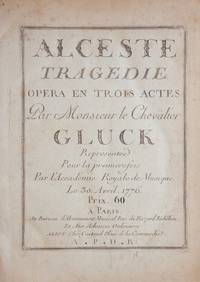
1777ref. 40432Paris Lyon: Au Bureau d'Abonnement Musical Rue du Hazard Richelieu et Aux Adresses Ordinaires. A Lion Chez Castaud Place de la Commedie 1777. Folio. Early dark brown morocco. 1f. recto title verso publisher's catalogue 293 pp. With "Lagny" in contemporary black ink to blank inner margin of p. 1. Binding worn rubbed and bumped. Slightly worn; title slightly browned and foxed; occasional minor foxing soiling browning and small stains; several leaves slightly trimmed at outer margin not affecting text or notation; small loss to blank lower outer corner of p. 87; light impression to lowermost system of p. 43. Lacking pp. 35/36. Second edition. Wotquenne 44. Hopkinson p. 54 44Acc. Lesure p. 236. BUC p. 385. RISM G2639. Alceste an opera in three acts with text by R. de Calzabigi and a ballet by Noverre was first performed on 26 December 1767 at the Burgtheater in Vienna. It was revised by Gluck for a performance in Paris on 23 April 1776. "Gluck himself stressed the nature of Alceste as a `reform opera' by providing in the preface dedicating the printed score to the Grand Duke Leopold a discussion that goes far beyond the conventional. .That key document at once a manifesto and a defense . is a sharp repudiation of the theory practice and conventions of the old "opera seria" represented in its final phase by Metastasio and his favourite composer Hasse." TNG Vol. 7 pp. 463 and 467. Au Bureau d'Abonnement Musical, Rue du Hazard Richelieu et Aux Adresses Ordinaires. A Lion Chez Castaud Place de la Commedie unknown
1994ref. 1389597Hopewell NJ: The Ecco Press 1994. First Edition First Printing. Hardcover. Octavo 134 pages. In Very Good condition with a Very Good condition dust jacket. White spine with black lettering. Dust jacket is wrapped in a mylar covering price is uncut "$22.00 - Canada $28.99" and has mild wear along the spine head and tail edges. Boards have mild wear along the head and tail edges and stains on the head and tail edges. Textblock has stains on the end-pages pastedowns and edges. Signed flat by Louise Glück on title page. DL consignment. Shelved in Case 0. Louise Glück was born on April 22 1943 in New York City to parents of Russian and Hungarian Jewish descent. Glück was taught Greek mythology and classic stories from a young age which greatly influenced her works. Glück began writing poetry in highschool eventually taking some poetry classes and attending workshops where she more deeply developed her craft. After a tumultuous life and career Glück finally began seeing wider success in her work in the 1990's. That success however came with personal pains which she channeled into her work producing a collection of essays in 1994 titled "Proofs & Theories: Essays on Poetry" 1389597. Shelved Dupont Bookstore. The Ecco Press hardcover
1980ref. 1389637New York NY: The Ecco Press 1980. First Edition First Printing. Hardcover. Small octavo 48 pages. In Very Good condition with a Very Good condition dust jacket. Black spine with purple and grey-green lettering. Dust jacket is wrapped in a mylar covering price is uncut "9.95" has mild shelving wear mild wear along the extremities and chipping along the fore corners. Textblock has a stain on page 41 stains on the "American Poetry Series" page and second front end-page and stains on the head edge. Signed flat by Louise Glück on the title page. DL consignment. Shelved in Case 0. Louise Glück was born on April 22 1943 in New York City to parents of Russian and Hungarian Jewish descent. Glück was taught Greek mythology and classic stories from a young age which greatly influenced her works. Glück began writing poetry in highschool eventually taking some poetry classes and attending workshops where she more deeply developed her craft. After a mixed career of teaching and writing poetry Glück would produce her third collection of poems; "Descending Figure" in 1980. "Descending Figure" was released to generally positive reviews though some criticized Glück as hating children for her poem "The Drowned Children" most regarded the collection as a overall improvement in Glück's work. 1389637. Shelved Dupont Bookstore. The Ecco Press hardcover