Gluck, LouiseBiblio.com

2,270 results
2001ref. 47502New York: Ecco Press 2001. First printing. Fine in fine jacket. Contemporary poet Stanley Plumly's copy of this Pulitzer- and Nobel-winning poet's ninth poetry collection - sent to him with birthday greetings from the publisher. 9'' x 6''. Original quarter black cloth with grey boards. In original unclipped $23.00 dust jacket. 68 pages. Handwritten note on Ecco letterhead laid in. In part: "Stanley - Nice speaking with you today. Patty asked me to send this to you so.voilà." Trace edgewear. Else bright and sharp overall. Ecco Press unknown
1990ref. 47503New York: The Ecco Press 1990. First printing. Fine in fine jacket. First edition of Glück's acclaimed fifth poetry collection. A handsome example of one of the Pulitzer- and Nobel-winning poet's most accomplished books. 9'' x 6''. Original quarter black cloth with grey boards. In original unclipped $17.95 dust jacket. 68 pages. Minor edgewear and bumping. Faint page toning to jacket flaps. The Ecco Press unknown
1969ref. 136043Oxford: Anvil Press Poetry 1969. Signed limited first edition of the Pulitzer and Nobel Prize-winning poet's first book one of only 50 numbered copies. Octavo original cloth. Signed by Louise Gluck on the half-title page. Fine in a near fine dust jacket. "This book introduces Louise Gluck who at twenty-four is already a poet of terrifying accomplishment. Miss Gluck's work gives us a sense of defiled life made whole again by courage wit and intelligence" Stanley Moss. Anvil Press Poetry hardcover
1854ref. 37441Leipzig: Friedrich Fleischer 1854. Hardcover. Very Good. Octavo. Quarter cloth with paper boards. xii 508 pp. 1 folding plate of music in facsimile. Binding slightly worn; joints split. Minor browning throughout. First Edition. Friedrich Fleischer hardcover
ref. DADAX0299307700University of Wisconsin Press 2016-04-12. 1. hardcover. New. 6.00x1.10x9.00. Buy with confidence. Excellent Customer Service & Return policy. University of Wisconsin Press hardcover
1975ref. 505830New York : THE ECCO PRESS 1975. Book. Very Good. Hardcover. Signed by Authors. 1st Edition. FIRST EDITION INSCRIBED TO PREVIOUS OWNER AND SIGNED TWICE BY THE AUTHOR SMALL CHIP ON DUST JACKETHEAD OF SPINE. THE ECCO PRESS Hardcover
1968ref. 505887THE NEW AMERICAN LIBRARY 1968. Book. Near Fine. Hardcover. Signed by Authors. 1st Edition. NO JACKET FIRST EDITION FIRST PRINTING OF THE POET'S FIRST BOOK. SIGNED BY THE AUTHOR ON THE TITLE PAGE. THE NEW AMERICAN LIBRARY Hardcover
1993ref. 505886ECCO 1993. Book. Very Good. Soft cover. Signed by Authors. SECOND PUBLISHER PRINTING SIGNED BY AUTHOR ON TITLE PAGE ONE PAGE PAGE 27 DAMAGED PRINTER'S ERROR ELSE BOOK IS VERY GOOD. ECCO Paperback
1993ref. 505884ECCO 1993. Book. Fine. Paperback. Signed by Authors. THIRD PRINTING PAPERBACK SIGNED BY AUTHOR ON TITLE PAGE. ECCO Paperback
1996ref. 505888ECCO 1996. Book. Fine. Hardcover. 1st Edition. FIRST EDITION FINE IN FINE DUST JACKET. ECCO Hardcover
1969ref. 505883ANVIL PRESS POETRY 1969. Book. Good. Soft cover. Signed by Authors. 1st Edition. FIRST U.K. EDITION SOILING TO BACK COVER ELSE TEXT CLEAN BINDING FIRM SIGNED BY AUTHORON TITLE PAGE. ANVIL PRESS POETRY Paperback
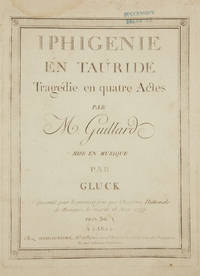
1795ref. 36809Paris: Des Lauriers 1795. Folio. Quarter dark green calf with green cloth boards spine in decorative compartments gilt titling gilt marbled edges. 1f. recto title verso blank 1f. recto publisher's catalogue verso blank 211 pp. Engraved. Occasional performance markings in blue pencil. Some browning foxing and soiling; light dampstaining to upper portion of leaves; final leaves slightly creased at lower outer corners; small handstamp to upper margin of title. Second Edition. Hopkinson 46 A c the present copy is presumably from an earlier issue without plate number and with fewer items in the catalogue. Loewenberg 371. Sonneck p. 56. Lesure p. 239. BUC p. 386. RISM G2816. With this opera "Gluck foreshadowed most clearly the musical achievement of Wagner. For it was not until Iphigenie en Tauride that he contrived a balance between musical and dramatic interest which was of its school a perfect one . Iphigenie en Tauride is the one indisputable masterpiece produced by Gluck the one composition which can be measured against the very highest productions in its own or any other branch of musical expression." Cooper: Gluck p. 260. Des Lauriers unknown
ref. 124951New York: The Ecco Press 1990. First edition of the Nobel Prize-winning author's collection of poetry prompted by the death of her father. Octavo original half cloth. Association copy inscribed by the poet opposite the half-title page "For Stuart I look forward to your new work I wish you all good fortune - Louise." The recipient Stuart Dischell is a fellow poet and friend of Gluck. Fine in a fine dust jacket. Jacket illustration by Michaela Sullivan. Jacket illustration by Christa Näher. In 1984 Glück joined the faculty of Williams College in Massachusetts as a senior lecturer in the English Department. The following year her father died. The loss prompted her to begin a new collection of poems Ararat 1990 the title of which references the mountain of the Genesis flood narrative. Writing in The New York Times in 2012 the critic Dwight Garner called it "the most brutal and sorrow-filled book of American poetry published in the last 25 years" The Ecco Press hardcover
2008ref. __3865961576Frank & Timme 2008. Perfect Paperback. New. 206 pages. German language. 8.27x5.83x0.47 inches. Frank & Timme paperback
2014ref. x-022614271XUniv of Chicago Pr 2014. Paperback. New. reprint edition. 262 pages. 9.00x6.00x0.60 inches. Univ of Chicago Pr paperback
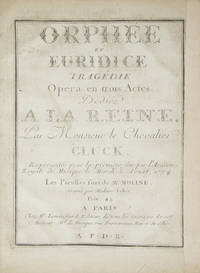
1774ref. 29643Paris: Lemarchand 1774. Folio. 19th century quarter dark brown leather-backed marbled boards spine in decorative compartments gilt titling gilt. 1f. recto title verso publisher's catalogue 1f. recto dedication verso argument 217 pp. With an inscription signed by the Canadian conductor Wilfrid Pelletier 1896-1982 to Italian conductor Tullio Serafin 1878-1968 dated New York 1928 to front flyleaf. Bass figurings added in manuscript to pp. 10-12 Act I scene 1; final page of music signed by the publisher Lemarchand. Binding worn; edges rubbed; spine split at joints and hinges; chipped at head and tail. Slightly worn and browned; title soiled with outer edge reinforced with paper tape; some minor staining; several repairs to inner margins; occasional small holes. First Edition variant issue. Hopkinson 41Af. Wotquenne 41. Lesure p. 240. RISM G2852 not distinguishing among issues. First performed in Vienna at the Burgtheater on 5 October 1762 in Italian to a libretto by Ranieri de' Calzabigi and in Paris at the Opéra on 2 August 1774 in French to a libretto by Pierre Louis Moline after Calzabigi. "The classical orientation of Calzabigi evident in Orfeo ed Euridice from the moment the curtain rose on the almost archaeologically recreated ancient funerary ritual e.g. the threefold calling of the name of the deceased coloured the entirety of his collaboration with Gluck. Despite the ambiguous attributions of the prefaces signed by the composer it is clear that Gluck largely shared his librettist's classical enthusiasms . It is revealing that Gluck sought out subject matter from Greek tragedy independently of Calzabigi after the latter's departure from Vienna - most probably with his inner conviction mixing with a desire to exploit the goût grec then prevailing in France . Calzabigi's poetry was almost completely devoid of metaphors and similes and placed a mere three characters in a fluid context of dances and choruses or both simultaneously. The action was reduced to essentials: a demonstration of the persuasive powers of music and a cautionary tale on the dangers of curiosity with Orpheus bewailing the loss of his wife already as the curtain rose. Gluck's approach as composer was no less radical particularly in his near-complete elimination of coloratura and of opening ritornellos in the solo numbers. Above all the opera was remarkable in its emphasis on continuity which was achieved chiefly through the enchaining of harmonically open-ended sections of music and through the complete avoidance of recitativo semplice in favour of orchestrally accompanied recitatives so as to avoid sharp contrasts of texture with the set pieces. This continuity and the nearly syllabic vocal writing were calculated to prevent applause and thus also to promote the audience's absorption in the spectacle." Bruce Alan Brown and Julian Rushton in Grove Music Online. Lemarchand unknown
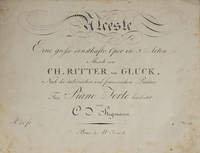
1815ref. 25656Bonn: N. Simrock PN 1125. 1815. Oblong folio. Contemporary marbled boards. 1f. recto title verso blank 3 cast list and table of contents 4-159 i blank pp. Engraved. Disbound. Boards quite worn; spine lacking. Slightly worn soiled foxed and stained; some corners slightly turned; minor underlining and annotations in red pencil to cast list; early repairs to inner margins of title and table of contents not affecting text; small binder's holes to inner margins. Later edition of the French version. Hopkinson 44C a. The French version of Alceste to a libretto by Marie François Louis Gand Leblanc Roullet was first performed at the Académie Royale de Musique in Paris on 23 April 1776. "Gluck's revision of Alceste for performance in Paris in 1776 amounts almost to a recomposition. His alterations were far more extensive than those he had made in his Paris adaptation of Orfeo . The French Alceste had a new text by Roullet Gluck's librettist for Iphigénie en Aulide based on Calzabigi's libretto; but alterations to the plot and the order of events led to major differences between the two. The principals at the première of the French version included Rosalie Levasseur Alcestis Joseph Legros Admetus Henri Larrivée Hercules Moreau Apollo and Nicolas Gélin High Priest. At the first Paris performances of Alceste the Act 3 denouement was substantially different from the version familiar today and closer to the Italian original. Gluck and Roullet after much criticism altered the act to incorporate a part for Hercules who has no place in the Italian original. Just as Gluck was arranging more music to enlarge the final divertissement again to please Parisian taste he heard of the death of his adopted daughter Marianne in Vienna; he left Paris and assigned the completion of the divertissement to Gossec. This revised version published in Paris in 1776 is the one that has nearly always been performed subsequently." Jeremy Hayes in Grove Music Online. N. Simrock [PN 1125.] unknown
1776ref. 24109Paris: Aux Adresses Ordinaires En Province Chez les Mds. de Musique 1776. Folio. Sewn. 1 title 2-5 music i blank pp. Spine reinforced with paper with numerous pinholes to outer margin; several small wormholes; tears to upper outer edges; occasional additional minor tears and stains; upper portion of final leaf lacking with early paper replacement missing music completed in manuscript. Lesure p. 238. RISM G2768 one copy only of the keyboard part at the Bibliothèque nationale. Aux Adresses Ordinaires, En Province Chez les Mds. de Musique unknown
1990ref. DADAX0805806199Psychology Press 1990-01-02. 1. paperback. New. 5.98x0.95x9.02. Buy with confidence. Excellent Customer Service & Return policy. Psychology Press paperback
2000ref. SONG0822957175University of Pittsburgh Press 2000-03-15. 1. paperback. Used: Good. 6.00x0.80x9.00. Buy with confidence. Excellent Customer Service & Return policy. University of Pittsburgh Press paperback
2016ref. G1319154050I2N00FREEMAN MACMILLAN 2016. Hardcover. Like New. Pages are clean and are not marred by notes or folds of any kind. ~ ThriftBooks: Read More Spend Less.Dust jacket quality is not guaranteed. FREEMAN MACMILLAN hardcover
2010ref. mon0000518626Palgrave Macmillan 04/03/2010 00:00:01. hardcover. Very Good. 2.3982 in x 25.7804 in x 19.9848 in. Palgrave Macmillan hardcover
ref. VERK1427Wien Centralblatt für Eisenbahnen u. Dampfschiffahrt 1882. 4°. 35 S. u. 4 Tafeln HLn. d. Zeit m. mont. OUmschlag ausgeschiedenes Bibl.-Expl. mit den entsprechenden Kennzeichnungen Einband staubfleckig. Wien, Centralblatt für Eisenbahnen u. Dampfschiffahrt 1882. unknown
ref. ria9780299307707_inpHardcover. New. New Book; Fast Shipping from UK; Not signed; Not First Edition; Budapest at the fin de siècle was famed and emulated for its cosmopolitan urban culture and nightlife. It was also the second-largest Jewish city in Europe. Mary Gluck delves into the popular culture of Budapest’s coffee houses musi hardcover
ref. ria9780226300047_inpHardback. New. New Book; Fast Shipping from UK; Not signed; Not First Edition; As the 1960s ended Herbie Hancock embarked on a grand creative experiment. Having just been dismissed from the celebrated Miles Davis Quintet he brought a new group of musicians together into what would become a revolutionary band. Th hardcover