2 256 résultats
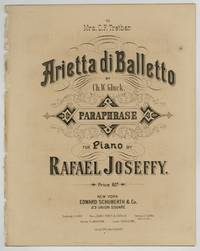
1881réf. 623209New York: Edward Schuberth & Co 1881. Softcover. Good. Sheet music. Folio. Two nested bifolia with a single-sheet-insert making ten pages. Notched and worn along the folds from once being bound within an album as a result the insert remains bound to the inner bifolium light offsetting throughout faint music shop stamp on the front cover and the exterior lightly soiled a complete but good only copy. An instrumental piece for piano. Plate imprint "E. S&Co. 712." OCLC locates a single holding The British Library. Edward Schuberth & Co unknown books
1881réf. 623209New York: Edward Schuberth & Co 1881. Softcover. Good. Sheet music. Folio. Two nested bifolia with a single-sheet-insert making ten pages. Notched and worn along the folds from once being bound within an album as a result the insert remains bound to the inner bifolium light offsetting throughout faint music shop stamp on the front cover and the exterior lightly soiled a complete but good only copy. An instrumental piece for piano. Plate imprint "E. S&Co. 712." OCLC locates a single holding The British Library. Edward Schuberth & Co unknown
réf. 109840A Paris, Au Bureau d'Abonnement Musical, Rue du Hazard Richelieu Et Aux Adresses Ordinaires, A. P. D. R., sans date (circa 1775), 1f.blanc, titre avec le catalogue des ouvrages de musique de l'éditeur au verso, 298 pages, 2ff.blancs, cartonnage moderne avec les pages de gardes remplacées, titres dorés sur pièce de titre en basane brune. Des rousseurs, traces d'humidité et petits trous de ver dans la marge supérieure, 2pages refaites à la main et collées sur les pages 24 et 26, quelques notes manuscrites dans la marge. Comme pour l'Edition originales de chez Le Marchand les partitions ont été gravées par Huguet.
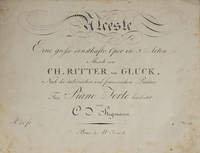
1815réf. 25656Bonn: N. Simrock PN 1125. 1815. Oblong folio. Contemporary marbled boards. 1f. recto title verso blank 3 cast list and table of contents 4-159 i blank pp. Engraved. Disbound. Boards quite worn; spine lacking. Slightly worn soiled foxed and stained; some corners slightly turned; minor underlining and annotations in red pencil to cast list; early repairs to inner margins of title and table of contents not affecting text; small binder's holes to inner margins. Later edition of the French version. Hopkinson 44C a. The French version of Alceste to a libretto by Marie François Louis Gand Leblanc Roullet was first performed at the Académie Royale de Musique in Paris on 23 April 1776. "Gluck's revision of Alceste for performance in Paris in 1776 amounts almost to a recomposition. His alterations were far more extensive than those he had made in his Paris adaptation of Orfeo . The French Alceste had a new text by Roullet Gluck's librettist for Iphigénie en Aulide based on Calzabigi's libretto; but alterations to the plot and the order of events led to major differences between the two. The principals at the première of the French version included Rosalie Levasseur Alcestis Joseph Legros Admetus Henri Larrivée Hercules Moreau Apollo and Nicolas Gélin High Priest. At the first Paris performances of Alceste the Act 3 denouement was substantially different from the version familiar today and closer to the Italian original. Gluck and Roullet after much criticism altered the act to incorporate a part for Hercules who has no place in the Italian original. Just as Gluck was arranging more music to enlarge the final divertissement again to please Parisian taste he heard of the death of his adopted daughter Marianne in Vienna; he left Paris and assigned the completion of the divertissement to Gossec. This revised version published in Paris in 1776 is the one that has nearly always been performed subsequently." Jeremy Hayes in Grove Music Online. N. Simrock [PN 1125.] unknown books
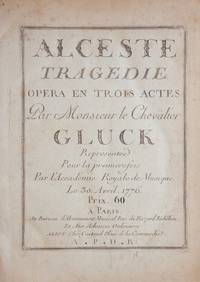
1777réf. 40432Paris Lyon: Au Bureau d'Abonnement Musical Rue du Hazard Richelieu et Aux Adresses Ordinaires. A Lion Chez Castaud Place de la Commedie 1777. Folio. Early dark brown morocco. 1f. recto title verso publisher's catalogue 293 pp. With "Lagny" in contemporary black ink to blank inner margin of p. 1. Binding worn rubbed and bumped. Slightly worn; title slightly browned and foxed; occasional minor foxing soiling browning and small stains; several leaves slightly trimmed at outer margin not affecting text or notation; small loss to blank lower outer corner of p. 87; light impression to lowermost system of p. 43. Lacking pp. 35/36. Second edition. Wotquenne 44. Hopkinson p. 54 44Acc. Lesure p. 236. BUC p. 385. RISM G2639. Alceste an opera in three acts with text by R. de Calzabigi and a ballet by Noverre was first performed on 26 December 1767 at the Burgtheater in Vienna. It was revised by Gluck for a performance in Paris on 23 April 1776. "Gluck himself stressed the nature of Alceste as a `reform opera' by providing in the preface dedicating the printed score to the Grand Duke Leopold a discussion that goes far beyond the conventional. .That key document at once a manifesto and a defense . is a sharp repudiation of the theory practice and conventions of the old "opera seria" represented in its final phase by Metastasio and his favourite composer Hasse." TNG Vol. 7 pp. 463 and 467. Au Bureau d'Abonnement Musical, Rue du Hazard Richelieu et Aux Adresses Ordinaires. A Lion Chez Castaud Place de la Commedie unknown books
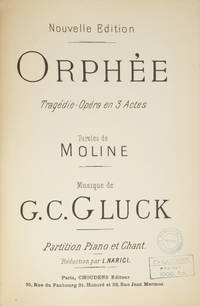
1904réf. 36794Paris: Choudens PN A.C. 10714 1904. Large octavo. Quarter mid-tan calf with marbled boards spine in gilt-ruled compartments dark brown leather title label gilt marbled endpapers original publisher's upper wrapper printed in sepia and black bound in. 1f. recto title verso blank 1f. named cast list and contents verso blank 218 pp. Binding slightly worn rubbed and bumped; ca. 1" lacking to head of spine; hinges cracked; front free endpaper partially detached. Choudens [PN A.C. 10714] unknown books
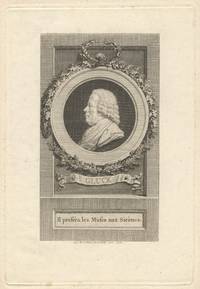
réf. 41429Image size 183 x 125 mm; sheet size 233 x 152 mm. Very slightly browned foxed and soiled at margins; very minor paper loss to left margin. In very good condition overall. "More successfully than any of his contemporaries Gluck translated the widespread agitation for reform of opera and theatrical dance on the part of European intellectuals into actual works for the stage first in pantomime ballets and Italian serious operas for Vienna and then in operas of various sorts for Paris. His long experience in setting Metastasian drammi per musica and his work in Vienna as music director of the Burgtheater court theatre were not without utility in these more innovative efforts." Bruce Alan Brown and Julian Rushton in Grove Music Online. unknown books
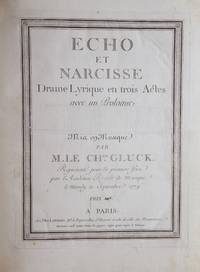
1779réf. 40424Paris: Chez des Lauriers Md. de Papiers Rue St. Honoré à côté de celle des Prouvaires Ou trouve aussi toutes sortes de papiers réglés pour copier la Musique 1779. Folio. Contemporary quarter dark brown calf with marbled boards spine in decorative compartments gilt with titling gilt to spine. 1f. recto title verso blank 256 pp. With blank overpaste to title obscuring the words "Par M. Le Baron de T." Signature "L. Wessén" in ink to front pastedown and "A. Benzinger" to free front endpaper. Binding worn rubbed and bumped; lower portion of upper joint partially split. Occasional small stains foxing browning tears and light dampstaining; minor loss to blank outer margin of pp. 139 and 149; several small holes to p. 237. Quite a good copy overall on quality paper. First Edition variant issue. Hopkinson p. 63 with attributes of 47Ac except here there is no plate number and the price "40" appears in manuscript and 47Ae as "Royale" has been erased here in pencil. Wotquenne 47. BUC p. 386. RISM G2739 First performed in Paris at the Opéra on 24 September 1779. "Echo et Narcisse was a failure at its early performances largely because the audiences and critics expected high drama along the lines of Alceste Armide and Iphigénie en Tauride. But Echo et Narcisse is a different type of work; it belongs to the pastoral tradition still popular at this date and a genre to which Gluck frequently returned. Comparisons were and are still made with Gluck's more popular dramas because Echo et Narcisse contains numbers and scenes similar to those that had made greater impressions before. It is not a weak opera and there is much fine music in it ." Jeremy Hayes in Grove Music Online Gluck was a "Bohemian-Austrian composer of Italian and French opera a leading figure in opera of the second half of the 18th century and the person chiefly credited with the 'reform' of opera after the age of Metastasian opera seria. . Force of circumstance may have led Gluck to Paris to complete his operatic career but in artistic terms Paris can be seen as his inevitable final destination. His years of grounding in opéra comique and the ballet and via Traetta his response to the French tragédie lyrique tradition had already provided the impetus for his overhaul of the opera seria; now it was time to confront that tradition on its own territory. On more than one occasion indeed Gluck explicitly owned the French influence and its particular effect on his preparation for Paris. Between them the eight operas that he produced for the Académie Royale de Musique in Paris - the two Iphigénie operas; the radical revisions for Paris of the Vienna 'reform' operas Orfeo and Alceste; the similar revisions of the Vienna opéras comiques Cythère assiégée and L'arbre enchanté; Armide a new opera on a libretto that Quinault had written for Lully more than 90 years earlier; and the last opera Echo et Narcisse - are all different attempts at the confrontation and revival of that lyric tradition." Jeremy Hayes Bruce Alan Brown Max Loppert and Winton Dean in Grove Music Online. Chez des Lauriers Md. de Papiers, Rue St. Honoré à côté de celle des Prouvaires Ou trouve aussi toutes sortes de papiers ré unknown books
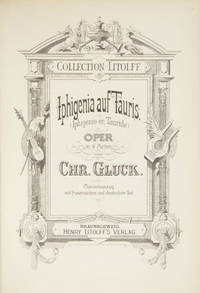
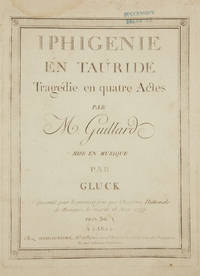
1900réf. 28967Braunschweig: Henry Litolff PN Collection Litolff No. 80 1900. Large octavo. Half mid-tan mottled calf with marbled boards raised bands on spine in gilt-ruled compartments titling gilt. 1f. recto title within architectural border verso cast list and contents 3-144 pp. Binding slightly worn. A tragedy in four acts to a libretto by Nicolas-François Guillard after Guymond de la Touche's Iphigénie en Tauride itself based on Euripides Gluck's opera was first performed in Paris at the Opéra on May 18 1779. "Iphigénie en Tauride was the crowning achievement of Gluck's career a result of the combination of his lifelong experience as an opera composer and a libretto which is arguably the best he ever set." Jeremy Hayes in Grove Music Online. Henry Litolff [PN Collection Litolff No. 80] unknown books
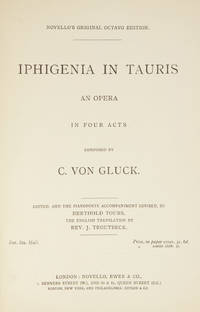
1900réf. 28969London: Novello Ewer & Co 1900. Large octavo. Full dark red blindtooled cloth with titling gilt to upper and spine all edges gilt. 1f. recto title verso blank 1f. recto cast list and argument verso explanation of abbreviations 137 i blank 1f. recto index verso printer's device pp. Binding slightly worn rubbed and bumped. Some signatures split or partially split. A tragedy in four acts to a libretto by Nicolas-François Guillard after Guymond de la Touche's Iphigénie en Tauride itself based on Euripides Iphigénie en Tauride was first performed in Paris at the Opéra on May 18 1779. "Iphigénie en Tauride was the crowning achievement of Gluck's career a result of the combination of his lifelong experience as an opera composer and a libretto which is arguably the best he ever set." Jeremy Hayes in Grove Music Online. Novello, Ewer & Co unknown books
1812réf. 41214Berlin: Schlesinger's Buch= und Musikhandlung Unter den Linden No. 34. PN 50 1812. Oblong folio. Contemporary dark brown mottled calf-backed marbled boards with oval label titled in manuscript to upper. 1f. recto title verso blank 3 "Personen" and incipits 4-123 i blank pp. Provenance Noted American harpsichordist Louis Bagger 1926-2024 Binding worn rubbed and bumped. Very occasional minor soiling to blank lower margins; occasional minor showthrough; small stains to title with small circular publisher's handstamp to inner margin. Hopkinson 46Ca. Gluck's work is a tragedy in four acts to a libretto by Nicolas-François Guillard after Guymond de la Touche's Iphigénie en Tauride itself based on Euripides's work of the same name. "Iphigénie en Tauride was the crowning achievement of Gluck's career a result of the combination of his lifelong experience as an opera composer and a libretto which is arguably the best he ever set." Jeremy Hayes in Grove Music Online It was first performed in Paris at the Opéra on 18 May 1779 "with excellent singers; Rosalie Lavasseur sang Iphigénie Larrivée Oreste Legros Pylade and Moreau Thoas. . The opera had a great success immediately and even Grimm wrote of it - I do not know whether this is melody but perhaps it is something better. When I hear Iphigénie I forget I am at the opera; I seem to be listening to a Greek tragedy with music by Lekain and Mlle Clarion. It was the crowning point of Gluck's career. Guillard had provided an excellent libretto more classical than Goethe's poem less Christian and more ruthless; and Gluck had seized on the contrast between Scythians and Greeks upon the perfectly dramatic figures of Iphigenia and Orestes and had produced a work which both re-created a part of Greek tragedy and at the same time foretold a new world." Cooper: Gluck p. 258. Schlesinger's Buch= und Musikhandlung, Unter den Linden No. 34. [PN 50] unknown books
1809réf. 40434Bonn: Chez N. Simrock PN 609 1809. Oblong folio. Quarter black leather with gilt rules mid-brown cloth boards spine in compartments gilt with titling gilt marbled edges. 1f. recto title verso cast list 3-149 pp. Text in French and German. Engraved throughout. With contemporary signature of former owner "Mappes" to upper outer corner of free front endpaper with handstamp of August Kuby in Munich below; "Amalie Mappes" to upper outer corner of title. Binding worn rubbed bumped and slightly stained. Occasional soiling; small ink stains browning and foxing to blank margins; small loss to lower outer corner of p. 27. First Edition. Hopkinson p. 41 40F. Wotquenne 40. RISM G2753 and GG2753 no copies in the U.S. Iphigenie en Aulide was first performed in Paris at the Opéra on 19 April 1774. "Judging from contemporary accounts such as the memoirs of Mannlich the several months of rehearsals for Iphigénie en Aulide must have been quite a spectacle with the irascible 60-year-old composer struggling to reform the bad habits of the singers and players of the Académie Royale to teach them his new opera. However the première of Iphigénie en Aulide in April 1774 was a triumph but the run of performances was interrupted by the death of Louis XV a month later. All the theatres closed and during the period of mourning Gluck quickly revised Orfeo ed Euridice and made a French version of the opera with a translation of the text by Pierre Louis Moline." Jeremy Hayes in Grove Music Online. Chez N. Simrock [PN 609] unknown books
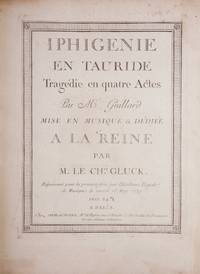
1783réf. 40425Paris: Des Lauriers without PN 1783. Folio. Modern quarter dark red morocco with marbled boards black leather title label to spine gilt. i recto title verso blank i "Catalogue de Musique du fond de Des Lauriers Md. de Sapier rue St. Honoréa Paris" i dedication 211 i blank pp. Engraved throughout. With a short article from Marmontel's Mémoires laid down to blank verso of title in English translation regarding the opera's reception history. Occasional staining soiling and foxing to blank margins; small stain and hole under lowermost system of p. 65; blank upper outer margin of title through p. 7 dampstained; stain and minor loss to lower margin of pp. 18-22. In very good condition overall. Third edition unrecorded variant. Hopkinson 40A e. Wotquenne 46 pp. 215-16. Lesure p. 239 different issue. BUC p. 386. RISM G2816. "Iphigénie en Tauride was given on May 18 1778 with excellent singers; Rosalie Lavasseur sang Iphigénie Larrivée Oreste Legros Pylade and Moreau Thoas . The opera had a great success immediately and even Grimm wrote of it - I do not know whether this is melody but perhaps it is something better. When I hear Iphigénie I forget I am at the opera; I seem to be listening to a Greek tragedy with music by Lekain and Mlle Clarion. It was the crowning point of Gluck's career. Guillard had provided an excellent libretto more classical than Goethe's poem less Christian and more ruthless; and Gluck had seized on the contrast between Scythians and Greeks upon the perfectly dramatic figures of Iphigenia and Orestes and had produced a work which both re-created a part of Greek tragedy and at the same time foretold a new world." Cooper: Gluck p. 258. While Marie-Antoinette is not actually mentioned on the title she was the queen to whom the work is dedicated. Des Lauriers [without PN] unknown books
1795réf. 36809Paris: Des Lauriers 1795. Folio. Quarter dark green calf with green cloth boards spine in decorative compartments gilt titling gilt marbled edges. 1f. recto title verso blank 1f. recto publisher's catalogue verso blank 211 pp. Engraved. Occasional performance markings in blue pencil. Some browning foxing and soiling; light dampstaining to upper portion of leaves; final leaves slightly creased at lower outer corners; small handstamp to upper margin of title. Second Edition. Hopkinson 46 A c the present copy is presumably from an earlier issue without plate number and with fewer items in the catalogue. Loewenberg 371. Sonneck p. 56. Lesure p. 239. BUC p. 386. RISM G2816. With this opera "Gluck foreshadowed most clearly the musical achievement of Wagner. For it was not until Iphigenie en Tauride that he contrived a balance between musical and dramatic interest which was of its school a perfect one . Iphigenie en Tauride is the one indisputable masterpiece produced by Gluck the one composition which can be measured against the very highest productions in its own or any other branch of musical expression." Cooper: Gluck p. 260. Des Lauriers unknown books
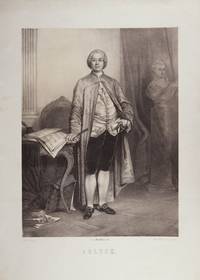
1860réf. 41452Berlin: W. Zawitz 1860. The composer is depicted full-length standing facing forward dressed in a long coat an elegant waistcoat britches and stockings. He holds a writing quill in his right hand which partially rests on an open opera manuscript resting on a table next to the composer; volumes of his works and music paper rest against a leg of the table. Image size 400 x 275 mm; sheet size 522 x 372 mm. Printed by J. Hesse on wove paper on an off-white ground. Some minor wear soiling and repairs; creases from folding faintly visible on recto. Gluck a Bohemian-Austrian composer was "a leading figure in opera of the second half of the 18th century and the person chiefly credited with the 'reform' of opera after the age of Metastasian opera seria." Jeremy Hayes Bruce Alan Brown Max Loppert and Winton Dean in Grove Music Online Hamman a Belgian painter and engraver specialized in portraying famous artists scholars and the nobility. W. Zawitz unknown books
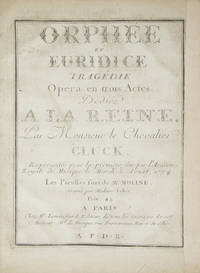
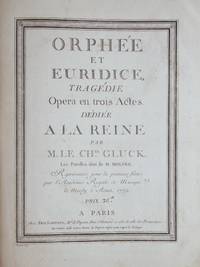
1774réf. 29643Paris: Lemarchand 1774. Folio. 19th century quarter dark brown leather-backed marbled boards spine in decorative compartments gilt titling gilt. 1f. recto title verso publisher's catalogue 1f. recto dedication verso argument 217 pp. With an inscription signed by the Canadian conductor Wilfrid Pelletier 1896-1982 to Italian conductor Tullio Serafin 1878-1968 dated New York 1928 to front flyleaf. Bass figurings added in manuscript to pp. 10-12 Act I scene 1; final page of music signed by the publisher Lemarchand. Binding worn; edges rubbed; spine split at joints and hinges; chipped at head and tail. Slightly worn and browned; title soiled with outer edge reinforced with paper tape; some minor staining; several repairs to inner margins; occasional small holes. First Edition variant issue. Hopkinson 41Af. Wotquenne 41. Lesure p. 240. RISM G2852 not distinguishing among issues. First performed in Vienna at the Burgtheater on 5 October 1762 in Italian to a libretto by Ranieri de' Calzabigi and in Paris at the Opéra on 2 August 1774 in French to a libretto by Pierre Louis Moline after Calzabigi. "The classical orientation of Calzabigi evident in Orfeo ed Euridice from the moment the curtain rose on the almost archaeologically recreated ancient funerary ritual e.g. the threefold calling of the name of the deceased coloured the entirety of his collaboration with Gluck. Despite the ambiguous attributions of the prefaces signed by the composer it is clear that Gluck largely shared his librettist's classical enthusiasms . It is revealing that Gluck sought out subject matter from Greek tragedy independently of Calzabigi after the latter's departure from Vienna - most probably with his inner conviction mixing with a desire to exploit the goût grec then prevailing in France . Calzabigi's poetry was almost completely devoid of metaphors and similes and placed a mere three characters in a fluid context of dances and choruses or both simultaneously. The action was reduced to essentials: a demonstration of the persuasive powers of music and a cautionary tale on the dangers of curiosity with Orpheus bewailing the loss of his wife already as the curtain rose. Gluck's approach as composer was no less radical particularly in his near-complete elimination of coloratura and of opening ritornellos in the solo numbers. Above all the opera was remarkable in its emphasis on continuity which was achieved chiefly through the enchaining of harmonically open-ended sections of music and through the complete avoidance of recitativo semplice in favour of orchestrally accompanied recitatives so as to avoid sharp contrasts of texture with the set pieces. This continuity and the nearly syllabic vocal writing were calculated to prevent applause and thus also to promote the audience's absorption in the spectacle." Bruce Alan Brown and Julian Rushton in Grove Music Online. Lemarchand unknown books
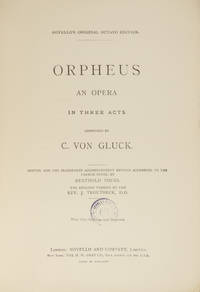
1891réf. 28576London: Novello and Company PN 8146 1891. Large octavo. Original publisher's dark ivory wrappers printed in dark orange. 1f. recto title verso blank 1f. recto argument verso blank 1f. index 135 i printer's' device 1f. publisher's catalogue pp. Wrappers somewhat worn and torn; portions of spine lacking at head and tail. Minor wear to outer margins of first six leaves. First performed in Vienna at the Burgtheater on October 5 1762 in Italian to a libretto by Ranieri de' Calzabigi and in Paris at the Opéra on August 2 1774 in French to a libretto by Pierre Louis Moline after Calzabigi. "Orfeo ed Euridice was the first of Gluck's three so-called reform operas written with Ranieri de' Calzabigi the other two were Alceste and Paride ed Elena in which a 'noble simplicity' in the action and the music was intended to replace the complicated plots and florid musical style of opera seria." Jeremy Hayes in Grove Music Online. Novello and Company [PN 8146] unknown books
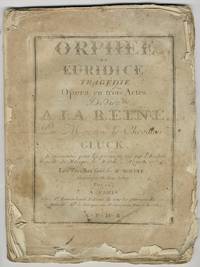
1783réf. 40431Paris: Chez Des Lauriers Md. de Papiers Rue St. Honoré à côté de celle des Provaires 1783. Folio. Early full dark brown leather with double rule gilt to edges of boards spine in compartments gilt with titling gilt marbled endpapers. 1f. recto title verso blank 1f. recto dedication verso "Argument" 217 pp. Bound with an extra title that of Hopkinson 41Ak. 1f. recto title verso blank 1f. recto blank verso "Argument" pp. Binding quite worn rubbed and bumped with loss to spine. Occasional minor soiling to blank outer margins; paper repairs to blank inner margins of approximately fifteen leaves; small binder's holes to blank inner margin of numerous leaves; occasional staining; worming to blank inner margin of final third of volume; extra title and Argument worn and soiling with worming to blank margins. Second edition of the French version. Wotquenne 41. A variant issue of Hopkinson 41Ai but with the price of 36 instead of 24 tt. Lesure p. 240. RISM G2853. First performed in Vienna at the Burgtheater on 5 October 1762 in Italian to a libretto by Ranieri de' Calzabigi and in Paris at the Opéra on 2 August 1774 in French to a libretto by Pierre Louis Moline after Calzabigi. "More successfully than any of his contemporaries Gluck translated the widespread agitation for reform of opera and theatrical dance on the part of European intellectuals into actual works for the stage first in pantomime ballets and Italian serious operas for Vienna and then in operas of various sorts for Paris." Bruce Alan Brown and Julian Rushton in Grove Music Online "The classical orientation of Calzabigi evident in Orfeo ed Euridice from the moment the curtain rose on the almost archaeologically recreated ancient funerary ritual e.g. the threefold calling of the name of the deceased coloured the entirety of his collaboration with Gluck. Despite the ambiguous attributions of the prefaces signed by the composer it is clear that Gluck largely shared his librettist's classical enthusiasms. . It is revealing that Gluck sought out subject matter from Greek tragedy independently of Calzabigi after the latter's departure from Vienna - most probably with his inner conviction mixing with a desire to exploit the goût grec then prevailing in France. . Calzabigi's poetry was almost completely devoid of metaphors and similes and placed a mere three characters in a fluid context of dances and choruses or both simultaneously. The action was reduced to essentials: a demonstration of the persuasive powers of music and a cautionary tale on the dangers of curiosity with Orpheus bewailing the loss of his wife already as the curtain rose. Gluck's approach as composer was no less radical particularly in his near-complete elimination of coloratura and of opening ritornellos in the solo numbers. Above all the opera was remarkable in its emphasis on continuity which was achieved chiefly through the enchaining of harmonically open-ended sections of music and through the complete avoidance of recitativo semplice in favour of orchestrally accompanied recitatives so as to avoid sharp contrasts of texture with the set pieces. This continuity and the nearly syllabic vocal writing were calculated to prevent applause and thus also to promote the audience's absorption in the spectacle." Bruce Alan Brown and Julian Rushton in Grove Music Online. Chez Des Lauriers, Md. de Papiers, Rue St. Honoré à côté de celle des Provaires unknown books
1774réf. 40430Paris: Chez Mr. Lemarchand . A.P.D.R. 1774. Folio. Unbound. Sewn. 1f. recto title verso publisher's catalogue 1f. recto dedication verso "Argument" 52 pp. Engraved. Incomplete with only first act and three pages of second act present. Worn overall with occasional staining foxing and soiling throughout primarily to blank margins; title worn and heavily browned stained and soiled with paper loss to edges; corners slightly bumped and creased; signatures separated; binder's holes to blank inner margin. First Edition unrecorded variant. Wotquenne 41. Hopkinson p. 43 41A. BUC p. 386. Lesure p. 240. RISM G2582. First performed in Vienna at the Burgtheater on 5 October 1762 in Italian to a libretto by Ranieri de' Calzabigi and in Paris at the Opéra on 2 August 1774 in French to a libretto by Pierre Louis Moline after Calzabigi. "The classical orientation of Calzabigi evident in Orfeo ed Euridice from the moment the curtain rose on the almost archaeologically recreated ancient funerary ritual e.g. the threefold calling of the name of the deceased coloured the entirety of his collaboration with Gluck. Despite the ambiguous attributions of the prefaces signed by the composer it is clear that Gluck largely shared his librettist's classical enthusiasms . It is revealing that Gluck sought out subject matter from Greek tragedy independently of Calzabigi after the latter's departure from Vienna - most probably with his inner conviction mixing with a desire to exploit the goût grec then prevailing in France . Calzabigi's poetry was almost completely devoid of metaphors and similes and placed a mere three characters in a fluid context of dances and choruses or both simultaneously. The action was reduced to essentials: a demonstration of the persuasive powers of music and a cautionary tale on the dangers of curiosity with Orpheus bewailing the loss of his wife already as the curtain rose. Gluck's approach as composer was no less radical particularly in his near-complete elimination of coloratura and of opening ritornellos in the solo numbers. Above all the opera was remarkable in its emphasis on continuity which was achieved chiefly through the enchaining of harmonically open-ended sections of music and through the complete avoidance of recitativo semplice in favour of orchestrally accompanied recitatives so as to avoid sharp contrasts of texture with the set pieces. This continuity and the nearly syllabic vocal writing were calculated to prevent applause and thus also to promote the audience's absorption in the spectacle." Bruce Alan Brown and Julian Rushton in Grove Music Online. Chez Mr. Lemarchand ... A.P.D.R. unknown books
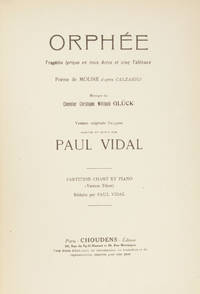
1934réf. 28968Paris: Choudens PN A.C. 15000 1934. Large octavo. Original publisher's ivory printed wrappers. 1f. recto title verso blank 1f. recto notes on first performance and named cast list verso blank 1f. recto contents verso blank 2f. preface 177 i blank pp. Occasional lyrics translated into Norwegian in pencil and black ink. Named cast includes Fernand Ansseau Aline Vallandri Yvonne Brothier and Marthe Coiffier. Wrappers slightly worn and soiled and worn; former owner's handstamp "Hjørdis Wied Koncertsangerinde" and small price handstamp to lower margin of upper wrapper; spine worn with some loss. Wied's handstamp to upper margin of free front endpaper and lower margin of three leaves; annotations in pencil and red crayon to contents; tear to outer margin of pp. 87-92. Revised Paris version. Re-issue of Hopkinson 41Cu. First performed in Paris at the Theâtre National de l'Opéra-Comique on 11 October 1921 under Albert Carré and Isola A. Frères. "Orfeo ed Euridice was the first of Gluck's three so-called reform operas written with Ranieri de' Calzabigi the other two were Alceste and Paride ed Elena in which a 'noble simplicity' in the action and the music was intended to replace the complicated plots and florid musical style of opera seria." Jeremy Hayes in Grove Music Online. Choudens [PN A.C. 15000] unknown books
1899réf. 28620Paris: Choudens PN A. C. 11331 1899. Large octavo. Original publisher's dark ivory wrappers printed in red and black. 1f. recto title verso blank 1f. recto notes on first performance named cast list and contents verso blank 118 pp. Named cast includes Delna Bréjean-Gravière Eyreams and Chasles. Wrappers slightly worn browned and chipped; former owner's signature in blue ink to upper. Some edges slightly damaged; handstamps to title; manuscript annotation to second leaf. Choudens [PN A. C. 11331] unknown books
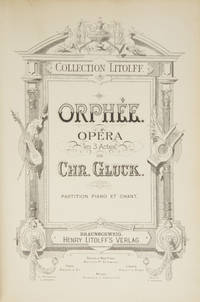
1900réf. 28577Braunschweig: Henry Litolff PN Collection Litolff No. 82 1900. Large octavo. Half brown calf with marbled boards raised bands on spine in gilt-ruled compartments titling gilt. i title within architectural border 2-3 cast list and contents 4-138 pp. Binding slightly worn rubbed and bumped. Light uniform browning. First performed in Vienna at the Burgtheater on 5 October 1762 in Italian to a libretto by Ranieri de' Calzabigi and in Paris at the Opéra on 2 August 1774 in French to a libretto by Pierre Louis Moline after Calzabigi. "Orfeo ed Euridice was the first of Gluck's three so-called reform operas written with Ranieri de' Calzabigi the other two were Alceste and Paride ed Elena in which a 'noble simplicity' in the action and the music was intended to replace the complicated plots and florid musical style of opera seria." Jeremy Hayes in Grove Music Online. Henry Litolff [PN Collection Litolff No. 82] unknown books
1825réf. 64538Edition Nicolo, 1 vol. in-4 reliure demi-vélin vert, Chez Madame Veuve Nicolo, à Paris, édition gravée et imprimée par Marquerie, s.d. [ circa 1825 ], 1 f. et 226 pp.
1962réf. 283186New York: St. Martin's 1962. hardcover. fine/very good. Ed. by Hedwig and E. H. Mueller von Asow. Illus. 8vo black cloth d.w. slightly chipped. New York: St. Martin's Press 1962. A fine copy in a very good dust wrapper St. Martin's unknown books
réf. 4304Klavierauszug. Leipzig, C. F. Peters, sans date (vers 1870). In-4 (27,1 cm) (2) feuillets, 188 pages. Reliure demi-chagrin noir, plats toilés, gardes marbrées. Reliure frottée aux coupes, coins et mors. Renfort de papier à la marge gauche du titre. [ C. F. P. 4420 ].