2250 risultati
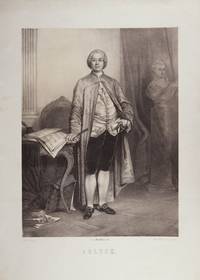
1860rif. 41452Berlin: W. Zawitz 1860. The composer is depicted full-length standing facing forward dressed in a long coat an elegant waistcoat britches and stockings. He holds a writing quill in his right hand which partially rests on an open opera manuscript resting on a table next to the composer; volumes of his works and music paper rest against a leg of the table. Image size 400 x 275 mm; sheet size 522 x 372 mm. Printed by J. Hesse on wove paper on an off-white ground. Some minor wear soiling and repairs; creases from folding faintly visible on recto. Gluck a Bohemian-Austrian composer was "a leading figure in opera of the second half of the 18th century and the person chiefly credited with the 'reform' of opera after the age of Metastasian opera seria." Jeremy Hayes Bruce Alan Brown Max Loppert and Winton Dean in Grove Music Online Hamman a Belgian painter and engraver specialized in portraying famous artists scholars and the nobility. W. Zawitz unknown books
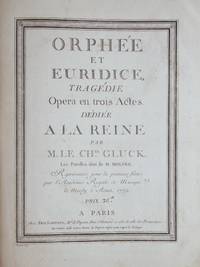
1774rif. 29643Paris: Lemarchand 1774. Folio. 19th century quarter dark brown leather-backed marbled boards spine in decorative compartments gilt titling gilt. 1f. recto title verso publisher's catalogue 1f. recto dedication verso argument 217 pp. With an inscription signed by the Canadian conductor Wilfrid Pelletier 1896-1982 to Italian conductor Tullio Serafin 1878-1968 dated New York 1928 to front flyleaf. Bass figurings added in manuscript to pp. 10-12 Act I scene 1; final page of music signed by the publisher Lemarchand. Binding worn; edges rubbed; spine split at joints and hinges; chipped at head and tail. Slightly worn and browned; title soiled with outer edge reinforced with paper tape; some minor staining; several repairs to inner margins; occasional small holes. First Edition variant issue. Hopkinson 41Af. Wotquenne 41. Lesure p. 240. RISM G2852 not distinguishing among issues. First performed in Vienna at the Burgtheater on 5 October 1762 in Italian to a libretto by Ranieri de' Calzabigi and in Paris at the Opéra on 2 August 1774 in French to a libretto by Pierre Louis Moline after Calzabigi. "The classical orientation of Calzabigi evident in Orfeo ed Euridice from the moment the curtain rose on the almost archaeologically recreated ancient funerary ritual e.g. the threefold calling of the name of the deceased coloured the entirety of his collaboration with Gluck. Despite the ambiguous attributions of the prefaces signed by the composer it is clear that Gluck largely shared his librettist's classical enthusiasms . It is revealing that Gluck sought out subject matter from Greek tragedy independently of Calzabigi after the latter's departure from Vienna - most probably with his inner conviction mixing with a desire to exploit the goût grec then prevailing in France . Calzabigi's poetry was almost completely devoid of metaphors and similes and placed a mere three characters in a fluid context of dances and choruses or both simultaneously. The action was reduced to essentials: a demonstration of the persuasive powers of music and a cautionary tale on the dangers of curiosity with Orpheus bewailing the loss of his wife already as the curtain rose. Gluck's approach as composer was no less radical particularly in his near-complete elimination of coloratura and of opening ritornellos in the solo numbers. Above all the opera was remarkable in its emphasis on continuity which was achieved chiefly through the enchaining of harmonically open-ended sections of music and through the complete avoidance of recitativo semplice in favour of orchestrally accompanied recitatives so as to avoid sharp contrasts of texture with the set pieces. This continuity and the nearly syllabic vocal writing were calculated to prevent applause and thus also to promote the audience's absorption in the spectacle." Bruce Alan Brown and Julian Rushton in Grove Music Online. Lemarchand unknown books
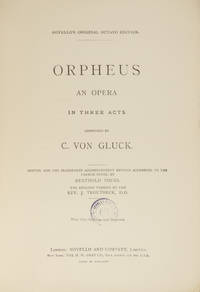
1891rif. 28576London: Novello and Company PN 8146 1891. Large octavo. Original publisher's dark ivory wrappers printed in dark orange. 1f. recto title verso blank 1f. recto argument verso blank 1f. index 135 i printer's' device 1f. publisher's catalogue pp. Wrappers somewhat worn and torn; portions of spine lacking at head and tail. Minor wear to outer margins of first six leaves. First performed in Vienna at the Burgtheater on October 5 1762 in Italian to a libretto by Ranieri de' Calzabigi and in Paris at the Opéra on August 2 1774 in French to a libretto by Pierre Louis Moline after Calzabigi. "Orfeo ed Euridice was the first of Gluck's three so-called reform operas written with Ranieri de' Calzabigi the other two were Alceste and Paride ed Elena in which a 'noble simplicity' in the action and the music was intended to replace the complicated plots and florid musical style of opera seria." Jeremy Hayes in Grove Music Online. Novello and Company [PN 8146] unknown books
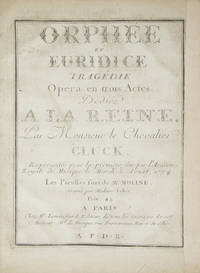
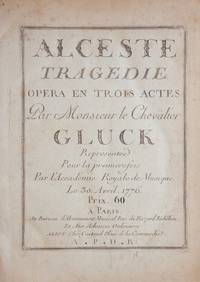
1783rif. 40431Paris: Chez Des Lauriers Md. de Papiers Rue St. Honoré à côté de celle des Provaires 1783. Folio. Early full dark brown leather with double rule gilt to edges of boards spine in compartments gilt with titling gilt marbled endpapers. 1f. recto title verso blank 1f. recto dedication verso "Argument" 217 pp. Bound with an extra title that of Hopkinson 41Ak. 1f. recto title verso blank 1f. recto blank verso "Argument" pp. Binding quite worn rubbed and bumped with loss to spine. Occasional minor soiling to blank outer margins; paper repairs to blank inner margins of approximately fifteen leaves; small binder's holes to blank inner margin of numerous leaves; occasional staining; worming to blank inner margin of final third of volume; extra title and Argument worn and soiling with worming to blank margins. Second edition of the French version. Wotquenne 41. A variant issue of Hopkinson 41Ai but with the price of 36 instead of 24 tt. Lesure p. 240. RISM G2853. First performed in Vienna at the Burgtheater on 5 October 1762 in Italian to a libretto by Ranieri de' Calzabigi and in Paris at the Opéra on 2 August 1774 in French to a libretto by Pierre Louis Moline after Calzabigi. "More successfully than any of his contemporaries Gluck translated the widespread agitation for reform of opera and theatrical dance on the part of European intellectuals into actual works for the stage first in pantomime ballets and Italian serious operas for Vienna and then in operas of various sorts for Paris." Bruce Alan Brown and Julian Rushton in Grove Music Online "The classical orientation of Calzabigi evident in Orfeo ed Euridice from the moment the curtain rose on the almost archaeologically recreated ancient funerary ritual e.g. the threefold calling of the name of the deceased coloured the entirety of his collaboration with Gluck. Despite the ambiguous attributions of the prefaces signed by the composer it is clear that Gluck largely shared his librettist's classical enthusiasms. . It is revealing that Gluck sought out subject matter from Greek tragedy independently of Calzabigi after the latter's departure from Vienna - most probably with his inner conviction mixing with a desire to exploit the goût grec then prevailing in France. . Calzabigi's poetry was almost completely devoid of metaphors and similes and placed a mere three characters in a fluid context of dances and choruses or both simultaneously. The action was reduced to essentials: a demonstration of the persuasive powers of music and a cautionary tale on the dangers of curiosity with Orpheus bewailing the loss of his wife already as the curtain rose. Gluck's approach as composer was no less radical particularly in his near-complete elimination of coloratura and of opening ritornellos in the solo numbers. Above all the opera was remarkable in its emphasis on continuity which was achieved chiefly through the enchaining of harmonically open-ended sections of music and through the complete avoidance of recitativo semplice in favour of orchestrally accompanied recitatives so as to avoid sharp contrasts of texture with the set pieces. This continuity and the nearly syllabic vocal writing were calculated to prevent applause and thus also to promote the audience's absorption in the spectacle." Bruce Alan Brown and Julian Rushton in Grove Music Online. Chez Des Lauriers, Md. de Papiers, Rue St. Honoré à côté de celle des Provaires unknown books
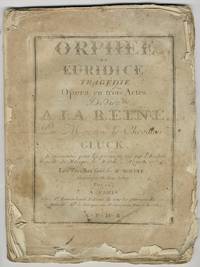
1774rif. 40430Paris: Chez Mr. Lemarchand . A.P.D.R. 1774. Folio. Unbound. Sewn. 1f. recto title verso publisher's catalogue 1f. recto dedication verso "Argument" 52 pp. Engraved. Incomplete with only first act and three pages of second act present. Worn overall with occasional staining foxing and soiling throughout primarily to blank margins; title worn and heavily browned stained and soiled with paper loss to edges; corners slightly bumped and creased; signatures separated; binder's holes to blank inner margin. First Edition unrecorded variant. Wotquenne 41. Hopkinson p. 43 41A. BUC p. 386. Lesure p. 240. RISM G2582. First performed in Vienna at the Burgtheater on 5 October 1762 in Italian to a libretto by Ranieri de' Calzabigi and in Paris at the Opéra on 2 August 1774 in French to a libretto by Pierre Louis Moline after Calzabigi. "The classical orientation of Calzabigi evident in Orfeo ed Euridice from the moment the curtain rose on the almost archaeologically recreated ancient funerary ritual e.g. the threefold calling of the name of the deceased coloured the entirety of his collaboration with Gluck. Despite the ambiguous attributions of the prefaces signed by the composer it is clear that Gluck largely shared his librettist's classical enthusiasms . It is revealing that Gluck sought out subject matter from Greek tragedy independently of Calzabigi after the latter's departure from Vienna - most probably with his inner conviction mixing with a desire to exploit the goût grec then prevailing in France . Calzabigi's poetry was almost completely devoid of metaphors and similes and placed a mere three characters in a fluid context of dances and choruses or both simultaneously. The action was reduced to essentials: a demonstration of the persuasive powers of music and a cautionary tale on the dangers of curiosity with Orpheus bewailing the loss of his wife already as the curtain rose. Gluck's approach as composer was no less radical particularly in his near-complete elimination of coloratura and of opening ritornellos in the solo numbers. Above all the opera was remarkable in its emphasis on continuity which was achieved chiefly through the enchaining of harmonically open-ended sections of music and through the complete avoidance of recitativo semplice in favour of orchestrally accompanied recitatives so as to avoid sharp contrasts of texture with the set pieces. This continuity and the nearly syllabic vocal writing were calculated to prevent applause and thus also to promote the audience's absorption in the spectacle." Bruce Alan Brown and Julian Rushton in Grove Music Online. Chez Mr. Lemarchand ... A.P.D.R. unknown books
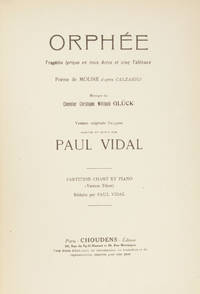
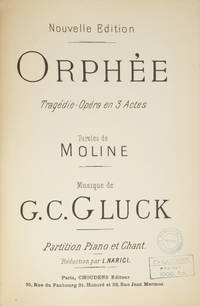
1934rif. 28968Paris: Choudens PN A.C. 15000 1934. Large octavo. Original publisher's ivory printed wrappers. 1f. recto title verso blank 1f. recto notes on first performance and named cast list verso blank 1f. recto contents verso blank 2f. preface 177 i blank pp. Occasional lyrics translated into Norwegian in pencil and black ink. Named cast includes Fernand Ansseau Aline Vallandri Yvonne Brothier and Marthe Coiffier. Wrappers slightly worn and soiled and worn; former owner's handstamp "Hjørdis Wied Koncertsangerinde" and small price handstamp to lower margin of upper wrapper; spine worn with some loss. Wied's handstamp to upper margin of free front endpaper and lower margin of three leaves; annotations in pencil and red crayon to contents; tear to outer margin of pp. 87-92. Revised Paris version. Re-issue of Hopkinson 41Cu. First performed in Paris at the Theâtre National de l'Opéra-Comique on 11 October 1921 under Albert Carré and Isola A. Frères. "Orfeo ed Euridice was the first of Gluck's three so-called reform operas written with Ranieri de' Calzabigi the other two were Alceste and Paride ed Elena in which a 'noble simplicity' in the action and the music was intended to replace the complicated plots and florid musical style of opera seria." Jeremy Hayes in Grove Music Online. Choudens [PN A.C. 15000] unknown books
1899rif. 28620Paris: Choudens PN A. C. 11331 1899. Large octavo. Original publisher's dark ivory wrappers printed in red and black. 1f. recto title verso blank 1f. recto notes on first performance named cast list and contents verso blank 118 pp. Named cast includes Delna Bréjean-Gravière Eyreams and Chasles. Wrappers slightly worn browned and chipped; former owner's signature in blue ink to upper. Some edges slightly damaged; handstamps to title; manuscript annotation to second leaf. Choudens [PN A. C. 11331] unknown books
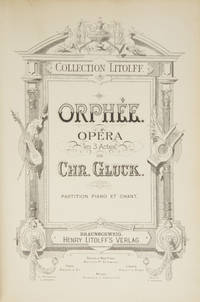
1900rif. 28577Braunschweig: Henry Litolff PN Collection Litolff No. 82 1900. Large octavo. Half brown calf with marbled boards raised bands on spine in gilt-ruled compartments titling gilt. i title within architectural border 2-3 cast list and contents 4-138 pp. Binding slightly worn rubbed and bumped. Light uniform browning. First performed in Vienna at the Burgtheater on 5 October 1762 in Italian to a libretto by Ranieri de' Calzabigi and in Paris at the Opéra on 2 August 1774 in French to a libretto by Pierre Louis Moline after Calzabigi. "Orfeo ed Euridice was the first of Gluck's three so-called reform operas written with Ranieri de' Calzabigi the other two were Alceste and Paride ed Elena in which a 'noble simplicity' in the action and the music was intended to replace the complicated plots and florid musical style of opera seria." Jeremy Hayes in Grove Music Online. Henry Litolff [PN Collection Litolff No. 82] unknown books
1962rif. 283186New York: St. Martin's 1962. hardcover. fine/very good. Ed. by Hedwig and E. H. Mueller von Asow. Illus. 8vo black cloth d.w. slightly chipped. New York: St. Martin's Press 1962. A fine copy in a very good dust wrapper St. Martin's unknown books
1954rif. 28504Milan: G. Ricordi & C. 1954. This is the piano score words with piano accompaniment of the famous opera by Gluck. A Very Good copy tight bright and clean. Hard Cover. Very Good/No Dust Jacket. 4to - over 9¾" - 12" tall. G. Ricordi & C. Hardcover
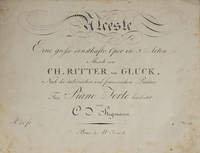
1815rif. 25656Bonn: N. Simrock PN 1125. 1815. Oblong folio. Contemporary marbled boards. 1f. recto title verso blank 3 cast list and table of contents 4-159 i blank pp. Engraved. Disbound. Boards quite worn; spine lacking. Slightly worn soiled foxed and stained; some corners slightly turned; minor underlining and annotations in red pencil to cast list; early repairs to inner margins of title and table of contents not affecting text; small binder's holes to inner margins. Later edition of the French version. Hopkinson 44C a. The French version of Alceste to a libretto by Marie François Louis Gand Leblanc Roullet was first performed at the Académie Royale de Musique in Paris on 23 April 1776. "Gluck's revision of Alceste for performance in Paris in 1776 amounts almost to a recomposition. His alterations were far more extensive than those he had made in his Paris adaptation of Orfeo . The French Alceste had a new text by Roullet Gluck's librettist for Iphigénie en Aulide based on Calzabigi's libretto; but alterations to the plot and the order of events led to major differences between the two. The principals at the première of the French version included Rosalie Levasseur Alcestis Joseph Legros Admetus Henri Larrivée Hercules Moreau Apollo and Nicolas Gélin High Priest. At the first Paris performances of Alceste the Act 3 denouement was substantially different from the version familiar today and closer to the Italian original. Gluck and Roullet after much criticism altered the act to incorporate a part for Hercules who has no place in the Italian original. Just as Gluck was arranging more music to enlarge the final divertissement again to please Parisian taste he heard of the death of his adopted daughter Marianne in Vienna; he left Paris and assigned the completion of the divertissement to Gossec. This revised version published in Paris in 1776 is the one that has nearly always been performed subsequently." Jeremy Hayes in Grove Music Online. N. Simrock [PN 1125.] unknown
1777rif. 40432Paris Lyon: Au Bureau d'Abonnement Musical Rue du Hazard Richelieu et Aux Adresses Ordinaires. A Lion Chez Castaud Place de la Commedie 1777. Folio. Early dark brown morocco. 1f. recto title verso publisher's catalogue 293 pp. With "Lagny" in contemporary black ink to blank inner margin of p. 1. Binding worn rubbed and bumped. Slightly worn; title slightly browned and foxed; occasional minor foxing soiling browning and small stains; several leaves slightly trimmed at outer margin not affecting text or notation; small loss to blank lower outer corner of p. 87; light impression to lowermost system of p. 43. Lacking pp. 35/36. Second edition. Wotquenne 44. Hopkinson p. 54 44Acc. Lesure p. 236. BUC p. 385. RISM G2639. Alceste an opera in three acts with text by R. de Calzabigi and a ballet by Noverre was first performed on 26 December 1767 at the Burgtheater in Vienna. It was revised by Gluck for a performance in Paris on 23 April 1776. "Gluck himself stressed the nature of Alceste as a `reform opera' by providing in the preface dedicating the printed score to the Grand Duke Leopold a discussion that goes far beyond the conventional. .That key document at once a manifesto and a defense . is a sharp repudiation of the theory practice and conventions of the old "opera seria" represented in its final phase by Metastasio and his favourite composer Hasse." TNG Vol. 7 pp. 463 and 467. Au Bureau d'Abonnement Musical, Rue du Hazard Richelieu et Aux Adresses Ordinaires. A Lion Chez Castaud Place de la Commedie unknown
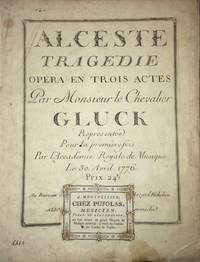
1776rif. 1634Paris; Lion Lyon: Au Bureau d’Abonnement Musical Rue du Hazard Richelieu Et Aux Adresses Ordinaires; Chez Castaud Place de la Commedie 1776. First edition. In contemporary green vellum with red title vignettes on spine and front panel. Tinted edges. Contemporary bookseller’s vignette on title page Chez Pujolas Montpellier. Cover rubbed at extremities stained damaged at corners. Title page torn at lower corner with no effect to text. Old shelf mark in ink on the title page. Bookblock somewhat loose. Pages lightly brown. Occasional stains. A brown stain to the lower edge of the fists few leaves and to the side edge of the last leaves. Overall in very good condition. First edition. In contemporary green vellum with red title vignettes on spine and front panel. Tinted edges. Contemporary bookseller’s vignette on title page Chez Pujolas Montpellier. 2 305 1 p. First edition of the full score of the French revised version of Gluck’s Alceste. "The first edition consisting of 305 numbered pages - of which only two copies have been found by me - exists in two states." Hopkinson. A scarce true first edition of the full score of Christoph Willibald Gluck’s 1714–1784 opera finished in 1767 and recomposed for the Paris performances in 1776. The present edition consisting of 305 numbered pages with the printed price on the title page “Prix 24 Fr” and with the “Catalogue” on the verso of the title page. RISM G 2638; Hopkinson 44A; Wotquenne 44 . Au Bureau d’Abonnement Musical, Rue du Hazard Richelieu, Et Aux Adresses Ordinaires; Chez Castaud Place de la Commedie unknown
rif. 1019296003.Ghardcover. Good. Access codes and supplements are not guaranteed with used items. May be an ex-library book. hardcover
rif. 117934992X.Gpaperback. Good. Access codes and supplements are not guaranteed with used items. May be an ex-library book. paperback
rif. 1022551140.Gpaperback. Good. Access codes and supplements are not guaranteed with used items. May be an ex-library book. paperback
rif. 1020976160.Ghardcover. Good. Access codes and supplements are not guaranteed with used items. May be an ex-library book. hardcover
rif. 3743443368.Gpaperback. Good. Access codes and supplements are not guaranteed with used items. May be an ex-library book. paperback
rif. 1018934731.Ghardcover. Good. Access codes and supplements are not guaranteed with used items. May be an ex-library book. hardcover
2026rif. LRB6011338Paris: Editions Recreasoft 2026 Sprache: Deutsch. Ca. 616 Seiten. Deutsch : Nachdruck auf Anfrage. Originalausgabe : 1797. Juristischer Kommentar zu den Pandekten nach Hellfeld von Christian Friedrich von Glück einem der bedeutenden Vertreter der pandektistischen Rechtswissenschaft. Das Werk gehört in den Kontext der gelehrten deutschen Zivilrechtsdogmatik des späten 18. Jahrhunderts und ist für die Geschichte der Rechtswissenschaft von besonderem Interesse. Buchbilder sind unverbindlich English : Print-on-demand reprint. Original edition : 1797. Legal commentary on the Pandects after Hellfeld by Christian Friedrich von Glück one of the major figures in German pandectist legal scholarship. The work belongs to the learned German civil law tradition of the late 18th century and is of particular interest for the history of jurisprudence. Book images are non-contractual. Editions Recreasoft. Softcover. New. Editions Recreasoft paperback
2026rif. LRB25041554Paris: Editions Recreasoft 2026 Sprache: Deutsch. Ca. 596 Seiten. Deutsch : Nachdruck auf Anfrage. Originalausgabe : 1797. Wichtiger juristischer Kommentar zu den Pandekten nach Hellfeld verfasst im Rahmen der gelehrten deutschen Rechtswissenschaft des späten 18. Jahrhunderts. Das Werk richtet sich an das Studium des römischen Rechts und seiner systematischen Auslegung und bietet ein bedeutendes Zeugnis der pandektistischen Tradition und der wissenschaftlichen juristischen Kommentarliteratur. Buchbilder sind unverbindlich English : Print-on-demand reprint. Original edition : 1797. Important legal commentary on the Pandects according to Hellfeld written within the learned German legal scholarship of the late 18th century. The work is directed to the study of Roman law and its systematic interpretation and it offers a significant example of the pandectist tradition and scholarly legal commentary. Book images are non-contractual. Editions Recreasoft. Softcover. New. Editions Recreasoft paperback
2026rif. LRB25041557Paris: Editions Recreasoft 2026 Sprache: Deutsch. Ca. 588 Seiten. Deutsch : Nachdruck auf Anfrage. Originalausgabe : 1797. Juristischer Kommentar zur Erläuterung der Pandekten nach Hellfeld ein umfassendes Werk zur Auslegung des römischen Rechts und seiner systematischen Anwendung. Das Buch richtet sich an Leser mit Interesse an der klassischen Rechtswissenschaft der Pandektenlehre und der historischen Entwicklung des Privatrechts. Buchbilder sind unverbindlich English : Print-on-demand reprint. Original edition : 1797. Juridical commentary on the Pandects according to Hellfeld an extensive work devoted to the interpretation of Roman law and its systematic application. This book will appeal to readers interested in classical legal scholarship Pandect science and the historical development of private law. Book images are non-contractual. Editions Recreasoft. Softcover. New. Editions Recreasoft paperback
2026rif. LRB25041556Paris: Editions Recreasoft 2026 Sprache: Deutsch. Ca. 596 Seiten. Deutsch : Nachdruck auf Anfrage. Originalausgabe : 1797. Juristischer Kommentar zu den Pandekten nach Hellfeld ein bedeutendes Werk der rechtswissenschaftlichen Literatur des ausgehenden 18. Jahrhunderts. Der Band gehört in den Kontext der gelehrten Pandektenexegese und ist von besonderem Interesse für die Geschichte des römischen Rechts der deutschen Rechtswissenschaft und der Kommentarliteratur jener Zeit. Buchbilder sind unverbindlich English : Print-on-demand reprint. Original edition : 1797. Legal commentary on the Pandects according to Hellfeld an important work of late 18th-century jurisprudence. The volume belongs to the learned tradition of Pandect scholarship and is of particular interest for the history of Roman law German legal science and commentarial literature of the period. Book images are non-contractual. Editions Recreasoft. Softcover. New. Editions Recreasoft paperback
2026rif. LRB25041552Paris: Editions Recreasoft 2026 Sprache: Deutsch. Ca. 588 Seiten. Deutsch : Nachdruck auf Anfrage. Originalausgabe : 1797. Ausführliche Erläuterung der Pandecten nach Hellfeld; ein Commentar ist ein juristisches Fachwerk der gelehrten Rechtswissenschaft des späten 18. Jahrhunderts und richtet sich an Leser mit Interesse an der Geschichte des römischen Rechts sowie an der systematischen Auslegung pandektistischer Fragestellungen. Buchbilder sind unverbindlich English : Print-on-demand reprint. Original edition : 1797. Ausführliche Erläuterung der Pandecten nach Hellfeld; ein Commentar is a legal scholarly work from the late eighteenth century and will appeal to readers interested in the history of Roman law and the systematic interpretation of pandectist questions. Book images are non-contractual. Editions Recreasoft. Softcover. New. Editions Recreasoft paperback
2026rif. LRB25041555Paris: Editions Recreasoft 2026 Sprache: Deutsch. Ca. 592 Seiten. Deutsch : Nachdruck auf Anfrage. Originalausgabe : 1797. Juristische Abhandlung und Kommentar zu den Pandekten nach Hellfeld ein bedeutendes Werk der deutschen Rechtswissenschaft des späten 18. Jahrhunderts. Der Text richtet sich an die wissenschaftliche Erschließung des römisch-rechtlichen Stoffes und ist für die Geschichte der Pandektenlehre sowie der juristischen Kommentartradition von Interesse. Buchbilder sind unverbindlich English : Print-on-demand reprint. Original edition : 1797. Legal treatise and commentary on the Pandects according to Hellfeld an important work of late 18th-century German legal scholarship. The text is intended for the scholarly study of Roman law and is of interest for the history of Pandectist doctrine and the tradition of legal commentary. Book images are non-contractual. Editions Recreasoft. Softcover. New. Editions Recreasoft paperback