2138 risultati
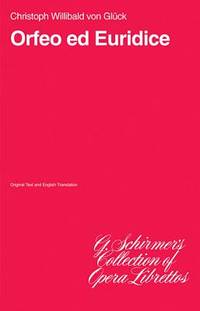
1986rif. Q-0793598125G. Schirmer Inc 1986-10-31. paperback. New. In shrink wrap. Looks like an interesting title! G. Schirmer, Inc paperback
rif. 0486273245.Gpaperback. Good. Access codes and supplements are not guaranteed with used items. May be an ex-library book. paperback
1990rif. 36843EMI, 1990. 7636372 2 CD CD
rif. 1396174478.Ghardcover. Good. Access codes and supplements are not guaranteed with used items. May be an ex-library book. hardcover
rif. 40422Paris 19th century. 61 x 47.3 cms with frame 69.5 x 56 cms. The composer is depicted bust-length turned 3/4 left facing forward wearing a red jacket blue waistcoat white collared blouse with lace and wig. For a fine full-page color illustration of the original held at the Louvre see MGG Vol. 5 plate 15. "Gluck was recognized as an extraordinary phenomenon in his lifetime as is evident from Burney's deferential treatment of the composer during his visit to Vienna in 1772. Shortly afterwards the controversy stirred in French journals resonated well beyond the capital to other countries. The daily cultural discourse of Paris concerned Gluck's 'musical revolution' a catch-phrase taken up by Gluck's opponents such as Jean-François Marmontel as well as by his defenders; in 1781 the 'revolution worked in music by M. le Chevalier Gluck' later dubbed the 'German Orpheus' was used as the title of a collection of pamphlets for and against Gluck with a heavy editorial bias in favour Lesure c1984. Although operas by Piccinni Salieri and especially Sacchini as well as French contemporaries such as Grétry continued alongside Gluck in the French repertoire beyond the Revolution and Empire revivals of Gluck constituted the principal touchstone of dramatic music into the 1820s when the last routine revivals were acclaimed by Berlioz. Opera composers including Salieri Lemoyne and Vogel in Paris were presented or presented themselves as his legitimate successors; elsewhere Mozart especially in Idomeneo and J.M. Kraus were strongly affected by Gluck's example in constructing scenes applying a dramatically motivated admixture of lyricism and more direct and declamatory vocal expression and sometimes in modelling as when the statue in Don Giovanni adopts the tone of the oracle in Alceste. After his death his direct effect can still be heard in Die Zauberflöte and in several French operas including those of Méhul Cherubini and Spontini. Among the Romantics he continued to inspire respect and from Berlioz and Wagner emulation. Berlioz supervised productions of Orphée and Alceste in Paris 1859 and 1866. In Orphée Berlioz created the basis for the version most used over the next century at least by restoring the Italian key-scheme in several scenes to accomodate the tessitura of the title role to a female singer; Pauline Viardot was the first in a line to include Giulia Ravoli Kathleen Ferrier Janet Baker and others although the French version with tenor retained some currency. Musicians close to Berlioz began to realize his ideal of a complete critical edition although only a handful of 'reform' operas were published. Wagner wrote about Gluck in Oper und Drama having learned much from deep study of Iphigénie en Aulide of which he made a modernized performing version Dresden 1847. In 1890 for Weimar Richard Strauss similarly adapted Iphigénie en Tauride. Such orchestrational revision and the melding of recitative and aria to blur Gluck's structure of closed forms represented a style of musical archaeology from which Handel and Mozart also suffered or in terms of public exposure benefited. The later 20th century witnessed not only numerous revivals of the reform operas some in musically authentic form and including the Vienna Orfeo but also a less one-sided critical view of Gluck became possible with the publication of a new critical edition and a revival of interest in works in other genres especially opéra comique and with Don Juan ballet. Winton Dean has observed that Gluck's compromise between the demands of words and music 'was one of the most satisfying and successful of all and has placed his greatest works beyond the reach of time' Grove6. None of Gluck's operas except Orfeo/Orphée is likely to become a staple work in the repertory; however to the extent that every production has the aspect of a revival continued interest in his achievement and consequently revival of an increasing proportion of his output is guaranteed so long as opera continues to occupy a central place in Western musical culture." Julian Rushton in Grove Music Online. unknown
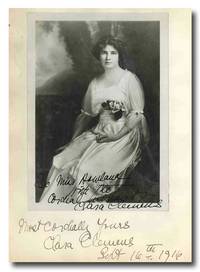
1916rif. 64676N.p. ca. 1916. Inscribed twice by Clemens 1874-1962 the sole surviving child of Samuel Clemens. On the photograph itself she has written: "To Miss Howland with the cordial wishes of Clara Clemens." The recipient is further identified by the inscription on the verso from Alma Gluck the Romanian-born American soprano accompanied by a clipped portrait photo from a magazine to "Enid Howland." Additionally Clemens has inscribed the mount: "Most cordially Yours Clara Clemens Sept. 16th 1916." Clara was after her father's death the controversial custodian of his estate and literary rights. She published her biography of him in 1931 along with books on other subjects and worked at a career in singing with which this artifact is likely connected. Mounted and evidently extracted from an album amicorum or scrapbook with another party's photo and inscription on verso. Mount a bit chipped and edge-torn faint crease on photo otherwise good. Enclosed in oversize half-morocco slipcase. unknown
1916rif. WRCLIT67956Np 1916. Original silver print of formal photographic portrait. 175 x 125mm. Mounted an evidently extracted from an album amicorum or scrapbook with another party's photo and inscription on verso. Mount a bit chipped and edge-torn faint crease on photo otherwise good. Enclosed in oversize half-morocco slipcase. Inscribed twice by Clemens 1874-1962 the sole surviving child of Samuel Clemens. On the photograph itself she has written: "To Miss Howland with the cordial wishes of Clara Clemens." The recipient is further identified by the inscription on the verso from Alma Gluck the Romanian-born American soprano accompanied by a clipped portrait photo from a magazine to "Enid Howland." Additionally Clemens has inscribed the mount: "Most cordially Yours Clara Clemens Sept. 16th 1916." Clara was after her father's death the controversial custodian of his estate and literary rights. She published her biography of him in 1931 along with books on other subjects and worked at a career in singing with which this artifact is likely connected. unknown books
1997rif. R260149172GRAND THEATRE DE BORDEAUX. 1997. In-8. Broché. Bon état, Couv. convenable, Dos satisfaisant, Intérieur frais. Monographie d'opéra de 41 pages. Premier plat illustré en couleurs. Couverture rempliée. Nombreuses illustrations en noir et blanc dans le texte.. . . . Classification Dewey : 782.1-Théâtre musical, opéra
rif. RO50013476Journal des Jeunes Personnes. XIXème. In-4. En feuillets. Bon état, Couv. légèrement passée, Dos satisfaisant, Quelques rousseurs. 4 pages.. . . . Classification Dewey : 780.26-Partitions
rif. RO50013222Enoch & cie. XXème. In-8. Broché. Bon état, Couv. légèrement passée, Dos très frotté, Intérieur frais. 138 pages. Ornements en couverture et en page titre. Coiffe en pied manquante.. . . . Classification Dewey : 780.26-Partitions
rif. R150023152CALMANN LEVY .. Non daté.. In-12. Broché. Bon état, Couv. convenable, Dos satisfaisant, Intérieur acceptable. 21 pages.. . . . Classification Dewey : 840-Littératures des langues romanes. Littérature française
rif. RO80080306CHOUDENS. Non daté. In-Folio. Broché. Etat d'usage, Couv. convenable, Dos satisfaisant, Intérieur acceptable. 7 pages de partitions. Petits accrocs en marges.. . . . Classification Dewey : 780.26-Partitions
1942rif. RO50015764Durand & Cie. 1942. In-8. En feuillets. Bon état, Livré sans Couverture, Dos satisfaisant, Intérieur frais. 3 pages.. . . . Classification Dewey : 780.26-Partitions
1896rif. RO50023023"Imprimerie des Annales. 8 mars 1896. In-4. En feuillets. Bon état, Couv. convenable, Dos satisfaisant, Quelques rousseurs. Non paginé. 4 pages environ. Gravures noires et blanches représentant les directeurs du conservatoire de l'époque, ""Un secret"" de M. Gruet, ""Thermidor, la dernière charette - M. Coquelin dans Labussière"".. . . . Classification Dewey : 780.26-Partitions"
1905rif. RO50023494"Imprimerie des Annales. 19 mars 1905. In-4. En feuillets. Bon état, Couv. convenable, Dos satisfaisant, Quelques rousseurs. Non paginé. 4 pages environ. Photos noires et blanches ayant pour thèmes ""La famille des Coquelin"", ""A travers l'actualité"" et ""La guerre russo-japonaise"".. . . . Classification Dewey : 780.26-Partitions"
rif. RO20042608LITOLFF'S / ENOCH FRERES. non daté. In-8. Relié demi-cuir. Bon état, Couv. convenable, Dos satisfaisant, Intérieur frais. 138 pages. Recueil de partitions accompagnées de paroles. Titre et filets dorés sur le dos en cuir noir.. . . . Classification Dewey : 780.26-Partitions
1997rif. R260106692OPERA DE BORDEAUX. 1997. In-8. Broché. Bon état, Couv. convenable, Dos satisfaisant, Intérieur frais. Monographie d'opéra de 41 pages. Premier plat illustré en couleurs. Couverture rempliée. Nombreuses illustrations en noir et blanc dans et hors texte.. . . . Classification Dewey : 782.1-Théâtre musical, opéra
rif. RO50044766PETERS. NON DATE. In-8. Broché. Etat d'usage, Tâchée, Dos satisfaisant, Intérieur acceptable. 142 pages de partitions. Protection plastique transparente. Couverture en couleur. Texte en allemand et français.. . . . Classification Dewey : 780.26-Partitions
1899rif. RO50043318CHOUDENS. 1899. In-8. Broché. Bon état, Plats abîmés, Dos frotté, Intérieur acceptable. 118 pages de partitions. Premier plat illustré en noir et blanc. Inscription sur la première page blanc. Couverture plastique transparente de protection. Paroles de Moline.. . . . Classification Dewey : 780.26-Partitions
rif. RO50043321CHOUDENS. NON DATE. In-8. Broché. Bon état, Couv. légèrement passée, Dos abîmé, Intérieur frais. 118 pages de partitions. Paroles de Moline.. . . . Classification Dewey : 780.26-Partitions
rif. RO50047552M. LABBE. NON DATE. In-8. En feuillets. Bon état, Tâchée, Dos satisfaisant, Quelques rousseurs. 2 pages de partitions non paginées. Tampon sur le premier plat ainsi que sur la première page. Chantée par Delna de l'opéra comique.. . . . Classification Dewey : 780.26-Partitions
rif. RO50049448C.F. PETERS. NON DATE. In-8. Relié. Etat d'usage, Coins frottés, Coiffe en pied abîmée, Intérieur acceptable. 138 pages de partitions. Compositeur, titre et filets dorés au dos de l'ouvrage. Annotation et tampon sur la page de titre. Coins et plats frottés.. . . . Classification Dewey : 780.26-Partitions
rif. RO50053382PETERS. NON DATE. In-8. Broché. Etat d'usage, Tâchée, Dos abîmé, Quelques rousseurs. 138 pages de partitions. Couverture en couleur. Tampon et annotation sur le premier plat, sur la page de titre ainsi que sur la première page.. . . . Classification Dewey : 780.26-Partitions
1922rif. RO50056476CHOUDENS. 1922. In-8. En feuillets. Etat d'usage, Plats abîmés, Dos très frotté, Quelques rousseurs. 177 pages de partitions. Version originale française adaptée et revue par Paul Vidal. Représenté pour la première fois au Théâtre National de l'opéra comique le 11 Octobre 1921. Plats frottés. Poème de Moline d'après Calzabigi.. . . . Classification Dewey : 780.26-Partitions
rif. RO50056977PHILIPPO. NON DATE. In-Folio. En feuillets. Etat d'usage, Couv. légèrement passée, Dos abîmé, Papier jauni. 7 pages de partitions. Paroles de M. Moline.. . . . Classification Dewey : 780.26-Partitions