INCONNULivre Rare Book
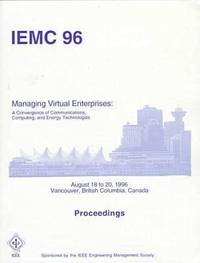
1996 IEEE International Engineering Management Conference
1996ref. DBS.Management-9780780335IEEE 1996. 1. Paperback. New. IEEE paperback
Sanctum Books · India$324.85≈ €289.66
1,919 results
ref. R320002072INCONNU. NON DATE. In-12. Broché. Bon état, Couv. convenable, Dos satisfaisant, Intérieur acceptable. 62 pages illustrées de nombreux schémas.. . . . Classification Dewey : 621.3-Electronique
1987ref. 150425005IEEE 1987-01-01. Hardcover. Very Good. VG Clean text IEEE hardcover
1996ref. DBS.Management-9780780335IEEE 1996. 1. Paperback. New. IEEE paperback
1996ref. DBS.Management-9780780335IEEE 1996. 1. Paperback. New. IEEE paperback
1996ref. DBS-9780780335523IEEE 1996. 1. Paperback. New. IEEE paperback
1996ref. DBS-9780780335523IEEE 1996. 1. Paperback. New. IEEE paperback
1996ref. AME_9780780335523IEEE 1996. N/A. Paperback. New/New. _ IEEE paperback
1996ref. USD_9780780333345IEEE 1996. 2nd. Paperback. Used - Like New/Used - Like New. _ IEEE paperback
1996ref. DBS-9780780333345IEEE 1996. 2nd. Paperback. New. IEEE paperback
1996ref. DBS-9780780333345IEEE 1996. 2nd. Paperback. New. IEEE paperback
1996ref. AME_9780780333345IEEE 1996. 2nd. Paperback. New/New. _ IEEE paperback
1979ref. 68319New York: Institute of Electrical and Electronics Engineers 1979. Wraps. Good. No dust jacket. Cover has wear and soiling and a small tear/cut at the back. xiii 114p 4; 29 cm. Sponsored by IEEE Quantum Electronics and Applications Society and Optical Society of America. From Wikipedia: "The IEEE Photonics Society formerly the IEEE Lasers and Electro-Optics Society LEOS is a society of the Institute of Electrical and Electronics Engineers IEEE focused on the scientific and engineering knowledge about the field of quantum electronics. In the hierarchy of IEEE the Photonics Society is one of the close to 40 technical societies organized under the IEEE Technical Activities Board. The society's website states that its Field of Interest "shall be lasers optical devices optical fibers and associated lightwave technology and their applications in systems and subsystems in which quantum electronic devices are key elements. The society is concerned with the research development design manufacture and applications of materials devices and systems and with the various scientific and technological activities which contribute to the useful expansion of the field of quantum electronics and applications". The Society supports publications sponsors meetings and other forms of information exchange. The foundation of the society was made in 1965 by establishing the IEEE Quantum Electronics Council QEC. In 1977 under the leadership of Henry Kressel the council became the IEEE Quantum Electronics and Applications Society QEAS. On January 1 1985 the society was renamed into IEEE Lasers and Electro-Optics Society LEOS. On April 9 2009 the society was again renamed now into IEEE Photonics Society." From Wikipedia: "The Optical Society originally established as the Optical Society of America OSA is a scientific society dedicated to advancing the study of light optics and photonics in theory and application by means of publishing organizing conferences and exhibitions partnership with industry and education. The organization has members in more than 100 countries OSA had 17 000 individual members and more than 230 corporate member companies. OSA was founded in 1916 under the leadership of Perley G. Nutting with 30 optical scientists and instrument makers based in Rochester New York. OSA soon began publication of its first journal of research results and established an annual meeting. It was founded as the "Optical Society of America" and has evolved into a global enterprise with a worldwide constituency. In recognition of this the society was renamed in 2008 as The Optical Society OSA. The mission of the Optical Society is to promote the generation dissemination application and archiving of knowledge in optics and photonics. The purposes of the Society are scientific technical and educational. Scientific publishing is a core activity of the society consisting of 16 flagship partnered and co-published peer-reviewed journals and 1 magazine. With more than 240 000 articles including papers from over 450 conferences the digital library Optics InfoBase is the largest peer-reviewed collection of optics and photonics." Institute of Electrical and Electronics Engineers paperback
ref. 0780321375.Gpaperback. Good. Access codes and supplements are not guaranteed with used items. May be an ex-library book. paperback
ref. 0780300009.Gpaperback. Good. Access codes and supplements are not guaranteed with used items. May be an ex-library book. paperback
1955ref. ZB2634151955-2000. volumes 1-46 lacks volumes 27 28 30 partly bound ex library else text clean & bindings tight. - If you are reading this this item is actually physically in our stock and ready for shipment once ordered. We are not bookjackers. Buyer is responsible for any additional duties taxes or fees required by recipient's country. Photos available upon request. unknown
1984ref. ZB263362IEEE 1984-1987. volumes 1-4 each complete in four numbers; original paper wrappers very good. - If you are reading this this item is actually physically in our stock and ready for shipment once ordered. We are not bookjackers. Buyer is responsible for any additional duties taxes or fees required by recipient's country. Photos available upon request. IEEE unknown
1967ref. ZB278836London: 1967. 237 pp. illustrated quarto pam bound ex library still very good. - If you are reading this this item is actually physically in our stock and ready for shipment once ordered. We are not bookjackers. Buyer is responsible for any additional duties taxes or fees required by recipient's country. London: unknown
1965ref. 725941PN. New. 1965. Soft Cover. Date is original print. This is a reprint edition. . PN paperback
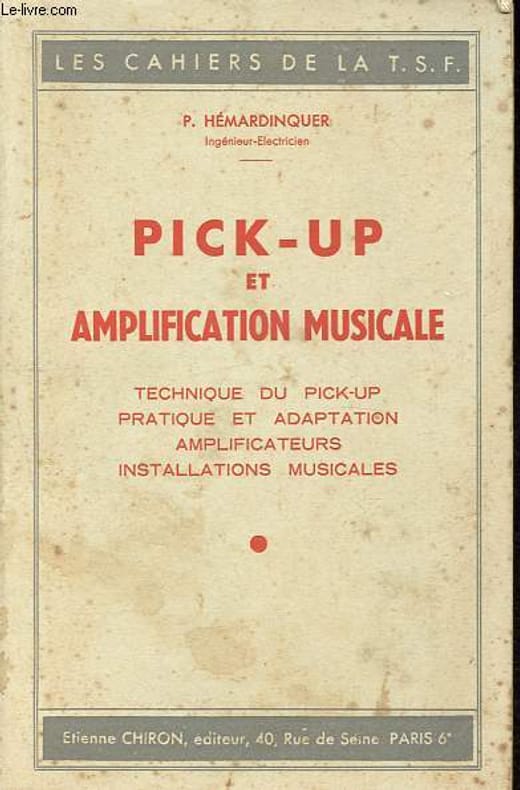
1939ref. R200140666Etienne Chiron. 1939. In-8. Broché. Etat d'usage, Tâchée, Dos satisfaisant, Quelques rousseurs. 153 pages, quelques illustrations en noir et blanc dans et hors texte - papier jauni, coins frottés.. . . . Classification Dewey : 621.3-Electronique
1997ref. 1302216PN. New. 1997. Soft Cover. Date is original print. This is a reprint edition . PN paperback
1971Hardcover without jacket. Ex-academic library: abrasion on front pastedown; lending history on FEP, label on rear pastedown; stamps on page block and title page. Minor mark on BEP. Content is clear throughout. TS Used
1957ref. 004947Paris librairie De la Radio 1957 In-8 Broché Bon
1967ref. RO80259516S.A. Philips. 1967. In-8. Broché. Bon état, Couv. légèrement passée, Dos fané, Intérieur frais. 238 pages. Nombreux schémas en noir et blanc dans le texte.. . . . Classification Dewey : 621.3-Electronique
2016ref. RO30357615First interactive. 2016. In-8. Broché. Bon état, Coins frottés, Dos satisfaisant, Intérieur acceptable. 372 pages. Nombreuses illustrations en couleurs, in texte.. . . . Classification Dewey : 621.3-Electronique
1979ref. 76193Lexington MA: Honeywell Defense Electronics Division 1979. Presumed First Edition First printing. Spiral bound wraps. Good. 43 sheets printed on one side only plus covers. Cover has wear and soiling. Illustrations. HgCdTe or mercury cadmium telluride also cadmium mercury telluride MCT MerCad Telluride MerCadTel MerCaT or CMT is an alloy of cadmium telluride CdTe and mercury telluride HgTe with a tunable bandgap spanning the shortwave infrared to the very long wave infrared regions. The amount of cadmium Cd in the alloy can be chosen so as to tune the optical absorption of the material to the desired infrared wavelength. CdTe is a semiconductor with a bandgap of approximately 1.5 electronvolts eV at room temperature. HgTe is a semimetal which means that its bandgap energy is zero. Mixing these two substances allows one to obtain any bandgap between 0 and 1.5 eV. I-V characteristic of a photodiode. The linear load lines represent the response of the external circuit. The points of intersection with the curves represent the actual current and voltage for a given bias resistance and illumination. A photodiode is a semiconductor device that converts light into an electrical current. The current is generated when photons are absorbed in the photodiode. Photodiodes may contain optical filters built-in lenses and may have large or small surface areas. Photodiodes usually have a slower response time as their surface area increases. Photodiodes are similar to regular semiconductor diodes except that they may be either exposed to detect vacuum UV or X-rays or packaged with a window or optical fiber connection to allow light to reach the sensitive part of the device. Many diodes designed for use specifically as a photodiode use a PIN junction rather than a p-n junction to increase the speed of response. A photodiode is designed to operate in reverse bias. Honeywell Defense Electronics Division paperback