214 résultats
1855réf. 43859Leipzig Johann Ambrosius Barth 1855. Without wrappes. In: "Annalen der Physik und Chemie. Hrsg. von J.C. Poggendorff" 94. Bd. No 1 "Heft" No 1 1855. Pp. 1-176 a. 4 folded engraved plates. Entire issue offered. Titlepage to vol. 94 small stamp on verso. Fick's paper: pp. 59-86. Helmholtz's paper: pp. 1-28. Clean and fine. First appearance of Fick's importent paper in molecular physics in which he annouced his two laws of diffusion.Fick's first law relates the diffusive flux to the concentration field by postulating that the flux goes from regions of high oncentration to regions of low concentration with a magnitude that is proportional to the concentration gradient spatial derivative. - Fick's second law predicts how diffusion causes the concentration field to change with time. Wikipedia.First appearance of HELMHOLTZ'S fundamental paper in physiological optics in which he examined the sensitivity of the eye for the individual elements of the violet end of the spectrum; he was able to detect a whole series of distinct tones of purple: he alters the name 'invisible rays' to that of 'ultra-violet rays'; discussion of the relations of the wavelenghts of complementary colours and the intensity required if the mixture of simple complementarity colours is to produce white. He answered these questions quantatively. "THE TREATISE the paper offered WHICH HAS BEEN FUNDAMENTAL FOR ALL LATER WORK OF THE SAME KIND concludes with an inquiry into the validity of Newton's Colour Circle which Helmholtz designates as one of the most brilliant inspirations of that great thinker."Leo Koenigsberge "Hermann von Helmholtz" pp. 131-133. unknown
1979réf. PH-247Berlin-Heidelberg: Springer-Verlag 1979. Classic comprehensive text covers theoretical and experimental work on the influence of photoexcitation on the physical properties of ferroelectrics pyroelectrics and other nonlinear electro-optical material. Includes the thermodynamic and microscopic theory of photoferroelectric phenomena; anomalous photovoltaic effect and photorefractive effect in ferroelectrics; applications to holography and optical storage. 174 pgs. Illustrated with 63 figures. Stamp on front endpaper and outer edge. Minimal shelfwear. First Edition. Hard Cover. Very Good. 8vo - over 7¾" - 9¾" tall. Ex- Professional Library. Springer-Verlag Hardcover
1957réf. OP-53New York: Interscience Publishers 1957. Classic comprehensive text presents detailed coverage of microanalytical methods involving both the microscope and temperature control including hot and cold stages hot bars; general calibration techniques for characterization and identification of organic compounds estimation of purity methods of purification analysis of mixtures determination of composition diagrams and polymorphism; study of pour-point depressants; thermal stability of decomposable compounds; kinetics of crystal growth recrystallization and grain growth; etc. 307 pp. Illustrated. Color frontispiece. Dustjacket has a small chunk missing on the upper edge and lower corner; minor shelfwear. In mylar. First Edition. Hard Cover. Fine/Good. 8vo - over 7¾" - 9¾" tall. Interscience Publishers Hardcover
2002réf. OP-109Warrendale PA.: Materials Research Society 2002. Comprehensive text presents detailed coverage of the progress of interband and intersubband transitions in semiconductor materials including III-V IV and II-VI materials and quantum novel devices. Topics also covers processing issues for optoelectronic devices work on solar cell and lasers materials utilizing low nitrogen concentration compounds VCSELs quantum dots quantum wells and heterostructures. Materials ranged over the III-V aand II-VI semiconductors including GaAs GaAsN InP ZnSe and others. Technological applications ranged over infrared detectors microelectronics optical materials lasers solar cell applications and design and VCSELs. 732 pp. Illustrated. Small minor prior ownership stamp on front endpaper. Lower front corner slightly bumped. Minimal shelfwear. First Edition. Hard Cover. Very Good. 8vo - over 7¾" - 9¾" tall. Materials Research Society hardcover
1971réf. OP-10Boulder CO.: Golem Press 1971. Classic highly acclaimed text translated from the original Russian by the late Prof. Petr Beckmann presents a detailed treatment of problems and results applied to a wide range of antennas including random antenna arrays; radar ambiguity functions; field statistics of the diffraction pattern in the focal plane of an aperture antenna; phenomena observed in tropospheric propagation; minimization of beam pointing errors; optimization of antennas with respect to beamwidth gain side lobe level radiation pattern etc. 370 pgs. Illustrated. Some isolated sections with random highlights- does not adversely affect the general text. Prior owner's name on front endpaper and outer edge. Dustjacket has some minor rubbing to corners and edges; tiny closed tear on top edge; price-clipped front inside flap; in mylar. Scarce. First Edition. Hard Cover. Very Good/Very Good. 8vo - over 7¾" - 9¾" tall. Golem Press hardcover
réf. DADAX0471984477New unknown
1968réf. OP-1Tokyo Japan: Maruzen Co. Ltd. 1968. Comprehensive text presents an illustrated chronological survey of the various types of electron microscopes of Japan from 1936-1965 including technical specifications features date of commercialization and description. Includes a list of symbols list of members and presidents of the Society of Electron Microscopy Japan. 199 pgs. Illustrated with numerous black/white plates. Small stamps to outer edges; blank label and secondatry label removal mark on front endpaper. Gilt spine Minor rubbing to edges. . First Edition. Hard Cover. Very Good. 4to - over 9¾" - 12" tall. Ex-Professional Library. Maruzen Co. Ltd. Hardcover
1946réf. OP-69New York: Reinhold Publishing 1946. Classic revised and expanded edition includes an extensive section on electron optics and updated plates throughout. Sections include wave motion in elastic media; dual theory of the electron; electron emission; electromagnetic theory of light; 1944 Toronto microscope; the magnetic and the electrostatic electron microscope; dual theory of light; etc. 325 pgs. Numerous illustrations. Photo frontispiece. Gilt spine. Minor shelfwear. Second Edition. Hard Cover. Very Good. Illus. by Stone Dorothy. 8vo - over 7¾" - 9¾" tall. . Reinhold Publishing Hardcover
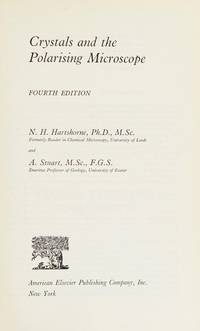
1970réf. OP-71London U.K.: Edward Arnold Ltd. 1970. Classic comprehensive revised and expanded text contains detailed topics in stereographic projection; optical properties of crystals; morphology of crystals; the polarising microscope; microscopic examination of crystals: orthoscopic and conoscopic observations; rotation methods; liquid crystals; polymers and biological applications; chemical and industrial applications; etc. 614 pgs. Illustrated including a folding plate of nomogram for determination of refractive indices. Small stamp on endpaper and outer edge; minor scuff mark to front cover. Gilt spine; minimal shelfwear. . Fourth Edition. Hard Cover. Very Good. 8vo - over 7¾" - 9¾" tall. Ex-Technical Library. Edward Arnold Ltd. Hardcover
1755réf. 50315Altenburg Richterischen Buchhandlung 1755. 4to. Contemp. boards. Handwritten titlelabel on spine. Engraved titlevignette. 205315 pp. and 22 folded engraved plates. A few scattered brownspots but in general clean. Scarce first German edition of this hugely influential textbook in optics."Smith wrote on optics and harmonics. In 1738 he published A Compleat System of Optics in Four Books viz. A Popular at Mathematical a Mechanical and a Philosophical Treatise. Both comprehensive and reliable the work became probably the most influential optical textbook of the eighteenth century. It was also published in Dutch in 1753 in German in 1755 and in two different French translations in 1767 In 1778 an abridged version was published in English. In turn its popularity helped to establish the eighteenth-century conviction that light is particulate." DSB. hardcover
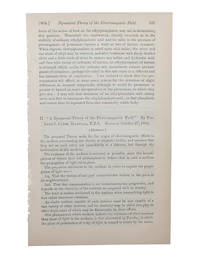
1864réf. 41709London Taylor and Francis 1864. No wrappers as extracted from"Proceedings of the Royal Society". From November 19 1863 to December 22 1864 inclusive." Vol. XIII. Pp 531-536. First printing of the first announcement of Maxwell unification of light-waves electricity and magnetism the most importent of the papers relating to his electromagnetic theory in which he brought electro-magnetical phenomena on a clear mathematical form. The present paper is an abstract of the larger paper which was read to the Royal Academy in 1864 but only issued the year later 1865 in "Philosophical Transactions of the Royal Society" where it was printed in full and as an abstract in "Philosophical Magazine" 1865."A generation later Einstein's work on relativity was founded directly oupon Maxwell's electromagnetic theory; it was this that led him to equate Faraday with Galileo and Maxwell with Newton." PMM No 355 but only the paper from 1865. - Dibner. Heralds of Science No 68 1865 paper. unknown
1973réf. CH-22Michigan: Ann Arbor Science 1973. Classic comprehensive reference set presents by photomicrographs and electron micrographs the relationship between the appearance of images of many different types of particles and their identities including improvements in ultramicroscopy automatic image analysis electron microprobe analyses fractionation methods source testing applications of dispersion staining etc. Set includes: Vol. 1: Principles and Techniques Vol. II: The Light Microscopy Atlas Vol. III: The Electron Microscopy Atlas Vol. IV: The Particle Analyst's Handbook Vol. V: Light Microscopy Atlas and Techniques & Vol. VI: Electron Optical Atlas and Techniques. 1454 pp. collectively. Illustrated. Gilt front covers and spines. Corners and spine edges slightly rubbed on some volumes. Vol. I rear endpaper taped and tiny chip to bottom of pp. 295-296. Former ownership label pastedown and small stamps on the front endpaper title page and outer edge of all volumes. Minor light rubbing to lower spine on some volumes from label removal no residue. Text crisp and clean with no marks or highlights. Minimal shelfwear. Heavy item. Scarce. . . Second Edition. Hard Cover. Very Good. Folio - over 12" - 15" tall. Ex-Professional Library. Ann Arbor Science hardcover
1504réf. 5444Venice: Giovanni Battista Sessa June 1504. THIRD OR FOURTH EDITION of the two editions of 1504 priority has not been determined. THE FIRST TO BE EDITED BY LUCA GAURICO. Hardcover. Fine. Bound in modern vellum. Title with large woodcut showing the author in his study surrounded by books lecturing his students one of whom takes notes. Sessa's cat-and-mouse printer's device appears on the same leaf.The text is illustrated with 77 woodcut diagrams. A very fine copy crisp and bright. There is a very light stain on the title page a bit of soiling in the gutter of leaf A3 and a discreet paper repair to the fore-edge of the final leaf. "The 'Perspectiva communis' was the most widely used of all optical texts from the early fourteenth until the close of the sixteenth century and it remains today the best index of what was known to the scientific community in general on the subject" DSB. It was first printed in Milan around 1482 then in 1503 it was included in a collection by Thomas Bradwardine "Praeclarissimum mathematicarum opus"Valencia. This 1504 edition the first edited by Luca Gaurico can be considered the third although another edition of the pre-Gaurico version was also published in 1504 at Leipzig. A mathematician from Naples and teacher of Scaliger Gaurico who also edited the works of Archimedes and Ptolemy completely revised the text. "The work on which Pecham's fame has chiefly rested is the Perspectiva communis probably written between 1277 and 1279 during Pecham's professorship at the papal curia. In the first book Pecham discussed the propagation of light and color the anatomy and physiology of the eye the act of visual perception physical requirements for vision the psychology of vision and the errors of direct vision. In book II he discussed vision by reflected rays and presented a careful and sophisticated analysis of image formation by reflection. Book III was devoted to the phenomena of refraction the rainbow and the Milky Way. "The central feature of Pecham's optical system and the dominant theme of book I of the 'Perspectiva communis' is the theory of direct vision. Here as elsewhere Pecham endeavored to reconcile all the available authorities-Aristotle Euclid Augustine al-Kindi Ibn al-Haytham Ibn Rushd Grosseteste and Bacon. Following Ibn al-Haytham Pecham argued that the emission of visual rays from the observer's eye is neither necessary nor sufficient as an explanation of sight; the primary agent of sight is therefore the ray coming to the eye from a point on the visible object. But in an attempt to follow Aristotle al-Kindi and Grosseteste as well Pecham argued that visual rays do nevertheless exist and perform the important but not always necessary function of moderating the luminous rays from the visible object and making them "commensurate with the visual power." Thus Pecham like Bacon resolved the age-old debate between the emission and intromission theories of vision in favor of a twofold radiation although to be sure priority was given to rays issuing from the visible object. "The rays issuing from points on the visible object fall perpendicularly onto the cornea and penetrate without refraction to the sensitive ocular organ the glacial humor or crystalline lens; nonperpendicular rays are weakened by refraction and therefore can be largely ignored. Since only one perpendicular ray issues from each point of the visible object and the collection of such perpendicular rays maintains a fixed order between the object and the eye a one-to-one correspondence is established between points on the object and points on the glacial humor and unconfused perception of the visual field is thus achieved. Vision is not "completed" however in the glacial humor. There is a further propagation of the rays or species through the vitreous humor and optic nerve to the common nerve where species from the two eyes combine and eventually to the anterior part of the brain and the "place of interior judgment." "Pecham's optical system included significantly more than a theory of direct vision. He briefly discussed the doctrine of species; treated at length the propagation of rays; and developed a theory to explain how solar radiation when passing through noncircular apertures gives rise to circular images. He expressed the full law of reflection and applied it to image formation by plane spherical cylindrical and conical mirrors; in this analysis he revealed an implicit understanding of the nature of the focal point of a concave mirror. Although he did not possess a mathematical law of refraction he successfully applied the general qualitative principles of refraction to the images that result from refraction at plane and circular interfaces between transparent media of various densities. In his discussion of the rainbow Pecham again attempted to reconcile different theories. He argued that all three kinds of rays rectilinear reflected and refracted concur in the generation of the rainbow. "Pecham's 'Perspectiva communis' is still extant in more than sixty manuscripts and went through twelve printed editions including a translation into Italian between 1482 and 1665. It was used and cited by many medieval and Renaissance natural philosophers including Dominicus de Clavasio Henry of Langenstein Blasius of Parma Lorenzo Ghiberti Leonardo da Vinci Albert Brudzewski Francesco Maurolico Giambattista della Porta Girolamo Fabrici Johannes Kepler Willebroad Snellius and G. B. Riccioli. It was lectured upon in the late Middle Ages at the universities of Vienna Prague Paris Leipzig Cracow Würzburg Alcala and Salamanca."DSB. Giovanni Battista Sessa, June hardcover
1628réf. 4005Venice: Lucio Spineda 1628. SOLE EDITION. Hardcover. Fine. Contemporary limp vellum in fine condition paste-down torn. The text is in excellent condition with a few instances of light toning in gatherings O S and X and a small worm-track in the margin of the first few lvs. The text is illustrated with woodcut diagrams. An extremely rare book. OCLC cites only 1 copy in North America Columbia University and 5 other institutional copies outside of Italy two in Denmark two in France one in Switzerland. Vagnetti described the book without having seen a copy. Riccardi described an incomplete copy. First and only edition of this wide-ranging work on selected problems in perspective and its underlying geometry largely organized around what the author considers to be commonly found theoretical or practical errors. Diano proves himself to be well read in the contemporary literature of optics and perspective citing Kepler Maurolico Aguilon and others. The final two chapters describe perspective instruments of the variety used by Dürer. Ferdinando di Diano born around 1571 was an Italian mathematician philosopher and theologian author of some fifteen texts on various subjects including the natural sciences. In "The Eye Wandering from Reason Emended. Perspective"1628 Diano distinguishes between 'perspectiva naturalis' physiological optics and 'perspectiva artificialis' the graphic method that allows the rationalization of space. Diano considers human perception via 'perspectiva naturalis' to be fallible; one cannot be sure what one perceives visually is true or merely a 'deception of the mind'. That is the observer does not know if the images that reach the retina are altered in some way by the mind. By contrast through 'perspectiva artificalis' using optical and measuring tools to "construct" an accurate perspective view the individual can affirm the reliability of one's senses. It is this enhancement of the ability of men to thwart the illusions of visual perception that is at the heart of the "The Eye Wandering from Reason Emended. Perspective." In Diano's views it is the ability to distinguish our perception from reality that distinguishes the soul of rational people from those of madmen and beasts. Lucio Spineda hardcover