1.888 Ergebnisse
Best.-Nr. DADAX1851094806New unknown
194132 pages. Features: Cover photo of the King and Duke of Kent welcomning U.S. Ambassador John G. Winant to England; Illustration of Don Alfonso De Bourbon of Hapsburg who died in Rome on February 28th; Seven photos of Mogadishi, capital of Italian Somaliland, captured by General Cunningham; Four pages of excellent photos show R.A.F. gunners undergoing intensive training; Page of photos of Turkey's dauntless leaders - Ismet Ineunu, Dr. Refik Saydam, and Bay Sukru Sarajoglu; Map-illustrated article entitled "The Germans in the Mediterranean"; Two pages of illustrations of the men and machines of the Turkish Air Force which confront the Axis menace; Two pages of photos illustrate the emancipation of Turkish women - shown are a judge, politician, professor, artists, and more; Centerfold illustration shows torpedoed ship with devastating damage in drydock for repairs (please note: significant coffee stains to this illustration); Full-page photo of British infantryman in Libya in full battle gear; Full-page photo of Fully-armed Greek infantryman on the Albanian front; Two-page illustration of R.A.S.C. men drawing rations in a typical skilfully concealed distribution centre; Photos of bomb damaged S. Mary's Church in Swansea; Photo of massive 1.75 ton unexploded Nazi bomb recovered from East Anglia; Photo of devastating R.A.F bomb damage to German rail marshalling yard; Photos of personalities of the week include G.W. Rendel, M. Filoff, M.N. Momtchiloff, M. De Vleeschauwer with General Cunningham, Mrs. Rex Benson with Air Marshal Portal, Joseph Kennedy giving evidence on the Lease-and-Lend bill in Washington, L. Von A. De La Periere, Dr. J. Rendel Harris, and the Rev. Eric S. Loveday; Two pages of photos of Lifeboatmen - always on duty defying the seas and Nazi bombers; Illustrated instructions how to personally deal with fire bombs; and more. Staples disintegrated. Unmarked with average wear. A worthy vintage copy of this excellent wartime issue. Book
196268 pages. Features: One-page photo ad for the Boeing-Vertol HC-1B Chinook helicopter in flight; Guerrilla War Paperback Bibliography; One-page photo ad for the Bell HU-1B helicopter; One-page photo ad for the Hiller TEN99 helicopter; WWII - The Military Balance Sheet - part 1 of 2 articles assessing the conduct of WWII by the top Allied civilian and military leadership; Aviation Safety vs. Combat Readiness; The Unsolved Mystery of Pete Ellis - the man whose secret study forecast the events of WWII; Tanks and Vertical Envelopment - the Forsyth Brothers propose a solution; Tax Time Tips; The M73C Machine Gun - A Special Report; Foulmouths Aren't Tough - They Foul Up the Corps; Promotions and Transfers; Back cover photo ad for the Kaman Huskie VMO helicopter; and more. Average wear. Unmarked. Some soiling to front cover. A sound vintage copy. Magazine
1834Best.-Nr. 278441834 Un dessin Original gouaché en couleurs , Format : 43 centimètres de haut par 57 centimètres de large, sur papier blanc, représentant une "MACHINE LOCOMOBILE", par Henry Delaunay, signature manuscrite en bas à droite : H. D. 1834,
1834Best.-Nr. 278451834 Un dessin Original gouaché en couleurs , Format : 43,5 centimètres de haut par 57,5 centimètres de large, sur papier blanc, représentant une "MACHINE LOCOMOBILE", par Henry Delaunay, signature manuscrite en bas à droite DELAUNAY ,
1858Best.-Nr. 21309Paris Librairie Scientifique Industrielle de Lacroix-Comon 1858/59 in-8 demi-basane 2 tomes de texte et 2 tomes d'Atlas reliés en 2 volumes, reliure demi-basane (half binding sheepskin) marron in-octavo (14,5 x 22,5 cm), dos long (spine without raised band)décoré or (gilt decoration), à filets or (gilt line), titre et tomaison frappés or (gilt title), triple filets "or" en place des nerfs et en tête et en pied, papier marbré vieux rose et noir aux plats (cover with marbled paper), toutes tranches lisses (all smooth edges), (III + 532) + (580) pages + Atlas de 97 planches hors-texte en noir (certaines dépliantes) pour les 2 parties de texte (52 et 45 planches), 1858-1859 Paris Librairie Scientifique Industrielle de Lacroix-Comon Editeur,
1811Best.-Nr. gg2234J. Klostermann fils Broché 1811 In-4 (21 x 27 cm), broché, 304 pages, bien complet des 28 planches hors texte in fine ; manques au dos, frottements aux plats, quelques rousseurs et mouillures occasionnelles, en l'état, à relier. Livraison a domicile (La Poste) ou en Mondial Relay sur simple demande.
Best.-Nr. SONG0817217274Used: Good unknown
1954Best.-Nr. 4878Paris, Collection Chiffres, Arcanes, 1954. In-8 broché de [2]-246-[4] pages. Couverture illustrée (salie). Dos jauni trace de pli au premier plat.
Best.-Nr. DADAX0471635294New unknown
Best.-Nr. DADAX0367504448New unknown
Best.-Nr. SONG1579120717Used: Good unknown
Best.-Nr. DADAX0131471392New unknown
Best.-Nr. Z3-QBJQ-SABDFair. Acceptable reading copy. Complete and intact; may show wear or markings. unknown
1887Best.-Nr. 004513Providence RI: Narragansett Machine Co. 1887. Very good. 1887 Holiday Edition; oblong 6 x 3 1/4; pp. 1 2-48; light-brown wraps printed in red and black; illustrated with numerous drawings; tiny chips to lower corners of front wrap else minor wear; in very good or better condition. Created to accompany the Narragansett Machine Company's popular wall-mounted "standard chest weight" systems and other indoor sporting machines the manual provided users with structured routines instructions and diagrams for daily physical culture and calisthenics. Among other things the manual specifically noted that the enclosed training exercises were not only for men but for women both young girls and grown-up ladies as well. The Narragansett Machine Company was a major manufacturer of 19th-century gymnastic and anthropometric apparatus. Their equipment and manuals were pivotal in the early days of American physical education. Narragansett Machine Co. paperback
1887Best.-Nr. 004513Providence RI: Narragansett Machine Co. 1887. Very good. 1887 Holiday Edition; oblong 6 x 3 1/4; pp. 1 2-48; light-brown wraps printed in red and black; illustrated with numerous drawings; tiny chips to lower corners of front wrap else minor wear; in very good or better condition. Created to accompany the Narragansett Machine Company's popular wall-mounted "standard chest weight" systems and other indoor sporting machines the manual provided users with structured routines instructions and diagrams for daily physical culture and calisthenics. Among other things the manual specifically noted that the enclosed training exercises were not only for men but for women both young girls and grown-up ladies as well. The Narragansett Machine Company was a major manufacturer of 19th-century gymnastic and anthropometric apparatus. Their equipment and manuals were pivotal in the early days of American physical education. Narragansett Machine Co. paperback books
Best.-Nr. DADAX0470413034New unknown
Best.-Nr. DADAX0198714939New unknown
Best.-Nr. DADAX0081006594New unknown
1948Best.-Nr. 1106631948 Du N° 1 de janvier 1948 au N° 12 de décembre 1948 - Année 1948 complète (30e année) - Bureau Veritas - Paris - Revue mensuelle - In-4, cartonnage toilé bleu - Dos toilé avec titre et année en dorés - Relié avec les couvertures et les pages de publicité - Illustrations en N&B
Best.-Nr. MA01C-01664The Howe Machine Company. Used - Very Good. NY: The Howe Machine Company 1876. Sm 8vo Paperback. 32pp. B/W illustrations. Very Good book. Beautiful multicolor wrappers. Light edgewear to the spine. Light soiling to covers. Light occasional foxing to margins. In polypropylene bag. machinery technology trade catalog Inquire if you need further information. The Howe Machine Company paperback
Best.-Nr. SONG1594413169Used: Good unknown
Best.-Nr. SONG0367466120Used: Good unknown
1882Very Good Turkish, Ottoman (1500-1928) First and Only Edition of this extremely rare first user guide for the Ottoman market for a sewing machine manufactured by the Singer Company. This richly illustrated user guide in Ottoman Turkish, printed for "28 K" model (manufactured in 1882) of Singer sewing machines includes numerous diagrams showing the parts of the machine and threading the needle, sewing techniques, using the belt wheel and foot pedal, measuring techniques, the thickness of needles and threads, and how to detect and avoid counterfeits of the brand. In Ottoman Empire, Singer sewing machines were initially started to be offered for sale in Constantinople and Smyrna (today's Istanbul and Izmir) in the 1880s, soon after Isaac Merritt Singer & Company was incorporated with Edward B. Clark, Attorney-at-law from New York in 1851. The company opened its first dealer/dealership in the last period of the Imperial Ottoman at Cadde-i Kebîr [i.e. Istiklâl Street] in Pera, and became the first foreign company to open a dealer/dealership and issue an invoice in Turkey. As the first company to use the "direct marketing" method, Singer went to mountain villages in Turkey, together with its salespersons, instructors, and technicians, who were in charge of showing and informing people on how to use Singer sewing machines, for many years. Singer was the first company to prepare user's guides, to provide extensive service, to initiate the practice of "Guarantee Coupon", to deliver training on sewing - embroidery, and to introduce gas stoves and ovens to Turkish people. In addition, Schneidertempel (Tailors Synagogue), which was founded in 1894 by Mayer Schönman, who was the tailor of Sultan Abdulhamid II in the Ottoman palace, and the head of the tailor's guild at that time, broke the monopoly of male tailors in the Ottoman Empire and led the way for every woman to do sewing at home. At the beginning of the 20th century, free sewing courses for women started to be organized by Singer in Turkey. Furthermore, Singer played a role in the history of all leading garment-industry brands of Turkey. (Source: Official Singer Website - History). ABOUT ZELLICH PRINTING HOUSE: Antonio Zelic (Zellich) of Brela was one of many Dalmatians who left his homeland in pursuit of a better life during the 19th century. However, instead of going west, he set out toward the East, to the Ottoman imperial capital - Istanbul. Upon arrival in the city on the Bosphorus, Zelic found employment at the first lithographic print house founded by Henri Cayol in the Ottoman Empire. In 1869, Zelic opened his own lithographic print house called "Zellich and Sons" (A. Zellich et fils). His descendants continued his work with great success, and the Zellich Print House, now known as "Zellich Brothers" (Zellich frères), became one of the most renowned in the Empire. The Zellich Brothers won recognition due to the high quality of their products, and, above all, the amazing beauty of their postcards and posters. Their crowning achievement was an order for the printing of the Ottoman Turkish Lira banknotes in 1914. The Zellichs received many Ottoman and international awards, including medals conferred by the Pope, the Persian shah, and the Serbian king.". (Source: Documentary film "Zelic- Printers to the Empire", Levantineheritage). Original illustrated wrappers. Roy. 8vo. (24 x 16 cm). In Ottoman script (Old Turkish with Arabic letters, pre-1928). 24 p., [24] unnumbered b/w engraved ills. Heavily stains on top of the pages, a trace of folding. Overall a good copy. Özege 15450.; Only one institutional copy in the Library of Congress according to the WorldCat: OCLC 125421484.
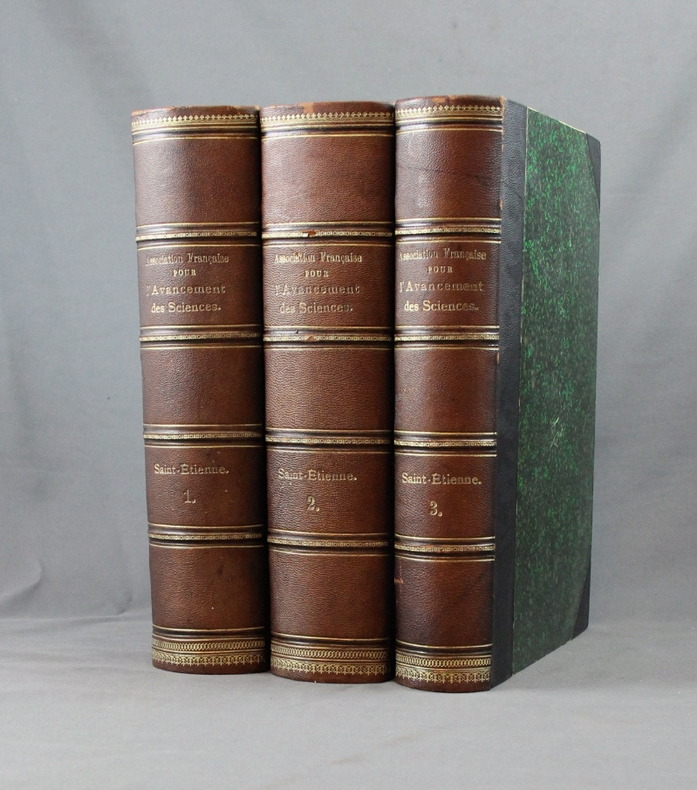
1897Best.-Nr. 2546Saint-Etienne, Société de l’impr. Théolier - J. Thomas & Cie, 1897. 3 vol. in-8 de XV, 512-[2] + 536 + 426-[6] pages. Demi-chagrin noir à coins, dos à nerfs ornés de filets et roulettes dorés, tranches rouges. Dos légèrement passés, quelques griffures aux coiffes.