[Mathematics]ABAA
31.004 resultados
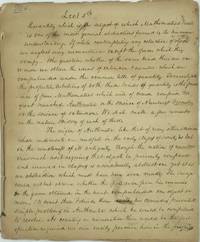
ref. 66753nd. A manuscript lecture on the principles of mathematics and the "two great branches- Arithmetic or the science of Numbers & Geometry or the science of extension." Stitched sheets 15 pp. approx. 3750 words in a neat hand all but one page written on rectos only. A few ink and pencil corrections a few pages starting away from the amateur stitching. The unidentified scribe records notes on the origin of Arithmetic the introduction of commerce and the advancements of society calculations the binary scale the decimal scale etc. Along the way he discusses the Greeks Leibnitz Charles XII of Sweden Roman numerals Dr. Nicholas Saunderson the blind professor of Mathematics at Cambridge and the abacus. The scribe concludes that through mathematics "all nations however various in manners of language or laws united in the use of these symbols have secured to themselves in trade all the advantages of a universal language. unknown books
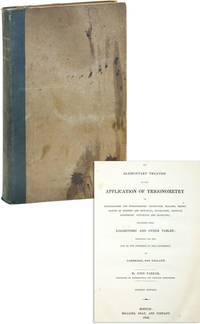
1840ref. 48011Boston: Hilliard Gray and Company 1840. Fourth edition. Octavo; contemporary cloth-backed boards; viii155;75pp; 9 folding plates. Old ink-stains to front board; spine cloth slightly faded; still a solid Good or better copy. Early ownership signature "J.S.D. Taylor" in ink to front free endpaper overwriting an earlier now illegible pencil signature. Fourth and final edition first published 1822. A volume in the Cambridge mathematical series a series of textbooks initiated and largely written by Farrar Professor of Mathematics and Philosophy at Harvard from 1807 to 1836. KARPINSKY p.246. Hilliard, Gray and Company unknown books
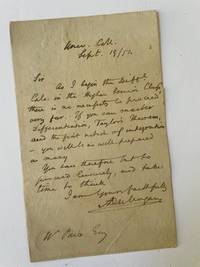
1855ref. 142511855. De Morgan Augustus. Autograph mathematical manuscript signed is a mid-nineteenth-century manuscript fragment documenting the hand of one of Victorian Britain's most important mathematicians and logicians. De Morgan is best known for De Morgan's laws for major work in formal logic and for introducing the term "mathematical induction." He also tutored Ada Lovelace in mathematics during the period of her work with Charles Babbage's Analytical Engine linking the manuscript to the intellectual world from which modern symbolic logic and early computational thought developed. De Morgan Augustus. Autograph mathematical manuscript signed. Circa mid-nineteenth century. One page approximately 4½" x 7" written in ink on laid paper and signed "Augustus De Morgan" at lower center. The sheet contains symbolic mathematical notation including differential expressions and function-like terms written as a compact formula rather than as a worked explanatory proof. The notation provides direct visual evidence of De Morgan's mathematical practice while the signature makes the fragment a documented autograph example by a figure central to the nineteenth-century formalization of mathematics and logic. De Morgan served as the first professor of mathematics at University College London and was widely recognized for his teaching writing and work in logic and algebra. Light age toning; moderate staining to upper half and center of sheet chiefly above the signature; faint horizontal fold across center; signature bold and fully legible. Overall very good. A concise signed mathematical manuscript by De Morgan connecting Victorian mathematical notation to the development of formal logic and the educational circle of Ada Lovelace. unknown books
1947ref. 68936Lancaster PA: The National Research Council 1947. MATHEMATICS. Volume II number 20 of the Quarterly Journal Mathematical Tables and Other Aids to Computation. Octavo 9 1/4 x 6 1/8 inches; 235 x 155 mm. 321- 404 pp. With frontispiece .Table of contents printed on the back wrapper and general title-page at the rear. Publisher's printed wrappers. Wrappers sunned. Library stamp to front wrapper and to blank recto of frontispiece. Overall very good. This journal contains an article on the technical developments of the Zuse Computer which was the world's first working programmable fully automatic digital computer. HBS 68936. $500. The National Research Council unknown books
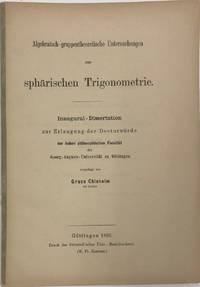
1895ref. 160351895. Chisholm Grace. Algebraic Group Theoretical Studies on Spherical Trigonometry. 1895. Scarce. Submitted in 1895 at the University of Göttingen this dissertation marks the first doctorate awarded to a woman in any discipline by a German university. At a time when Prussian institutions largely excluded women from formal academic candidacy Grace Chisholm crossed national boundaries from England to pursue advanced mathematical study under Felix Klein a leading architect of modern geometry. Her research applied group-theoretical methods then at the forefront of mathematical innovation to spherical trigonometry aligning with the Klein school's effort to unify algebra and geometry. The work stands at a pivotal moment in both the professionalization of mathematics and the gradual opening of European higher education to women. Chisholm Grace. Algebraic Group Theoretical Studies on Spherical Trigonometry. Göttingen: University of Göttingen 1895. Doctoral dissertation in German. Soft covers; 73 pages with mathematical figures and diagrams. Outer wrapper absent; green spine reinforcement visible. Minor edge wear and toning consistent with age. Chisholm later collaborated extensively with William Henry Young in analysis and measure theory while also publishing independent work such as On Infinite Derivatives 1915 which earned the Gamble Prize in Mathematics. Her career illustrates both intellectual accomplishment and structural barriers faced by women mathematicians at the turn of the twentieth century positioning this dissertation as a foundational document in the history of women in science. Overall very good condition. Scarce. Only two copies held in American institutions as per OCLC Worldcat. unknown books
1854ref. 151971854. Collection documenting American education from the mid nineteenth century through the early twentieth century combining institutional publications with a detailed student laboratory notebook. The materials illustrate the expansion of formal schooling scientific instruction and collegiate culture in the United States during a period when educational institutions increasingly standardized curricula and emphasized laboratory based science training. The archive also reflects the broader intellectual environment of American education during this era when academies seminaries and colleges served as central sites for both professional formation and civic leadership. Archive of four educational items dated between 1854 and 1905. The centerpiece is a manuscript chemistry laboratory notebook compiled by student Frank Hanke during the academic year 1904-1905 while attending R. T. Crane High School in Chicago Illinois. The notebook contains approximately 220 handwritten pages documenting sixty five experiments carried out during the course including chemical equations observational notes and numerous illustrations of laboratory apparatus. Hanke describes experimental procedures in detail writing for example: "I carefully slid over the opening of the receiver the glass slip just far enough to insert a burning splinter of wood. I thrust the splinter into the receiver and the flame immediately went out and the gas did not burn." The volume includes sixteen hand drawn diagrams illustrating laboratory procedures and equipment along with four large full page drawings depicting a Bunsen burner luminous and non luminous flames and Davy's safety lamp. Three fold out charts compare the "Metal alkalies" "Metals of the Calcium Group" and the "Iron Group." Thirteen additional loose sheets of manuscript notes accompany the notebook whose original boards bear a printed photographic image of the school building and the student's name written in ink. The archive also includes printed institutional catalogues and commemorative material: 1 Trustees of Phillips Academy. Catalogue of the Trustees Instructors and Students of Phillips Academy. Andover Massachusetts 1854. Institutional catalogue listing faculty and students and outlining courses and academic structure of the academy. 2 Bangor Theological Seminary. General Catalogue of the Theological Seminary Bangor Maine. Bangor 1895. Catalogue describing faculty students course offerings and the institutional history of the seminary. 3 Bowdoin College. The Thirty Fifth Anniversary of the Class of 1849. Brunswick Maine 1884. Commemorative program documenting the reunion of the graduating class and summarizing the careers of former students including individuals who later served on opposing sides of the American Civil War. During the nineteenth century American educational institutions expanded significantly developing formal catalogues that documented curricula faculty and student enrollment while also promoting institutional identity. At the same time laboratory instruction became a defining feature of scientific education particularly in chemistry where students recorded experimental procedures and results in detailed notebooks. The Frank Hanke manuscript provides a rare firsthand record of secondary school science education in the early twentieth century illustrating how students learned experimental technique and chemical classification through hands on laboratory work. When considered together with the catalogues and commemorative publication from Phillips Academy Bangor Theological Seminary and Bowdoin College the archive offers insight into the institutional structure and student culture of American education across several generations. Minor tears and light staining with occasional foxing to catalogue covers; manuscript notebook well preserved with light toning consistent with age. Overall good to very good condition. A diverse archive documenting both institutional and student perspectives on American education between the mid nineteenth century and the early twentieth century. unknown books
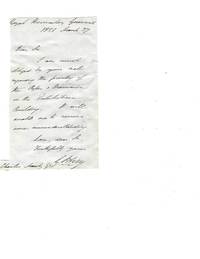
1851ref. 142301851. Airy George Biddell autograph letter signed to engineer Charles Manby March 27 1851 concerns professional discussion of the Exhibition Building shortly before the opening of the Great Exhibition in London. Airy served as Astronomer Royal from 1835 to 1881 and applied his mathematical and scientific work beyond astronomy to engineering and other government technical questions. The letter dates from a consequential year in his Greenwich career: his newly designed Transit Circle had entered service in January 1851 defining the Greenwich meridian later adopted internationally as longitude 0°. Airy George Biddell. Royal Observatory Greenwich March 27 1851. Autograph letter signed to Charles Manby. 1 page. 6.25" x 3.75". Airy writes "I am much obliged by your note regarding the presenting of the Paper & Discussion on the Exhibition Building. It will enable me to remove some misunderstanding." The "Exhibition Building" refers to Joseph Paxton's vast iron and glass Crystal Palace erected in Hyde Park for the Great Exhibition of 1851 which opened on May 1 little more than a month after this letter. Airy's reference to a "Paper & Discussion" and his desire "to remove some misunderstanding" records his participation in contemporary technical discussion surrounding a building whose unprecedented scale and prefabricated iron and glass construction presented engineers and scientists with questions extending beyond conventional masonry architecture. Airy later made substantial contributions to engineering mechanics including his mathematical work on stresses within beams and served as a government scientific adviser on major engineering questions involving bridges railways canals telegraphy and standards. His later consultation concerning wind pressure for Thomas Bouch's proposed Forth bridge also brought him into the engineering debates revisited after the Tay Bridge disaster of 1879. This 1851 letter places Airy within those engineering discussions decades earlier and directly connects the Astronomer Royal with the technical debate surrounding the Crystal Palace immediately before the Great Exhibition opened. Letter trimmed with mounting traces to verso; otherwise very good condition. A dated correspondence linking one of Victorian Britain's principal scientific administrators with professional discussion of the defining exhibition building of 1851. unknown books
1823ref. 332092New York: Samuel Wood & Sons 1823. Hardcover. Very Good. First American edition. 12mo. 216pp. frontispiece plates charts. Quarter red morocco gilt and papercovered boards. Rubbing and wear at the extremities corners bumped and front joint tender about very good. Samuel Wood & Sons hardcover books
1826ref. 243245Edinburgh: Printed for Adam Black and William Tait. 1826. First edition. x 207 pp. 1 vols. 8vo. Uncut in the original boards printed paper spine label slightly stained. Fine copy of a very scarce book. First edition. x 207 pp. 1 vols. 8vo. OCLC: 52466797 4 copies -- only one in the U.S. Printed for Adam Black and William Tait. unknown books
1840ref. 57837Easton Pa: printed by Hetrich & Maxwell 1840. 8vo pp. 20; removed from binding wrappers wanting foxed and unevenly trimmed; all else very good. Urges the study of mathematics as a way to gain the power of analysis and reason. American Imprints 40-4201. printed by Hetrich & Maxwell unknown books
1758ref. 46397London: T. Payne 1758. First edition 8vo pp. iv 204; tables formulas and equations throughout the text; late 19th century half blue morocco over marbled boards by Blackwell gilt-decorated spine gilt-lettered direct t.e.g.; joints and extremities scuffed and rubbed; textblock about fine. T. Payne unknown books
1954ref. S0498New York etc.:: McGraw-Hill for the American Mathematical Society 1954. 1954. 8vo. v 169 pp. Illus. index. Red cloth. Ownership signature. Fine. FIRST EDITION. Contributions from C. C. Lin S. Chandrasekhar Pr. R. Garabedian W. Bleakney N. W. McLachlan and others. McGraw-Hill, for the American Mathematical Society, 1954. hardcover books
1885ref. 20064Cambridge: W Metcalfe and Son 1885. First Edition. Original publisher's cloth. Near Fine. 8vo. A presentation from the author. A series of 21 extracted papers some with individual fly titles from various mathematical journals all written by Glaisher and then bound with a separately printed general title page and short introduction. He was at one time President of the London Mathematical Society Secretary of the Royal Astronomical Society etc. The volume offered here appears to be some kind of Festschrift for the young gifted mathematician memorializing his work on a specific subject. W Metcalfe and Son hardcover books
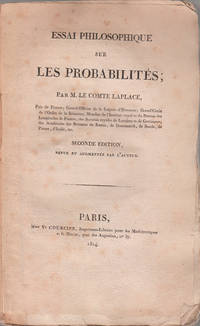
1814ref. 3065Paris: V Courcier 1814. Second Enlarged Edition. Original pink marbled wrappers. Fine with some occasional spotty foxing. 8vo. This Essai is the separately issued introduction to the second edition of Laplace's Theorie Analytique . first published in 1812 and appearing with the important supplements and addenda as the second edition here in 1814. Laplace's biographer in the DSB notes that this book has had a longer life and greater readership than any other work by the author. ' The reason for its continuing - indeed its growing - success has clearly been the importance that probablility statistics and stochastic analysis have increasingly assumed in science social science . Inevitably Laplace's technical writings have come to have the same sort of relation to the later development of the discipline of probability that for example Newton's Principia . had to the science of mechanics. ' DSB XV 374; see Stigler for appropriate citations. V Courcier unknown books
1937ref. 4740Cambridge: Univ. Press 1937. First Edition. Original printed wrappers. A very good copy; small Macmillan sticker over the imprint on the front cover; price correction stamp on rear cover. 8vo. This is #35 in the Cambridge Tracts in Mathmatics series. Landau's paper of new advances in additive number theory. Landau succeeded Minowski to the chair of mathematics at Gottingen. See DSB. Univ. Press unknown books
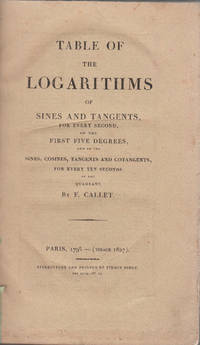
1827ref. 6630Paris: Firmin Didot 1827. First Edition. Contemporary binder's cloth. A very good copy; original spine laid down; untrimmed; unopened. 8vo title 372 pp. Printed on yellow paper. Callet's logarithmic tables were generally regarded as being the most accurate ever produced to that date. This volume was printed for Babbage as an accompaniment to the first editon of his own issue of logarithmic tables in 1827. Henderson points out that this volume of Callet was printed by Didot on the special yellow buff paper to match the Babbage issue. Van Sinderen points out that Babbage wanted to produce a set of tables without error and that Callet was one of Babbage's original and acknowledged sources. The set of tables offered here providing trigonometrical functions was taken en bloc from Callet by Babbage who was a connoisseur and collector of printed mathematical tables and a fastidious analyst of tabular errors. It could be purchased separately when issued. A superb artifact of the history of computing and printing. Henderson p. 98; not in Van Sindern see #33; M. Campbell-Kelly. Charles Babbage's table of logarithms 1827 University of Warwick. Department of Computer Science 1987 Firmin Didot hardcover books
1792ref. 8069London: F Wingrave 1792. First Edition. Original publisher's blue wrappers. Very good untrimmed; some wear to the wrappers; modest browning to the pages of the Preface. Folio. 16 64 446 pp. a - d2 A - 5C2-1 An important accurate and massive set of tables accompanied by a 64 page preface dated Jan. 14 1793 and introduction by Maskelyne The author was on the staff of the Nautical Almanac and a pupil of Hutton. Henderson #92. F Wingrave unknown books
1911ref. 1692Leipzig: Teubner 1911-'14. Second Edition. Contemporary cloth backed bds. A very good copy; old ownership stamp on the titles. Small 4to. The second lithographic printing of the lecture notes for the series of lectures given in 1907-' 08. The first volume deals with algebraic analysis the second with geometry including a review of the history and literature of the subject. This lithographic printing was utilized to cut the expense of typesetting and unlike earlier lecture series by Klein now carry the copyright notice of a publisher. DSB VII 396-400. Teubner hardcover books
1920ref. 5735London: A W Faber ca 1920. First Edition. orig. cloth backed prtd. bds. A very good copy. 8vo. There are folding charts of the rule. A detailed instruction book for the Faber slide rules. A W Faber hardcover books
1828ref. 1027Berlin: Kgl. Akademie der Wissen. zu Berlin 1828. OFFPRINT. Recent half leather over marbled boards. Very good with some moderate spotting. 4to 6 1 - 254 2 - original blank pp. 2 engraved plates of the apparatus. One of the important geophysical works undertaken by Bessel. The text describes the construction in conjunction with the famous maker Repsold and painstaking design of the instrument to achieve the high standard of accuracy demanded for precise astronomical calculations. The second pendulum clock of the observatory was not meant to provide information about the time but to indicate the regular rotation of the celestial sphere for star mapping. Errors and inaccuracies played havoc with the measurement of the right ascension. Bessel's accomplishment was to produce a device of great accuracy and mathematical precision. Bessel offered his paper for publication in 1828. At that time the Proceedings of the Berlin Academy were two years behind in their publication dates. Bessel's work however was deemed to be of such importance that the editors chose to break the proper chronological entry and publish this lengthy work as part of the Proceedings then in press i.e. the year 1826. The prefatory statement explaining this is present only in the offprint offered here. The entry in Poggendorff and the DSB for 1826 is therefore an understandable error. One of the best accounts of Bessel's device and its construction is in Lenzen and Multhauf's work on the development of gravity pendulums. DSB I 97-102; see Lenzen & Multhauf. Kgl. Akademie der Wissen. zu Berlin hardcover books
1673ref. 1818Paris: F Muguet 1673. First Edition. Modern full leather in a contemporary style. Good with some toning and occasional spotting; occasional marginal finger soiling; signature on title page. Folio 14 161 1 - errata pp. There are text illus. some full page throughout. One of the great books of science and a foundation book in the development of horological science. Cajori makes the statement that this book '. ranks second only to the Principia of Newton.' The book opens with a description of pendulum clocks and quickly goes into a study of the motion and dynamics of accelerated bodies. It is this mathematical study of motion that leads to the derivation that the cycloid is the only tautochronous curve the concept of the conservation of energy and the thirteen theorems that are at the close of the book. The book exhibits mathematical sophistication and inspired insight into the most thorny issues of dynamics. Newton read it and applied many of its ideas in the derivation of the law of gravity Newton's acknowledgment is at Prop. IV of Book I of the Principia. PMM #154; Grolier #53; Dibner #145; Norman #1137; see Yoder Unrolling Time . for a detailed explanation of the mathematical work in this book. F Muguet hardcover books
1810ref. 1134Paris: Imp. Imperiale 1810. First Edition. Original paper wrappers. Very good; front wrapper detached; first signature loose; spine abraded; unopened. 4to 8 272 pp. Delambre's summary of the progress of mathematics astronomy algebra geometry and mechanics through the 18th century. An excellent contemporary synopsis. See DSB; see Norman #1481. Imp. Imperiale unknown books
1760ref. 6004American or British After 1760. Very Good. 1 leaf 200 x 323mm; watermark of crowned lion with scepter and fascia of arrows very like Churchill #88 which he identifies as English colonial dated 1762. Seven columns of numbers with brief explanation on verso. Folds some beginning to split. Manuscript 18th-century game or puzzle which allows whoever knows the key to accurately guess anyone's age or chosen number in a "pick-a-number" scenario. We won't divulge the secret--but it has to do with binomial number systems--and it works! Similar magic age tables persist to the present day in a somewhat different form. unknown books
1787ref. 59006459Chesterfield: J. Bradley 1787. Bound in 19th century pebbled boards stamped in gold. This is apparently a proof copy of the book that was published in 1788 of which there are only two copies on OCLC/Worldcat. There are no copies of this book noted. It is handwritten on the title page that this was a gift of the author. This copy has 12 pages unlike the 1788 edition which has 25 pp. with a diagram. Pagination: iii1 5-12 the Solution - Finis on p.12. Following blank un-numbered page are two diagrams. I believe this may be the only copy of this printing in existence. . First Edition. Hard Cover. Very Good/No Jacket. 4to - over 9¾" - 12" tall. J. Bradley Hardcover books
1888ref. 14319Braunschweig: Vieweg 1888. WITH: O. Fischer Matyas Lerch E. Phragmen C. Neumann C. Meray. 1. DEDEKIND Richard Was sind und was sollen die Zahlen. Braunschweig: Vieweg and Son 1888. 8vo. xviii 58 pp. including half-title. First edition rare of Dedekind’s important work on set theory. His epochal 1872 publication Stetigkeit und irrationale zahlen gave the first rigorous definition of the system of real numbers laying the foundation for much of modern day real analysis and point-set topology. This his follow-up work elaborates on his attempts “to derive a purely logical foundation for arithmetic and devised a number of axioms that formally and exactly represented the logical concept of whole numbers” DSB. Dedekind 1831-1916 a German mathematician friend and colleague of Georg Cantor claimed all of mathematics to be a branch of logic. In this work The nature and meaning of numbers he “presents a theory of the integers using set-theoretic concepts and outlines a possible approach to placing the rationals on a logistically well-founded axiomatic basis” Parkinson p. 415. 2. FISCHER Otto Konforme abbildung sphärischer dreiecke auf einander mittelst algebraischer funktionen. Leipzig: von Metzger & Wittig 1885. 8vo. 76 pp. Complete with half-title and 2 large folding plates on heavier stock. First edition of the author’s thesis on conforming images of spherical triangles by means of algebraic functions. Fischer 1861-1916 was a German physiologist and mathematician earning a doctorate degree from the Franke Foundation in Halle an der Saale in 1885 under Felix Klein. His main interest was the mechanics of the muscles and joints of the human musculoskeletal system. He was a professor at the University of Leipzig where he taught both medicine and mathematics. 3. PHRAGMÉN Lars Edvard Über die Berechnung der einzelnen Glieder der Riemann’schen primzahlformel. Stockholm: Kongliga vetenskaps-Akademiens Förhandlingar 1891. 8vo. pp. 721-744. First edition of this famous work on the calculation of the individual members of the Riemann prime number formula. The son of mathematics teachers Phragmén 1863-1937 also taught mathematics before obtaining his degree at the University of Uppsala. He was an editor at the Acta Mathematica where he corresponded with Poincare to correct a book in which he found a number of errors. He was also president of the Swedish Society of Actuaries. He is best known however for the Phragmén-Lindelöf principle an extension of the maximum modulus principle of complex analysis to unbounded domains. 4. NEUMANN Carl Ueber den Satz der virtuellen verrückungen; Ueber das princip der virtuellen oder facultativen verrückungen. Leipzig: von Breitkopf und Härtel 1869. Two separate papers. 8vo. pp. 257-280; 53-64. In Konigl. Sachs. Gesellschaft der Wissenchaften. With annotations on the first couple of pages. At the end of the second paper a thank you by C.F. Gauss. Two works on virtual displacements. Neumann created the second-type boundary which when imposed on an ordinary or partial differential equation if specifies the value that the derivative of a solution is to take on the boundary of the domain. Neumann 1832-1925 was professor of mathematics at both the Universities of Tübingen and Leipzig. His main interests were in applied mathematics and he wrote on mathematical physics potential and electrodynamics. He was also editor of Mathematische Annalen. 5. LERCH Matyáš Contributions à la théorie des fonctions; Addition au mémorie présenté dans la séance du 15 Octobre Prag 1886. Two separate papers. 8vo. pp. 571-582; pp.423-432. With a 4 page letter containing mathematical symbols handwritten by Lerch to Karl Weierstrass 1815-1897 tipped in between the two papers. The letter is signed by Lerch and dated October 1890. A small section of page 582 is crossed out in the same hand. First printings of Lerch’s contributions to general mathematical functions. These papers are the first in a series dealing with the general theory of functions the most significant of which constitutes construction of continuous functions having no derivative. These works were written quite early. Lerch 1860-1922 showed exceptional abilities while still studying at the Czech Technical University at Prague. Before 1896 he published more than 110 scientific papers in domestic as well as prominent foreign journals. Much of his work concerned mathematical analysis including theories of infinite series of the gamma function of elliptic functions and the integral calculus. Weierstrass is generally referred to as the father of modern analysis. He made significant contributions and advancements in the field of calculus of variations. Numerous theories and functions bear his name. 6. MÉRAY Hugues Charles Robert Théorie des radicaux fondée exclusivement sur les propriétés générales des séries entières. Dijon Darantiere 1885. 8vo. 75 1 pp. Title page in manuscript signed by Méray and dated Dijon 1891. With annotations throughout probably by the author for another edition. First edition of Méray’s famous work Radical theory based exclusively on the general properties of power series. Méray 1835-1911 is remembered for having anticipated clearly and with only minor differences of style Cantor’s theory of irrational numbers one of the main steps in the arithmetization of analysis. Of interest an earlier “arithmetical” theory of irrational numbers was propounded by Weierstraass in his lectures when he introduced the real numbers as sums of sequences of rational numbers. Dedekind also seems to have developed his theory of irrationals at an earlier date. No copies of Phragmén Lerch or Méray are located by OCLC. Vieweg unknown books