1,309 results
Firenze, Scuola di Statistica dell'Università, 1967, in-8, brossura editoriale, pp. 251. Ottime condizioni.
2022br. Una raccolta ragionata di mappe, schemi e tabelle di sintesi per facilitare l'apprendimento delle regole di italiano, matematica e inglese e favorirne il corretto utilizzo grazie a esemplificazioni pratiche. Il diario delle regole di italiano. Morfologia: le parti del discorso - articoli, preposizioni, nomi, aggettivi, pronomi, avverbi, congiunzioni, esclamazioni e verbi - e i passi da seguire per l'analisi grammaticale. Sintassi: la struttura della frase e dei principali complementi e i passi da seguire per l'analisi logica. Il diario delle regole di matematica. Numeri: strutture numeriche, le 4 operazioni, divisibilità, frazioni e percentuali, numeri relativi. Spazio e figure: misura, enti della geometria, poligoni, teorema di Pitagora, circonferenza e cerchio, solidi. Relazioni e funzioni: equazioni, espressioni con le lettere, proporzioni e piano cartesiano. Dati e previsioni: dati statistici e probabilità. Il diario delle regole di inglese. Parti del discorso: nomi, pronomi, articoli, aggettivi e avverbi. Focus sulle diverse forme verbali: be e have got, Present Simple e Continuous, Past Simple e Continuous, i futuri, Present e Past Perfect,... Costruzione della frase: periodi ipotetici dei vari tipi, il passivo, il discorso indiretto Tre volumi che portano a sintesi l'esperienza di esperti disciplinaristi con il contributo di psicologi dell'età evolutiva. Un Kit utile per tutti, in particolare per bambini e ragazzi con difficoltà di apprendimento e di memorizzazione. È indicato a partire dalla classe IV della scuola primaria e per tutta la scuola secondaria di I grado.
1994ref. 147509Couverture souple. 2 volumes brochés 1042 + 998 pages. Emboîtage carton.
2017Carlos M. Madrid Casado Hilbert. Alla ricerca di assiomi universali. , RBA 2017, Copertina plastificata. Tagli e pagine integri. Collana: "Geni della Matematica". Periodico settimanale, anno I, n. 4. Ottimo (Fine) .
1841ref. 197091841. Pennsylvania Mathematic Education 19th-Century Handwritten Arithmetic Notebook from Bucks County Pennsylvania. Manuscript arithmetic notebook comprising 48 handwritten pages approximately 12 × 7½ inches executed by Isaac Fluck of Bucks County Pennsylvania between December 1841 and 1842. Fluck was born in 1826 making him approximately sixteen years old when he compiled these pages during his high-school education. The volume is systematically organized with clear subject headings at the top of each leaf - such as "English Money" "Cloth Measure" "Addition of Federal Money" and "Compound Division" - followed by worked examples written computations and applied problem sets. A recurring emphasis on conversions measurements and multi-step arithmetic underscores the practical education valued in mid-nineteenth-century America. The notebook is distinguished by its preservation of authentic word problems that illustrate how mathematical instruction was tied to everyday concerns. One problem asks the learner to "Subtract 36 acres 2 rods from 900 acres 3 rods 16 perches" while another records multi-digit subtraction including "Subtract fifteen thousand five hundred and nine from twenty thousand six hundred and fifty four." Other entries show Fluck reducing long measures - from leagues to miles and furlongs to poles - and calculating "simple subtraction" with large numbers evidencing both the student's increasing confidence and the curriculum's emphasis on real-world numeracy. The alternating use of black and blue ink throughout the notebook as well as the range of topics addressed indicates ongoing study over months rather than a single session. The breadth of lessons - from federal money and cloth measure to compound multiplication and time calculations - reflects the type of math education offered in preparatory schools of the period. As a student-produced manuscript this notebook offers rare primary evidence of arithmetic pedagogy prior to the widespread adoption of printed textbooks and demonstrates how young Americans were trained in the mathematical skills necessary for commerce trade and measurement in a rapidly developing nation. For institutional collections it provides direct insight into the intellectual life of a teenage student in pre-Civil War Pennsylvania and the material culture of learning in the antebellum United States. Condition: The notebook's covers are detached and some dampstaining and foxing throughout otherwise very good condition. unknown books
1841ref. 197091841. Pennsylvania Mathematic Education 19th-Century Handwritten Arithmetic Notebook from Bucks County Pennsylvania. Manuscript arithmetic notebook comprising 48 handwritten pages approximately 12 × 7½ inches executed by Isaac Fluck of Bucks County Pennsylvania between December 1841 and 1842. Fluck was born in 1826 making him approximately sixteen years old when he compiled these pages during his high-school education. The volume is systematically organized with clear subject headings at the top of each leaf - such as "English Money" "Cloth Measure" "Addition of Federal Money" and "Compound Division" - followed by worked examples written computations and applied problem sets. A recurring emphasis on conversions measurements and multi-step arithmetic underscores the practical education valued in mid-nineteenth-century America. The notebook is distinguished by its preservation of authentic word problems that illustrate how mathematical instruction was tied to everyday concerns. One problem asks the learner to "Subtract 36 acres 2 rods from 900 acres 3 rods 16 perches" while another records multi-digit subtraction including "Subtract fifteen thousand five hundred and nine from twenty thousand six hundred and fifty four." Other entries show Fluck reducing long measures - from leagues to miles and furlongs to poles - and calculating "simple subtraction" with large numbers evidencing both the student's increasing confidence and the curriculum's emphasis on real-world numeracy. The alternating use of black and blue ink throughout the notebook as well as the range of topics addressed indicates ongoing study over months rather than a single session. The breadth of lessons - from federal money and cloth measure to compound multiplication and time calculations - reflects the type of math education offered in preparatory schools of the period. As a student-produced manuscript this notebook offers rare primary evidence of arithmetic pedagogy prior to the widespread adoption of printed textbooks and demonstrates how young Americans were trained in the mathematical skills necessary for commerce trade and measurement in a rapidly developing nation. For institutional collections it provides direct insight into the intellectual life of a teenage student in pre-Civil War Pennsylvania and the material culture of learning in the antebellum United States. Condition: The notebook's covers are detached and some dampstaining and foxing throughout otherwise very good condition. unknown
1815ref. 7910EBLeipzig, bei Johann Ambrosius Barth, 1815. 8°. 19 x 12 cm. VI, 274 Seiten. Halblederband der Zeit mit goldgeprägtem Rückentitel auf grünem Lederschildchen, marmoriertem Bezugspapier und rotem Schnitt.
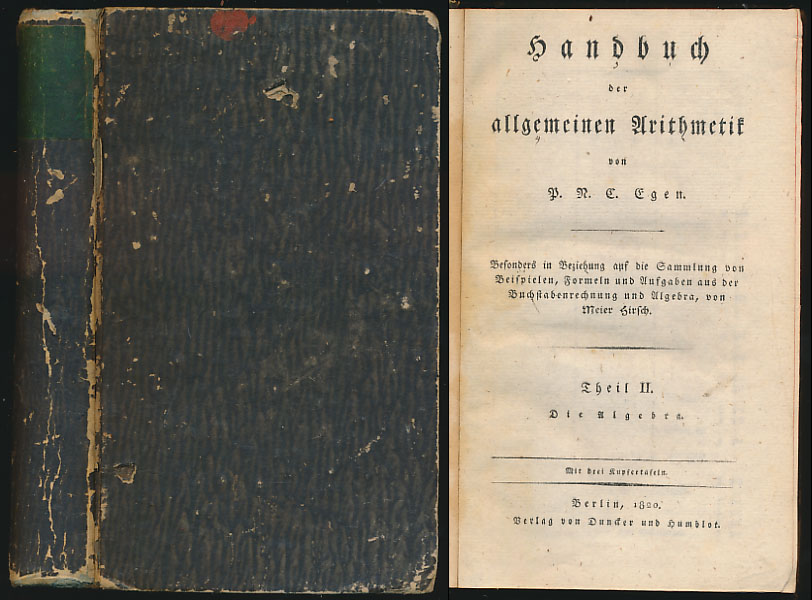
1820ref. 4834EBBerlin, Verlag von Duncker und Humblot, 1820. 4°. 20 cm. VIII, 433 Seiten, 2 Blatt. Schwarzer Pappband.
1974K. Assaf - S.A. Assaf Handbook of Mathematical Calculations. , Iowa State Univ. Press 1974, Legatura ed. Copertina cartonata ombrata in modo lieve, con dorso scolorito. Interno molto buono. Timbri su occhietto e frontespizio. Buono (Good) . 081381135X
1943ref. 60039Couverture souple. Couverture légèrement défraîchie. 192 pages.
ref. 21993Paris Vuibert et Nony, Editeurs 1907 in 8 (23x14,5) 1 volume broché, couverture imprimée, pages 294 à 475, et 27 pages, avec des figures dans le texte. Deuxième édition. A. Grévy, Ancien Elève de l'Ecole Normale Supérieure, Docteur ès Sciences, Professeur agrégé au Lycée Saint-Louis. Bel exemplaire ( Photographies sur demande / We can send pictures of this book on simple request )
in-16°, 189 pp., broché. Très bel exemplaire. [MB-4] Arithmétique, Algèbre, Géométrie, Statistiques.
1962V. Profenna Guida allo studio del libro di esercizi di matematica generale.. , Edizioni G.U.S. 1962, Legatura artigianale. Copertina in cartone telato ombrata, taglio superiore brunito, ingialliti gli altri due. Firma in primo sguardo. Alcune pagine con sottolineature e annotazioni a matite di differenti colori. Libro rarissimo, in forma dattiloscritta, in -8, importante per la ricerca. Il libro è organizzato in una appendice e due parti. Appendice: Richiami algebrici, calcolo combinatorio e trigonometria. Parte 1) matrici, determinanti, sistemi lineari, funzioni e geometria analitica. Parte 2) limiti, derivati e differenziali, studio funzioni, integrali, serie, equazioni differenziali, calcolo differenziale in più variali e complementi. Buono (Good) .
1988Bruno Martinoli Guida alla simulazione. Metodi, linguaggi e modelli di Ricerca Operativa per simulare processi ed eventi con esempi relativi a casi aziendali. , Franco Angeli 1988, Copertina cartonata sporca e ingiallita lievemente. Tagli e pagine ingialliti. Collana: "Matematica e Statistica". Buono (Good) .
1935ref. NATW2346Dresden u. Leipzig, Steinkopff 1935. XI, 163 S., 5 nn. S. Vlgsanz., mit 11 Abb., OBrosch., verstaubt, abgegriff., Rücken an beiden Seiten m. Fehlst., bzw. kl. Rissen, Schnitt verstaubt. (= Wissenschaftliche Forschungsberichte. Naturwissenschaftl. Reihe Bd. 35).
1990Joe Whittaker Graphical models in applied multivariate statistics. , Wiley and Sons 1990, Legatura: in piena pelle. Impressioni: in oro, al dorso, al piatto. Sovraccoperta: a colori, con alette informative, ingiallita dal tempo. Pagine: lievemente ingiallite dal tempo. Buono (Good) .
1900E. Nagel - J. R. Newman Godel's Proof. , New York Univ. Press 1900, Brossura ed. Copertina plastificata. Buono (Good) . 0814703259
19161 Vol. In-16 p.tela, tit.oro su tass. al dorso, cpt.stanca pag. 357 PROG 11656 CATT_ATT 21
1747In -8°, pp. 128, cartonato. Prima e unica edizione di questo libro dedicato ai giochi, ma ricco di escursioni nel campo della matematica e delle scienze sociali: notevole per originalità l’ampio capitolo dedicato alle “minchiate”, ovvero i tarocchi toscani (arricchiti di una serie di carte rispetto ai tarocchi classici), in cui l’autore non si limita a descrivere il gioco e le sue regole, ma aggiunge delle lunghe e nutrite ‘note allegoriche’, in cui le carte e le varie situazioni di gioco vanno a comporre una parziale ma a volte non superficiale rappresentazione dell’universo. Matematico per formazione, scrittore prolifico, Francesco Saverio Brunetti da Corinaldo (n. 1693, non si conosce la data della morte) “visse quasi sempre in Roma, ove sotto i pontificati di Clemente XII, Benedetto XIV, e Clemente XIII, diede varj saggi della sua abilità” (Comolli, III, p. 43): al di là della sua attività di ricerca scientifica, è segnalata la capacità divulgatoria del B. che, come in questo caso, scrisse più di un trattato su istanza di (e dedicandolo a) una nobildonna “per facilitarne l’intelligenza” e renderlo “all’uso femminile, sull’esempio del Fontanelle, dell’Algarotti, e di tant’altri”. Nel presente trattato la parte matematica si limita in effetti ad alcuni esercizi di aritmetica, dando più spazio al discorso e, come nel caso degli scacchi, a una chiara esposizione delle regole (qui completata da un cospicuo repertorio di aperture). Comolli, Angelo, “Bibliografia storico-critica dell'architettura civile ed arti subalterne”, Roma, 1788-92 First and only edition of this book on games, with many excurtions in mathematics and social sciences: it’s remarkable the wide part dedicated to the “Minchiate”, i.e. tuscan tarots (with more cards than the classic ones): the author not only explains the game and its rules, but also adds some long ‘allegoric notes’, in which cards and game situations composes a short but not shallow representation of human types and events. Basically a scientist, Brunetti (born in 1693, death is unknown), was living in Rome, under protection of popes Clemens XII, Benedict XIV, Clemens XIII: his activity included disclosure works, as this one, in which mathematics are limited to basic arithmetics, giving more room to explanations and, as for chess, a plain exposition of rules (there’s also a nourrished openings list). See Comolli, III vol., p. 43
1970direttore Giuseppe Ottaviani Giornale dell'Istituto Italiano degli Attuari. Anno 1° e 2° semestre 1970. , Istituto Italiano degli Attuari 1970, Copertina cartonata ingiallita. Tagli e pagine ingialliti. Sommario degli argomenti trattati, visibili in foto, alla quarta di copertina. Buono (Good) .
1979direttore Giuseppe Ottaviani Giornale dell'Istituto Italiano degli Attuari. Anno XLII n. 1-2, 1° e 2° semestre 1979 (lingue Italiano, Inglese, Francese). , Istituto Italiano degli Attuari 1979, Copertina cartonata ingiallita lievemente. Tagli e pagine ingialliti. Sommario degli argomenti trattati, visibili in foto, alla quarta di copertina. Buono (Good) .
1980direttore Giuseppe Ottaviani Giornale dell'Istituto Italiano degli Attuari. Anno XLIII - n. 1, 1° semestre 1980. , Istituto Italiano degli Attuari 1980, Copertina cartonata. Tagli e pagine ingialliti lievemente. Sommario degli argomenti trattati, visibili in foto, alla quarta di copertina. Buono (Good) .
1967direttore Giuseppe Ottaviani Giornale dell'Istituto Italiano degli Attuari. Anno XXX - n. 2, 2° semestre 1967. , Istituto Italiano degli Attuari 1967, Copertina cartonata ingiallita. Tagli e pagine ingialliti. Sommario degli argomenti trattati, visibili in foto, alla quarta di copertina. Buono (Good) .
1966direttore Giuseppe Ottaviani Giornale dell'Istituto Italiano degli Attuari. Anno XXIX - n. 2, 2° semestre 1966. , Istituto Italiano degli Attuari 1966, Copertina cartonata ingiallita. Tagli e pagine ingialliti. Sommario degli argomenti trattati, visibili in foto, alla quarta di copertina. Buono (Good) .
1961direttore Giuseppe Ottaviani Giornale dell'Istituto Italiano degli Attuari. Anno XXIN - n. 1, 1° semestre 1961. , Istituto Italiano degli Attuari 1961, Copertina cartonata ingiallita. Tagli e pagine ingialliti. Bordi stanchi. Sommario degli argomenti trattati, visibili in foto, alla quarta di copertina. Buono (Good) .