2499 risultati
rif. SONG0190200014Used: Good unknown
rif. SONG0691151636Used: Good unknown
rif. DADAX3319726579New unknown
rif. DADAX0367548410New unknown
rif. DADAX3030327213New unknown
rif. SONG1530818532Used: Good unknown
rif. DADAX1452216754New unknown
rif. DADAX1683441486New unknown
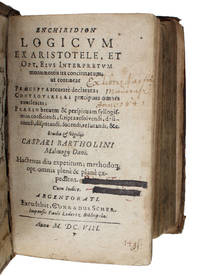
1608rif. 57593Argentorati Strassburg Conradus Scher 1608 - Strassburg Raab 1612. - Strassburg Raab 1612 Small 8vo. 3 works bound in one contemp. full vellum. Covers blindtooled in panels with floral cornerpieces. Old handwritten title on spine. Light wear. An: 1. 244497 pp. First edition. Thesaurus II338 - 2. 208 pp. - 3. 2426116 of 24 pp. Lacking the last leaves in the Index. 7 leaves with lower corners torn of which 2 have some loss of letters. Light browning an yellowing to leaves. "Bartholin’s fame is due not to his originality but to his learning and reputation as a teacher; as a strict Aristotelian he clarified the essential points in the doctrines of his time eliminating obsolete and superfluous theories. As a theologian his personal life was marked by piety and Lutheran orthodoxy. His anatomical manual Institutiones well arranged and handy but without illustrations was reprinted five times. It became still more famous when his son Thomas brought out an enlarged and illustrated edition."DSB. hardcover
rif. DADAX0199383405New unknown
rif. DADAX0393930785New unknown
rif. DADAX0071810455New unknown
rif. DADAX0078038413New unknown
1928rif. 46101Berlin Springer 1928. Orig. full cloth. Lower part of spine with loss of cloth. Lower right cornerof titlepage cut away no loss of letters. VIII120 pp. First edition. Die Grundlehren der Mathematischen Wissenshaften in Einzeldarstellungen Band XXVII. In the years 1917-22 Hilbert gave three seminal courses at the Univeristy og Göttingen on logic and the foundation of mathematics. He received considerable help in preperation and eventual write up of these lectures from Bernays. This material was subsequently reworked by Ackermann into the monograph 'Grundzüge der Theoretischen Logik' the offered item. It containes the first exposition ever of first-order logic and poses the problem of its completeness and the decision problem 'Entscheidungsproblem'. The first of these questions was answered just a year later by Kurt Gödel in his doctorial dissertation 'Die Vollständigkeit der Axiome des logischen Funktionenkalküls'. This result is known as Gödel's completeness theorem. Two years later Gödel published his famous 1931 paper 'Über formal unentscheidbare Sätze der Principia Mathematica und verwandter Systeme I' in which he showed that a stronger logic capable of modeling arithmetic is either incomplete or inconsistent Gödel's second incompleteness theorem. The later question posed by Hilbert and Ackermann regarding the decision problem was answered in 1936 independantly by Alonzo Church and Allan Turing. Church used his model the lambda-calculus and Turing his machine model to construct undecidable problems and show that the decision problem is unsolvable in first-order logic. These results by Gödel Church and Turing rank amongst the most important contributions to mathematical logic ever. hardcover
1928rif. 49908Berlin Springer 1928. 8vo. Uncut in orig. printed wrappers. VIII120. With the name of Bent Schultzer Former Danish professor in philosophy on first leaf. Internally clean. First edition. Die Grundlehren der Mathematischen Wissenshaften in Einzeldarstellungen Band XXVII. In the years 1917-22 Hilbert gave three seminal courses at the Univeristy og Göttingen on logic and the foundation of mathematics. He received considerable help in preperation and eventual write up of these lectures from Bernays. This material was subsequently reworked by Ackermann into the monograph 'Grundzüge der Theoretischen Logik' the offered item. It containes the first exposition ever of first-order logic and poses the problem of its completeness and the decision problem 'Entscheidungsproblem'. The first of these questions was answered just a year later by Kurt Gödel in his doctorial dissertation 'Die Vollständigkeit der Axiome des logischen Funktionenkalküls'. This result is known as Gödel's completeness theorem. Two years later Gödel published his famous 1931 paper 'Über formal unentscheidbare Sätze der Principia Mathematica und verwandter Systeme I' in which he showed that a stronger logic capable of modeling arithmetic is either incomplete or inconsistent Gödel's second incompleteness theorem. The later question posed by Hilbert and Ackermann regarding the decision problem was answered in 1936 independantly by Alonzo Church and Allan Turing. Church used his model the lambda-calculus and Turing his machine model to construct undecidable problems and show that the decision problem is unsolvable in first-order logic. These results by Gödel Church and Turing rank amongst the most important contributions to mathematical logic ever. unknown
1959rif. 46888No place The Association for Symbolic Logic 1959. 8vo. Wrappers blank with printed title on spine. Entire issue No. 1 of vol. 24 offered. Fine and clean. The seminal first printing of Kripke's debut article which provided the basis for his logic and for the model theory for modal logic in general. The work constitutes the very beginning of Kripke Semantics often called possible world semantics. Kripke's works in general are rare in fist editions. Many of them remain unpublished and are only known in privately circulated manuscripts.The American philosopher Saul A. Kripke born 1940 is an exceedingly important logician and philosopher of language and one of the most powerful and influential thinkers of analytic and Anglo-American philosophy. He is considered the greatest living philosopher and perhaps the greatest since Wittgenstein. In 2001 he was awarded the Schock Prize in Logic and Philosophy which is considered the philosopical equivalent of the Nobel Prize.Kripke who grew up in Omaha in a religious Jewish family was somewhat of a prodigy child. During grammar school he got intimately acquainted with and mastered to perfection algebra geometry and calculus and very early on he took up philosophy which later became his career. Still a teenager in high school he wrote a work that was to change the face of philosophical logic forever namely the groundbreaking paper "A Completeness Theorem for Modal Logic" which was printed a few years later in 1959 in the Journal of Symbolic Logic while he was in his first year at Harvard University. This seminal debut work proposed what later came to be known as Kripke models for modal logic. The story goes that the paper earned a letter from the department of mathematics urging Kripke to apply for a job there to which he is said to have written an answer explaining "My mother said that I should finish high school and go to college first."In 1962 he graduated from Harvard University where he remained until 1968 first as a member of the Harvard Society of Fellows and then as a lecturer. During these years he developed the logical theories founded in the "Completeness Theorem" further and made seminal contributions to the field of logic and semantics. Kripke Semantics is a formal semantics for non-classical logic systems that Kripke began developing in his teenage years first published something on in 1959 the present work and further developed in the 60'ies and. The development of Kripke Semantics was no less than a breakthrough in the making of non-classical logics of which no model theory existed before Kripke's. With this work Kripke laid the foundation for proving completeness theorems for modal logic and for identifying the weakest normal modal logic which is now named K after him. unknown
rif. SONG0792341007Used: Good unknown
rif. DADAX1852335262New unknown
rif. DADAX1461457459New unknown
rif. DADAX1461388430New unknown
rif. DADAX1436584558New unknown
rif. DADAX1436711150New unknown
rif. DADAX1436753945New unknown
rif. DADAX1852330562New unknown
rif. DADAX1930953127New unknown