4.207 Ergebnisse
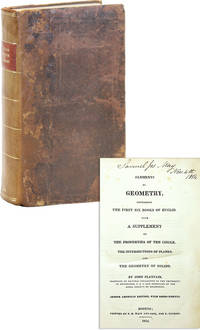
1814Best.-Nr. 47988Boston: T.B. Wait and Sons 1814. Second American Edition With Improvements. Octavo 23cm.; contemporary calf recently rebacked new red morocco spine label retaining original endpapers; 2xxviii4315152pp. Boards rather rubbed small dampspot to upper cover some browning to endpapers a few tiny holes to rear free endpaper else Good or better internally sound. Provenance: Copy of seventeen-year-old Samuel Joseph May 1797-1871 future reformer abolitionist and women's rights advocate with his ownership signature dated November 4 1814 to title page front pastedown p. 1 together with his gift inscription to fellow Harvard student Warren Goddard to rear flyleaf verso with Goddard's lengthy ownership inscription as a student at Harvard on front free endpaper a second ownership inscription of Goddard's on front flyleaf noting that the book was actually bought off of May. May graduated from Harvard in 1817 and went on to serve as a Unitarian clergyman collaborating with his friend William Lloyd Garrison in co-founding the New England Anti-Slavery Society the American Anti-Slavery Society and the pacifist New England Non-Resistance Society. SHAW & SHOEMAKER 32520. T.B. Wait and Sons unknown books
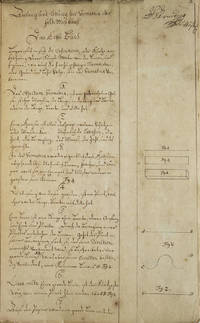
1728Best.-Nr. 315966University of Halle 1728. Abundantly illustrated with watercolor drawings and tables. 1 vols. 4to. Disbound remnants of contemporary reversed calf and marbled boardslosses to top edges. Abundantly illustrated with watercolor drawings and tables. 1 vols. 4to. Extensive German manuscript on geometry with handsome period-colored illustrations. The first part discusses the relationship of the diameter to the circumference with an introduction on Pi comparing findings by Euclid Archimedes and Ptolemy as well as 16th- and 17th-century scholars like Augustin Hirschvogel Albrecht Dürer Nicolaus de Cusa Ludolph van Ceulen Kepler Adam Kochansky François Viète Carlo Renaldini and Adriaan Metius. The second features problems theorems and solutions to geometrical exercises on linear and proportional measures of inscribed and circumscribed polygons. A few pages contain occasional verse and notes on chemical preparations. Johann Gottlieb Arndt was an engineer and taught mathematics at the University of Halle in 1728-32. He also published on physical mathematical and economic education. unknown books
1866Best.-Nr. 22043Hannover: Carl Rumpler 1866-1868. First Edition. Contemporary half-leather. Good; backstrip worn away; some spotting. 8vo I - xii 2 1 - 146 pp. 5 folding plates; II - 2 iii - xiv 1 - 268 2 - errata pp. 1 folding plate. One of the leading geometers of the period coming to the field through an early interest in analytical mechanics. DSB XI 299-300. Carl Rumpler hardcover books
1816Best.-Nr. 4402Edinburgh 1816. OFFPRINT. Original paper backed boards. A very good copy; frt. cover detached; small inoffensive inst. stamp on frt. bd. . 4to. There are 5 plates. Wallace was the author of this article on geometry for the Edinburgh Encylcopaedia. The complete article retaining the pagination and the five plates accompanying it was offprinted. Wallace inscribed this copy twice. On the front cover in Wallace's hand it states : Mr. Rigaud / Sav. Prof. Geometry / Oxford / May 1816. On the upper margin of the first text page Wallace again insc. it : From the Edinburgh Encylcopaedia / to Mr. Rigaud / From Mr. Wallace. The recipient was Stephen P Rigaud who was appointed Savillian professor of geometry in 1810 and in 1827 succeeded A Robertson as Radcliffe observer and Savilian prof. of astronomy. Rigaud is best known for his work on Newton's Principia. See DSB for Wallace; see DNB for Rigaud. hardcover books
1955Best.-Nr. 6710New York: Robert S. Beard 1955. 14 Posters/Blueprints 12 are printed in white on blueprint paper and 2 are printed in black on white paper generally 13x19." One is trimmed along top edge few others with fading and corner wear. generally very good. Ownership signature and address of Margaret Sutton on verso of one manuscript sketch of parallel lines on another. Robert S. Beard's stamp appears on the verso of another and few have manuscript captions or corrections on the front. Beautiful and intriguing set of designs owned by New York artist Margaret Sutton 1905-1990 who had a long and varied career in engineering art and design. These blueprints were created by an interesting figure in his own right Col. Robert S. Beard 1883-1974 author of many articles and a book Patterns in Space 1973 on aspects of geometric design. The influence of Beard's work is seen in a wide variety of disciplines from mathematics and cosmology to art and economics. His designs made a great impact on American mathematician Magnus Wenninger who wrote the first book on constructing polyhedron models. Dr. Jerome Baumring of the Institute of Cosmological Economics who is said to be the first known person to crack the complete esoteric trading system of W.D. Gann cites Beard's book as "one of the greatest cosmological treatises ever written." Patterns in Space is also listed alongside books by Mandelbrot in the study of fractals. Margaret Sutton likely became acquainted with Beard's works in the New York arts scene Beard teaching at Yeshiva University and Sutton receiving degrees at Columbia University where a set of Beard's models were on permanent display as of the publishing of his book in 1973. Included in this set are: The Golden Rectangle The Pentacle The Nesting Squares; Key of the Cosmos and Numbers; The Five Pointed Star series of 2; The Value of 2π; Patterns for Segments of Cubes; The Rhombic Dodecahedron; Patterns for the Honeycomb Dodecahedron; Seven Polyhedron Families Having 5" Cube Members; Table showing Face Polygons and Solids trimmed; Geometrical Construction for Regular Polygons; and Drawing the Polygons series of 3. What is so fascinating about this set is it shows a clear influence on Sutton's career and artistic trajectories. After taking drafting and engineering classes at Columbia she worked for Grumman Aircraft and then as a technical illustrator for the Merganthaler Linotype Company. She studied art at the Arts Students League likely with George Grosz and with Hans Hofmann at his school. She completed some 4000 paintings and drawings in her lifetime. In 1993 her friend and partner painter Alfred Levitt gave her body of work to the University of Mary Washington where it is now on display. The online exhibition from 2020 Margaret's Menagerie: The Animal Imagery of Margaret Sutton gives a good look at her varied works many of which use geometric patterns lines and shapes often in combination with her other love of animals and nature. The final photo in this listing is one of Sutton's works for reference not included in the sale. As of cataloguing we have not been able to locate any Beard designs elsewhere other than those mentioned in the preface of his book at Columbia and Berkeley. This set is a trove of beautiful design that blurs the lines between art and math showcasing the career path of a woman artist of the Greenwich Village scene who should be more well known. . Robert S. Beard unknown books
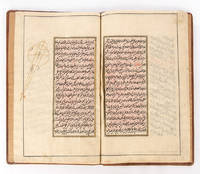
Best.-Nr. 114244India Jumadi 1284 AH 1867 AD. . Single volume illuminated manuscript on thin polished Indian laid paper text-block sprinkled in red and pink in Farsi Persian manuscript on paper black ink on paper 34 leaves 268 x 160 mm; 16 lines bold nasta'liq verging on shekasteh text-block ruled in gilt numerous diagrams in the text and adorning the margins most of these in gold some contemporary annotations to margins a few spots to preliminary leaves gilt ruling to text-block oxidised and caused closed tears in come instances mostly to inner ruling close to gutter some margins repaired; contemporary red sheep over pasteboards covers ruled in blind with central stamped motifs also in blind rebacked and edges repaired new endpapers and pastedowns covers rubbed. An attractive treatise on geometry and astronomy likely copied in India for a certain Alim al-Din Hussayn bin Abd'Allah al-Ansari in 1867 AD. The work includes many diagrams in the text showing various geometrical shapes diagrams of stars and planets and diagrams of various eclipses and spheres in orbit. India, Jumadi 1284 AH (1867 AD). hardcover
Best.-Nr. SONG3642380093Used: Good unknown
2000Best.-Nr. x-0792367111Springer 2000. Hardcover. New. 1st edition. 416 pages. 9.50x6.50x1.00 inches. Springer hardcover
Best.-Nr. DADAX1461275342New unknown
Best.-Nr. DADAX1461426200New unknown
Best.-Nr. DADAX1418100927New unknown
Best.-Nr. DADAX1461268109New unknown
Best.-Nr. DADAX146126846XNew unknown
Best.-Nr. DADAX1461286816New unknown
Best.-Nr. DADAX1461426820New unknown
Best.-Nr. DADAX1436553504New unknown
Best.-Nr. DADAX1436902673New unknown
Best.-Nr. DADAX364207751XNew unknown
Best.-Nr. DADAX1419717812New unknown
Best.-Nr. DADAX1845495292New unknown
1727Best.-Nr. 45242London T. Bowles 1727. Small 8vo. Contemp. full calf raised bands blindtooled covers Cambridge-binding. Wear to spine ends and spine. Hinges weakening but still holding. Titlepage in red/black. 21956 pp. and 80 full page engraved illustrations. Some soiling and browning mainly marginal last 10 engravings with a faint dapmstain. The charming plates are engraved by Leclerc. Scarce English edition the third of Leclerc's charming and very popular treatise on elementary practical geometry and perspective.Sebastien Leclerc 1637-1714 was originally an engraver who studied physics and geometry in relation to perspective theory a field of which he became famous. In 1672 he was appointed to "l'Academie de Peinture" as professor in perspective. He was also engraver to Louis XIV and was appointed professor at "l'Ecole des Gobelins". hardcover
1785Best.-Nr. 44970Paris Moutard 1785. 4to. Extracted from "Mémoires fe Mathematique et de Physique Présentés à l'Academie des Sciences par divers Savans" Tome X. Pp. 511-550 a. 2 folded engraved plates. Clean and fine. First appearance of this importent paper by the "greatest geometer of the century" in which he solves some main problems in coordinate geometry especially he introduced the "distant formula" for three dimensions years before it was used by Lagrange. He laid the foundation of a completely new branch of mathematics known as descriptive geometry. The paper was delivered already in 1771 but not published until 1785. "His first important original work was "Memoire sur les développées les rayons de courbure et différents genres d inflexions des courbes á double courbure" He published an extract from it in June 1769 in the Journal encycyclop´matiques and in October 1770 he finished a more complete version that he read before the Academie des Sciences in August 1771; the latter however was not published until 1785 Mémoires de mathématiques et de physique présentés á ’Academic par divers scavanns. By then some of the most important ideas in the memoir no longer seemed so original because Monge had employed them in other works published in the intervening years. Nevertheless this memoir is of exceptional interest for it presents most of the new conceptions that Monge developed in his later works as well as his very personal method of exposition which combined pure geometry analytic geometry and infinitesimal calculus."DSB. unknown
1859Best.-Nr. 42296London Richard Taylor and William Francis 1859. 4to. No wrappers as extracted from "Philosophical Transactions" Vol. 149 - Part I. Pp. 61-90. Clean and fine. First appearance of this pathbreaking paper in which Cayley unites 'Metrical Geometry' and 'Projectice Geometry' by introducing "imaginary" elements to metrical properties."The fundamental notions in metrical geometry are the distance between two points and the angle between two lines. Replacing the concept of distance by another also involving "imaginary" elements Cayley provided the means for unifying Euclideangeometry and the common non-Euclidean gemoetries into one comprehensive theory."Bell in "Men of Mathematics".In non-Euclidean geometry prepared the way for Klein's splendid discovery that the geometry of Euclid and the non-Euclidean geometries of Lobatchewsky and Riemann are all threee merely different aspects of a more general kind of geometry which includes them as special cases.Dealing with the relations between metrical and projective geometry Klein remarks In "Entwicklung der Mathematik" Teil I p. 148: "Vor allem kommt für uns sein Cayley's berühmtes 'A Sixth Memoir upon Quantics" im betrachtt. Quantioc heisst soviwel "Form" d.h. homogenes Polynom von zwei drei oder mehr Variablen wonach man binäre tertiäre usw. Formen unterscheidet." unknown
1873Best.-Nr. 53254London and New York Macmillan and Co. 1873. 4to. Orig. full brown cloth gilt spine pictorial gilt frontcover. Near mint condition. Small embossed stamp at upper corner of title-page David Dunlop ObservatoRy Library. In: "Nature a weekly illustrated Journal of Science." Volume VIII May 1873 to October 1873. XII562 pp. Entire volume offered. Riemann's paper: pp. 14-17 a. 36-37. Internally clean and fine no traces of use. First English translation of this milestone work on the foundations of geometry. It "is one of the key work from which derives the modern study of differential geometry and especially the study of manifolds of dimension greater than two. It was to prove central to the overthrow of Euclidean geometry as the source of geometrical ideas and to Einstein's general theory of relativity after 1915." Grattan-Guiness "Landmark Writings in Western Mathematics 1640-1940.It is a translation of Riemann's famous Habilitationsvortrag held in 1854 in secondary literature it is often misidentified as his Habilitationsschift but that was concerned with Fourier series and was delivered the year before. Riemann begins his lecture with a remark about a certain darkness that lies at the foundation of geometry. This darkness obscures the relations between that which geometry assumes i.e. the notion of space and the first principles of constructions in space. In Riemann's oponion one must take another approach towards this problem than the usual axiomatic method used ever since Euclid. The approach taken by Riemann is to a large extent guided by Gauss's work on the intrinsic geometry of surfaces; 'Disquisitiones generales circa superficies curvas' 1828. In this work Gauss showed that the curvature of a surface can be determined without reference to the ambient Euclidean space in which it lies i.e. that the curvature is an intrinsic property of the surface. Based on this Gauss showed several fundamental theorems about figures on the surface by referring only to the surface itself i.e. indicating that the surface itself is a space with its own geometry independent of the geometry of the ambient Euclidean space. Riemann argues that the true objects and properties of geometry are those which can be studied within the space itself and he defines a general n-dimensional space in a similar manner to the parametric representation of a surface. Riemann believed that we know space only locally he therefore bases his study of the geometry of such a general space or manifold as they are known today on the infinitesimal methods of calculus. This choice is a crucial departure from the classical axiomatic methods used by Euclid Lobachevsky and Bolyai. The notion of distance or metric on a manifold is a generalization of the usual Euclidean distance formula in n-dimensions. Particular choices of space and metric reveal both the hyperbolic geometries of Lobachevsky and Bolyai and elliptic or Riemannian geometry. Riemann's approach to geometry is of paramount importance this work "did more to change our ideas about geometry and physical space than any work on the subject since Euclid's Elements." Landmark Writings in Western Mathematics p.507. "The importance of this treatise is not confined to pure mathematics. Without it Einstein would not have been able to develop his general theory of relativity." Printing and the Mind of Man p.177. hardcover
1770Best.-Nr. 31785Berlin Haude & Spener 1770. 4to. No wrappers as issued in "Mémoires de l'Academie Royale des Sciences et Belles Lettres" tome XXIV pp. 327-354 and 1 engraved plates. First edition. Lambert's work on non-Euclidean geometry is among the most important in the field. Carl Boyer writes "No one else came so close to the truth without actually discovering non-Euclidean geomtry." History of Mathematics pp. 504. Lambert wrote his famous book 'Theorie der Parallellinien' in 1766 but it was not published until 1786 nearly a decade after his death. Lambert originally set out to prove Euclid's parallel postulate in a similar way to that which Saccheri had used in his 'Euclides Vindicatus' but in contrast he did not interpret the consequences of non-Euclidean geometry as absurd. The offered paper 'Observations Trigonometriques' is the only work by Lambert on non-Euclidean geometry which was published during his life-time. Here he made the important discovery of the duality between spherical and hyperbolic geometry i.e. that hyperbolic trigonometries can be deduced from spherical trigonometries by using imaginary angles and consequently he introduced the hyperbolic functions for the first time. By illustrating this duality Lambert gave strong evidence of the consistency of non-Euclidean geometries. See Kline's Mathematical Thought from Ancient to Modern Times pp. 404 & 868. unknown