4 207 résultats
1709réf. 45238Paris Jean Boudot 1709 a. 1711. 4to. Without wrappers. Extracted from "Mémoires de l'Academie des Sciences. Année 1708" and Annèe 1709. Pp. 339-365 a. 1 folded engraved plate pp. 320-350 a. 1 folded engraved plate. First printing of two importent papers in the further development of Cartesian analytical geometry."The irrepressible Michel lRolle.in the Memoires of the Academie des Sciences for 1708-1709 the papers offered raised doubts about the correctness of the Cartesian graphical solution of equations as he had about the validity of the calculus of L'Hospital. He pointed out that to solve fx= 0 one arbitrarily chooses a curve gxy = 0 and on combining it with fx = 0 one obtains new curves hxy = 0 the intersection of which with gxy = 0 furnish the solution of fx = 0; and he realized that in this way extraneous solutions may be introduced. Imaginary branches further comp0licated the problem and although Rolle sawthe difficulties he was unable to solve them."Boyer "History of Analytical Geometry" p. 155. unknown
1834réf. 41598Berlin G. Reimer 1834. 4to. No wrappers. In "Journal für die reine und angewandte Mathematik. Hrsg. von A.L. Crelle" Bd. 12 Heft 1 IV88 pp. the whole issueHeft 1 offered with titlepage to volume 12. Jacobi's paper: pp. 1-69. a. 1 engraved plate. First edition of a main paper dealing with n-dimensional geometry."Of the papers devoted to n-fold integrals Jacobi's 1834 paper "De binis quibuslibit." is of crucial importence in this connection the theory of algebraic forms of variables. Here besides the problem of computing multiple integrals an importent problem of the theory of algebraic forms is solved." Andrei Nik. Kolmogorov. unknown
1829réf. 41605Berlin G. Reimer 1829. 4to. No wrappers. Extracted from "Journal für die reine und angewandte Mathematik. Hrsg. von A.L. Crelle" Bd. 4. - Plücker's paper pp. 349-370 First edition of a major paper in the arithmetization of geometry introducing the so-called triangular coordinates. "In 1829 Plücker contributed to Crelle's Journal the paper offered here with a revolutionary point of view that broke completely with the old Cartesian view of coordinates as line segments. The equation of a straight line in homogenous coordinates has the form ax by ct=0.Plücker saw that one could modify the usual language and call abc the homogenous coordinates of a line.Plücker had discovered the immidiate analytic counterpart of the geometric principle of duality about which Gergonne and Poncelet had quarreled; it now became clear that the justification that pure geometry had sought in vain was here supplied by the algebraic point of view." Boyer History of Mathematics. unknown
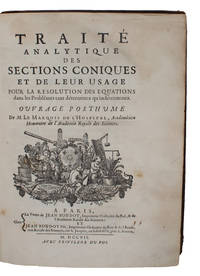
1707réf. 48217Paris Jean Boudot et Jean Boudet fils 1707. 4to. Contemporary full calf. A bit of cracking to front hinges so that cords are seen but cover not loosening. Spine with 6 raised bands richly gilt compartments. Wear to top of spine. Two small old paperlabels one to upper compartment one to frontcover. Covers slightly rubbed. 44595 pp. Large woodcut vignette on titlepage 2 other vignettes one engraved one in woodcut. 32 folded engraved plates and one smaller folded plate Fig. A. An old owners stamp on flyleaf. Internally clean and fine. A few tiny brownspots. Wide-margined and printed on good paper. Scarce first edition of l'Hôspital's second book - his second successfull textbook - the manuscript of which was left completed at his death in 1704. His first book "Analyse des infiniment petits pour l’intelligence des lignes courbes" 1696 was the first textbook of the differential calculus and his name lives on in the name of the rule for finding the limiting value of a fraction whose numerator and denominator tend to zero. His mathyematical teacher was Jean Bernoulli.The year in which Newton published the anti-Cartesian "Arithmeticus" there appeared in France a conspicuously successfull textbook on Cartesian geometry along the lines of that of Guisnée. This was the "Traité Analytique des Sections Coniques". a book which contains less original material than that of Guisnée but which is more extensive and closer to the modern manner of treatment. The work had been intended for publication at the time the authors famous calculus textbook appeared in 1696 but l'Hospital's illness apparently led to delay and it appeared posthumously in 1707. It is Cartesian in emphasis and although it consists of but one volume follows generally the tripartite plan of Lahire and Ozanam: first an algebraic quasi-analytic treatment of the Conic Sections along the lines of Apollonian theory; then an analytic study of the loci and finally a long section on the customary construction by conics of the roots of cubic and quartic polynominal equations. LHospital sometimes used two axes and seems to have recognized the interchangeability of these but he betrays some hesitation. In general L'Hospital like Descartes was more interested in analytic geometry as a measure of ecpressing loci algebraivcally than as a method of deriving the properties of a curve from its equation." Carl B. Boyer "History of Analytic geometry" pp. 150-154. hardcover
réf. BN168813Klett-Cotta. Die natürliche Geometrie des Kindes Hardcover Die natürliche Geometrie des Kindes Hardcover Die natürliche Geometrie des Kindes Hardcover Klett-Cotta hardcover
réf. BN376165Lehrmittelverlag des Kantons Zürich. Geometrie: Kommentar 7. Schuljahr Peter Willi Geometrie: Kommentar 7. Schuljahr Peter Willi Geometrie: Kommentar 7. Schuljahr Peter Willi Lehrmittelverlag des Kantons Zürich unknown
réf. BN374764Lehrmittelverlag des Kantons Zürich. Geometrie Mittelstufe Kopiervorlagen: 4. bis 6. Schuljahr Hohl Walter; Lauffer Felix and Schnellmann Thomas Geometrie Mittelstufe Kopiervorlagen: 4. bis 6. Schuljahr Hohl Walter; Lauffer Felix and Schnellmann Thomas Geometrie Mittelstufe Kopiervorlagen: 4. bis 6. Schuljahr Hohl Walter; Lauffer Felix and Schnellmann Thomas Lehrmittelverlag des Kantons Zürich unknown
1998réf. BN573870CRC Press 1998. 1998. Rings Hopf Algebras and Brauer Groups Lecture Notes in Pure & Applied Mathematics Band 197 Rings Hopf Algebras and Brauer Groups Lecture Notes in Pure & Applied Mathematics Band 197 Verschoren A. Stefaan Caenepeel f Week on Algebra and Algebraic Geometry University of Antwerp and the a. o. CRC Press unknown
2002réf. BN629393American Mathematical Society 2002. 2002. Complex Manifolds and Hyperbolic Geometry: II Iberoamerican Congress on Geometry January 4-9 2001 Cimat Guanajuato Mexico Contemporary Mathematics Complex Manifolds and Hyperbolic Geometry: II Iberoamerican Congress on Geometry January 4-9 2001 Cimat Guanajuato Mexico Contemporary Mathematics Harvey William Sevin Recillas-Pishmish and Mexico Iberoamerican Congress on Geometry 2001 Guanajuato American Mathematical Society unknown
1991réf. x-0306436930Plenum Pub Corp 1991. Hardcover. New. 681 pages. 9.61x6.69x1.50 inches. Plenum Pub Corp hardcover
1998réf. x-0824701534Marcel Dekker Inc 1998. Paperback. New. 1st edition. 352 pages. 10.25x7.25x0.75 inches. Marcel Dekker Inc paperback
2002réf. mon0000403113Amer Mathematical Society 2002-12-01. Paperback. Very Good. 0.8700 in x 9.8400 in x 7.0100 in. Amer Mathematical Society paperback
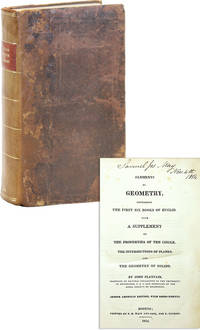
1814réf. 47988Boston: T.B. Wait and Sons 1814. Second American Edition With Improvements. Octavo 23cm.; contemporary calf recently rebacked new red morocco spine label retaining original endpapers; 2xxviii4315152pp. Boards rather rubbed small dampspot to upper cover some browning to endpapers a few tiny holes to rear free endpaper else Good or better internally sound. Provenance: Copy of seventeen-year-old Samuel Joseph May 1797-1871 future reformer abolitionist and women's rights advocate with his ownership signature dated November 4 1814 to title page front pastedown p. 1 together with his gift inscription to fellow Harvard student Warren Goddard to rear flyleaf verso with Goddard's lengthy ownership inscription as a student at Harvard on front free endpaper a second ownership inscription of Goddard's on front flyleaf noting that the book was actually bought off of May. May graduated from Harvard in 1817 and went on to serve as a Unitarian clergyman collaborating with his friend William Lloyd Garrison in co-founding the New England Anti-Slavery Society the American Anti-Slavery Society and the pacifist New England Non-Resistance Society. SHAW & SHOEMAKER 32520. T.B. Wait and Sons unknown
réf. 40040474-6Used - Good. Former library copy. Pages intact with minimal writing/highlighting. The binding may be loose and creased. Dust jackets/supplements are not included. Includes library markings. Stock photo provided. Product includes identifying sticker. Better World Books: Buy Books. Do Good. unknown
2011réf. BN28357Springer 2011. 2011. Hardcover. 246 x 168 x 2 cm. Vectorworks® ist das meist genutzte CAD-Programm für Apple und eines der führenden für Windows. Mit dem Buch lernen Architekten Innenarchitekten Bühnen- und Szenenbildner sowie Studierende das Programm noch besser kennen. Zu Beginn werden Leser in Programmoberfläche Werkzeuge Strukturhilfen Standardzeichentechniken und -translationsoperationen eingeführt wobei die 3D- und 2D-Werkzeuge anhand eines Beispielprojekts vorgestellt werden. Am Ende steht ein komplettes 3D-Modell des Bauwerks einschließlich davon abgeleiteter Pläne. Programmoberfläche · Blattrand und Raster ausblenden · Fangeinstellungen · Automatische Sicherung · Handbuch Quickstart · Arbeitsumgebungen · Tastenkürzel · Rasterbilder importieren · Klassen anlegen · Ebene bearbeiten · Navigation Klassen/Ebenen · Zeichnen per Koordinateneingabe · 2D zu 3D · 3D-Werkzeug Boden/Decke · Bauteildefinition · Boden/Decke bearbeiten · 3D-Werkzeug Wand · Wände verbinden · Wände bearbeiten · Partielle Höhenanpassung von Wänden · Wandverbindungen bearbeiten · Grundrissdarstellung steuern · Fenster und Türen als 2D/3D-Symbole anlegen · Arbeitsebenen als Konstruktionshilfe · 2D/3D-Symbole bearbeiten · Symbole im Modell einsetzen · Klassenstruktur von Symbolen · Symbolverwaltung in der Zubehörpalette · Ebenen als Geschosse · Ebenenübergreifende Modellansicht · 3D-Befehl Dachfläche anlegen · Wände an Dach anpassen · Dachfläche bearbeiten und ergänzen · Wandnische anlegen · Gekrümmte Bauteile als NURBS-Flächen modellieren · Kurvenflächen verbinden · Wendeltreppe mit dem Treppen-Werkzeug erstellen · Treppenobjekt 2D-editieren · Treppenobjekt im Modell einsetzen · Gesicherte Darstellungen · Layoutebene anlegen · Ansichtsbereiche · Ansichten Schnitt und Grundrisse aus 3D-Modell erzeugen · Zeichnungen 2D-editieren · Schraffuren und Verläufe anlegen · Bemaßungen anlegen und editieren · Kombination Liniendarstellung/Renderworks · Kamera festlegen · Kamerasteuerung aus dem Layout · Szenenbeleuchtung mit Umgebungslicht und anderen Lichtquellen · HDRI-Beleuchtung · Indirekte Beleuchtung · Vorgabe-Materialien · Shader- und Bitmapbasierte Texturen selbst erstellen · Materialzuweisung und Texturprojektion · Renderzeit-Optimierung · Spiegelung mit Rasterbildobjekten- Autor: Horst Sondermann ist Architekt und Professor an der Architekturfakultät der HFT Stuttgart. Er studierte an der TU Berlin und unterrichtet seit 1994 Darstellende Geometrie und Architekturdarstellung. Zur Architekturvisualisierung hat er bereits die Bücher Licht Schatten Raum · Architekturvisualisierung mit Cinema 4D® Cinema 4D®·Tipps und Tricks für die Architekturvisualisierung sowie Photoshop® in der Architekturgrafik im Springer-Verlag veröffentlicht. Vectorworks® ist das meist genutzte CAD-Programm für Apple und eines der führenden für Windows. Mit dem Buch lernen Architekten Innenarchitekten Bühnen- und Szenenbildner sowie Studierende das Programm noch besser kennen. Zu Beginn werden Leser in Programmoberfläche Werkzeuge Strukturhilfen Standardzeichentechniken und -translationsoperationen eingeführt wobei die 3D- und 2D-Werkzeuge anhand eines Beispielprojekts vorgestellt werden. Am Ende steht ein komplettes 3D-Modell des Bauwerks einschließlich davon abgeleiteter Pläne. Programmoberfläche · Blattrand und Raster ausblenden · Fangeinstellungen · Automatische Sicherung · Handbuch Quickstart · Arbeitsumgebungen · Tastenkürzel · Rasterbilder importieren · Klassen anlegen · Ebene bearbeiten · Navigation Klassen/Ebenen · Zeichnen per Koordinateneingabe · 2D zu 3D · 3D-Werkzeug Boden/Decke · Bauteildefinition · Boden/Decke bearbeiten · 3D-Werkzeug Wand · Wände verbinden · Wände bearbeiten · Partielle Höhenanpassung von Wänden · Wandverbindungen bearbeiten · Grundrissdarstellung steuern · Fenster und Türen als 2D/3D-Symbole anlegen · Arbeitsebenen als Konstruktionshilfe · 2D/3D-Symbole bearbeiten · Symbole im Modell einsetzen · Klassenstruktur von Symbolen · Symbolverwaltung in der Zubehörpalette · Ebenen als Geschosse · Ebenenübergreifende Modellansicht · 3D-Befehl Dachfläche anlegen · Wände an Dach anpassen · Dachfläche bearbeiten und ergänzen · Wandnische anlegen · Gekrümmte Bauteile als NURBS-Flächen modellieren · Kurvenflächen verbinden · Wendeltreppe mit dem Treppen-Werkzeug erstellen · Treppenobjekt 2D-editieren · Treppenobjekt im Modell einsetzen · Gesicherte Darstellungen · Layoutebene anlegen · Ansichtsbereiche · Ansichten Schnitt und Grundrisse aus 3D-Modell erzeugen · Zeichnungen 2D-editieren · Schraffuren und Verläufe anlegen · Bemaßungen anlegen und editieren · Kombination Liniendarstellung/Renderworks · Kamera festlegen · Kamerasteuerung aus dem Layout · Szenenbeleuchtung mit Umgebungslicht und anderen Lichtquellen · HDRI-Beleuchtung · Indirekte Beleuchtung · Vorgabe-Materialien · Shader- und Bitmapbasierte Texturen selbst erstellen · Materialzuweisung und Texturprojektion · Renderzeit-Optimierung · Spiegelung mit Rasterbildobjekten- Autor: Horst Sondermann ist Architekt und Professor an der Architekturfakultät der HFT Stuttgart. Er studierte an der TU Berlin und unterrichtet seit 1994 Darstellende Geometrie und Architekturdarstellung. Zur Architekturvisualisierung hat er bereits die Bücher Licht Schatten Raum · Architekturvisualisierung mit Cinema 4D® Cinema 4D®·Tipps und Tricks für die Architekturvisualisierung sowie Photoshop® in der Architekturgrafik im Springer-Verlag veröffentlicht. Springer hardcover
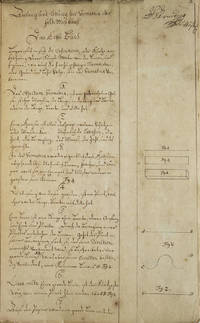
1728réf. 315966University of Halle 1728. Abundantly illustrated with watercolor drawings and tables. 1 vols. 4to. Disbound remnants of contemporary reversed calf and marbled boardslosses to top edges. Abundantly illustrated with watercolor drawings and tables. 1 vols. 4to. Extensive German manuscript on geometry with handsome period-colored illustrations. The first part discusses the relationship of the diameter to the circumference with an introduction on Pi comparing findings by Euclid Archimedes and Ptolemy as well as 16th- and 17th-century scholars like Augustin Hirschvogel Albrecht Dürer Nicolaus de Cusa Ludolph van Ceulen Kepler Adam Kochansky François Viète Carlo Renaldini and Adriaan Metius. The second features problems theorems and solutions to geometrical exercises on linear and proportional measures of inscribed and circumscribed polygons. A few pages contain occasional verse and notes on chemical preparations. Johann Gottlieb Arndt was an engineer and taught mathematics at the University of Halle in 1728-32. He also published on physical mathematical and economic education. unknown
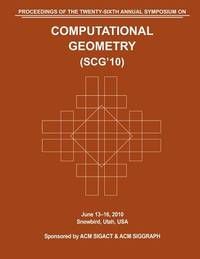
réf. A9781450300162Paperback / softback. New. paperback
2011réf. DADAX1450300162New unknown
réf. 1568810466.GVHStape. Good. Access codes and supplements are not guaranteed with used items. May be an ex-library book. unknown