1816ref. 4402Edinburgh 1816. OFFPRINT. Original paper backed boards. A very good copy; frt. cover detached; small inoffensive inst. stamp on frt. bd. . 4to. There are 5 plates. Wallace was the author of this article on geometry for the Edinburgh Encylcopaedia. The complete article retaining the pagination and the five plates accompanying it was offprinted. Wallace inscribed this copy twice. On the front cover in Wallace's hand it states : Mr. Rigaud / Sav. Prof. Geometry / Oxford / May 1816. On the upper margin of the first text page Wallace again insc. it : From the Edinburgh Encylcopaedia / to Mr. Rigaud / From Mr. Wallace. The recipient was Stephen P Rigaud who was appointed Savillian professor of geometry in 1810 and in 1827 succeeded A Robertson as Radcliffe observer and Savilian prof. of astronomy. Rigaud is best known for his work on Newton's Principia. See DSB for Wallace; see DNB for Rigaud. hardcover books
1866ref. 22043Hannover: Carl Rumpler 1866-1868. First Edition. Contemporary half-leather. Good; backstrip worn away; some spotting. 8vo I - xii 2 1 - 146 pp. 5 folding plates; II - 2 iii - xiv 1 - 268 2 - errata pp. 1 folding plate. One of the leading geometers of the period coming to the field through an early interest in analytical mechanics. DSB XI 299-300. Carl Rumpler hardcover books
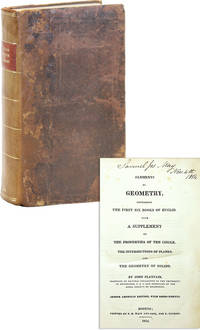
1814ref. 47988Boston: T.B. Wait and Sons 1814. Second American Edition With Improvements. Octavo 23cm.; contemporary calf recently rebacked new red morocco spine label retaining original endpapers; 2xxviii4315152pp. Boards rather rubbed small dampspot to upper cover some browning to endpapers a few tiny holes to rear free endpaper else Good or better internally sound. Provenance: Copy of seventeen-year-old Samuel Joseph May 1797-1871 future reformer abolitionist and women's rights advocate with his ownership signature dated November 4 1814 to title page front pastedown p. 1 together with his gift inscription to fellow Harvard student Warren Goddard to rear flyleaf verso with Goddard's lengthy ownership inscription as a student at Harvard on front free endpaper a second ownership inscription of Goddard's on front flyleaf noting that the book was actually bought off of May. May graduated from Harvard in 1817 and went on to serve as a Unitarian clergyman collaborating with his friend William Lloyd Garrison in co-founding the New England Anti-Slavery Society the American Anti-Slavery Society and the pacifist New England Non-Resistance Society. SHAW & SHOEMAKER 32520. T.B. Wait and Sons unknown books
1955ref. 6710New York: Robert S. Beard 1955. 14 Posters/Blueprints 12 are printed in white on blueprint paper and 2 are printed in black on white paper generally 13x19." One is trimmed along top edge few others with fading and corner wear. generally very good. Ownership signature and address of Margaret Sutton on verso of one manuscript sketch of parallel lines on another. Robert S. Beard's stamp appears on the verso of another and few have manuscript captions or corrections on the front. Beautiful and intriguing set of designs owned by New York artist Margaret Sutton 1905-1990 who had a long and varied career in engineering art and design. These blueprints were created by an interesting figure in his own right Col. Robert S. Beard 1883-1974 author of many articles and a book Patterns in Space 1973 on aspects of geometric design. The influence of Beard's work is seen in a wide variety of disciplines from mathematics and cosmology to art and economics. His designs made a great impact on American mathematician Magnus Wenninger who wrote the first book on constructing polyhedron models. Dr. Jerome Baumring of the Institute of Cosmological Economics who is said to be the first known person to crack the complete esoteric trading system of W.D. Gann cites Beard's book as "one of the greatest cosmological treatises ever written." Patterns in Space is also listed alongside books by Mandelbrot in the study of fractals. Margaret Sutton likely became acquainted with Beard's works in the New York arts scene Beard teaching at Yeshiva University and Sutton receiving degrees at Columbia University where a set of Beard's models were on permanent display as of the publishing of his book in 1973. Included in this set are: The Golden Rectangle The Pentacle The Nesting Squares; Key of the Cosmos and Numbers; The Five Pointed Star series of 2; The Value of 2π; Patterns for Segments of Cubes; The Rhombic Dodecahedron; Patterns for the Honeycomb Dodecahedron; Seven Polyhedron Families Having 5" Cube Members; Table showing Face Polygons and Solids trimmed; Geometrical Construction for Regular Polygons; and Drawing the Polygons series of 3. What is so fascinating about this set is it shows a clear influence on Sutton's career and artistic trajectories. After taking drafting and engineering classes at Columbia she worked for Grumman Aircraft and then as a technical illustrator for the Merganthaler Linotype Company. She studied art at the Arts Students League likely with George Grosz and with Hans Hofmann at his school. She completed some 4000 paintings and drawings in her lifetime. In 1993 her friend and partner painter Alfred Levitt gave her body of work to the University of Mary Washington where it is now on display. The online exhibition from 2020 Margaret's Menagerie: The Animal Imagery of Margaret Sutton gives a good look at her varied works many of which use geometric patterns lines and shapes often in combination with her other love of animals and nature. The final photo in this listing is one of Sutton's works for reference not included in the sale. As of cataloguing we have not been able to locate any Beard designs elsewhere other than those mentioned in the preface of his book at Columbia and Berkeley. This set is a trove of beautiful design that blurs the lines between art and math showcasing the career path of a woman artist of the Greenwich Village scene who should be more well known. . Robert S. Beard unknown books
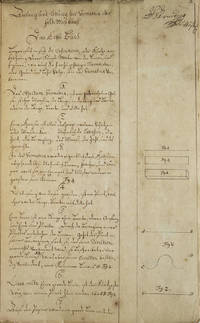
1728ref. 315966University of Halle 1728. Abundantly illustrated with watercolor drawings and tables. 1 vols. 4to. Disbound remnants of contemporary reversed calf and marbled boardslosses to top edges. Abundantly illustrated with watercolor drawings and tables. 1 vols. 4to. Extensive German manuscript on geometry with handsome period-colored illustrations. The first part discusses the relationship of the diameter to the circumference with an introduction on Pi comparing findings by Euclid Archimedes and Ptolemy as well as 16th- and 17th-century scholars like Augustin Hirschvogel Albrecht Dürer Nicolaus de Cusa Ludolph van Ceulen Kepler Adam Kochansky François Viète Carlo Renaldini and Adriaan Metius. The second features problems theorems and solutions to geometrical exercises on linear and proportional measures of inscribed and circumscribed polygons. A few pages contain occasional verse and notes on chemical preparations. Johann Gottlieb Arndt was an engineer and taught mathematics at the University of Halle in 1728-32. He also published on physical mathematical and economic education. unknown books