Rome, David; Hayes, Saul (Introduction)MareMagnum

2.476 resultados
1970176 pages. Index. Includes the following sections: (Louis) Gurofsky Correspondence; In the "Globe"; The Fateful Year 1900; The Correspondence Continues; Arbitrating in Montreal Dispute? Gurofsky is described as "the concerned Jew of the Toronto ghetto". Unmarked with moderate wear. Binding intact. A sound copy. Book
194074 pages. Features: College fashion cover illustration; Bright red Canada brand Lobster ad inside front cover; Salute to a People, by Margaret Lawrence; Nice one-page photo ad for RCA Victor radios features the Model A-32; Come to the Fair (fiction); Two pages of black and white photos of college fashions for ladies; By Design - watch out when a pretty girl starts studying model trains!; Ugly Duckling - Jan worries about blonde Judith; Light Was Her Laughter (continued); "I'm glad we're friends with Canada", said FDR's mother to S.G. Moyer; Nice color ad for Campbell's Soups; Woodbury soap ad features photo of 'noted societal commentator' Cholly Knickerbocker; Women Face the Second Year of WWII; One-page ad for Fleischmann's Yeast features photos of locomotive cleaning and manually loading a horse-drawn wagon; Woodbury cold cream ad features photo of Andrea Leeds; One-page photo ad for Magic Baking Powder features young girl at chalkboard; The Bath Through the Ages; Teach the Children Music; Beauty News; Half-page ad for Mercury sportswear features photo of U.B.C. (UBC) outstanding woman athlete Ruth Wilson wearing her UBC top and Mercury campus stockings; Nice bright colourful ad for Hewetson Shoes inside back cover; Fantastic colour-photo ad for Crown Brand Corn Syrup on back cover features young man in necktie gobbling pancakes, plus an endorsement by Mrs. Percy Bone of Thornhill, Ontario, and a small colour photo of Kate Aitken; and much more. Moderate wear. Small address label upon front cover. A quality vintage copy. Book
1968363 pages. Black and white photographic plates. 15" x 9" legal base map of district laid inside front board. "A revised and much enlarged edition of the 1936 edition. First forty-five pages cover the Sturgeon Namao areas, homesteading, transportation, mining, Carbondale, local government, district churches, schools, and recreation. Balance of book devoted to bibliographies/family histories from 1879 to 1955." - Krotki (2) 941. Gift greetings upon front free endpaper otherwise unmarked with average wear. Binding intact. A sound copy of this very informative genealogical reference. Book
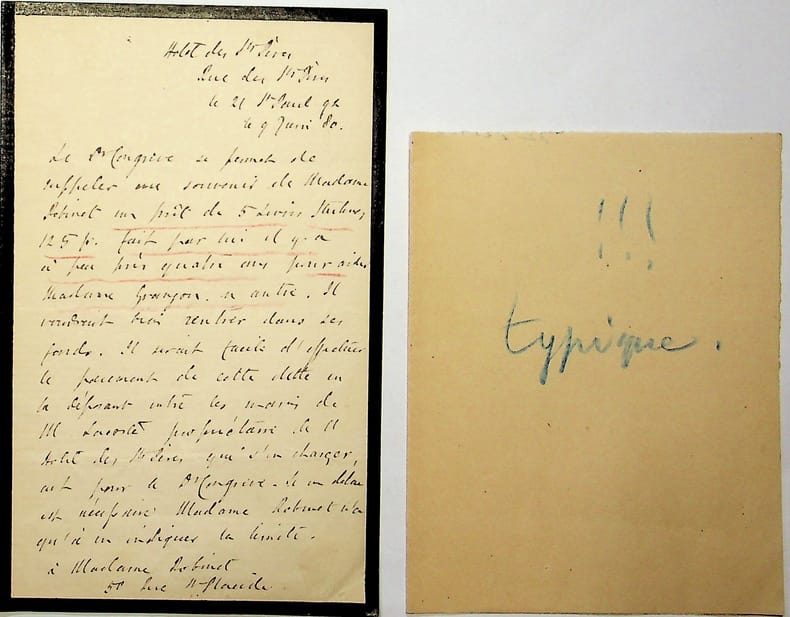
ref. 018957[Positivisme] Richard Congreve (1818-1899), philosophe anglais, figure de proue du positivisme en Angleterre, à l'origine du schisme en 1878. L.A.S. en français et à la troisième personne, 21 Saint Paul 92 [9 juin 1880], 1p in-8. A Marie Weyer (1827-1881), épouse du docteur Jean-François Robinet (1825-1899), médecin d'Auguste Comte et important positiviste français. « Le Dr Congreve se permet de rappeler au souvenir de Madame Robinet un prêt de 5 livres sterling fait par lui il y a à peu près quatre ans pour aider madame Granjon ou autre. Il voudrait bien rentrer dans ses fonds. Il serait surtout facile d'effectuer le paiement de cette dette en la déposant entre les mains de M. Lacoste propriétaire de l'hôtel des Saints Pères qui s'en chargerait pour le Dr Congreve. Si un délai est nécessaire, Madame Robinet n'a qu'à en indiquer la limite ». Léopold Auguste Granjon (1845-1875) est un ouvrier, militant ouvrier, franc-maçon et positiviste, membre du cercle des prolétaires positivistes. Il meurt donc en laissant son épouse Constance Friant (1843-?) qui avait donc été aidée par les positivistes. Les lettres entre positivistes sont rares. [443]
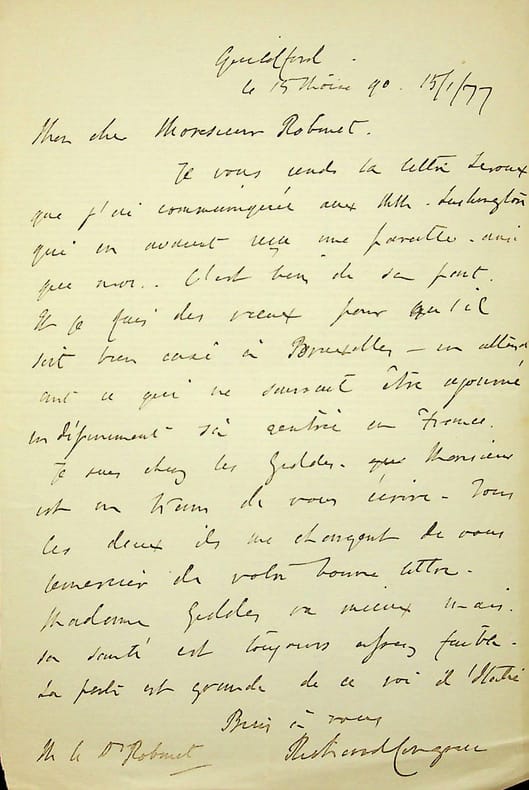
ref. 018961[Positivisme] Richard Congreve (1818-1899), philosophe anglais, figure de proue du positivisme en Angleterre, à l'origine du schisme en 1878. L.A.S. en français, Guildford, 15 Moïse 90 [15 janvier 1877 sic! 1878], 1p in-8. Au docteur Jean-François Robinet (1825-1899), médecin d'Auguste Comte et important positiviste français. « Mon cher Monsieur Robinet, Je vous rends la lettre de Leroux que j'ai communiquées aux MMrs. Lushigton qui en avaient reçu une pareille, ainsi que moi. c'est bien de sa part. Et je fais des voeux pour qu'il soit bien casé à Bruxelles - en attendant ce qui ne saurait être ajourné indéfiniement sa rentrée en France. je suis chez les Geddes. Monsieur est en train de vous écrire. Tous les deux ils me chargent de vous remercier de votre bonne lettre. Madame Geddes va mieux mais sa santé est toujours assez faible. La perte est grande de ce roi d'Italie. Bien à vous. Richard Congreve ». Godfrey Lushington (1832-1907) était un haut fonctionnaire anglais. Emily Geddes (1840-1929) et son mari James Geddes (1841-1880) sont la belle-soeur et le beau-frère de Congreve. Le roi d'Italie est Victor-Emmanuel II, mort le 9 janvier 1878. Leroux est probablement Ernest Leroux (1845-1917) qui publia des ouvrages positivistes dont les Lettres d'Auguste Comte à John Stuart Mill (1877). Les lettres entre positivistes sont rares. [444]
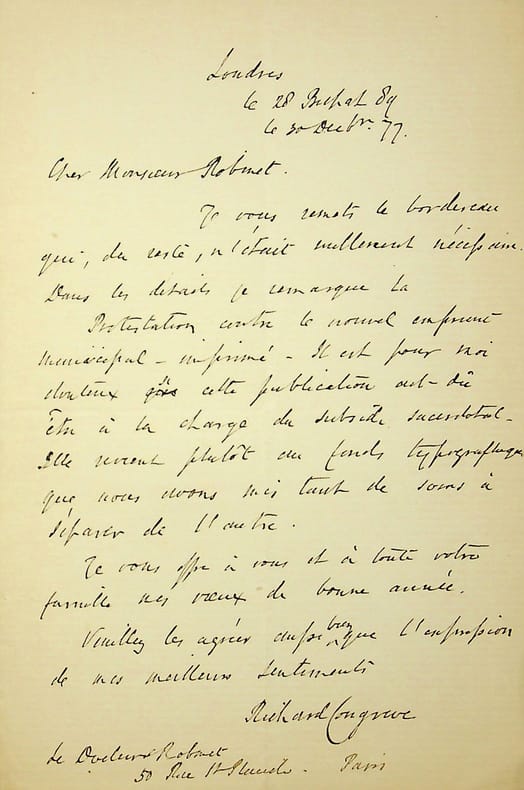
ref. 018966[Positivisme] Richard Congreve (1818-1899), philosophe anglais, figure de proue du positivisme en Angleterre, à l'origine du schisme en 1878. L.A.S. en français, Londres, 28 Bichat 89 [30 décembre 1877], 1p in-8. Au docteur Jean-François Robinet (1825-1899), médecin d'Auguste Comte et important positiviste français. « Cher Monsieur Robinet, Je remets le bordereau qui, du reste, n'était nullement nécessaire. Dans les détails, je remarque la protestation contre le nouvel emprunt municipal - imprimé. Il est pour moi douteux si cette publication ait dû être à la charge du subside sacerdotal. Elle revient plutôt au fonds typographique que nous avons mis tant de soins à séparer de l'autre. Je vous offre à vous et à toute votre famille mes voeux de bonne année. Veuillez les agréer aussi bien que l'expression de mes meilleurs sentiments. Richard Congreve ». Les lettres entre positivistes sont rares. [445]
BARBERI GIULIO Composizione per un piatto in maiolica. Due putti reggono nastri e rami di alloro per omaggiare lo scudo araldico centrale: un'aquila con banda trasversa. Attorno festoni con frutta, a contorno cornicetta doppia con nastri. , , Disegno originale, china e acquarello, con forma arrotondata, probabilmente a grandezza naturale, sulla parte sinistra. A destra dicitura e firma autografa dell'A., con data 25 - 4 - 1908. Giulio Barberi, figlio di Enrico, fu anch'egli valente scultore e ceramista, nato e vissuto, come il padre, a Bologna di lui rimangono sculture particolarmente alla Certosa Buono (Good) .
1777LA MOLDAVIE, LA VALAKIE ET LA TRANSILVANIE Avec partie de la Bulgarie, de la Hongrie et de la Pologne. Venise, Paolo Santini 1777, Grande carta di cm 56,5 x 42,7 allo schiaccio + margini. Delimitazione dei confini in colore coevo, piegata al mezzo, piccola ripresa al margine superiore ma ottimo esemplare fresco e pulito Buono (Good) .
1737MOYREAU JEAN (INCISORE) - WOUVERMENS PH. (PITTORE) Le colombier du Mareschal. Gravé d'apres le Tableau original de P.Wouvermens de vingt pouces six lignes de large sur dix sept poces de haus qui est du Cabinet de Monsieur D'Argenville Maitre des Comptes (n° 26). Paris, chez Moyreau Graveur du Roy, Rue Gallande vis a vis S.t Blaise 1737, Bella incisione in rame all'acquaforte, in orizzontale, mm 460 x 345 + buoni margini. Molti animali e personaggi in primo piano. Pulita e nitida. A sinistra il ritorno di un pastore con il suo gregge, a destra un maniscalco con l'aiutante sistemano i ferri, mentre due cavalieri attendono. In cornice in legno chiaro, a becco convesso eseguita negli anni 1930/40 Buono (Good) .
SCORZONI ALESSANDRO (SANDRO) Calcara 1858 - Bologna 1833. Fu allievo prediletto di Antonio Puccinelli dell'Accademia di Belle Arti di Bologna. Artista versatile riuscì ad elaborare la sua arte con le più diverse tecniche: olio, acquarello, pastello, tempera ... , , Fu valido collaboratore di Alfonso Rubbiani nel restauro del Castello dei Manzoli. Con il suo ingresso al Circolo Artistico di Bologna si dedicherà anche alla illustrazione e alla decorazione, capacità che, in seguito, svilupperà anche nella Manifattura Minghetti. Questo grande spolvero, più volte ripiegato, fa parte di una serie di due arazzi (Amor calmo - Amor ardente) che produsse per la Famiglia Corni di Modena. Con firma dell'A. e descrizione: "Spolvero dell'arazzo della Signora Rina Accame Corni esistente questo e un secondo nel Palazzo Corni di Modena" Buono (Good) .
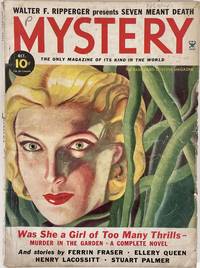
1934ref. 28772Chicago IL: Tower Magazines Inc. 1934. Cover creases edge wear with closed tears a good to very good copy. 28772. Large octavo single issue cover by Harold Woolridge pictorial wrappers. Fiction by Walter F. Ripperberger Stuart Palmer Ellery Queen Roger East and others. A large format densely illustrated bedsheet-sized pulp. "The fiction emphasized the woman's point of view was often narrated by a woman and featured as many feminine as masculine detectives. In the rear of the magazine flowered all the usual departments of a more conventional woman's publication . That this magazine would publish much fiction of interest seems improbable. But without effort it contrived to be superb. ILLUSTRATED DETECTIVE selected outstanding writers who had made their mark in the 1920s and mingled these with rising writers of the 1930s. Over the years the magazine would publish work by top names in the mystery field including Ellery Queen Stuart Palmer Sax Rohmer Arnold Kummer Hulbert Footner Vincent Starrett and H. Bedford-Jones. The fiction was polished often strongly compressed and good enough for a large amount of it to appear later between book covers. The magazine appeared monthly for almost six years sixty-nine issues at ten cents a copy. After three years the title was changed to THE MYSTERY MAGAZINE . Covers were tasteful bright and uneventful relying heavily on the faces of self-confident women. Inside was an astonishing amount of material: eight to ten pieces of fiction four or more crime-fact articles and up to ten continuing departments about half of these slanted directly toward women. When the magazine was at its peak in the early 1930s it offered material carefully calculated to appeal to most tastes and both sexes . MYSTERY was as meticulously planned as an orchestral score. Its careful variations played upon every shade of reader interest. It was consciously polished self-consciously feminine. A curious pared sound rang in its fiction as if the stories had been edited with a chain saw but the prose flashed with a bright nickel glitter. Slick the magazine may have been and often over illustrated but it was also considerably interesting and for years excellent." - Cook Mystery Detective and Espionage Magazines pp. 287-90. Tower Magazines, Inc. unknown
1929Very Good French In contemporary 1/3 leather bdg. Small folio. (33 x 26 cm). In French. [10] ,214, [4] p., 'c' numerous b/w plates. La peinture Indienne a l'epoque des Grands Moghols. First Edition. Rare. Sour cadette de la rayonnante miniature persane, la peinture moghole ne fut étudiée qu'à dater du début de ce siècle. Elle n'était considérée jusqu'à ce jour que sous l'aspect d'une branche souvent inférieure des expressions esthétiques iraniennes. Vue sous l'angle de l'art indien, elle retrouve la place importante qui lui était due. Nous avons rendu compte dans les notes bibliographiques de ce Bulletin, M. Parmentier en 1919, nous-même en 1929, d'un ouvrage de M. E. B. Havell intitulé Indian Sculpture and Painting. Cet auteur eut le premier le mérite de placer l'école moghole et l'école néo-indienne à leur rang légitime. M. I. S. rend un juste hommage à M. Havell ainsi qu'à ses successeurs dans l'appréciation des choses sous cet angle nouveau. Il était cependant fort regrettable de constater la pauvreté de la littérature française sur cette question. Nous ne pouvons donc que féliciter vivement M. I. S. de nous avoir offert un important volume sur un sujet à peu près neuf dans notre langue. La nouveauté de ce dernier exigeait la méthode rigoureuse qui a présidé à l'élaboration de ce travail. Dans une première partie historique, M. I. S. étudie la filiation des traditions anciennes avec l'école moghole et néo-indienne. L'auteur insiste sur la continuité de la tradition artistique indienne. Les moyens d'expression des formes picturales de l'homme, puis de la nature, leur définition et leur classement font l'objet d'une seconde partie analytique. Enfin, l'auteur entreprend de déterminer la formation esthétique de la peinture moghole dans une dernière partie, où il étudie, synthétiquement, le rythme de la composition et de la couleur, II est un fait certain : c'est la peinture qui s'est le moins bien conservée au cours des siècles. Cependant, quelques épaves ont miraculeusement survécu aux intempéries, aux invasions et aux guerres. Comme, d'autre part, de nombreuses allusions littéraires font mention de peintures, nous avons en mains les données suffisantes pour que l'historien d'art puisse reconstituer les étapes de l'évolution de cet art. Quoique notre connaissance des débuts soit nécessairement déformée par la légende, la peinture semble avoir tenu à cette époque lointaine une grande place dans la pensée indienne. Elle était le délassement préféré des princes, et la bibliographie amoureuse y trouve largement son compte. Toute personne cultivée avait chez elle le matériel nécessaire à l'exécution d'un portrait, et ceux-ci étaient, paraît-il, fort ressemblants. Mais le caractère profane de la représentation des personnages fut tel qu'au début il était interdit aux moines bouddhiques de séjourner dans les lieux où de pareilles images étaient exposées. Cette interdiction ne dura d'ailleurs pas et l'Eglise bouddhique comprit rapidement la nécessité d'user à son tour de ce puissant moyen de favoriser sa propagande. La connaissance de ces interdictions suffit à déterminer l'origine laïque de la peinture indienne. Les canons aux règles impérieuses ne font leur apparition que vers le VIIe siècle et superposent la formule d'école à l'inspiration directe de la nature. Ces lois enrayeront ainsi graduellement l'évolution de cette forme d'art. En ce qui concerne la décoration des monuments, les plus anciennes fresques sont celles delà grotte Jogimarâ (Orissâ) datant du début de notre ère et celles d'Ajantâ qui remontent, pour certaines «caves», aux deux premiers siècles. Ces représentations, dont le thème est emprunté aux Jàtakas, révèlent une technique en possession de moyens très développés. Notons en passant que les différents auteurs qui ont traité de ce sujet ne sont pas parfaitement d'accord sur les différents moyens mis en ouvre par cette technique. La symétrie des volumes, la sécheresse, une raideur générale, sont les
ref. 51856Paris: JB d�pos�e C. 1930 . Girl with long hair crouching on a rock cradling her knee with stamped 'Bronze garanti Paris JB d�pos�e' mark and signed 'Milo' to base on a marble stand. Weight including base : 1.54kg. Dimensions of bronze: 15.0cm height x 10.5cm length x 6.0cm width . "Milo Martin was a Swiss sculptor and medal-artist. He set up a studio in the Orangerie of Parc Mon-Repos. Most of his sculptures are spread across the Lausanne region. He also travelled to other European countries to exhibit his works in international exhibitions - these included those in Brussels and Amsterdam in 1928 in Paris in 1934 Vienna in 1937 where he won "lauriers d'or" or the golden laurels Cairo and Alexandria in 1938 and New York in 1939-1940. He won first prize in the national competition for medal design at the Swiss National Exhibition in Berne in 1913 and the silver medal for sculpture in the art competitions of the 1928 Olympic Games for his "Athl�te au repos". He won several public commissions and from 1931 to 1936 sat on Switzerland's federal commission for fine arts. He died in Lausanne. Paris: JB d�pos�e, C. 1930 . unknown
ref. 23268Apparently the top of the letter has been cut off with presumably his address and the date and name of correspondent. Paper 20 x 11.5cm punch-hole one only the other having been cut off as stated above - perhaps filed formerly. Text: "My name may perhaps be known to you as that of a well-known Scottish poet and essayist author of a number of books on Scottish literary historical sociological economic and political matters. I enclose a leaflet giving some information about my work. I will be glad to write and submit an article along the above lines immediiately if I hear from you that you are willing to consider this." WITH: Leaflet 8vo four pages at some time torn in two and crudely repaired with punch-holes entitled "Speaking for Scotland Tributes Concerning Hugh MacDiarmuid". "199" in red crayon is written on front top right. Scarce: holdings NLS and some American Libraries. Apparently the top of the letter has been cut off (with presumably his address and the date, and name of correspondent). unknown
1927ref. 30577New York: Experimenter Publishing Company 1927. Pages tanned but supple mild edge rubbing clear tape at spine ends corner creases a very good copy. 30577. Large octavo single issue cover by Frank R. Paul pictorial wrappers. Pulp magazine. Includes part one of "The Moon Pool" by A. Merritt and a reprint of "The Time Machine" by H. G. Wells. Reference: Tymm and Ashley Science Fiction Fantasy and Weird Fiction Magazines pp. 14-49. Experimenter Publishing Company unknown
1927ref. 30573New York: Experimenter Publishing Company 1927. Text paper tanned but supple mild edge rubs clear tape at spine ends with tiny chip at upper left front corner a very good to nearly fine copy. 30573. Large octavo single issue cover by Frank R. Paul pictorial wrappers. Pulp magazine bedsheet format. Include the first published SF story by Dr. Miles J. Breuer. Also fiction by Murray Leinster H. G. Wells Garrett P. Serviss and others. Reference: Tymm and Ashley Science Fiction Fantasy and Weird Fiction Magazines pp. 14-49. Experimenter Publishing Company unknown
1926ref. 30567New York: Experimenter Publishing Company 1926. Pages browning some minor loss at corner tips clear tape to spine ends some edge rubs a very good to nearly fine copy. 30567. Large octavo single issue cover by Frank R. Paul pictorial wrappers. Pulp magazine bedsheet format. Includes part 2 of "Station X" by George Winsor other fiction by H. G. Wells Garrett Serviss and others. Reference: Tymm and Ashley Science Fiction Fantasy and Weird Fiction Magazines pp. 14-49. Experimenter Publishing Company unknown
1927ref. 30579New York: Experimenter Publishing Company 1927. Pages tanned but supple slight edge rubbing clear tape at spine ends a very good to nearly fine copy. 30579. Large octavo single issue cover by Frank R. Paul pictorial wrappers. Pulp magazine. Includes part three of "The Moon Pool" by A. Merritt. Other authors include A. Hyatt Verrill H. G. Wells Edgar Allan Poe and others. This issue also has a letter from a fifteen year old A. Betram Chandler. Reference: Tymm and Ashley Science Fiction Fantasy and Weird Fiction Magazines pp. 14-49. Experimenter Publishing Company unknown
1927ref. 30582New York: Experimenter Publishing Company 1927. Text paper tanned but supple slight edge rubbing a fine copy. 30582. Large octavo single issue cover by Frank R. Paul pictorial wrappers. Pulp magazine bedsheet format. Stories by Ray Cummings H. G. Wells Garret Smith and others. Reference: Tymm and Ashley Science Fiction Fantasy and Weird Fiction Magazines pp. 14-49. Experimenter Publishing Company unknown
1931ref. 26184New York: The Clayton Magazines Inc. 1931. Covers trimmed tiny tear and crease to lower left front corner a fine copy. 26184. Octavo cover painting by Wessolowski pictorial wrappers. Pulp magazine. Stories by Ray Cummings Robert H. Wilson Murray Leinster and others. Reference: Tymm and Ashley Science Fiction Fantasy and Weird Fiction Magazines pp. 60-103. The Clayton Magazines, Inc. unknown
1980ref. 26057Bowling Green OH: Bowling Green University Popular Press 1980-1983. All are very good to nearly fine. 26057. Octavo 8 issues printed wrappers. The first eight numbers of this scholarly journal devoted to mystery and detective fiction. The first number includes a large section devoted to John D. MacDonald focused on paper presented at conference on MacDonald at the University of South Florida. There is also introduction and comments by MacDonald. The issues devote articles to classic and modern authors and their characters. Books pulps and media are covered. Bowling Green University Popular Press unknown
1899ref. OB908Paris Librairie Hachette 1899. First Edition. Hard Cover. 3 leaves 397 p. 20 leaves of plates illus.; 31.5 cm. Study of the representation of women in various art forms from antiquity to the late 19th century. A sumptuous book rare in libraries. Bound in full red leather stamped in gold; corners worn; Very Good. Stock#OB908 oversize. Librairie Hachette hardcover
1937ref. 36691Dover DE: D. M. Publishing Co. Inc. 1937. Tanning to text paper light edge wear with some rubs and small tears vertical crease to front cover a very good copy. Uncommon. 36691. Octavo single issue pictorial wrappers. Pulp magazine. Includes fiction by Rene Barad and Gerard Lamour both pseudonyms for Robert Leslie Bellem. Several other stories are the only ones written by the author suggesting other pseudonymous work. D. M. Publishing Co., Inc. unknown
1950ref. 32730New York: Avon Periodicals Inc. 1950. Slight tanning to text paper a fine copy. Sharp. 32730. Octavo single issue pictorial wrappers. Pulp magazine. Interplanetary adventure and space opera were to be the main story themes of this short lived magazine coming near the end of the pulp era. Authors included are Ray Cummings A. E. Van Vogt Lester del Rey William Tenn and others. Also includes a illustrated comic book section with art by Joe Kubert in several of the stories and a Conan pastiche "Crom the Barbarian" written by Gardner Fox with art by John Giunta. This Conan pastiche appears to be one of the earliest if not the first sword and sorcery in comic form and it does also appear to be the first depiction of a Conan like character certainly influenced by Robert E. Howard. Reference: Tymm and Ashley Science Fiction Fantasy and Weird Fiction Magazines pp. 467-471. Avon Periodicals, Inc. unknown
1938ref. 27914Kingswood Surrey: The World's Work 1913 Ltd. 1938. Text paper tanned but supple small separation of front cover from spine at upper left edge slight wear to spine ends a nearly fine to fine copy. 27914. Octavo single issue cover art by W. J. Roberts pictorial wrappers. Pulp magazine. Britain's first adult oriented science fiction magazine at first publishing solely original material from British authors and reprints from U.S. magazines and later adding new material from American authors. "Tales of Wonder was a lively entertaining and enjoyable magazine." Tymm and Ashley Science Fiction Fantasy and Weird Fiction Magazine pp. 652-654. The magazine had to cease publication due to wartime paper restrictions after sixteen issues. Includes Edmond Hamilton Francis Flagg Stanton A. Coblentz and others. Also includes a science article by Arthur C. Clarke "Man's Empire of Tomorrow" his first professional appearance. The World's Work (1913) Ltd. unknown