MAXWELL, JAMES CLARK - THE "MAXWELL-DISTRIBUTION"S FINAL FORM - A MAIN PAPER IN 19TH CENTURY PHYSICSBiblio.com
1 788 résultats
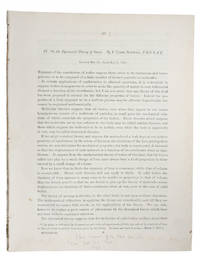
1867réf. 43456London Taylor and Francis 1867. 4to. No wrappers as extracted from "Philosophical Transactions" Vol. 157 - Part I. Titlepage to volume 155 and pp. 49-88. Titlepage with minor light browning at corners. Internally clean. A small stamp on verso of titlepage. First appearance of this seminal paper in its full version from "Transactions" representing the announcement of Maxwell's final "Theory of Gases" and introduces the "Maxwell Distribution" in its final form a statistical means of describing aspects of the kinetic theory of gases a theory together with his electromagnetic theory are considered to be SOME OF THE GREATEST ADVANCES IN PHYSICS OF ALL TIMES. Everett considers this paper 1868 to be Maxwell's greatest single paper. Maxwell's discoveries laid the foundations of special relativity and quantum mechanics.One of Maxwell's major investigations was on the kinetic theory of gases. Originating with Daniel Bernoulli this theory was advanced by the successive labours of John Herapath John James Waterston James Joule and particularly Rudolf Clausius to such an extent as to put its general accuracy beyond a doubt; but it received enormous development from Maxwell who in this field appeared as an experimenter on the laws of gaseous friction as well as a mathematician.In 1866 he formulated statistically independently of Ludwig Boltzmann the Maxwell-Boltzmann kinetic theory of gases. His formula called the Maxwell distribution gives the fraction of gas molecules moving at a specified velocity at any given temperature. In the kinetic theory temperatures and heat involve only molecular movement. This approach generalized the previously established laws of thermodynamics and explained existing observations and experiments in a better way than had been achieved previously. Maxwell's work on thermodynamics led him to devise the Gedankenexperiment thought experiment that came to be known as Maxwell's demon. unknown
1966réf. 059777New York: Interscience Publishers / John Wiley & Sons 1966. 1st Edition 1st Printing. Hardcover. Fine/Near Fine. Xiv 394 Pp. Gray-Green Cloth Printed In Dark Green. First Printing. Near Fine Previous Owner's Name. Dj With Slight Wear Two Short Tears At Top Of Rear Panel. Remarkably Thorough Experimental And Theoretical History And Analysis. Definitive For The Advanced Student And The Expert. Per Wikipedia Chien-Shiung Wu Chinese: ; Pinyin: Wú Jiànxióng; Wade-Giles: Wu2 Chien4-Hsiung2; 1912 - 1997 Was A Chinese-American Particle And Experimental Physicist Who Made Significant Contributions In The Fields Of Nuclear And Particle Physics. Wu Worked On The Manhattan Project Where She Helped Develop The Process For Separating Uranium Into Uranium-235 And Uranium-238 Isotopes By Gaseous Diffusion. She Is Best Known For Conducting The Wu Experiment Which Proved That Parity Is Not Conserved. This Discovery Resulted In Her Colleagues Tsung-Dao Lee And Chen-Ning Yang Winning The 1957 Nobel Prize In Physics While Wu Herself Was Awarded The Inaugural Wolf Prize In Physics In 1978. Her Expertise In Experimental Physics Evoked Comparisons To Marie Curie. Her Nicknames Include The "First Lady Of Physics" The "Chinese Madame Curie" And The "Queen Of Nuclear Research". After Work On The Manhattan Project During Wwii Wu Accepted An Offer Of A Position As An Associate Research Professor At Columbia. She Would Remain At Columbia For The Rest Of Her Career And Was First Named Associate Professor In 1952 Which Made Her The First Woman To Become A Tenured Physics Professor In University History. In November 1949 Wu Experimented With The Conclusions Of Einstein's Epr Thought Experiment Which Called Quantum Entanglement "Spooky Action At A Distance". Wu Was The First To Establish The Phenomenon And Validity Of Entanglement Using Photons Through Observing Angular Correlation As Her Result Confirmed Maurice Pryce And John Clive Ward's Calculations On The Correlation Of The Quantum Polarizations Of Two Photons Propagating In Opposite Directions. Specifically The Experiment Carried Out By Wu Was The First Important Confirmation Of Quantum Results Relevant To A Pair Of Entangled Photons As Applicable To The Einstein-Podolsky-Rosen Epr Paradox. Her 1950 Letter To Physical Review Famously Identified Confirmation Of Wheeler's Ideas On Entanglement. Tsung-Dao Lee And Another Chinese Theoretical Physicist Chen Ning Yang Grew To Question A Hypothetical Law Of Elementary Particle Physics The "Law Of Conservation Of Parity". Lee And Yang Worked Out A Pencil-And-Paper Design Of An Experiment For Testing Conservation Of Parity In The Laboratory. Because Of Her Expertise In Choosing And Then Working Out The Hardware Manufacture Set-Up And Laboratory Procedures Wu Then Informed Lee That She Could Carry Out The Experiment. Wu Chose To Do This By Taking A Sample Of Radioactive Cobalt-60 And Cooling It To Cryogenic Temperatures With Liquid Gases. Cobalt-60 Is An Isotope That Decays By Beta Particle Emission And Wu Was Also An Expert On Beta Decay. The Discovery Of Parity Violation Was A Major Contribution To Particle Physics And The Development Of The Standard Model. The Discovery Actually Set The Stage For The Development Of The Model As The Model Relied On The Idea Of Symmetry Of Particles And Forces And How Particles Can Sometimes Break That Symmetry.The Wide Coverage Of Her Discovery Prompted The Discoverer Of Fission Otto Frisch To Mention That Those At Princeton Would Often Say That Her Experiment Was The Most Impactful Since The Michelson-Morley Experiment That Inspired Einstein's Theory Of Relativity. In December 1962 Wu Experimentally Demonstrated A Universal Form And More Accurate Version Of Fermi's Old Beta Decay Model Confirming The Conserved Vector Current Cvc Hypothesis Of Richard Feynman And Murray Gell-Mann On The Road To The Standard Model. Interscience Publishers / John Wiley & Sons hardcover
1988réf. ZB253536American Institute of Physics 1988. volumes 15-24 1988-1997 mostly original paper wrappers ex library good price is for the lot. - If you are reading this this item is actually physically in our stock and ready for shipment once ordered. We are not bookjackers. Buyer is responsible for any additional duties taxes or fees required by recipient's country. Photos available upon request. American Institute of Physics unknown
1946réf. 049312The American Philosophical Society 1946. 1st Edition 1st Printing. Soft cover. Fine. 79 Pp. Entire Issue In Original Wrappers 1946. Fine Slight Browning No Marks. The Moment In The Twentieth Century When Scientists As A Class Were Clearly Appalled By The Colossal Destructive Power They Had Created For Governments And Others To Use In Any Way They Wish A Moral Qualm Which Has Practically Almost Disappeared And There Are Always Some Following In The Footsteps Of These Scientists Who Will Make Any New Weapon Or Or Political Candidate Or Media Influencer Regardless Of The Consequences So Many In Fact That We No Longer Even Notice Them Individually. They Are The System. The American Philosophical Society paperback
1913réf. 032015London: Macmillan And Co 1913. First English Language Edition 1st Printing. Hardcover. Very Good. Xiv 1 219 Pp 4 Pp Ads At Rear. Blue Cloth Gilt And Blindstamped. Seven Line Inscription And Signature Of Zeeman Dated In December 1924 To Alfred Lande. Light Rubbing At Corners And Front Spine Edge Gilt All Present But Not Brilliant Very Faint Dampstaining In Upper Right Third Of Front Cover And Small Area In Upper Corner Of Rear Cover But No Trace On Contents; Otherwise Clean No Fading To Cloth. From Wikipedia: Alfred Landé 1888 -1976 Was A German-American Physicist Known For His Contributions To Quantum Theory. In 1913 Landé Was Sent By Arnold Sommerfeld His Thesis Advisor At The University Of Munich To Be A Special Assistant For Physics To David Hilbert At The University Of Göttingen To Replace Paul Peter Ewald Whom Sommerfeld Had Sent To The Same Position In 1912. Landé Obtained His Doctorate Under Sommerfeld At The University Of Munich Two Weeks Prior To The Start Of The First World War. He Joined The Red Cross And Served For Two Years On The Eastern Front Before Being Invited By Max Born To Join Him At The Artillery Testing Commission One Of The Few Scientific Sections Of The Army. Apart From Their Work On Artillery Location By Sound Ranging They Began To Examine The Cohesive Forces And Compressibility Of Crystals. This Work Led To The Unexpected Result That The Electron Trajectories In Atoms Were Not At All Like Planetary Orbits Which At The Time Was The Usual Understanding Of The Electron In An Atom. Landé Studied Atomic Structure Intensively For The Next Seven Years. In 1916 Sommerfeld Had Begun To Apply The New Atomic Theory To Form A General Quantization Rule. In 1919 Landé Unexpectedly Turned To Spectroscopy Even Though The Continuation Of The Study Of The Spatial Orientation Of The Atoms Was The Most Pressing Problem Of The Time. He Turned To The Problem Of Atoms With Several Electrons In Particular To The Simplest Case The Spectrum Of Helium. The Spectrum Showed Non-Combining Single And Double Actually Triplet As It Turned Out Later Terms So That It Seemed As If Helium Was Made Of Two Different Substances Which Is Explained Today As The Result Of Electron Spin. Landé's Work Contained Several New Important Ideas Including The Rule Of Vector Addition Of Two Quantum-Mechanical Angular Momenta J1 And J2. His Findings And Postulates Were Later Confirmed By Quantum Theory. Landé's Frankfurt Investigations December 1920 Until April 1921 Ended With The Discovery Of The Well-Known Landé G-Formula And An Explanation For The Anomalous Zeeman Effect. The Landé G-Factor Is Now Defined Through Mj The Magnetic Quantum Number. In 1923 Landé Stated The Landé Interval Rule A Rule Dealing With The Relation Between An Electron's Spin And Orbit. Landé Was A Forerunner In A Phase Of New Interpretation Of Quantum Theory From Which Concrete Physical Statements About Experimentally Verifiable Facts Can Be Made. This Happened After The First Phase Of The Interpretation Of The Theory With Well-Known Discussions Between Niels Bohr Werner Heisenberg And Wolfgang Pauli Who Favoured The Copenhagen Interpretation Opposed In Varying Degrees By Erwin Schrödinger Louis De Broglie And Most Notably Albert Einstein. After 1950 And For The Rest Of His Life Landé Turned Energetically Against The Copenhagen Interpretation Of Quantum Theory Requiring As Did Einstein An Objectively Real Description Of Physical Processes. This Change Was Driven By Landé's Perception That Wave-Particle Duality Was An Unnecessary Misrepresentation Of Quantum Processes That He Explained By Developing A New Unitary Particle Formulation Without Dualistic Reference To Waves. Landé Based His New Formulation Upon Non-Quantal Principles Of Symmetry And Invariance With Duane's Rule For Quantisation Of Momentum Exchange With Space-Periodic Structures And Leibniz's Principle Of Cause-Effect Continuity To Explain The Intrinsically Probabilistic Nature Of Quantum Processes. His Interpretation Is Considered A Minority Interpretation. Macmillan And Co hardcover
1977réf. PH-380Amsterdam The Netherlands: North-Holland 1977. The Periodic System contains Niels Bohr's important papers and manuscripts treating the problem of atomic structure presented in two parts. Part I consists of published papers and some unpublished manuscripts treating the application of the theory to the problem of atomic structure and the explanation of the periodic system of the chemical elements preceded by an introduction. Part II consists of the complete original texts of the letters quoted in the introduction. The few Danish letters are followed by translations. Bohr's explanation of the structure of atoms reached a peak in this period of the early 1920's and was very influential upon the development of physics and chemistry. Includes an inventory of manuscripts in the Niels Bohr archive and an errata sheet for Volume 3. 765 pgs. Illustrated. Gilt spine and front cover bust of Niels Bohr. Frontispiece photo of Niels Bohr taken in 1922. Lower corners and rear upper edge slightly bumped. Text pristine. First Edition. Hard Cover. Fine. 4to - over 9¾" - 12" tall. North-Holland Hardcover
réf. 205017London: Head of Zeus in association with Goldsboro Books 2015-2020. 1st UK Edition. Hardcover. Fine/Fine. Signed by Authors on title/limitations pages . Very Scarce set of 8 books 7 by Cixin Liu and one by Baoshu all 1st edition 1st impression and signed by the author. All are limited editions with seven of the eight books being numbered 175 out of 250. Set includes The Three-Body Problem 175/250 also signed and dated by translator The Dark Forest 175/250 also signed by translator Death�s End Forest 175/250 also signed by translator The Redemption of Time by Baoshu 175/250 signed by Baoshu and the translator Ball Lightning 175/250 The Supernova Era 175/250 also signed by translator Hold Up the Sky 55/250 and Of Ants and Dinosaurs 175/250. All published by Head of Zeus in association with Goldsboro Books. ISBNs are 9781784971557 9781784971595 9781784971632 9781788542203 9781786694683 9781788542388 9781838937607 9781789546118. All books are in Fine/Fine condition DJ�s are not price clipped and are protected in clear archival quality non adhesive protectors. All books are unread with no inscriptions or markings other than author/translator signatures. A very scarce set in this condition. Head of Zeus in association with Goldsboro Books hardcover
1961réf. ZB393201Rockefeller University Press 1961-1970. Volumes 1-10; partly bound price is for the lot. - If you are reading this this item is actually physically in our stock and ready for shipment once ordered. We are not bookjackers. Buyer is responsible for any additional duties taxes or fees required by recipient's country. Photos available upon request. Rockefeller University Press unknown
1991réf. ZB393039IOP Press 1991-1999. Volumes 1-9 1991-1999 an uninterrupted run of complete volumes partly bound library markings textually clean & tight price is for the lot. - If you are reading this this item is actually physically in our stock and ready for shipment once ordered. We are not bookjackers. Buyer is responsible for any additional duties taxes or fees required by recipient's country. Photos available upon request. IOP Press unknown
1730réf. 035995London: William Innys 1730. 4th Edition 1st Printing. Hardcover. Near Fine. New Calf Spine And Tips Over Marbled Paper Covered Boards New Endpapers. Two Preliminary Blanks Title Advertisements To First Second And Fourth Editions382 Pp 12 Folding Plates And Two Pages Of Publisher's Ads At Rear. Page Block 19.5 Cm Text Block 6.5" X 3 1/2" From Top To Bottom Of Printed Area Including Page Running Headings Tall. Top Edge Of Page Block Is Dark Grey Or Black Fore Edge And Bottom Edge Red All Polished. Leaves 7 5/8" Tall; Binding 7 3/4" X 5 3/16". The Last And Best Edition Prepared By Newton Corrected From The Third Edition By Newton; In This Fourth Edition Of 1730 There Are 31 Queries And It Is The Famous "31St Query" That Over The Next Two Hundred Years Stimulated A Great Deal Of Speculation And Development On Theories Of Chemical Affinity. The Publishers Have Added To This Edition Several Citations From The Lectiones Opticae 1669-1671 To Show Where Demonstrations Omitted From The Opticks May Be Found. Unusually Well Preserved Binding Fine Contents Clean Some Tiny Foxing Spots Mainly In Margins And Mainly Towards Beginning Of Book; Very Slight Wear To Edges Of Page Block. . William Innys hardcover
1998réf. ZB394168Pergamon Press 1998. volumes 1-75. 1998. partly bound library markings textually clean & tight price is for the set. - If you are reading this this item is actually physically in our stock and ready for shipment once ordered. We are not bookjackers. Buyer is responsible for any additional duties taxes or fees required by recipient's country. Photos available upon request. Pergamon Press unknown
1975réf. ZB393202Rockefeller University Press 1975-1996. Volumes 13-70; mostly in original paper wrappers. - If you are reading this this item is actually physically in our stock and ready for shipment once ordered. We are not bookjackers. Buyer is responsible for any additional duties taxes or fees required by recipient's country. Photos available upon request. Rockefeller University Press unknown
1673réf. 5022Kempten: Per Rudolphum Dreherr 1673. SOLE EDITION. Hardcover. Fine. Bound in contemporary stiff vellum small repairs to foot of the spine re-cased endpapers renewed. Internally this copy is in fine condition with only minor faults as follows: half-title soiled small wormholes in first four lvs. a peppering of small wormholes to final four index lvs. and final blank leaf. Marginal hole not affecting text to leaf B3 margins of portrait leaf foxed and with light stain at foot. The volume was re-cased probably to remove a second slim work judging by the size of the overlapping vellum fore-edges of the binding. Provenance: Engraved armorial bookplate of Augustin Erath 1648-1719 German Augustinian Canon theologian translator. The "Phonurgia" is illustrated with an added engraved allegorical title by Georg Andreas Wolfgang 1631-1716 after Felix Cheurier an engraved title vignette an engraved portrait of Emperor Leopold I by Wolfgang after Franz Herman two engraved plates seventeen engravings and numerous woodcut diagrams and illustrations in the text musical notation ornamental woodcut head- and tail-pieces and decorative initials. Among the illustrations are Michele Todini's "claviorganum" one of the most technologically advanced keyboards of Kircher's time Kircher's own musical invention the "Aeolian Harp" and the invention that inspired the book Kircher's "Speaking Trumpet" the megaphone shown at the shrine of St. Eustace in Monterella. Various chambers with peculiar acoustical properties are also depicted such as a Vitruvian amphitheater the courtyard at the Villa Simonetta in Milan and the "ears" of the Tyrant Dionysius of Syracuse. There is also a depiction of one of Kircher's "talking statues" his 17th century intercom. "The 'Phonurgia Nova' is in part Kircher's response to Sir Samuel Morland 1625-95 a fellow of the Royal Society of London who claimed.to have invented the megaphone. Numerous testimonies from Kircher's admirers such as James Alban Gibbs and Gaspar Schott are appended to the work defending Kircher's claim as the inventor of the tuba stentorophonica as Morland called it. Kircher had indeed written extensively on the device in his 'Musurgia' and had been using the 'speaking trumpet' for years at the shrine of Mentorella to call people to services. The 'Phonurgia' treats the science and applications of sound amplification and echoes. It was the first book published in Europe devoted entirely to acoustics." Merrill. "The importance that the Jesuits placed on sensory experience as part of worship had a significant impact on Kircher's treatment of music. Within the devotional framework music was valued precisely because of its capacity to move the passions to produce strong emotional effects that under properly controlled conditions were designed to ravish the soul and lead the faithful closer to the divine. Indeed Kircher declared that the goal of all music was to move the affections and this belief goes a long way toward explaining his interest in classifying all the various emotional or affective states that music can imitate. Kircher's was the first systematic account of the 'doctrine of affections' which underpinned early opera and oratorio and was one of the fundamental assumptions of later Baroque composers such as Bach and Handel."Penelope Gouk "Making Music Making Knowledge: The Harmonious Universe of Athanasius Kircher". Per Rudolphum Dreherr hardcover


