3 424 résultats
réf. DADAX0738200565New unknown
réf. DADAX0198708637New unknown
réf. DADAX0306480379New unknown
réf. DADAX1420083112New unknown
réf. SONG1118959590Used: Good unknown
réf. DADAX1439048525New unknown
réf. DADAX0133942651New unknown
réf. SONG0128209992Used: Good unknown
1779réf. e5306Uppsala and Abo: Holme Vol.I J. Erdman Vol. II. Worn condition. Covers rubbed and detached. Ex Royal College of Surgeons Ireland Library. Content in overall good condition. 1779. First Edition. Brown hardback leather cover. 200mm x 120mm 8" x 5". xii 412pp; 510pp. b/w fold out plate. Text in Latin. Volume II published 1780. . Holme [Vol.I] J. Erdman [Vol. II] hardcover
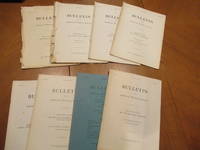
1955réf. 036871Lancaster: American Physical Society 1955. 1st Edition . Soft cover. Near Fine. All Eight Issues In Original Wrappers. All Near Fine Except Number1 Which Has Worn And Frayed Covers Which Are Loose Although Text Pages Near Fine. All Issues Contain Paragraph Summaries Of All Papers Presented At The Society's Sessions. American Physical Society paperback
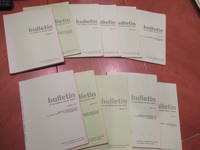
1972réf. 036872Lancaster: American Physical Society 1972. 1st Edition . Soft cover. Near Fine. Twelve Issues In Original Wrappers. All Near Fine. International Postage At Usps Priority Mail Box Rate. American Physical Society paperback
1935réf. 015317Paris: Gauthier-Villars 1935. First Edition . Printed Wrappers. Good. Contents clean and unmarked. Covers with small chips a tear along spine edge at top library markings ex-library California Institute of Technology. With three publishers advertisement sheets for other publications of the time. Gauthier-Villars unknown
1948réf. 032852Utrecht: Drukkerij Fa. Schotanus & Jens 1948. 1st Edition 1st Printing. Soft cover. Good. 130 Pp Errata Printed On Inside Of Rear Cover Also With "Stellingen" Thesis Summary Laid In Loosely. Worn Spine Torn 1/2" Chip At Bottom Covers Split Along Rear Spine Edge So That Coves Detached But Present. Ownership Signature Of Jan Korringa H. A. Kramers' Assistant In Leiden At This Time. Bloembergen Won The Nobel Prize In 1981 For This Work. Drukkerij Fa. Schotanus & Jens paperback
1948réf. 032128Kobenhavn Copenhagen: Det. Kgl. Danske Videnskabernes Selskab 1948. 1st Edition 1st Printing. Soft cover. Near Fine. 144 Pp. Original Beige-Grey Card Covers Printed In Black. Lightly Used No Damage No Wear Or Marks Browning To Edges Of Covers Pages Without Foxing. Det. Kgl. Danske Videnskabernes Selskab paperback
1931réf. 032098Groningen Den Haag: J. B. Wolters Uitgevers-Maatschappij 1931. 1st Edition . Soft cover. Very Good. X 112 Pp. Original Brown Wrappers Printed In Black. Stellingen Statement Of Thesis Laid In Loosely With Printed Card "Receptie Na Afloop Der Promotie In Het Academiegebouw" Also Laid In Loosely. Light Wear At Corners Covers Immaculate Small Chip At Lower Right Corner Of Front Cover And Splits At Sides Of Spine. This Is The Copy Of His Thesis Advisor H. A. Kramer With Small Pencil "/ K" At Top Of Front Cover. Hendrik Brugt Gerhard Casimir 1909 - 2000 Was Best Known For His Research On The Two-Fluid Model Of Superconductors And The Casimir Effect. He Studied Theoretical Physics At Leiden Under Paul Ehrenfest. His Phd Thesis Offered Here Dealt With The Quantum Mechanics Of A Rigid Spinning Body And The Group Theory Of The Rotations Of Molecules. During That Time He Also Spent Some Time In Copenhagen With Niels Bohr And Then Worked With Wolfgang Pauli In Zurich. In 1942 During World War Ii Casimir Moved To The Philips Physics Laboratory Natlab. He Retired From Philips In 1972. Although He Spent Much Of His Professional Life In Industry Hendrik Casimir Was One Of The Great Dutch Theoretical Physicists. Casimir Made Many Contributions To Science During His Years In Research From 1931 To 1950. He Helped Found The European Physical Society And Became Its President From 1972 Till 1975. In 1979 He Was One Of The Key Speakers At Cern's 25Th Anniversary Celebrations. While At Natlab In 1948 Casimir Collaborating With Dirk Polder Predicted The Quantum Mechanical Attraction Between Conducting Plates Now Known As The Casimir Effect Which Has Important Consequences. Casimir Also Worked At Mems Etc. J. B. Wolters Uitgevers-Maatschappij paperback
1960réf. 034864Reading / London: Addison-Wesley Publishing Company 1960. 1st Edition 1st Printing. Hardcover. Near Fine/Very Good. Ix 369 Pp. Grey Cloth Gilt. Near Fine In Dj With Light Wear At Corners And Along Bottom Edge Very Slight Fading To Spine Panel. Addison-Wesley Publishing Company hardcover
1973réf. 020095London: Blackie & Son 1973. First Edition First Printing . Blue Cloth. Near Fine/Near Fine DJ. 221 Pp.Blue Cloth Gilt. First Edition The Uk Edition Precedes The American Edition Published By Hafner. Near Fine In Near Fine Dust Jacket Trace Of Wear. Blackie & Son hardcover
1931réf. 056296Berlin : Verlag Von Julius Springer 1931. 1st Edition 2nd Printing. Hardcover. Near Fine/Near Fine. 469 Pp. Second Printing 1931 18 Pp Longer And With A New Second Preface By Courant. Yellow Cloth. Ownership Signature Of Computer Security Pioneer Donald . Woodbridge On Front Pastedown. Near Fine In Near Fine Dust Jacket Verlag Von Julius Springer hardcover
1985réf. 020449London / Philadelphia: Taylor & Francis 1985. First Edition 1st Printing. Hardcover. Fine/Fine. 427 Pp. Blue Cloth Gilt. First Edition First Printing. As New In As New Dust Jacket. Taylor & Francis hardcover
1939réf. 032861'S-Gravenhage: Martinus Nijhoff 1939. First Separate Edition . Soft cover. Good. 96 Pp. Publisher's Brown Paper Covers Printed In Black. First Printing. Fokker Studied Mining Engineering At The Delft University Of Technology And Physics At The University Of Leiden With Hendrik Lorentz Where He Earned His Doctorate In 1913. He Continued His Studies With Albert Einstein Ernest Rutherford And William Bragg. In His 1913 Thesis He Derived The Fokker-Planck Equation Along With Max Planck. After His Military Service During World War I He Returned To Leiden As Lorentz' And Ehrenfest's Assistant. In 1928 Fokker Succeeded Hendrik Lorentz As Director Of Research At Teylers Museum In Haarlem. In 1938 He Helped Lise Meitner Escape The Nazi's. Quite Scarce Lectures Only 3 Institutional Holdings Shown In Worldcat. Slight Wear To Covers Which Are Browning At Edges But Paper Spine Is Completely Perished. A Few Pencil Notes By Student Jan Korringa Later A Physicist And Assistant To Kramers. Inscribed "Rey/Sept. '39" At Top Of Title Page Probably For H. A. Kramers. Martinus Nijhoff paperback
1946réf. 035871New York: The Macmillan Company 1946. 1st Edition 1st Printing. Red Cloth. Near Fine/No DJ. X 161 Pp. Red Cloth. First American Printing With 1946 Date In Title Page. Near Fine Slight Rubbing At Corners Spine Lettering Strong. Former Owner's Name On Front Pastedown. A Scarce Books As Gamow's Concern Was Not Stupid Enough For Leaders Yet He Could Not Be Argued With Due To His Intelligence Rather Than His Position In Some Institution. He Apparently Distributed Some Copies Himself; We Sold One Pointedly Inscribed To Admiral Chester Nimitz. The Macmillan Company hardcover
1965réf. 033385New York: The American Physical Society 1965. 1st Edition . Soft cover. Near Fine. Entire Issue In Original Blue-Green Wrappers. Near Fine. In 1965 "Pauling Spent Much Of His Time Away From Santa Barbara Developing A New Model Of The Atom Which He Called The Close-Packed-Spheron Model Of Atomic Nuclei. This Theory Of Nuclear Structure Was Published In Four Different Articles "Structural Significance Of The Principal Quantum Number Of Nucleonic Orbital Wave Functions" Phys. Rev. Lett. September 1965; "Structural Basis Of Neutron And Proton Magic Numbers In Atomic Nuclei" Nature October 1965; "The Close-Packed-Spheron Model Of Atomic Nuclei And Its Relation To The Shell Model" Proc. Natl. Acad. Sci. October 1965; And "The Close-Packed-Spheron Theory And Nuclear Fission" Science October 1965 Each Of Which Addressed Different Implications Of The Theory. Pauling'S Work Dealt With "Magic Numbers" And Nuclear Subshells. Previously It Was Known That Magic Numbers Describe The Quantity Of Protons And Neutrons That Make An Atom Particularly Stable. Pauling'S Theory However Suggests That The "Magic" Qualities Associated With These Numbers Of Nuclear Components Corresponds To The Filling Of Nuclear "Spherons" Or Nuclear Sub-Units Where Protons And Neutrons Are Arranged. These Spherons Or Sub-Units Were Also Referred To As Shells In Previous Theories. The Close-Packed Theory Therefore Suggests That Nuclear Components Form Clusters Rather Than Arranging As Independent Particles. The Close-Packed-Spheron Model Was Based On The Earlier Nuclear Shell Theory. Pauling Took The Nuclear Shell Theory A Step Further By Attempting To Explain Why Specific Numbers Of Protons And Neutrons Cause Greater Nuclear Stability. The Close-Packed-Spheron Model States That The Lower Magic Numbers Represent Atoms In Which The First Or Second Nuclear Shells Are Filled And That Higher Magic Numbers Correspond To A Special "Mantle" Shell; That Is A Hybridized Shell That Can Form If Greater Amounts Of Nuclear Components Arrange Into Spheres. In Developing His Model Pauling Was Trying To Explain The Arrangement Of Nuclear Components By Simplifying Previous Theories And Applying The Principles Of Electron Orbitals To Protons And Neutrons In The Atomic Nucleus. Pauling'S Past Work Had Helped To Establish The Principles Of Electron Orbital Hybridization And He Hoped That This New Work Would Yield Similar Fruit For The Atomic Nucleus. If Such Were The Case It Would Then Be Possible To Explain The Stability Of Atoms With Magic Numbers And The Geometric Arrangement Of Protons And Neutrons. Pauling'S Close-Packed Theory Was Interesting And Relatively Simple; However It Failed To Spark Interest Among Many Other Scientists. For The Next Several Years Pauling Continued To Advocate For The Theory And In June 1974 He Applied For A National Science Foundation Grant To Support Further Theoretical Research On The Structure Of Atomic Nuclei. The Application Was Denied And Pauling Turned His Attentions Elsewhere." See The Pauling Blog. The American Physical Society paperback
1969réf. 051925University of Tennessee Press 1969. 1st Edition 1st Printing. Hardcover. Fine/Very Good. Xi348 Pp. Yellow Cloth Spine Lettered In Gilt On Black. Near Fine No Marks. Dust Jacket Priced $10.50 Wear A Few Short Tears And Minute Losses. University of Tennessee Press hardcover
1952réf. 043043Cambridge: Addison-Wesley Press 1952. 1st Edition 1st Printing. Hardcover. Near Fine/Very Good. Illustrations Throughout. Xx 650 Pp. Maroon Cloth Spine Gilt Over Lighter Colored Boards. First Printing. Near Fine In Dj With 2 Half Inch Closed Tears Top Of Front Panel A Few Minute Losses On Top Edge Of Spine. Spine Panel Faded. With An Offprint Of The One Page Review From The Proceedings Of The Physical Society By R. Furth. Addison-Wesley Press hardcover
1952réf. 034532Cambridge: Addison-Wesley Press 1952. 1st Edition 1st Printing. Hardcover. Near Fine/Very Good. Illustrations Throughout. Xx 650 Pp. Maroon Cloth Spine Gilt Over Lighter Colored Boards. First Printing 1952 Date On Title Page. Near Fine Tiny Name Stamp Of Prominent Physical Chemist Robert B. Soosman On Front Endpaper In Vg Dj With Price Clipped Very Shallow Chipping At Ends Of Spine 1/4" Deep By 1/8" Chip At Top Of Front Flap Fold Spine Panel Faded. . Addison-Wesley Press hardcover