3 424 résultats
réf. DADAX0750309490New unknown
réf. DADAX0750310308New unknown
réf. DADAX0321976444New unknown
réf. DADAX0849323789New unknown
réf. SONG1461364612Used: Good unknown
réf. SONG1402065019Used: Good unknown
réf. DADAX0134081498New unknown
réf. DADAX0471445282New unknown
réf. DADAX0134159381New unknown
réf. DADAX0135216117New unknown
réf. SONG0387951199Used: Good unknown
1985réf. 046468Princeton: Princeton Univ Press 1985. 1st Edition 1st Printing. Hardcover. Near Fine/Fine. X 158. Black Cloth Spine Stamped In Gilt Other Printings Have Spine Stamped In Metallic Violet. Early Printing Book Without Indication Of Later Printing Same As First Issue But Without Review Of Peierls' Book On Dj Rear Flap First Printings Had An Ad For Peierls' Book At The Bottom Of The Rear Flap According To A March 1986 Letter From The Publisher To Feynman. Alix G. Mautner Memorial Lecture On The Theory Of Light Written For A Popular Audience. Book Fine No Wear Or Damage Small Owner's Name And 1988 Date At Top Of Front Free Endpaper. Dust Jacket Priced $18.50 Is Fine No Wear Spine Lettering Slightly Faded To A Greyish-Purple. Princeton Univ Press hardcover
1958réf. 060238New York: Hutchinson & Co 1958. 1st Edition 1st Printing. Hardcover. Near Fine/Near Fine DJ. 192 Pp.Black Cloth Stamped In Silver. First Printing "First Published 1958". Book Clean Gilt Bright No Wear No Marks. Dj Not Price Clipped 16S Net Slightly Used And Soiled / Foxed Browning To Spine And Edges 1 1/4" Closed Tear At Bottom Of Front Panel. Hutchinson & Co hardcover
1958réf. 059926New York City Ny: Basic Books 1958. 1st Edition 1st Printing. Hardcover. Fine/Near Fine. 362 Pp. Green And Black Cloth Gilt. First Printing. Fine In Near Fine Unfaded Dust Jacket Priced $6.00. Serious Articles Almost Certainly The First Book Printing Of The Feynman Talks And Also The Oppenheimer Talk At Caltech. Basic Books hardcover
2005réf. 056862Basic Books Perseus Books 2005. 1st Edition 1st Printing. Hardcover. Fine/Fine. Xviii254 Pp. Dark Blue And Medium Blue Boards. First Printing Indicated. Signed By Laughlin 5. Fine In Fine Dust Jacket Priced Us$26.00. Per Wikipedia Robert Betts Laughlin Born 1950 Is The Anne T. And Robert M. Bass Professor Of Physics And Applied Physics At Stanford University. Along With Horst L. Störmer Of Columbia University And Daniel C. Tsui Of Princeton University He Was Awarded A Share Of The 1998 Nobel Prize In Physics For Their Explanation Of The Fractional Quantum Hall Effect. In 1983 Laughlin Was First To Provide A Many Body Wave Function Now Known As The Laughlin Wave-Function For The Fractional Quantum Hall Effect Which Was Able To Correctly Explain The Fractionalized Charge Observed In Experiments. This State Has Since Been Interpreted As The Integer Quantum Hall Effect Of The Composite Fermion. His 2017 Paper "Pumped Thermal Grid Storage With Heat Exchange" Inspired Project Malta At Google X And Subsequently Malta Inc. Basic Books ( Perseus Books) hardcover
1920réf. 032975Haarlem: De Erven Loosjes 1918 1920. First Separate Edition . Soft cover. Good. 76 Pp. Light Beige Wrappers Printed In Black. Publisher's Offprint Dated 1920 Edited By Keesom Of This Paper By Lorentz First Published In 1918. Wear And Losses To Paper Backstrip Front Cover Detached And Rear Cover Almost Detachedslight Wear At Tip With Very Small Corner Chip At Lower Front Tips. Paper Browning A Little Fading And Browning To Covers. No Names Or Marks But Bookplate Of A Well-Published Leiden-Trained Mathematical Physicist Jan Korringa. Handwritten Title On Spine. With The Three Summary Handouts For The Lectures De Electronentheorie I Ii And Iii Of 7 8 And 10 Pp. Pencil Notes And Formulae Probably By H A Kramers Who Attended These Lectures And Passed Many Of His Books On To His Student And Later Principal Assistant Korringa. The Three Class Summaries Are Scarce. De Erven Loosjes (1918) paperback
1912réf. 035654Archives Neerlandaises Des Sciences Exactes 1912. First Separate Edition . Soft cover. Near Fine. Pp 1-15 Published Beginning At P. 139 In "The Archives" But Here Paginated 1-15. Tan Wrappers Printed In Black. Publisher's Offprint For The Author. First Separate Edition. Near Fine No Damage. Archives Neerlandaises Des Sciences Exactes paperback
réf. SONG3540360565Used: Good unknown
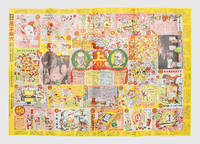
1949réf. 193149Tokyo: Nihon Hatsumei Shinbunsha c. 1949. An educational board game similar to snakes and ladders teaching the history of atomic physics. Four characters named "Proton" "Neutron" "Electron" and "Meson" accompany the players from the discovery of the X-ray to the Bikini Atoll nuclear bomb tests. It was released to celebrate Yukawa Hideki winning the Nobel Prize the first Japanese person to do so. Sugoroku board games were produced in Japan since the early modern period and were often used as educational tools for young children. This example is focused on nuclear physics using bright colours and cartoon illustrations to explain complex concepts. The players start at the discovery of the X-ray move to Marie Curie's radium experiments one of the characters states "I suppose Marie Curie is like a mother to us" learn about the invention of Wilson's cloud chamber before being introduced to man-made radiation the splitting of the atom the invention of the cyclotron and the idea of a nuclear chain reaction. The centre of the board advocates for nuclear energy being used for good with the slogan "No more Hiroshimas!". Yukawa Hideki 1907-1987 received the Nobel Prize in 1949 for predicting the existence of mesons carrying the strong nuclear force. Colour paper game board 529 x 754 mm folding to 267 x 178. Text in Japanese. With original colour pictorial wrapper 255 x 181 mm. Board bright creased where folded; short closed tear to wrapper at head: a near-fine copy in like wrapper. unknown
réf. DADAX0471438162New unknown
réf. DADAX0321035720New unknown
réf. DADAX0471926515New unknown
réf. DADAX0471214523New unknown
1957réf. 50909Lancaster American Physical Society 1957. Lex8vo. In the original printed orange wrappers. In "Reviews of Modern Physics" Volume 29 April No. 2 1957. Entire issue offered. Lacking backtrip and stamp to front wrapper Langley Aeronautical Laboratory. Otherwise a fine a copy. Feynman Pp. 205-212. Entire issue: Pp. 159-254. First printing of the Reviews of Modern Physics issue entirely dedicated to the International Congress on Theoretical Physics held in Seattle Washington 1957. The congress turned out to be exceptionally important in the field of superconductivity and Feynman here presented his only paper on the subject even though he spend most of the 1950ies on precisely this. Feynman's work on the subject led directly to Bardeen's focus on the subject which eventually resulted on Bardenn Leon Cooper and John Robert Schrieffer published their famous BCS-theory paper in 1957:"John Bardeen already well-known for his work leading to the discovery of the transistor turned his full attention to superconductivity in 1951 having realized that the isotope effect identified the interaction between electrons that must be responsible for the phenomenon. The basic idea would be a Fermi-degenerate gas of nearly free electrons with a weakly attractive interaction by way of the lattice phonons. Solving that problem - for example finding the ground state of such a system - proved to be a difficult task. There was also the threat of powerful competition. Richard Feynman one of the masters of quantum electrodynamics could not help but notice the similarity between that problem and this one. By 1955 by then at the University of Illinois at Urbana Bardeen decided that reinforcements were needed. He called up C. N. Yang at the Institute for Advanced Study at Princeton to ask for a postdoc versed in the kind of field theory one uses in quantum electrodynamics. Yang recommended Leon Cooper. At about the same time one of Bardeen's graduate students J. Robert Schrieffer decided to work on superconductivity. The team was assembled. In the cramped quarters of the University of Illinois physics department Bardeen and Cooper had to share an office a hardship that did not prove to be an obstacle to progress. The team worked furiously in early 1957 driven in part by the feeling that Feynman was hot on the trail using powerful new techniques they knew little about. However it was not Feynman but Bardeen Cooper and Schrieffer who produced the microscopic theory" Goodstein Richard Feynman and the History of Superconductivity. unknown
réf. DADAX0471222917New unknown