234 resultados
1926ref. 50187Paris, Gauthier-Villars et Cie, 1926. 8vo. Bound with orig. printed wrappers in contemp. hcloth. Spine gilt with gilt lettering. A small part of lower spine with a bit of discolouring after a papelabel. A punched stamp on top of title-page. Light wear along edges of boards.VI,133,(1) pp. and (2) pp. of announcements. Textfigs. Internally clean.
1926ref. 50187Paris Gauthier-Villars et Cie 1926. 8vo. Bound with orig. printed wrappers in contemp. hcloth. Spine gilt with gilt lettering. A small part of lower spine with a bit of discolouring after a papelabel. A punched stamp on top of title-page. Light wear along edges of boards.VI1331 pp. and 2 pp. of announcements. Textfigs. Internally clean. First edition. In this work De Broglie set forth the idea that electrons as was previously regarded as particles also have wave-quaracters as well as light has. The idea was tested and confirmed by Davisson and Germer the year after in 1927. Also Schrödinger took up the idea and formulated his wave-equation explaning the stationary states of the electron of Niels Bohr by applying De Broglie's concept of electrons as waves to the hydrogen atom. "Thus the duality of both light and matter had been established and physicists had to come to terms with fundamental particles which defied simple theories and demanded two sets of 'complementary' descriptions each applicable under certain circumstances but imcompatible with one another." PMM: 417. hardcover
ref. DADAX0849394600New unknown
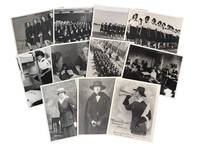
1968ref. 235551968. U.S. Navy women's service press photograph archive released by the U.S. Naval Historical Center in 1968 documenting how the Navy represented women's military labor across World War I World War II and later twentieth century service. The group links the Yeomen F of 1918 the first women formally enlisted in the U.S. Navy to the WAVES established during World War II and still present in postwar naval administration inspection training and ceremony. The photographs show women's military participation as clerical work uniformed discipline barracks life recruitment public parade and institutional remembrance. Photo archive of 11 Large silver gelatin press photographs most measuring 8" x 10" released by the U.S. Naval Historical Center Al images produced in 1968 with images subjects from 1918 to the 1960s. The photos show a Navy Department office in Washington D.C. in 1918 with uniformed and civilian personnel at desks; a woman identified in the caption as "Counselor Eastwood in the office"; a group of WAVES passing in review on an airfield; women marching in formation in New York City during a wartime bond drive; women seated in an auditorium; uniformed officers posed outside a building marked "Uniforms"; a woman in Navy dress working beside a bunk; and a line of women in white shirts and dark skirts marching in formation. Earlier Navy memory appears through portraits of Julia Washington Allen Yeoman F First Class shown with her cap turned to reveal "U.S.N." and "Yeoman F" lettering and Elsie M. Long Yeoman Second Class identified as serving on active duty from October 7 1918 to June 4 1919. A recruiting poster reads "Women awake! Your country needs you. Learn to be of national service. Join the Navy League. Help the Navy local headquarters." Women entered the Navy in large numbers during World War I because clerical expansion created a labor need that could be filled under existing enlistment language; Yeomen F worked as stenographers clerks translators messengers radio operators and office personnel while remaining segregated by gendered expectations of acceptable service. During World War II the WAVES brought women into the Naval Reserve under a formal wartime structure expanding their work into administration communications aviation support supply intelligence training and stateside naval operations. These 1968 release photographs show how the Navy later organized that history for public use: women appear as disciplined personnel administrative workers patriotic recruits and predecessors in a service tradition that the institution could claim as part of its own record. Light surface and corner wear verso captions stamps and release labels. Overall very good condition. An official record of how the U.S. Navy preserved and circulated the history of women's military service from the Yeomen F to the WAVES and their postwar successors. unknown
1968ref. 235551968. U.S. Navy women's service press photograph archive released by the U.S. Naval Historical Center in 1968 documenting how the Navy represented women's military labor across World War I World War II and later twentieth century service. The group links the Yeomen F of 1918 the first women formally enlisted in the U.S. Navy to the WAVES established during World War II and still present in postwar naval administration inspection training and ceremony. The photographs show women's military participation as clerical work uniformed discipline barracks life recruitment public parade and institutional remembrance. Photo archive of 11 Large silver gelatin press photographs most measuring 8" x 10" released by the U.S. Naval Historical Center Al images produced in 1968 with images subjects from 1918 to the 1960s. The photos show a Navy Department office in Washington D.C. in 1918 with uniformed and civilian personnel at desks; a woman identified in the caption as "Counselor Eastwood in the office"; a group of WAVES passing in review on an airfield; women marching in formation in New York City during a wartime bond drive; women seated in an auditorium; uniformed officers posed outside a building marked "Uniforms"; a woman in Navy dress working beside a bunk; and a line of women in white shirts and dark skirts marching in formation. Earlier Navy memory appears through portraits of Julia Washington Allen Yeoman F First Class shown with her cap turned to reveal "U.S.N." and "Yeoman F" lettering and Elsie M. Long Yeoman Second Class identified as serving on active duty from October 7 1918 to June 4 1919. A recruiting poster reads "Women awake! Your country needs you. Learn to be of national service. Join the Navy League. Help the Navy local headquarters." Women entered the Navy in large numbers during World War I because clerical expansion created a labor need that could be filled under existing enlistment language; Yeomen F worked as stenographers clerks translators messengers radio operators and office personnel while remaining segregated by gendered expectations of acceptable service. During World War II the WAVES brought women into the Naval Reserve under a formal wartime structure expanding their work into administration communications aviation support supply intelligence training and stateside naval operations. These 1968 release photographs show how the Navy later organized that history for public use: women appear as disciplined personnel administrative workers patriotic recruits and predecessors in a service tradition that the institution could claim as part of its own record. Light surface and corner wear verso captions stamps and release labels. Overall very good condition. An official record of how the U.S. Navy preserved and circulated the history of women's military service from the Yeomen F to the WAVES and their postwar successors. unknown books
2017ref. B2508221IMEAK Deniz Ticaret Odasi 2017. n/a IMEAK Deniz Ticaret Odasi unknown
2012ref. 046360Istanbul: Boyut Yayincilik 2012. Hardcover. New. 4to - over 9¾ - 12" tall. Original bdg. HC. In publisher's special box. 4to. 33 x 33 cm. In Turkish. 311 p. color ills. Kayip dünyalar atlasi. Atlas of lost civilizations. Boyut Yayincilik hardcover
1888ref. PHO-823Cambridge ,Deighton, Bell & Co., 1888. 2 volumes , in-8° , relié percale éditeur , XII-264pp , XVI-328pp , première édition rare, cachet ,bon état.
ref. DADAX047149058XNew unknown
ref. DADAX0367198789New unknown
1899ref. 2111902160600496Shun'yo-do 1899. Soft Cover. Fine. Size: paperback Shun'yo-do paperback
ref. DADAX1466515317New unknown
ref. DADAX0470033606New unknown
ref. DADAX0125286295New unknown
ref. DADAX0412547104New unknown
ref. 39795, , in-8, , étui-chemise, Cet ensemble est constitué des plaquettes suivantes : SARASIN (Ed.) & DE LA RIVE (L.) : Sur les ondulations électriques hertziennes dans l'airÉ Genève, 1890, 3pp. - CARPENTIER (J.) : La télégraphie hertzienne (Congrès de Montauban) É Paris, 1902, 14pp. - DUBOIS (E.). Ondes hertziennes. Leur application à la télégraphie É Amiens, 1903, 50pp. (envoi autographe signé à Henri Becquerel) Couverture rigide
194540 pages. Features: Dramatic cover photo of a Pacific LCI firing rockets; This is the Army We Have to Defeat - a picture of the Japanese soldier and of the organization of which he is the core; The Aircraft Carrier - lethal sea weapon and powder keg, too; Col. Howard A. Rusk explains the returning soldier's emotional problems and offers a solution; The Mediterranean will become a highway for all nations; Greatest Education Project in History - set up by our Army in Europe, it will have more than a million GI students; Claude R. Wickard explores Rural Electrification (RE); They Do a Sailor's Job - Six photos of female Waves at work in the U.S. Navy; Man of Science and of Penicillin - Sir Alexander Fleming talks of his discovery and its future promise; Nice color one-page ad for Virginia Rounds cigarettes; Good Words for Insects; Four photos of famous art pieces being returned to the Louvre from their provincial hiding places; Two pages of fashion photos of autumn suits for ladies; Nice color-photo back page Macy's ad features three ladies in winged-look raincoats; and more. Moderate external soiling and wear. Unmarked. Moderate age-toning to paper. A sound copy of this vintage WWII issue. Book
ref. DADAX0367091771New unknown
ref. DADAX0387205756New unknown
ref. DADAX0470012951New unknown
1901ref. 2111902160303486Hakubunkan 1901. Soft Cover. Fine. Number of pages: 57 pages Size: A5 size Hakubunkan paperback
ref. DADAX0470108851New unknown
ref. DADAX0521865549New unknown
189075 pages. The first eight pages are devoted to "Drills, Pantomines and Motion Songs - Swimming Drill" and are cutely illustrated with sketches of children performing the various motions. Next come 9 pages of "Marching and Motion Songs for Schools" which include words and piano music. Pages 19 through 61 cover Motion Songs with piano music included for most - songs include The Brook, Our Flag, The Violets, The Leaves, What the Wind Says, Fife and Drum, Little Things, On the Lake, Pussies, The Farm, The Meadows, Good Night, Song of the Waves, and Japanese Parasol Drill. Pages 62 through 75 are devoted to Marches and include diagrams. Heavily worn, soiled and stained yet binding remains intact. Page 17 missing. Prior owner's name atop front free endpaper else unmarked. While copy has seen considerable use, it retains its vintage charm. Book
196988 pages. Features/Articles: The alarming mystery of radar waves - What are we doing to huma life?; John Morgan and Martin Bronstein of the TV show Comedy Cafe; Editorial - let this be our last year in NATO; Pauline Jewett - Ottawa starts a department to fight poverty; nice colour photo ad for the Olds Delta 88 Royale; Interview with Arthur Hailey; Roloff Beny's India - lengthy article with great colour photos; John Doyle and his gamble with millions - the controversial mining promoter and close friend of Newfoundland Premier Joseph Smallwood; How to be a Global Villager; Nice colour photo ad for the Pontiac GTO and Firebird; Color them Big Ink - a Canadian band with members Robbie Robertson, Dick Manuel, Garth Hudson, Rick Danko and Levon Helm; Success Can't Spoil Bobby Orr - article with two photos; Great Chrysler colour photo ad for the New Yorker, Chrysler 300 and Newport Custom; Colour ad of the CTV news team including Harvey Kirck and twenty-five well-dressed others; Three Designing Models - Deborah Thompson, Judith Davies and Dona Saunders; Anyone Can Steal a Million - bank clerk Ann Spiller stole $492,000 and fooled the town of Penticton, BC; Some pages yellowed with age. Address label on front cover otherwise unmarked. Moderate wear. Binding sound. A quality copy of this great vintage issue. Book