Navy WAVESABAA
151 Ergebnisse
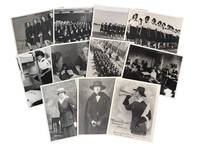
1968Best.-Nr. 235551968. U.S. Navy women's service press photograph archive released by the U.S. Naval Historical Center in 1968 documenting how the Navy represented women's military labor across World War I World War II and later twentieth century service. The group links the Yeomen F of 1918 the first women formally enlisted in the U.S. Navy to the WAVES established during World War II and still present in postwar naval administration inspection training and ceremony. The photographs show women's military participation as clerical work uniformed discipline barracks life recruitment public parade and institutional remembrance. Photo archive of 11 Large silver gelatin press photographs most measuring 8" x 10" released by the U.S. Naval Historical Center Al images produced in 1968 with images subjects from 1918 to the 1960s. The photos show a Navy Department office in Washington D.C. in 1918 with uniformed and civilian personnel at desks; a woman identified in the caption as "Counselor Eastwood in the office"; a group of WAVES passing in review on an airfield; women marching in formation in New York City during a wartime bond drive; women seated in an auditorium; uniformed officers posed outside a building marked "Uniforms"; a woman in Navy dress working beside a bunk; and a line of women in white shirts and dark skirts marching in formation. Earlier Navy memory appears through portraits of Julia Washington Allen Yeoman F First Class shown with her cap turned to reveal "U.S.N." and "Yeoman F" lettering and Elsie M. Long Yeoman Second Class identified as serving on active duty from October 7 1918 to June 4 1919. A recruiting poster reads "Women awake! Your country needs you. Learn to be of national service. Join the Navy League. Help the Navy local headquarters." Women entered the Navy in large numbers during World War I because clerical expansion created a labor need that could be filled under existing enlistment language; Yeomen F worked as stenographers clerks translators messengers radio operators and office personnel while remaining segregated by gendered expectations of acceptable service. During World War II the WAVES brought women into the Naval Reserve under a formal wartime structure expanding their work into administration communications aviation support supply intelligence training and stateside naval operations. These 1968 release photographs show how the Navy later organized that history for public use: women appear as disciplined personnel administrative workers patriotic recruits and predecessors in a service tradition that the institution could claim as part of its own record. Light surface and corner wear verso captions stamps and release labels. Overall very good condition. An official record of how the U.S. Navy preserved and circulated the history of women's military service from the Yeomen F to the WAVES and their postwar successors. unknown books
1944Best.-Nr. 167161944. Bloom Ensign. Naval Procurement Office. Typed Letter Signed 14 December 1944-. page In part: "Behind each exciting headline you are measuring contribution your daughter is making. President Roosevelt said 'The WAVES have proved they are capable of accepting the highest service to their country. The Navy WAVES were an all-female component of the military and the first division to give female officers the same rank and pay as their male counterparts in other divisions. signed by Ensign Barbara Bloom. unknown books
1951Best.-Nr. 17865San Angelo Texas: Newsfoto Publishing Company 1951 No copies recorded on OCLC. Anchor and Blades is a yearbook documenting the WAVES at the United States Naval Training Center in Great Lakes Illinois. The candid photos throughout the book feature women being outfitted for uniforms exercising and playing sports and ultimately graduating from the training program. Among the last pages of the book there are portraits labeled with names in a yearbook style for the women in Companies 14 and 15 who were graduating. The history of the training center can also be traced as the photos include shots of the buildings and grounds. . Blue cloth with embossed hat decoration and lettering. Gold lettering of title is designed to look like a rope. Colored image pasted to front cover. Photographic endpapers. . Quarto. 11 in. x 8 in. . Photographically reproduced illustrations on every page. Light bumping and wear to spine ands and lower corners. A very good copy. The WAVES Women Accepted for Volunteer Emergency Service also known as the Women's Reserve was the women's branch of the Naval Reserve during World War II. WAVES was established in 1942 when the Navy was authorized to accept women for the duration of war time plus six months. This measure was taken with the intention of sending men off to sea duty and replacing them with women on the shores. In order to be eligible for WAVES training school women had to be between 20 and 49 years old and have a college degree or two years of work experience. Newsfoto Publishing Company, [ hardcover books
1967Best.-Nr. 55415New York, Interscience Publishers (Interscience Tracts on Physics and Astronomy, No. 3), 1967. IX, 170 S. (21 cm) Kunststoffeinband / Gebundene Ausgabe
1963Best.-Nr. 5043New York, W. A. Benjamin (Frontiers in Physics), 1963. An Introduction für experimentalists XI, 123 S.; 23 cm Broschur
1977Best.-Nr. 52572New York: John Wiley & Sons, 1977. XII, 527 S. (24 cm) illustrierter Pappband / gebundene Ausgabe
1965Best.-Nr. 8969Berlin u.a., Springer, 1965. A Reprint of five Memoirs ca. 100 S. (Paginierung unterbrochen), (26 cm) Leinen / gebundene Ausgabe
1961Best.-Nr. 6885New York: W. A. Benjamin (Frontiers in Physics), 1961. X, 249 S. (23 cm) Broschur
1970Best.-Nr. 52764London etc., Thomas Nelson (Applications of Mathematics), 1970. VI, 348 s. (23 cm) Broschierte Ausgabe
1976Best.-Nr. 52574New York: Academic Press, 1976. XXI, 458 S. (23,5 cm) Leinen / gebundene Ausgabe
1972Best.-Nr. 54958Bonn, Bouvier Verlag Herbert Grundmann, 1972. origi.Broschur, gr.8°, 309 Seiten. Abhandlung zur Kunst.- Musik- und Literaturwissenschaft, Band 132.
1983Best.-Nr. 3116495St Jean de Braye: Editions Dangles 1983. 408 Seiten. 8° (17,5-22,5 cm). Illustrierte Orig.-Broschur. [Softcover / Paperback].
2017Libro rilegato come nuovo; copertina leggermente rovinata; Copertina rigida; tracce di leggera usura
1999Roy. 8vo., First Edition, with 46 plates on 32; cloth, gilt back, a near fine copy in unclipped dustwrapper. Detailed accounts of over a dozen individual U-boat careers augmented by a very good selection of well-chosen photographs.
19318vo., Second Impression, with numerous illustrations and diagrams in the text, small neat contemporary signature on front free endpaper, some faint offsetting from fold-ins to free endpapers; original grey cloth, gilt back, grey endpapers, a near fine copy in unclipped dustwrapper, the latter with minor loss at head and tail of backstrip, and browned at backstrip and rear panel. First published in the previous year. Wood was at this time Lecturer in Experimental Physics at Cambridge. The lectures comprise I: Waves; II: Signalling in Air and Water; III: Notes and Noises; IV: How Sounds are Analysed; V: The Ear and What it Does; VI: How Sounds are Recorded and Reproduced. Scarce in the dustwrapper.
1965Chiron, 1965. In-4 relié pleine toile éditeur de 168 pages. Nombreuses photos et planches hors texte. Très bon état
First Edition, viii, 122 pp., 6 folding engraved plates, nineteenth century half calf, from the library of the Northern Lighthouse Board with the coat of arms in gilt at the head of the spine, 5 raised bands on spine, ruled in gilt, morocco label, a very nice copy.
1966Inscribed by author on publisher's page. Full blue cloth boards. Endpapers split at front and rear hinges, but not loose. 9 1/8"w x 11"h. 30 pages. Illustrations in color by Napoli.
1921n 4° ; (8), VI, 625, (7) pp. Brossura editoriale originale con titolo impresso in nero in campo giallo ed entro cornice xilografica al piatto anteriore ed al dorso. Opera uscita nella collana “Grandes Encyclopedier Industrielles J.-B. Bailliere” nella parte riservata alla “Encyclopedie d'Electricite Industrielle” diretta da A. Blondel. Esemplare ancora a fogli chiusi, mai letto. Prima edizione rara ed in ottime condizioni di conservazione. Unico difetto una piccolissima ed ininfluente mancanza all'angolo superiore del piatto posteriore e per il resto senza difetti. Rara opera che illustra i progressi tecnologici raggiunti dalla tecnologia telegrafica (di terra, sottomarina, aerea, senza fili). Numerosissimi schemi tecnici e immagini nel testo. Nell'opera vengono presentate anche alcune delle macchine più innovative come la Pollak-Virag l'antenato del Fax. L'opera presenta anche un'importante apparato di studi degli impulsi elettrici. VERY GOOD COPY WITH THE ORIGINAL BROCHURE. RARE.
1916In 4°; XI, (1), 415, (1) pp. Legatura editoriale in piena tela verde con titolo impresso in oro al piatto anteriore, un minimo ed ininfluente difetto alla cerniera posteriore, senza perdita di materiale, nel complesso in ottime condizioni di conservazione. Ottimo esemplare. Varie immagini e schemi tecnici nel testo. Prima rarissima edizione francese di uno dei più celebri manuali di telegrafia senza fili, scritto dal grande professore scozzese di telegrafia senza fili e telefonia James Murray Erskine, tradotto da Henri Magniez ingegnere elettrico della Compagnia Generale di Radiotelegrafia. James Erskine-Murray (1868-1927), scozzese di nascita, fu uno dei più grandi esperti del suo tempo di tecnologia wireless. Si formò per sei anni studiando sotto Lord Kelvin presso l’Università di Glasgow prima di arrivare al Trinity College di Cambridge come studente di ricerca. Finiti gli studi divenne un consulente telegrafia e pubblicò quest’opera per la prima volta nel 1907. Il lavoro ebbe enorme successo prima nei paesi anglosassoni dove nel giro di meno dieci anni ebbe 6 ristampe e poi grazie a questa traduzione francese anche nel resto d’Europa. Il suo scopo era quello di informare i tecnici, studenti e operatori radio su molti aspetti di una tecnologia in rapida evoluzione. Il libro copre i recenti sviluppi del tempo. L’opera si pone come un classico precoce nel campo della progettazione e delle onde radio e offrì agli studenti contemporanei e appassionati di radio una guida utile e specifica sulle prime tecnologie wireless. Esemplare assai raro e ancor più raro in queste ottime condizioni di conservazione. A good copy.
1940A group of contributions to ultra-high-frequency radio engineering, including studies of frequency modulation, which originated in the laboratories of the Radio Corporation of America. 448 pages. Slight wear to cover edges, small surface tear to front cover edge, a little dogeared,
1988Book is in excellent condition. Binding is solid and square, exterior shows no blemishes, text/interior is clean and free of marking of any kind. Dust jacket shows signs of shelf wear only, no large tears. 658 pages with charts, graphs, b&w photos and images, tables, formulae. Book is divided into 9 sections, each with 5-9 articles by different authors about a particular subject. Sections include: Imagine techniques; NDE and materials characterization, Medical imaging, Acoustic holography and tomography, Tissue characterization, Inverse scatering, Imaging techniques II, Acoustic microscopy, Seismic, underwater and source location.
1984Book is in excellent condition. Binding is solid and square, covers have sharp corners, exterior shows no blemishes, text/interior is clean and free of marking of any kind. Dust jacket shows the slightest signs of shelf wear only, no tears. 332 pages in seven chapters including Fundamental principles, Elementary results from the field equations, The euler equations in steady flow, transonic phenomenology, The transonic flow small disturbance eqations, Transonic Viscous flows. Graphs, tables, charts, lots of formulae.
1987Book is in excellent condition. Binding is solid and square, covers have sharp corners, exterior shows no blemishes, text/interior is clean and free of marking of any kind. 167 pages with 250 illustrations covering about 180 artists, listed at the back. 10"w x 9 3/4"h.
2016français In-12 paginé de 127p.; broché de l'éditeur.


