3 results
1944ref. 167161944. Bloom Ensign. Naval Procurement Office. Typed Letter Signed 14 December 1944-. page In part: "Behind each exciting headline you are measuring contribution your daughter is making. President Roosevelt said 'The WAVES have proved they are capable of accepting the highest service to their country. The Navy WAVES were an all-female component of the military and the first division to give female officers the same rank and pay as their male counterparts in other divisions. signed by Ensign Barbara Bloom. unknown books
1951ref. 17865San Angelo Texas: Newsfoto Publishing Company 1951 No copies recorded on OCLC. Anchor and Blades is a yearbook documenting the WAVES at the United States Naval Training Center in Great Lakes Illinois. The candid photos throughout the book feature women being outfitted for uniforms exercising and playing sports and ultimately graduating from the training program. Among the last pages of the book there are portraits labeled with names in a yearbook style for the women in Companies 14 and 15 who were graduating. The history of the training center can also be traced as the photos include shots of the buildings and grounds. . Blue cloth with embossed hat decoration and lettering. Gold lettering of title is designed to look like a rope. Colored image pasted to front cover. Photographic endpapers. . Quarto. 11 in. x 8 in. . Photographically reproduced illustrations on every page. Light bumping and wear to spine ands and lower corners. A very good copy. The WAVES Women Accepted for Volunteer Emergency Service also known as the Women's Reserve was the women's branch of the Naval Reserve during World War II. WAVES was established in 1942 when the Navy was authorized to accept women for the duration of war time plus six months. This measure was taken with the intention of sending men off to sea duty and replacing them with women on the shores. In order to be eligible for WAVES training school women had to be between 20 and 49 years old and have a college degree or two years of work experience. Newsfoto Publishing Company, [ hardcover books
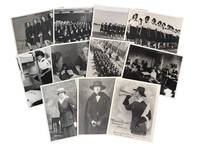
1968ref. 235551968. U.S. Navy women's service press photograph archive released by the U.S. Naval Historical Center in 1968 documenting how the Navy represented women's military labor across World War I World War II and later twentieth century service. The group links the Yeomen F of 1918 the first women formally enlisted in the U.S. Navy to the WAVES established during World War II and still present in postwar naval administration inspection training and ceremony. The photographs show women's military participation as clerical work uniformed discipline barracks life recruitment public parade and institutional remembrance. Photo archive of 11 Large silver gelatin press photographs most measuring 8" x 10" released by the U.S. Naval Historical Center Al images produced in 1968 with images subjects from 1918 to the 1960s. The photos show a Navy Department office in Washington D.C. in 1918 with uniformed and civilian personnel at desks; a woman identified in the caption as "Counselor Eastwood in the office"; a group of WAVES passing in review on an airfield; women marching in formation in New York City during a wartime bond drive; women seated in an auditorium; uniformed officers posed outside a building marked "Uniforms"; a woman in Navy dress working beside a bunk; and a line of women in white shirts and dark skirts marching in formation. Earlier Navy memory appears through portraits of Julia Washington Allen Yeoman F First Class shown with her cap turned to reveal "U.S.N." and "Yeoman F" lettering and Elsie M. Long Yeoman Second Class identified as serving on active duty from October 7 1918 to June 4 1919. A recruiting poster reads "Women awake! Your country needs you. Learn to be of national service. Join the Navy League. Help the Navy local headquarters." Women entered the Navy in large numbers during World War I because clerical expansion created a labor need that could be filled under existing enlistment language; Yeomen F worked as stenographers clerks translators messengers radio operators and office personnel while remaining segregated by gendered expectations of acceptable service. During World War II the WAVES brought women into the Naval Reserve under a formal wartime structure expanding their work into administration communications aviation support supply intelligence training and stateside naval operations. These 1968 release photographs show how the Navy later organized that history for public use: women appear as disciplined personnel administrative workers patriotic recruits and predecessors in a service tradition that the institution could claim as part of its own record. Light surface and corner wear verso captions stamps and release labels. Overall very good condition. An official record of how the U.S. Navy preserved and circulated the history of women's military service from the Yeomen F to the WAVES and their postwar successors. unknown books