Einstein, AlbertBiblio.com
2 986 résultats
réf. 1161452516.Ghardcover. Good. Access codes and supplements are not guaranteed with used items. May be an ex-library book. hardcover
1922réf. BBS-2017749Methuen & Co. Ltd 1922. First Edition. Hardcover. Acceptable/Good. First thus; the first English edition translated by G. B. Jeffery and W. Perrett. Containing 'Ether and Relativity' first delivered as an address on May 5 1920 at the University of Leyden and 'Geometry and Experience' an expanded form of an address to Berlin's Prussian Academy of Sciences on January 27 1921. Blue paneled cloth with black titling with a few small spots of soiling light rubbing to edges gone to slight fraying at spine ends heavy fading to spine and 1-inch diameter stain at spine's center. Spine square. The first signature is loose laid-in; the binding is otherwise strong. No missing pages. In original blue dust jacket about good in Mylar: toned lightly age-soiled rubbed and edgeworn with chipping at spine ends fore-edge corners and an additional chip from the rear fore-edge. Pages lightly and uniformly toned. Text unmarked. Housed protected in modern custom-made navy cloth slipcase with 'E-mc2' stamped in blind to one side. Methuen & Co. Ltd hardcover
réf. 1162683864.Gpaperback. Good. Access codes and supplements are not guaranteed with used items. May be an ex-library book. paperback
réf. 1016121873.Ghardcover. Good. Access codes and supplements are not guaranteed with used items. May be an ex-library book. hardcover
réf. 1169173802.Ghardcover. Good. Access codes and supplements are not guaranteed with used items. May be an ex-library book. hardcover
2010réf. Q-048624511XDover Publications 2010-07-21. Paperback. New. In shrink wrap. Looks like an interesting title! Dover Publications paperback
1922réf. EINSTEIN017518Methuen London. 1922. First English edition. Translated by G.B. Jeffery and W. Perrett. Octavo. pp iv 56 8 adverts. Contains two addresses "Ether and Relativity" and "Geometry and Experience'. Spine and cover edges a little faded. Lower corners slightly bruised. Endpapers and edges spotted. Very good in the scarce and fragile dustwrapper which is good chipped at edges a bit rubbed starting to split at the joints and missing a piece of about an inch in the centre of the spine. Methuen, London. unknown
1945réf. 1292Princeton: Princeton University Press 1945. Second edition first printing. 1945 LANDMARK SUMMARY OF NOBELIST ALBERT EINSTEIN'S THEORIES THAT ESTABLISHED MODERN PHYSICS--COPY OF NOBELIST CARLETON GAJDUSEK WHO DISCOVERED KURU THE FIRST PRION DISEASE. 8 inches tall hardcover gray cloth binding gilt title to spine decorative bookplate of D. Carleton Gajdusek to front paste-down signature of D. Carleton Gajdusek to front free endpaper vi 135 pp near fine in very good unclipped jacket with faint splash mark to cover light wear to spine ends and corners in protective mylar sleeve. This first printing of the second edition contains an appendix added by the author discussing advances in the theory of relativity since the first edition in 1921. ALBERT EINSTEIN 1879 – 1955 was a German-born theoretical physicist widely acknowledged to be one of the greatest and most influential physicists of all time. Einstein is best known for developing the theory of relativity but he also made important contributions to the development of the theory of quantum mechanics. Relativity and quantum mechanics are together the two pillars of modern physics. In 1922 he was awarded the 1921 Nobel Prize in Physics "for his services to Theoretical Physics and especially for his discovery of the law of the photoelectric effect". The Meaning of Relativity: Four Lectures Delivered at Princeton University May 1921 is a book published by Princeton University Press in 1922 that compiled the 1921 Stafford Little Lectures at Princeton University given by Albert Einstein. The lectures were translated into English by Edwin Plimpton Adams. The lectures and the subsequent book were Einstein's last attempt to provide a comprehensive overview of his theory of relativity and is his only book that provides an accessible overview of the physics and mathematics of general relativity. The book is made of four lectures. The first is titled "Space and Time in Pre-Relativity Physics". The second lecture is titled The Theory of Special Relativity and discusses the special theory of relativity. The third and fourth lectures cover the general theory of relativity in two parts. Einstein added an appendix to update the book for its second edition published in 1945 offered here. PROVENANCE: DANIEL CARLTON GAJDUSEK 1923-2008 was an American medical doctor and researcher who was co-recipient of the Nobel Prize in Physiology or Medicine in 1976 for his work in Kuru the first prion disease. Gajdusek graduated from Harvard Medical school at age 23 served as head of virological and neurological research at the National Institute for Health in 1958; and inducted into the National Academy of sciences in 1974. Gajdusek's best-known work focused on kuru. This disease was rampant among the South Fore people of New Guinea in the 1950s and 1960s. Gajdusek connected the spread of the disease to the practice of funerary cannibalism by the South Fore. With elimination of cannibalism kuru disappeared among the South Fore within a generation. He proved his hypothesis by successfully transmitting the disease to primates and demonstrating that it had an unusually long incubation period of several years. This was the first demonstration of the infectious spread of a noninflammatory degenerative disease in humans. Subsequently additional human agents belonging to the same group were discovered. They include sporadic familial and variant Creutzfeldt–Jakob disease. Gajdusek recognized that diseases like Kuru and Creutzfeldt–Jakob disease were caused by a new infectious agent that had not yet been identified. Princeton University Press hardcover
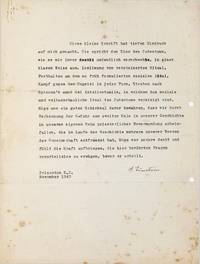
1943réf. 3079Princeton NJ: np 1943. first. Very Good. AN EXTRAORDINARY SIGNED 1943 STATEMENT DEFINING EINSTEIN'S CONCEPTION OF JUDAISM THROUGH REASON AND SPINOZA WHILE WARNING AGAINST "CLERICAL DOMINATION" IN A FUTURE JEWISH HOMELAND. Of course we all know Einstein as the great scientist. From the theoretical physicists among us to those of use who barely survived high school physics we are all captivated by the man and accept his place at the outer limits of human intellectual capacity. Yet it's when Einstein leaves the world of relativity and theoretical physics that we are often most drawn to his never-ending charisma. Especially exciting to so many of us are his deep convictions about human affairs especially politics and religion. Einstein famously was irreligiously religious. Born to a secular Jewish family his upbringing lacked the complex ritual we associate with Orthodox Judaism. He briefly became curious about religiosity as a child but his attempts at following religious ritual and doctrine ended a few years later as he confronted the conflict between scientific ideas and Biblical stories. Yet one still sees a deep spirituality in Einstein who saw a special camaraderie in the 17th-century Dutch Jewish philosopher Baruch Spinoza. Spinoza was a Jewish radical who had little patience for endless ritual. He did not see God as a being intervening in human affairs but as a great rational force who formed the universe using rational methods. We become close to God therefore by trying to understand the natural world not obeying endless rituals. One can easily see Spinoza's approach as appealing to Einstein. In Spinoza's view the scientist is the holyman his work bringing him closer to God's creations. While in 1943 many of Einstein's contemporaries could accept such a view in seventeenth-century Amsterdam it was another matter: Spinoza was formally expelled from his Jewish community. Shikmoni's Pamphlet & Einstein's Views Humanistisches Judentum Humanistic Judaism was not a conventional commercial publication. It was issued privately in Haifa in 1948 "on behalf of a Circle of Friends" with Einstein's contribution prominently advertised on the title page as a "Geleitwort von Prof. Albert Einstein." Shikmoni's short pamphlet aligns closely with Einstein's view of religion. Its central proposition is quite radical: a genuinely renewed Jewish culture must recover what Shikmoni regards as Judaism's original combination of humanism and a rational worldview. He traces that tradition through Moses and the Prophets incorporates Jesus "the Nazarene" and sees it culminating in Spinoza. For Shikmoni as for Einstein Spinoza offered a way of reconciling Jewish intellectual identity with reason and freedom from religious orthodoxy. Shikmoni's devotion to Spinoza extended beyond this pamphlet. In 1950 he founded the Spinoza House Bet Shpinozah or Spinozaeum in Haifa a center devoted to promoting Spinoza's philosophy in the newly established State of Israel. The organization attracted prominent supporters including David Ben-Gurion and Albert Einstein. The Document The typescript we have here was written by Einstein on his Princeton letterhead in November 1943 in response to Shikmoni's pamphet and would eventually be published as Einstein's foreword to the pamphlet. The pamphlet would not appear until 1948 five years after Einstein wrote these words. It is not difficult to understand why Shikmoni's manuscript made such an impression on Einstein. He recognized in it many of his own ideas about Judaism religion and Spinoza. Indeed in the typescript Einstein begins by admitting that Shikmoni had articulated something that he himself had long felt but had struggled to define: "This little work has made a deep impression on me. It expresses in a clear manner the meaning of Judaism as it had always hovered indistinctly before me." What follows is almost a miniature statement of Einstein's own religious philosophy: "liberation from petrified ritual; adherence to the social ideal formulated so early; struggle against the spirit of unreason in every form; striving toward Spinoza's amor dei intellectualis." Like Spinoza Einstein's Judaism is not defined principally by ritual observance but by ethics reason intellectual freedom and the pursuit of understanding. But Einstein then moves from religion to politics. The typescript is dated November 1943 five years before the establishment of Israel. We see Einstein already contemplating the character of a future Jewish homeland and warning against allowing religious authority to dominate it: "May a favorable fate preserve us from failing to recognize the danger and for a second time in our history falling in our own homeland under clerical domination which over the course of history has alienated several of our finest people from the community." The warning brings us directly back to Spinoza. Einstein had just invoked a Jewish thinker who had himself been expelled from his religious community for his unorthodox ideas; in the very next paragraph he warns of religious authority once again alienating "several of our finest people" from the Jewish community. There is another important feature of the present typescript. When Einstein's statement was finally published as the foreword to Shikmoni's pamphlet in 1948 one of its most forceful phrases had disappeared. Einstein's original reads: "Kampf gegen den Ungeist in jeder Form" "struggle against the spirit of unreason in every form". The entire phrase is omitted from the published version. The present signed typescript therefore preserves a substantive passage from Einstein's original statement that did not survive into its eventual publication. Full German Transcription Diese kleine Schrift hat tiefen Eindruck auf mich gemacht. Sie spricht den Sinn des Judentums wie er mir immer dunkel undeutlich vorschwebte in einer klaren Weise aus. Loslösung vom versteinerten Ritual Festhalten an dem so früh formulierten sozialen Ideal Kampf gegen den Ungeist in jeder Form Streben nach Spinoza's amor dei intellectualis in welchem das soziale und weltanschauliche Ideal des Judentums vereinigt sind. Möge uns ein gutes Schicksal davor bewahren dass wir durch Verkennung der Gefahr zum zweiten Male in unserer Geschichte in unserem eigenen Heim priesterlicher Bevormundung anheimfallen die im Laufe der Geschichte mehrere unserer Besten der Gemeinschaft entfremdet hat. Möge wer anders denkt und fühlt die Kraft aufbringen die hier berührten Fragen vorurteilslos zu erwägen bevor er urteilt. Princeton N.J. November 1943 A. Einstein English Translation This little work has made a deep impression on me. It expresses in a clear manner the meaning of Judaism as it had always hovered indistinctly before me: liberation from petrified ritual; adherence to the social ideal formulated so early; struggle against the spirit of unreason in every form; striving toward Spinoza's amor dei intellectualis in which the social and philosophical ideals of Judaism are united. May a favorable fate preserve us from failing to recognize the danger and for a second time in our history falling in our own homeland under clerical domination which over the course of history has alienated several of our finest people from the community. May those who think and feel differently summon the strength to consider without prejudice the questions touched upon here before passing judgment. Princeton N.J. November 1943 A. Einstein In a single page later published in an obscure German pamphlet Einstein brings together some of the convictions that defined his life beyond physics: his Jewish identity his reverence for Spinoza his distrust of religious orthodoxy and his belief that reason humanism and intellectual freedom should prevail over dogma. Typescript on Einstein's Princeton letterhead with his embossed Mercer Street address at top; signed by Einstein "A. Einstein." at bottom right. Princeton New Jersey November 1943. One page approx. 8.5 x 11 in; rust mark from paper clip at top left; scattered foxing; two binder punch holes at right margin. A RARE CLEAR EXPLANATION OF EINSTEIN'S RELIGIOUS BELIEFS AND HIS RELATIONSHIP TO JUDAISM. np unknown
réf. 8483061333.Ghardcover. Good. Access codes and supplements are not guaranteed with used items. May be an ex-library book. hardcover
1980réf. 011754Reading MA: Addison-Wesley Publishing Company Inc 1980. 1st 1st Printing. Hardcover. Very Good/No Jacket as Issued. 4 vo. First Edition First Printing; glossy blue c w/white titles lite shelf rubbing; 539 clean unmarked pages Addison-Wesley Publishing Company, Inc hardcover
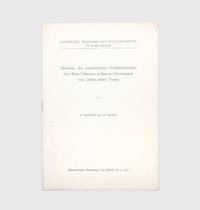
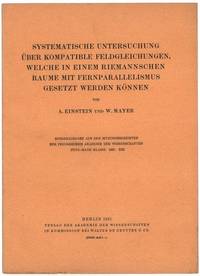
1933réf. 180318Amsterdam: Koninklijke Akademie van Wetenschappen 1933. First edition offprint issue of the third of Einstein and Mayer's four classic papers on semi-vectors in which they aimed to incorporate the Dirac equation into the general theory of relativity. "By introducing semi-vectors Einstein wanted to arrive at a mathematically simpler and more general formulation of spinors. The semi-vector generalization of the Dirac equation was thought to give a unified description of charged elementary particles in particular of the electron and proton" Van Dongen pp. 103-5. Large octavo pp. 4. Original cream wrappers front wrapper printed in black wire-stitched as issued. Extremities gently creased short closed tears at spine ends occasional light foxing: a very good copy. Boni 223; Weil 192. Jeroen van Dongen Einstein's Unification 2010. unknown
1987réf. 156153Metuchen NJ: The Scarecrow Press 1987. Hardcover. Fair. xv 1051 p. 22 cm. Black hardcover. Small tear in top of spine. Cracking at p. 3 and pages 3-22 detached. The Scarecrow Press hardcover
réf. 0810832208.Ghardcover. Good. Access codes and supplements are not guaranteed with used items. May be an ex-library book. hardcover
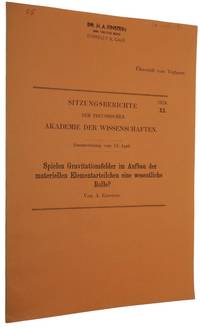
1919réf. 6166Berlin: Verlag der Akademie der Wissenschaften In Kommission bei Walter de Gruyter Reichsdruckerei 1919. First edition. First edition extremely rare author's presentation offprint 'Überreicht vom Verfasser' and the copy of Einstein's son Hans Albert of "Einstein's first attempt at a unified field theory" Pais Subtle is the Lord. Once Einstein completed work on the general theory of relativity at the end of 1915 "his attention shifted to the search for a unified theory of the electromagnetic and gravitational fields out of which he hoped to be able to explain the structure of matter. Quantum effects were to be derived from such a theory rather than postulated ad hoc. This remained his approach for the rest of his life" Cao Conceptual foundations of quantum field theory. . EINSTEIN'S FIRST ATTEMPT AT A UNIFIED FIELD THEORY" PAIS HANS ALBERT EINSTEIN'S COPY OF THE PRESENTATION OFFPRINT. First edition extremely rare author's presentation offprint 'Überreicht vom Verfasser' and the copy of Einstein's son Hans Albert of "Einstein's first attempt at a unified field theory" Pais Subtle is the Lord p. 287. Once Einstein completed work on the general theory of relativity at the end of 1915 "his attention shifted to the search for a unified theory of the electromagnetic and gravitational fields out of which he hoped to be able to explain the structure of matter. Quantum effects were to be derived from such a theory rather than postulated ad hoc. This remained his approach for the rest of his life" Cao Conceptual foundations of quantum field theory pp. 166-167. "As so often the case in relativity the story of quantum gravity begins with Einstein himself. Soon after the final formulation of general relativity he pointed out the need for a quantum modification of the theory. In his first paper on gravitational radiation the 1916 paper 'Näherungsweise Integration der Feldgleichungen der Gravitation' 'Approximate Integration of the Field Equations of Gravitation' Einstein argued that quantum effects must modify the general theory of relativity. Two years later he reiterated this conclusion the 1918 paper 'Über Gravitationswellen' 'On Gravitational Waves': 'As already emphasized in my previous paper the final result of this argument which demands a gravitational energy loss by a body due to its thermal agitation must arouse doubts about the universal validity of the theory. It appears that a fully developed quantum theory must also bring about a modification of the theory of gravitation.' Einstein writing in the 1919 paper offered here soon began to speculate whether gravitation plays a role in the atomistic structure of matter: 'There are reasons for thinking that the elementary formations which go to make up the atom are held together by gravitational forces. The above reflections show the possibility of a theoretical construction of matter out of the gravitational field and the electromagnetic field alone' In order to construct such a model of an 'elementary particle' Einstein shows that it is necessary to modify the original gravitational field equations .The major interest of this paper is that his attention now shifted from possible quantum modifications of general relativity to the search for a unified theory of the electromagnetic and gravitational fields on the basis of which he hoped to explain the structure of matter. Quantum effects are to be derived from such a theory rather than postulated ad hoc. Einstein remained committed to this approach for the rest of his life: the search for a 'natural' mathematical extension of the general theory in the hope that such a theory would somehow explain the quantization of matter and energy" Iyer and Bhawal Black Holes Gravitational Radiation and the Universe pp. 525-526. Einstein's work on unified field theory was inspired by James Clerk Maxwell's success in finding a unified theory of electricity and magnetism one of the greatest achievements of nineteenth century physics which showed that light was a form of electromagnetic wave and made possible modern inventios such as radio television and the telephone. Einstein continued his attempts to devise a unified theory of gravitation and electromagnetism for the rest of his life; his contributions in this area represent about a quarter of his entire research output and half his scientific production after 1920. Although he was ultimately unsuccessful a similar vision was realized in the decades after his death in the construction of the 'standard model' a unified theory of electromagnetism with the weak and strong nuclear forces which were unknown in Einstein's time and efforts to incorporate gravity into the model continue to this day. RBH lists three copies. OCLC lists only one copy none in US. Provenance: Hans Albert Einstein 1904-73 ink stamp and pencil notes on front wrapper. Hans Albert Einstein was a Swiss-American engineer and educator the second child and first son of physicists Albert Einstein and Mileva Marić. He was a long-time professor of hydraulic engineering at the University of California Berkeley. "As early as 1909 in his fundamental paper 'Zum gegenwärtigen Stand des Strahlungsproblems' 'On the current status of the radiation problem' which resulted from a discussion with Walter Ritz Einstein remarks 'dass des elektrische Elementarquantum e ein Fremdling ist in der Maxwell-Lorentzschen Elektrodynamik' 'that the electrical elementary quantum e is alien to Maxwell-Lorentz electrodynamics'. Einstein expressed the hope that 'die gleiche Modifikation der Theorie welche das Elementarquantum e als Konsequenz enthält auch die Quantenstruktur der Strahlung als Konsequenz enthalten wird' 'the same modification of the theory which contains the elementary quantum e as a consequence will also contain the quantum structure of radiation as a consequence'. Pauli 1949 in his review about 'Einstein's Contribution to Quantum theory' pointed out that though quantum theory later on deduced the quantum structure of radiation it has not solved Einstein's first problem and the elementary charge 'auch in der Quantenmechanik ein Fremdling geblieben ist' 'has also remained alien to quantum mechanics'. He emphasized that just this fact had been one of the strongest arguments to Einstein against the finality of the steps leading to quantum mechanics. "So during his Berlin years Einstein made it his task to find a synthesis of his general theory of relativity GRT and the then nascent quantum physics. In this connection he attributed logical primacy to the relevant relativistic field theory because it had reached a high degree of maturity in the GRT. After all Einstein's general-relativistic gravitation theory is the first theory on the fundamentals of physics working with genuinely non-linear equations and Einstein observed that such a nonlinearity is necessary for understanding the existence of the 'discrete field-quanta.' A linear theory allowing arbitrary superposition of fields would without further restrictions in the form of boundary and uniqueness conditions never lead to a discrete spectrum of solutions. But recourse to such restrictions means that the fields are held together by the operation of entities outside the scope of the theory . "In Einstein's view the problem of incorporating the elementary particles into field physics involved the question of finding field-theoretical models of electrons and protons which were the only known particles at that time. Einstein searched for solutions or general-relativistic field equations for the combined gravitational and electromagnetic fields representing mass and charge distributions with central symmetry and he hoped there would emerge self-consistent solutions only for discrete values of the mass and charge parameters i.e. for a 'particle spectrum.' "This 'Einstein particle problem' pursued ideas that had been developed already in the framework of the special theory of relativity and the Maxwell-Lorentz electrodynamics for instance in the nonlinear theory of the electromagnetic field by G. Mie and D. Hilbert. As an essential progress by the general-relativistic treatment Einstein regarded the genuine nonlinearity of the field equations which Mie and Hilbert had to introduce ad hoc and full consideration of the particle dynamics in the sense of the general-relativistic problem of motion. The generalizations of the Maxwell equations considered by Mie and Hilbert contain a too small number of components for the integrability conditions to determine the particle dynamics whereas the Einstein problem of motion in the GRT furnishers just this dynamics as a consequence of the integrability conditions for the field equations of gravitation. It is the GRT that with its metric field for the first time embraces inertia and gravity that is just those properties which are characteristic of all particles. "Einstein in fact succeeded in driving self-consistent gravitational and electromagnetic fields which can be interpreted as particle models of that kind. But his success depended on a weakening of his own equations of gravitation which physically amounts to the introduction of an additional hypothetical cosmical field of the 'Poincaré pressure.' By this weakening it becomes possible to set up self-consistent particle models with spherical symmetry for arbitrary centrosymmetric mass and charge distributions. In 1919 Einstein presented his result to the academy in his paper 'Spielen Gravitationsfelder im Aufbau der materiellen Elementarteilchen eine wesentliche Rolle' His answer to the question says that in his particle models the electrical field energy contributes ¾ and the gravitational energy ¼ of the total energy. "Einstein's first discourses on the particle problem in the GRT were closely related to the 1917/18 papers in which he laid the foundations of relativistic cosmology. In his Academy report 'Kosmologische Betrachtungen zur allgemeinen Relativitätstheorie' 'Cosmological considerations on the general theory of relativity' 1917 Einstein had by introducing the term λgμν with the 'cosmological constant' λ extended his equations of gravitation to his cosmological equations of gravitation Rμν - ½ gμνR λgμν = - κ Tμν . He could show that these equations permit as a particular solution with λ > 0 and constant positive mass density a statical model of the universe representing a closed spheric or elliptic three devotional Riemannian space . "In his paper of 1919 about the role of gravitation in the structure of elementary particles Einstein also interpreted the cosmological constant λ as the universal 'Poincaré' pressure' which according to a hypothesis of H. Poincaré is to guarantee the stability of Lorentz's electrons against their own repulsion forces. Einstein's ideas concerning this matter partly resulted from a controversial discussion with E. Schrödinger 1918 about the gravitational energy in the GRT and the structure of the energy tensor" Treder pp. 149-151. Indeed Schrödinger had pointed out another way of treating the cosmological constant: moving it from the left-hand side of equation where it represents a contribution to space-time curvature to the right-hand side where it represents a contribution to the energy-matter distribution. Then it would correspond physically to a kind of cosmic pressure. Schrödinger believed this might be the pressure postulated by Poincaré to maintain the stability of charged particles: an electric charge on the surface of a sphere creates a force pushing outwards so without any opposing force the charged sphere would explode outwards. Einstein never liked the cosmological constant. In the present paper he acknowledged that his introduction of the cosmological constant was "gravely detrimental to the formal beauty of the theory" Cambridge Companion to Einstein p. 257. Boni-Russ-L. 111; Schilpp 123; Weil 106. Treder 'Antimatter and the particle problem in Einstein's cosmology and field theory of elementary particles A historical essay on Einstein's work at the Akademie der Wissenschaften zu Berlin' Astronomische Nachrichten 296 1975 pp. 149-161. Large 8vo 254 x 182 mm pp. 349-356. Original printed wrappers. A very fine copy. Verlag der Akademie der Wissenschaften, In Kommission bei Walter de Gruyter [Reichsdruckerei] unknown
réf. 1494091399.Gpaperback. Good. Access codes and supplements are not guaranteed with used items. May be an ex-library book. paperback
réf. 50102pamphlet. 11 pages p 1105-1115 FROM: Annalen der Physik fourth series vol. 33. Modern wrappers. Leipzig 1910. unknown
réf. 0394735242.Gpaperback. Good. Access codes and supplements are not guaranteed with used items. May be an ex-library book. paperback
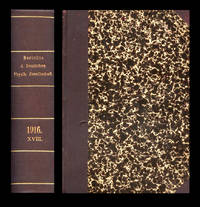
1916réf. 1614Braunschweig: Druck und Verlag von Friedr. Vieweg and Son 1916. 1st Edition. FIRST EDITION OF AN IMPORTANT WORK BY EINSTEIN: HIS FIRST PAPER ON THE DERIVATION OF PLANCK'S LAW HERE INTRODUCING THE THEORY OF THE STIMULATED EMISSION OF ELECTROMAGNETIC RADIATION INTO THE QUANTUM THEORY. "EINSTEIN'S CONCEPT OF STIMULATED EMISSION IS THE OPERATING PRINCIPLE OF THE NOW UBIQUITOUS LASER" Brandt Harvest of the Century 136. In 1900 Max Planck laid the foundation for quantum theory with his publication of Planck's law. Though Einstein commended Planck in his own "light-quantum hypothesis of 1905 he Einstein postulated that the energy quantization is a property of the radiation field itself and not due to the material resonators as Planck believed" ibid. "Einstein found a similarity between a cavity filled with radiation consisting of quanta and a vessel filled with gas consisting of atoms" Brandt Harvest of the Century 136. Einstein believed that "although either part of Planck's derivation was in itself consistent their combination was logically incompatible.For Einstein this inconsistency was no reason to reject Planck's quantum theory as such" it was a reason to study the foundations of traditional radiation theory and if needed revise them Jammer The Conceptual Development of Quantum Mechanics 26. "After completion of his general theory of relativity in 1916 Einstein was able to derive Planck's original quantum law to his satisfaction "by considering the possible interactions between radiation and matter" Brandt. From there he was able to suggest that in addition to spontaneous emission and absorption a process of stimulated emission could also take place. In Einstein's derivation of Planck's law he treats "the interaction between light quanta and atoms in the formalism of his A and B coefficients. They describe the probabilities for the absorption and emission of a light quantum of a given energy. The probability of absorption is of course proportional to the density of the radiation of that frequency. The emission is in part spontaneous like radioactivity but there is also stimulated emission which again is proportional to the density of the radiation of that frequency ibid. This is one of two papers Einstein wrote on the subject. Einstein's derivation "predicted that as light passed through a substance it could stimulate the emission of more light. This effect is at the heart of the modern laser" The Quantum and the Cosmos I History AIP portal. CONDITION & DETAILS: Braunschweig: Druck und Verlag von Friedr. Vieweg and Son. 8.5 x 6 in. vi 485 1 2 368. 2. Ex-libris with few markings and non at the spine see scan. Tightly bound. Brown cloth over marbled paper boards; gilt- ruled and lettered at the spine. Clean and bright throughout. Near fine. This volume is bound together with the 1916 volume titled Halbmonatliches Literaturverzeichnis der "Fortschritte der Physik" Bi-monthly bibliography of the "Advances in Physics". Druck und Verlag von Friedr. Vieweg and Son hardcover
1916réf. 2364Braunschweig: Druck und Verlag von Friedr Vieweg and Son 1916. First edition. Original wrappers. Very Good. FIRST PRINTING IN ORIGINAL WRAPPERS OF ONE OF EINSTEIN'S MAJOR WORKS: HIS FIRST PAPER ON THE DERIVATION OF PLANK'S LAW AND PROVIDING THE THEORETICAL BASIS FOR THE LASER. "Einstein commended the 'unparalleled boldness' of Planck's derivation of 1900 meaning not only the problem itself but also the fact that it was based on assumptions that were not entirely free of contradictions. Einstein now succeeded in the first of two papers in eliminating that flaw. More interesting than the derivation itself was the general character of his methods. Einstein proceeded from Niels Bohr's basic--and by then well tested--assumption that the electrons within an atom occupy a number of discrete energy states and are able through emission or absorption of radiation to pass from one of those states to another. Added to this was an assumption of thermodynamic equilibrium between radiation field and atom as well as a consideration of the 'classical' limiting case at high temperatures--and there was Planck's formula. This brief argument. also covers emission stimulated by the radiation field; thus the formulas already by implication contain the theory of the laser though it was to take nearly half a century to be realized" Folsing Albert Einstein 389. Weil 85. The "implication" containing the theory of the laser was more fully developed in his companion paper "On the Quantum Theory of Radiation" published a few weeks later. In the first paper Einstein wrestled with the concept that the atomic emission of radiation could be a directed process; in the second paper he convincingly demonstrates that this is indeed the case. IN: Verhandl. D. Deutch. Phys. Ges. Vol 18 pp. 318-323. Braunschweig: Druck und Verlag von Friedr. Vieweg and Son 1916. Octavo original wrappers; housed in custom half leather chemise. One thread literally resewn on wrappers a little creasing and soiling. A beautiful copy. RARE IN ORIGINAL WRAPPERS. Druck und Verlag von Friedr Vieweg and Son unknown
1925réf. 79Paris: Gauthier-Villars 1925. First French edition of Zur Elektrodynamik bewegter Korper On the Electrodynamics of Moving Bodies and 1st die Tragheit eines Korpers von seinem Energieinhalt abhangig Does the Inertia of a Body Depend on its Energy Content. Both 1905 treatises are "beyond compare and without precedent one of the greatest scientific achievements in content and one of the most brilliant in style" Gosling Albert Einstein. The first paper is "a landmark in the development of physics one of the two papers that laid out the theory of special relativity formulated a new conception of time. By assuming that the speed of light is the same to every observer moving at a constant velocity Einstein showed that space and time were not independent: spacetime was born. According to Hermann Weyl in 1918 this theory 'led to the discovery that time is associated as a fourth coordinate on an equal footing with the other three coordinates of space and that the scene of material events the world is therefore a four-dimensional metrical continuum.' It was a revolutionary piece of scientific work" Calaprice The Einstein Almanac 15. In the second work Einstein uses "the postulates of the special theory of relativity Einstein showed that energy radiated is equivalent to mass lost. For the first time he concluded that 'the mass of a body is a measure of its energy content'" ibid 16. CONDITION & DETAILS: Paris: Gauthier-Villars 1925. Small 8vo. 4 56 2 6 catalog. ILLUSTRATION: Frontispiece portrait of Einstein. EXTERIOR: Complete issue bound in original light brown stiff wraps. Some light surface dirt on the front wraps and a small area in the lower right where a piece of tape has been removed. Two barely visible repairs at the spine. Tightly bound. INTERIOR: Complete. Very small spot at the upper margin of page 3. Otherwise very good condition throughout. Gauthier-Villars paperback
1925réf. 39308Paris Gauthier-Villars et Cie 1925. Small8vo. Uncut in orig. printed wrappers. Portrait. 4562 pp. Publisher's Cat. 6 pp. 2 leaves with an insignificant small loss of upper right corner. A fine copy. First French edition of the initials papers on Special Relativity. It is a translation of the 2 Einstein-papers which appeared in 1905 "Elektrodynamik bewegter Körper" and "Ist die Trägheit eines Körpers von seinem Energieinhalt abhängig ". Published in the series "Les Maitres de la Pensee scientifique". - Weil: 9 c - Schielpp-Schields: 189. - Boni-Laurence: 9 B and 10 B. unknown
1931réf. 270891931. S.Ber. Akad. Wiss. Berl. 1931/13. - Berlin Verlag der Akademie der Wissenschaften 1931 8° 11 S. orig. Broschur. First Edition; the rare off-print from the "Sitzungsberichte". More and more frequently Einstein chose his assistants from mathematicians." One of the chief of them at that time was Professor Walter Mayer a small round individual who at first sight seemed crushed beneath the personality of Einstein. Einstein's family called him Mayerle and this Swabian diminutive suited him to perfection. But in Mayer's self-effacement there was more affection than respect. He gently contradicted Einstein interrupted him when necessary follwed up an argument and smiled a little mysteriously his head on one side as he watched the figures drawn up in front of him. "It is he who produced all my calculations; his skill is fantastic you know "Einstein used to say. In October 1933 Mayer followed Einstein in his American exile. -cf. Alicke Weil No.180; Schilpp-Shields No. 250; Alicke No. 149. unknown
1931réf. 38647Berlin Akademie der Wissenschaften 1931. 4to. Orig. printed green wrappers in Sitzungsberichte 1931 Heft XIII-XV pp. 257-65. Small nicks to frontwrapper. First edition in the periodical form. - Weil: 180. unknown
1931réf. 28368Berlin Gruyter & Co. 1931. 4to. Orig. printed orange wrappers. Offprint/Sonderausgabe aus Sitzungsberichten.pp. 1-11. Fine fresh copy. First edition of the rare Offprint with separate title and separate pagination. Se Weil No. 180 where this is not mentioned. - Mayer came to America in 1933 and about him as his collaborator Einstein said "It is he who produced all my calculations his skill is fantastic You know."The early Offprints from "Sitzungsberichten." are called "Sonderabdruck" up to Weil No.165 including this. From Weil 166 they are called "Sonderausgabe.". - Before 161 up to 160 the Offprints do not have separate title and pagination the pagination follows the numbering in the periodical. From 166 the Offprint has both separate printed title and pagination. - So Weil Nos 161-165 is still "Abdruck" but with separate title and pagination. These facts are not mentioned in the bibliographies. unknown